
Ocean life
What Animals Are Herbivores in the Ocean? Sea Turtles, Manatees, Fish & Krill
Few ocean animals eat true flowering plants, yet seagrass meadows, coral reefs and sunlit surface waters depend on dedicated marine grazers.
By An Nguyen · Updated

The short answer: the best-known ocean herbivores are adult green sea turtles, dugongs, manatees, marine iguanas, and coral-reef grazing fish such as blue tangs (surgeonfish), parrotfish, and damselfish, along with invertebrates like sea urchins, abalone, Queen conchs, and phytoplankton-filtering krill.
On land, herbivores eat grasses, leaves, bark, and fruit from vascular plants. In the ocean, true flowering plants are restricted almost entirely to shallow seagrass meadows, so marine herbivores split into three feeding guilds: seagrass grazers, seaweed and turf-algae scrapers, and phytoplankton filterers.
| Animal | Group | Main marine food | Where it feeds |
|---|---|---|---|
| Green sea turtle | Reptile | Seagrasses and marine algae | Tropical and subtropical reefs and bays |
| Dugong | Mammal (Sirenia) | Whole seagrass plants (leaves, stems, rhizomes) | Indo-West Pacific coastal seagrass beds |
| West Indian manatee | Mammal (Sirenia) | Seagrass and freshwater/estuarine plants | Warm Atlantic, Caribbean, and Gulf coasts |
| Blue tang | Reef fish | Filamentous microalgae and turf seaweeds | Indo-Pacific coral reefs |
| Marine iguana | Reptile | Red and green benthic marine algae | Rocky shores of the Galápagos Islands |
| Parrotfish & chubs | Reef fish | Epilithic algae and turf on coral rock | Tropical coral reefs worldwide |
| Sea urchins & abalone | Invertebrates | Kelp, drift seaweed, and coralline/turf algae | Kelp forests, rocky reefs, and tide pools |
| Antarctic krill | Crustacean | Single-celled phytoplankton and sea-ice algae | Southern Ocean surface waters and pack ice |
Seagrass grazers: green sea turtles, dugongs, and manatees
Seagrasses—such as turtle grass (Thalassia testudinum), manatee grass, and eelgrass—are true flowering plants that grow in sunlit coastal shallows. Because cellulose is tough to digest, only a few large marine vertebrates specialize on them.
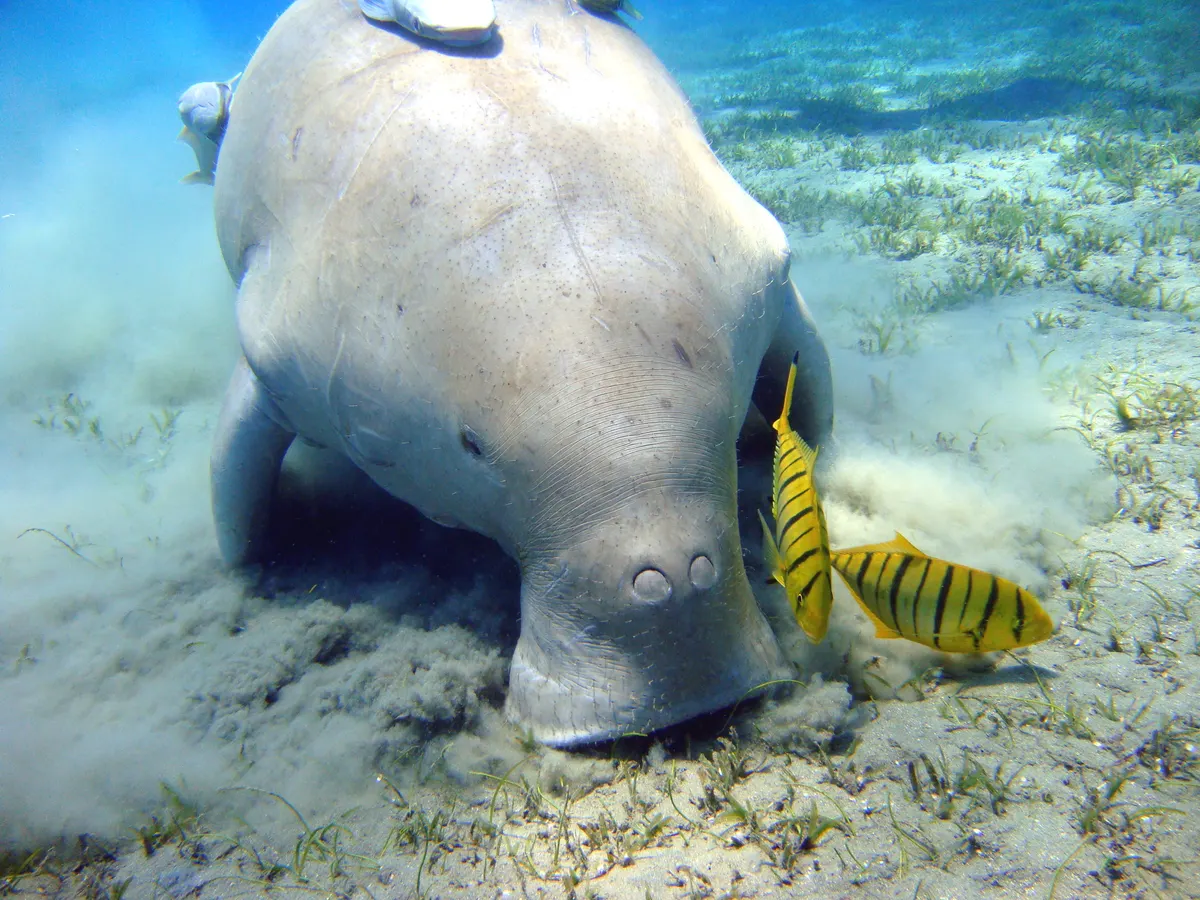
Photo by Julien Willem via Wikimedia Commons, CC BY-SA 3.0.

- Adult green sea turtles (Chelonia mydas): Among the seven living sea turtle species, NOAA identifies the green sea turtle as the only one whose adults are strictly herbivorous. Hatchlings and pelagic juveniles spend their early years as omnivores eating jellyfish, crustaceans, and drifting biota before recruiting to shallow bays and switching to seagrass and algae. Their serrated lower jaw works like shears to clip seagrass blades near the base while leaving the underground rhizomes intact.
- Dugongs (Dugong dugon): Often called "sea cows," dugongs are the only strictly marine herbivorous mammals. Unlike green turtles, a dugong uses its muscular, bristle-covered upper lip to uproot entire seagrass plants—roots, rhizomes, and leaves—leaving winding feeding trails across Indo-Pacific seabeds.
- Manatees (Trichechus manatus): West Indian manatees move across marine seagrass beds, brackish lagoons, and freshwater rivers, spending up to 6 to 8 hours a day consuming 4% to 9% of their body weight in submerged and floating plants. Like terrestrial hindgut fermenters such as horses and African elephants, dugongs and manatees rely on an enlarged hindgut packed with microbes to break down plant fiber. See dugong vs manatee for how their tails, snouts, and habitats differ.
Reef algae grazers: blue tangs, surgeonfish, and parrotfish
On tropical coral reefs, fast-growing macroalgae and filamentous turf algae constantly compete with slow-growing stony corals for sunlight and space. Herbivorous reef fish act as the reef's lawnmowers.
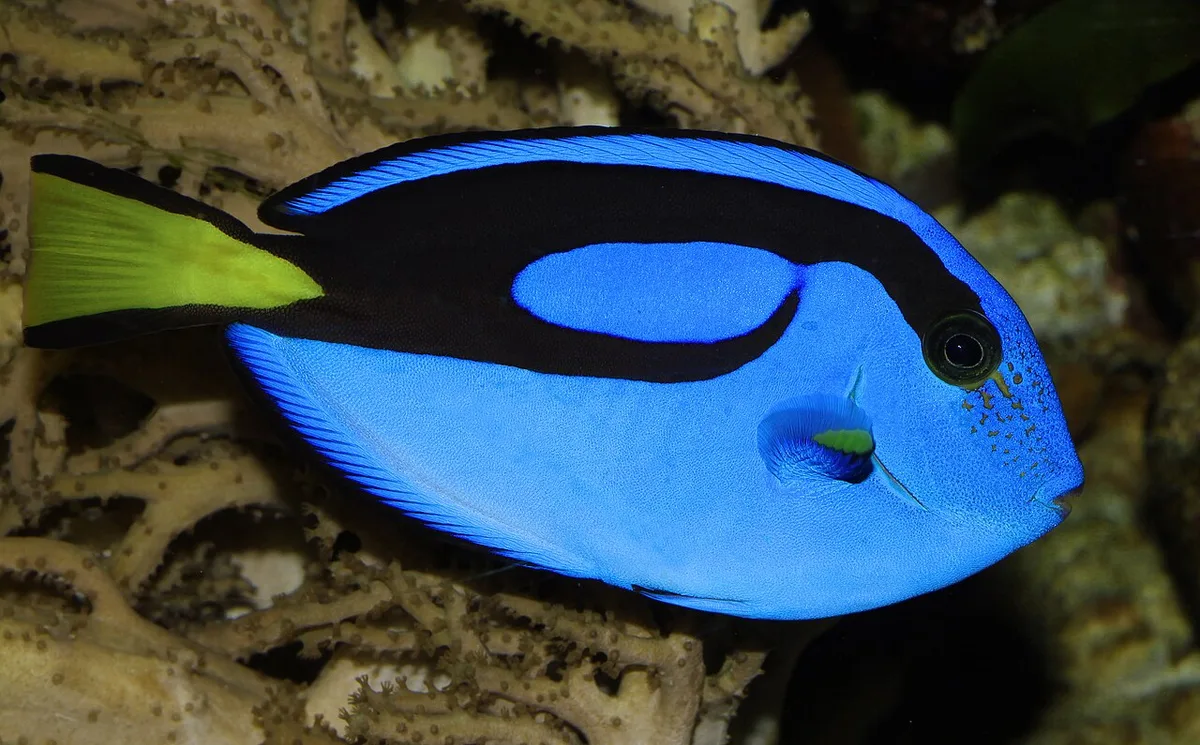
Photo by Holger Krisp via Wikimedia Commons, CC BY 3.0.

Adult blue tangs (Paracanthurus hepatus) and other surgeonfish (family Acanthuridae), along with rabbitfish and parrotfish, spend most of their daylight hours picking filamentous algae off dead coral rock and reef pavement. While post-larval blue tangs take zooplankton alongside algae, mature adults rely heavily on benthic microalgae. Without heavy grazing by surgeonfish, parrotfish, and herbivorous sea urchins, disturbed coral reefs can rapidly shift into algae-dominated beds.
Not every colorful reef fish is a plant eater: the emperor angelfish feeds primarily on sponges and tunicates, and clownfish are omnivores that combine algae with copepods and zooplankton.
The only sea-going herbivorous lizard: the marine iguana
In the Galápagos archipelago, the marine iguana (Amblyrhynchus cristatus) occupies a niche found nowhere else among living squamate reptiles. It dives into cold, upwelling coastal waters—or forages across exposed lava boulders at low tide—to scrape short red and green marine algae with its blunt snout and three-cusped teeth.
Because cold water saps a reptile's body heat and marine algae carry a heavy salt load, marine iguanas bask on dark volcanic rock to rewarm after dives and expel concentrated salt crystals by sneezing them out through specialized nasal glands.
Invertebrates and phytoplankton grazers—and why whales are not herbivores
In temperate kelp forests and rocky subtidal zones, invertebrates do much of the heavy plant grazing. Sea urchins chew through kelp holdfasts and drift blades with a five-toothed jaw apparatus called Aristotle's lantern; abalone, limpets, periwinkles, and Queen conchs scrape microalgae biofilms and macroalgae using a ribbon-like radula.
In the open sea, most primary production comes from microscopic phytoplankton rather than rooted plants. Herbivorous copepods and Antarctic krill (Euphausia superba) strain these single-celled algae directly from the water column or scrape them from the underside of winter sea ice.
A common point of confusion is whether filter-feeding giants like the blue whale, humpback whale, whale shark, or giant manta ray are herbivores. They are not: they feed primarily on krill, copepods, and small schooling fish—animal prey—which makes them filter-feeding carnivores sitting one step above the ocean's microscopic herbivores.
Sources
FAQ about What Animals Are Herbivores in the Ocean? Sea Turtles, Manatees, Fish & Krill
Select a question to reveal the answer.
What is the only strictly marine herbivorous mammal?
Are all sea turtles herbivores?
No. Among the seven living sea turtle species, only adult green sea turtles (Chelonia mydas) are primarily herbivorous, grazing on seagrass and marine algae. Loggerheads eat hard-shelled crabs and mollusks, leatherbacks specialize on jellyfish, and hawksbills feed mainly on reef sponges.
What fish are herbivores in the ocean?
Major herbivorous marine fish include surgeonfish and tangs (such as the blue tang), parrotfish, rabbitfish (Siganidae), sea chubs (Kyphosidae), and several damselfish and blennies that graze filamentous turf algae on coral and rocky reefs.
Are blue whales or whale sharks herbivores?
No. Although blue whales and whale sharks do not bite large prey, they filter-feed on krill, copepods, crab larvae, and small schooling fish. Because their food consists of animals (zooplankton and fish) rather than phytoplankton or seaweed, they are classified as carnivores.
Why are ocean herbivores important to coral reefs and seagrass beds?
Grazers such as blue tangs, parrotfish, and sea urchins crop fast-growing turf algae that would otherwise smother young corals, while green sea turtles and dugongs prune old seagrass blades, stimulating fresh growth and recycling nutrients across coastal ecosystems.