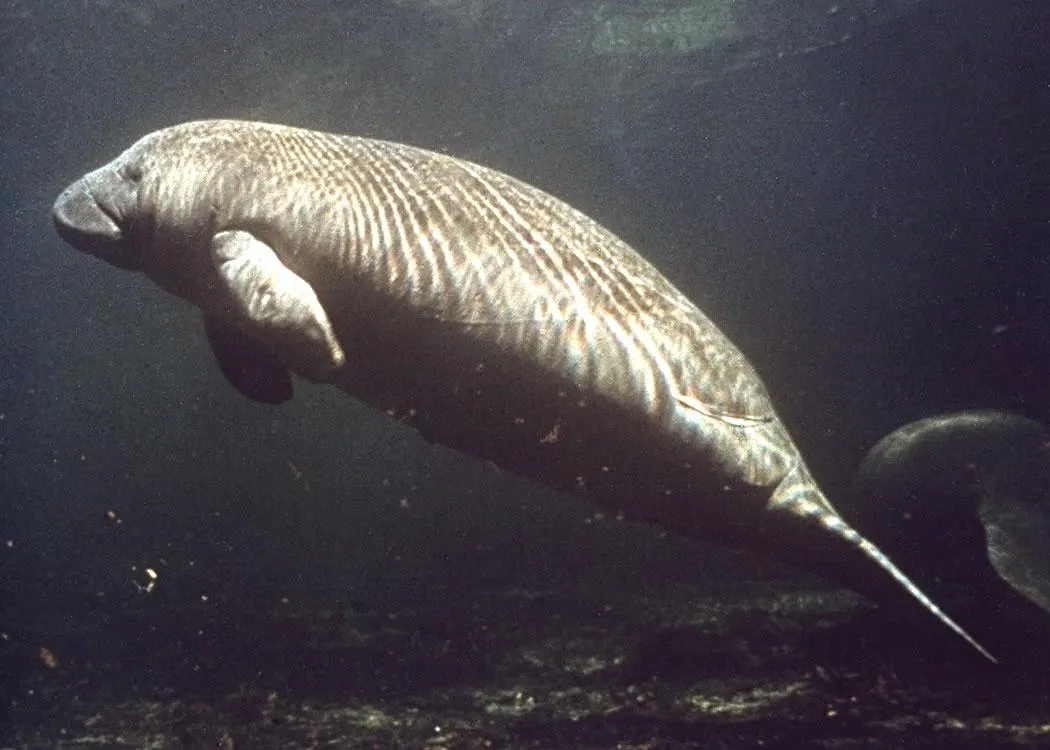
Dugong swimming in clear blue Red Sea water near Marsa Alam
Dugongs are fully marine sirenians found across warm Indo-Pacific coastal seas.
MammaliaVulnerable

Dugong Facts

A dugong's tail is crescent-shaped like a dolphin's, while a manatee's is paddle-shaped.

The dugong is a seagrass-grazing marine mammal found along warm coasts from East Africa to the western Pacific. Its slow reproduction and dependence on healthy seagrass beds leave many populations vulnerable to habitat loss and fishing activity.

By · Updated

Quick Facts

Dugong at a glance

Dugong dugonSireniaDugongidae

About their home

Kind of animal

Mammalia

Where they live

What they eat

How safe?

Vulnerable

Size and speed

How heavy

500 pounds – 1100 pounds

How long

8 feet – 10 feet

How fast

Usually about 6 mph; short bursts higher when startled

Lifespan

Up to 70 years

Core article

Dugong: ecology and life history

A closer look at habitat, diet, behavior, reproduction, and conservation.

Start here

Dugong

Gliding slowly through sunlit lagoons and seagrass meadows of the tropical Indo-Pacific, the dugong (Dugong dugon) is a gentle, air-breathing sea mammal built for underwater grazing. It shares an ancient sirenian ancestry with the manatees but is the only living member of the family Dugongidae. With a downturned, bristled snout and a dolphin-like crescent tail, it spends most of its life quietly shaping seagrass beds — one rooted mouthful at a time.

A Seagrass Specialist With a Fluked Tail

Adults run about 8 to 10 feet and 500 to over 1,000 pounds, with a torpedo-shaped body, paddle-like foreflippers, and no hind limbs. The surest way to tell a dugong from a manatee is the tail: a dugong has a notched, horizontal fluke, a manatee a rounded paddle. Its strongly downturned muzzle is covered in sensitive bristles that find plants in murky water, and dense, heavy bones act as ballast to hold it near the seabed while it grazes. Nostrils on top of the snout seal underwater, so it must surface to breathe. Older males and some females grow projecting upper incisors — small tusks — used in breeding competition. Despite a whale-like look, sirenians are more closely related to elephants and hyraxes; Steller's sea cow, hunted out in the 1700s, was the dugong's nearest relative, leaving Dugong dugon the sole surviving dugongid. See the dugong vs manatee comparison for how the two differ.

Where Dugongs Live

Dugong swimming in shallow coastal waters of Neil Island in the Andamans
Protected coastal reefs and quiet lagoons still shelter scattered dugong herds.

Dugongs inhabit shallow tropical and subtropical coast waters across the Indo-Pacific, from East Africa and the Red Sea through South and Southeast Asia to northern Australia, New Caledonia, and Vanuatu. They favour calm bays, reef lagoons, and broad seagrass flats usually less than about 30 feet deep, and — unlike many manatees — they do not enter freshwater rivers, staying tied to marine plant beds. Distribution follows seagrass rather than a continuous coastline: a bay may hold animals while the next shore has none. Some populations travel tens or hundreds of miles chasing forage and warm water; others stay within a small network of bays. Australia holds some of the largest remaining populations, while many Asian and island stocks are now small and scattered.

What Dugongs Eat

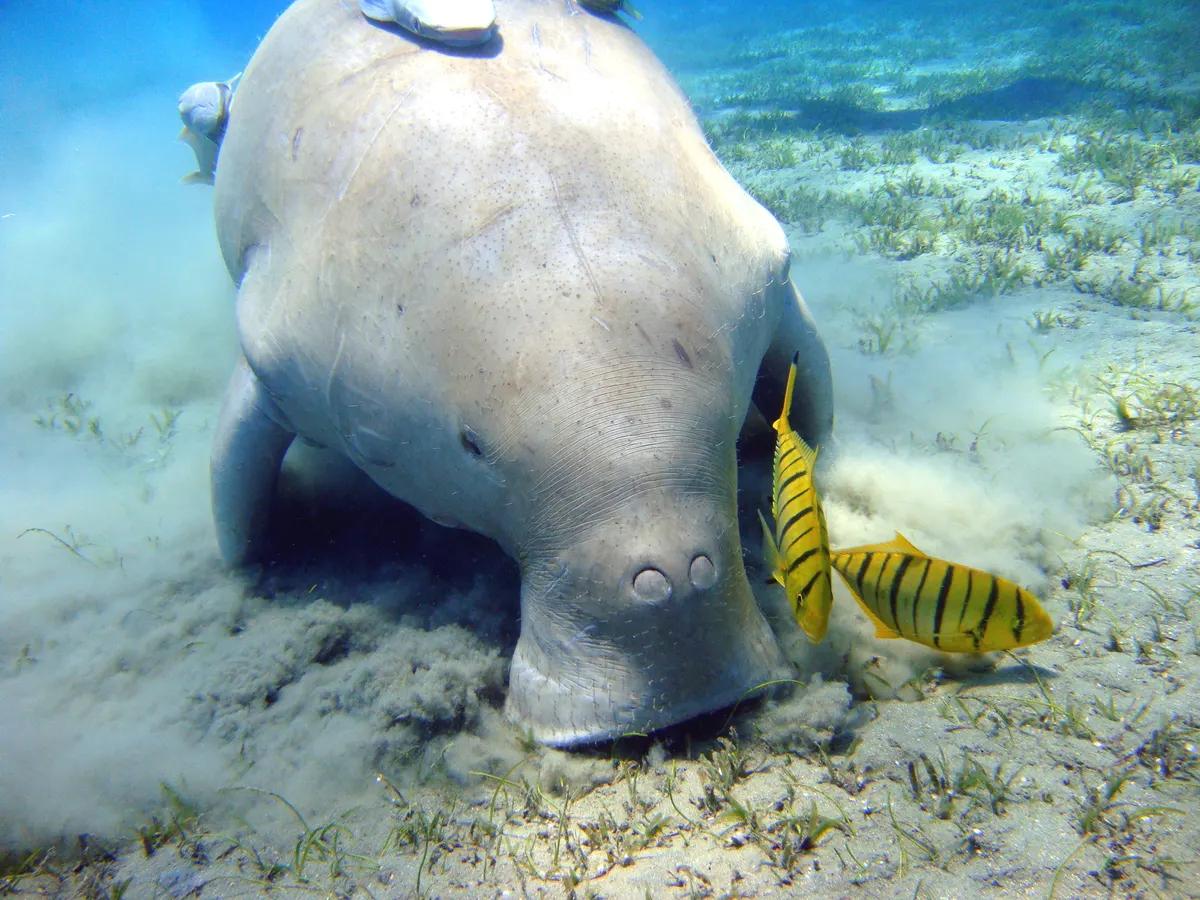
Dugong angled toward the seabed while swimming in clear coastal water
Herbivorous dugongs spend hours each day cropping underwater meadows.

Dugongs are strict herbivores specialized on seagrass. They crop leafy shoots but often dig into the sediment for nutritious roots and rhizomes, leaving distinct paired furrows across the meadow that show up in aerial surveys. Feeding runs for hours a day because the food is bulky and low in calories, and grit and fibre wear the teeth so hard that dugongs, like manatees, continuously replace their cheek teeth. They tend to select fast-growing, low-fibre, high-nitrogen seagrasses, and moderate grazing can actually stimulate fresh growth — though heavy feeding in a small meadow, especially after a storm or heatwave, can strip it. Healthy seagrass is not just a food source; it is the entire foundation of dugong survival.

Behavior: Solitary Grazers and Mother–Calf Pairs

Mother and calf dugong swimming side by side over Ningaloo Reef sand
Calves learn migration routes and grazing grounds by shadowing their mothers.

Dugongs are usually solitary or travel as loose mother–calf pairs, though animals may gather where food is rich, in fluid herds rather than fixed groups. They communicate with soft chirps and squeaks — most important between a calf and mother in cloudy water — and spend the day feeding, cruising slowly between meadows, and resting near the surface. Cruising speed is modest, but a startled dugong can put on a short burst. Feeding animals surface every few minutes for air; a resting one may stay down longer. Because they must reach the surface to breathe, fast boats crossing feeding grounds can strike them before either side reacts.

Life Cycle: Slow to Breed, Long to Live

Close view of a dugong calf swimming beside its mother
Newborn dugongs surface for air within moments of being born underwater.

Dugongs reproduce slowly. Females often mature in their teens and usually bear a single calf after about 13 to 15 months' gestation, giving birth underwater; the newborn rises at once for air, then nurses on rich milk from teats behind the foreflippers. The calf may depend on its mother for well over a year, riding her slipstream and learning travel corridors, feeding patches, and safe places to surface. Calving intervals commonly span several years, and a dugong that survives boats, nets, and sharks may live for decades — sometimes near 70 years, its age readable in growth layers of the tusks. That long life paired with rare births means populations recover only slowly, and the loss of one breeding female removes many potential future calves.

Conservation: Vulnerable and Tied to Seagrass

Simplified Indo-Pacific map highlighting dugong coastal range
Australia holds the world's largest remaining dugong populations.

The dugong is listed as Vulnerable, and many local populations keep declining. The biggest pressure is loss and damage to seagrass from coastal development, dredging, polluted runoff, and destructive fishing; marine heatwaves and severe storms can wipe out meadows across whole bays, and recovery takes years. Boats strike surfacing animals and nets entangle them, and hunting continues in some regions. Because dugongs depend so tightly on coastal plants, the clearest path forward is protecting and restoring connected seagrass meadows and cutting boat and net deaths — through speed zones, modified gear, quick release from entanglement, and watershed management that keeps sediment and nutrients off the coast. The global listing covers the species as a whole; some regional populations are far smaller and more threatened than Australia's large aggregations suggest.

References and Authoritative Sources

Dugong: classification and fun facts

Classification

Scientific Taxonomy
  1. Kingdom

    Animalia

  2. Phylum

    Chordata

  3. Class

    Mammalia

  4. Order

    Sirenia

  5. Family

    Dugongidae

  6. Genus

    Dugong

  7. Species

    D. dugon

Did You Know?

Fun Facts

1

A dugong's tail is crescent-shaped like a dolphin's, while a manatee's is paddle-shaped.

2

Dugongs are the only living members of the family Dugongidae; Steller's sea cow was a larger relative hunted to extinction.

3

An adult can eat tens of pounds of seagrass roots and leaves in a single day.

4

Dugongs never leave saltwater—they stay in coastal seas instead of rivers like many manatees.

5

Sailors' mermaid stories may have been inspired by distant glimpses of dugongs and manatees.

6

Mother dugongs and calves chatter with soft chirps and squeaks to stay together.

Common Questions

FAQ about Dugong

Select a question to reveal the answer.

What is a dugong?

A dugong is a large plant-eating marine mammal that lives in warm coastal seas. It is related to manatees and more distant elephants, and it breathes air even though it lives in the ocean.

How is a dugong different from a manatee?

Dugongs have a notched, whale-like fluke and live only in saltwater. Manatees have rounded paddle tails and often use rivers and estuaries as well as coasts.

What do dugongs eat?

Dugongs are herbivores that graze on seagrass. They often dig into the seabed to pull up roots and rhizomes as well as leafy shoots.

Where do dugongs live?

They live in shallow tropical and subtropical coastal waters of the Indo-Pacific, from East Africa and the Red Sea east to northern Australia and nearby islands.

How big is a dugong?

Most adults are about 8 to 10 feet long and can weigh 500 to more than 1,000 pounds.

What is a baby dugong called?

A baby dugong is called a calf. It is born underwater and rises quickly to take its first breath.

Show 4 more questionsExpand
Are dugongs endangered?

Dugongs are listed as Vulnerable. Seagrass loss, boat strikes, fishing-net entanglement, and hunting threaten many local populations.

How long can a dugong hold its breath?

Dugongs usually surface every few minutes while active, but a resting animal can stay underwater longer before needing air.

Why are dugongs important?

By grazing seagrass meadows, dugongs help keep underwater plant beds healthy and serve as a warning sign when coastal habitats are in trouble.

Do dugongs live with manatees?

No. Manatees live mainly in the Atlantic, Caribbean, and Amazon regions, while dugongs live in the Indo-Pacific. They are cousins but do not share the same oceans.