Giant Oceanic Manta Ray Facts
"Manta rays have the largest brain-to-body ratio of any fish."
Giant oceanic manta rays are huge, graceful rays that glide through warm seas using wing-like fins. They filter tiny prey from the water, visit reef...
Loading page content

"Manta rays have the largest brain-to-body ratio of any fish."
Giant oceanic manta rays are huge, graceful rays that glide through warm seas using wing-like fins. They filter tiny prey from the water, visit reef...
Mobula birostrisMyliobatiformesMobulidae
Explore manta-ray photos organized for learning and classroom observation.
Click any photo to view it larger. 8 images available.
Core article
Habitat, diet, behavior, and more — everything on one page.
Gliding through the deep blue with the silent grace of an underwater bird, the giant oceanic manta ray (Mobula birostris) is an icon of the pelagic realm. With a wingspan that can eclipse 20 feet and a body mass weighing thousands of pounds, it is the largest ray in the world. Despite its imposing, shadowy silhouette and close evolutionary ties to apex sharks, the manta ray is a gentle filter feeder, relying entirely on microscopic plankton to sustain its massive bulk. Highly intelligent, deeply curious, and capable of vast transoceanic migrations, the giant oceanic manta ray represents one of the ocean's most magnificent yet increasingly vulnerable megafauna species.
The giant oceanic manta ray is a cartilaginous fish belonging to the class Chondrichthyes, sharing an ancient lineage with sharks and chimaeras. Within the order Myliobatiformes, they are classified in the family Mobulidae (the devil rays). For decades, scientists believed there was only a single, globally distributed species of manta ray. However, in 2009, genetic and morphological re-evaluation officially split the genus into two distinct species: the giant oceanic manta ray (Mobula birostris) and the smaller, more coastal reef manta ray (Mobula alfredi).
Evolutionarily, the manta ray represents a dramatic divergence from the typical benthic (bottom-dwelling) lifestyle of most rays, such as stingrays and skates. Over millions of years, the manta abandoned the ocean floor for a pelagic existence, losing the venomous tail spine of its ancestors. Its body flattened and widened into a highly hydrodynamic disc, transforming the pectoral fins into massive, muscular wings designed for perpetual, energy-efficient gliding across vast ocean basins.
The sheer scale of Mobula birostris is breathtaking. A mature adult boasts a disc width (wingspan) ranging from 11 to 23 feet (3.5 to 7 meters) and can weigh between 1,500 and 4,000 pounds. Like all elasmobranchs, its skeleton is composed entirely of flexible cartilage rather than heavy bone, which significantly reduces its body density and aids in buoyancy.
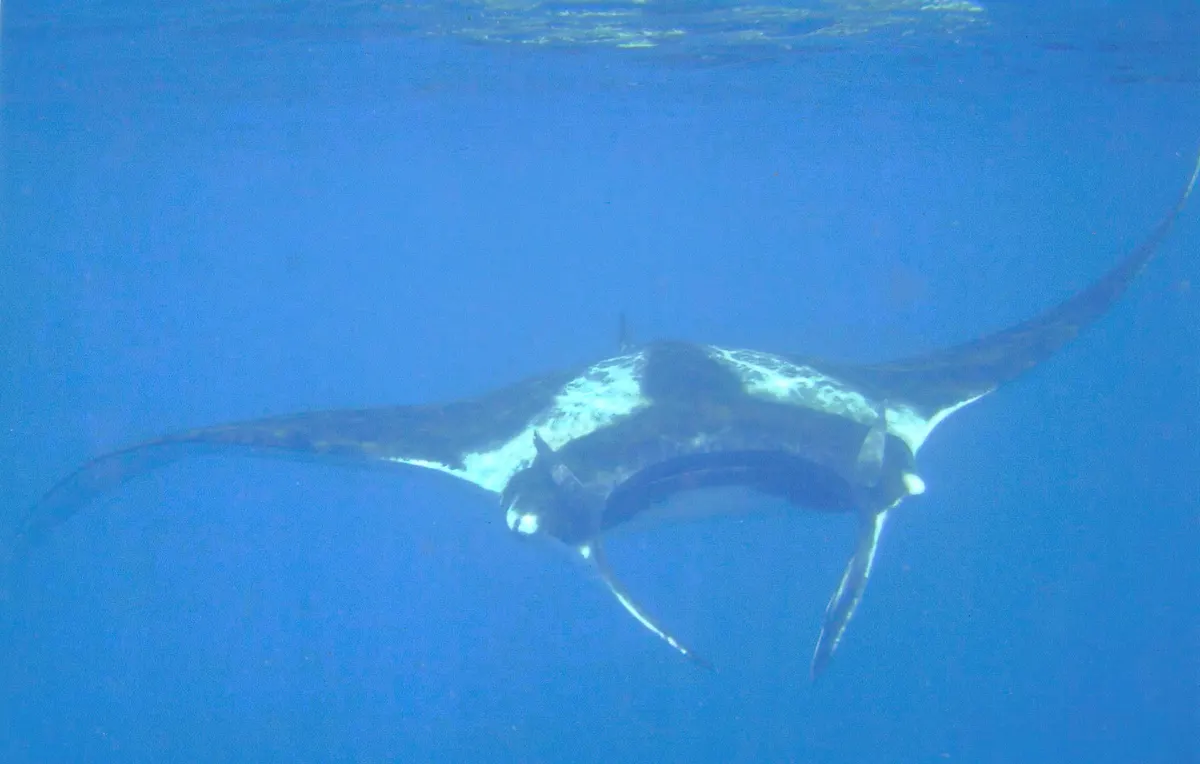
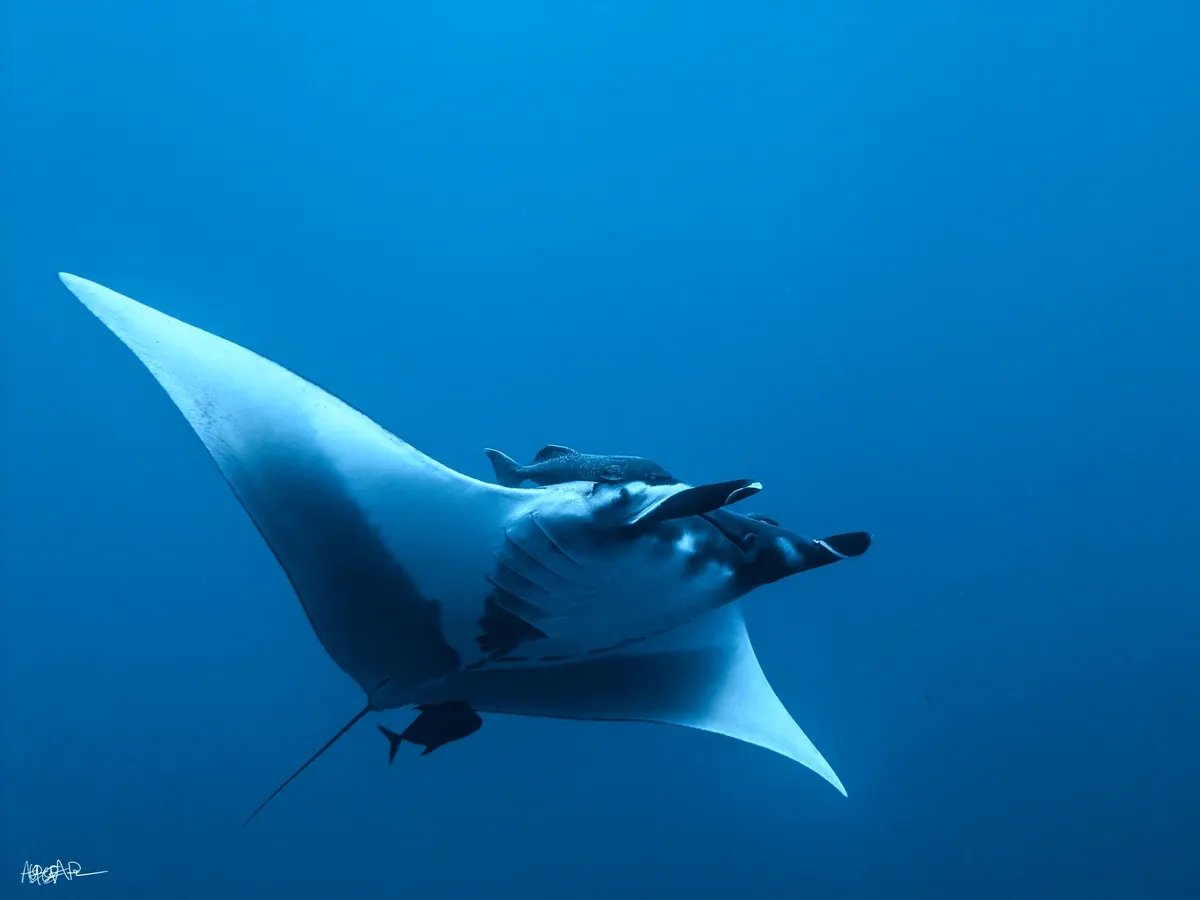
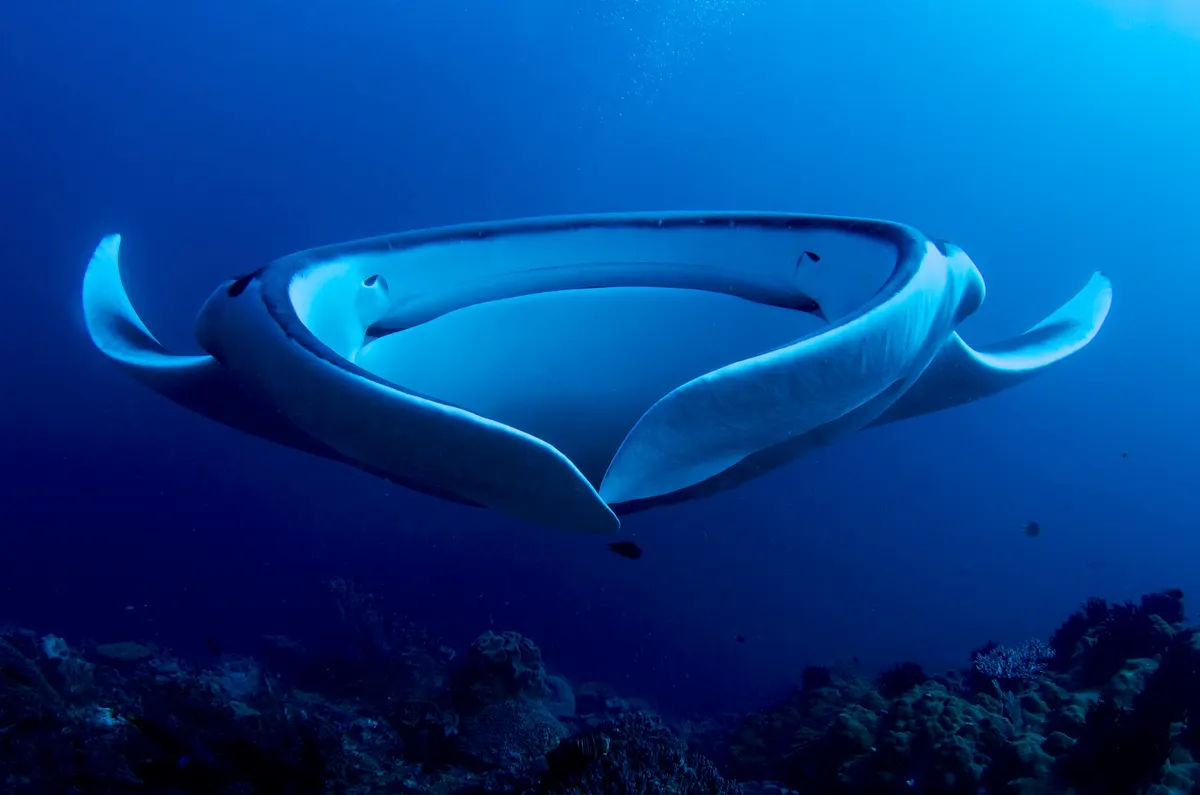
The manta's most distinctive anatomical features are the two fleshy appendages projecting forward from the front of its head, known as cephalic lobes. When traveling, these lobes are rolled tightly into spirals to reduce hydrodynamic drag, giving the animal a horned appearance that earned them the historical moniker "devil fish." When feeding, however, these lobes are unfurled and flattened, acting as massive funnels that direct plankton-rich water directly into the ray's cavernous, terminal mouth.
To process this food, the manta ray relies on specialized gill rakers—cartilaginous filter plates located inside its gill slits. As seawater rushes into the mouth and exits through the gills, the rakers trap microscopic prey, which is then swallowed into the stomach. The manta ray also exhibits extreme countershading, an oceanic camouflage mechanism. The dorsal (top) surface is black or dark blue, making it difficult to see from above against the deep ocean abyss, while the ventral (bottom) surface is stark white with unique black spot patterns that allow researchers to identify individual rays.

The giant oceanic manta ray boasts a circumglobal distribution, inhabiting the tropical, subtropical, and temperate waters of the Atlantic, Pacific, and Indian Oceans. They have been documented as far north as southern California and New Jersey in the United States, and as far south as New Zealand and South Africa.
Unlike the reef manta ray, which rarely strays far from specific coastal coral atolls, the giant oceanic manta is highly migratory and deeply pelagic. They spend the majority of their lives cruising the open ocean, following the complex oceanographic phenomena—such as upwelling zones, current convergences, and seamounts—that generate massive blooms of zooplankton. Despite their affinity for the deep ocean, they periodically aggregate at specific coastal sites, offshore islands, and shallow coral reefs to utilize specialized cleaning stations or capitalize on localized seasonal feeding events.

As an obligate filter feeder, the giant oceanic manta ray occupies a low trophic level, feeding exclusively on tiny marine organisms. Their diet is overwhelmingly composed of zooplankton, specifically euphausiids (krill), mysids, copepods, small shrimp, and the pelagic larvae of fish and crabs.
Because zooplankton is distributed patchily across the vast ocean, manta rays must employ highly specialized feeding strategies to maximize caloric intake. When they encounter a dense concentration of plankton, they unroll their cephalic lobes and begin actively feeding. The most spectacular of these strategies is the "barrel roll." The manta ray repeatedly loops backward in a tight, vertical 360-degree somersault, effectively staying within the densest part of the plankton patch while constantly forcing food-laden water through its gills. When feeding in groups, manta rays may form a "cyclone," swimming in a massive, coordinated chain-loop to create a hydrodynamic vortex that draws plankton into the center of the column, allowing dozens of individuals to feed efficiently.

While often solitary during their oceanic migrations, giant oceanic manta rays are highly social when aggregating at food sources or reef cleaning stations. Cleaning stations are specific coral outcrops manned by cleaner wrasses and other small fish. The manta ray approaches the station, slows its swimming speed, and enters a near-trance state, allowing the small fish to swim inside its mouth and over its gills to pick off necrotic tissue, parasitic copepods, and remoras. This symbiotic relationship is crucial for maintaining the ray's health and skin integrity.
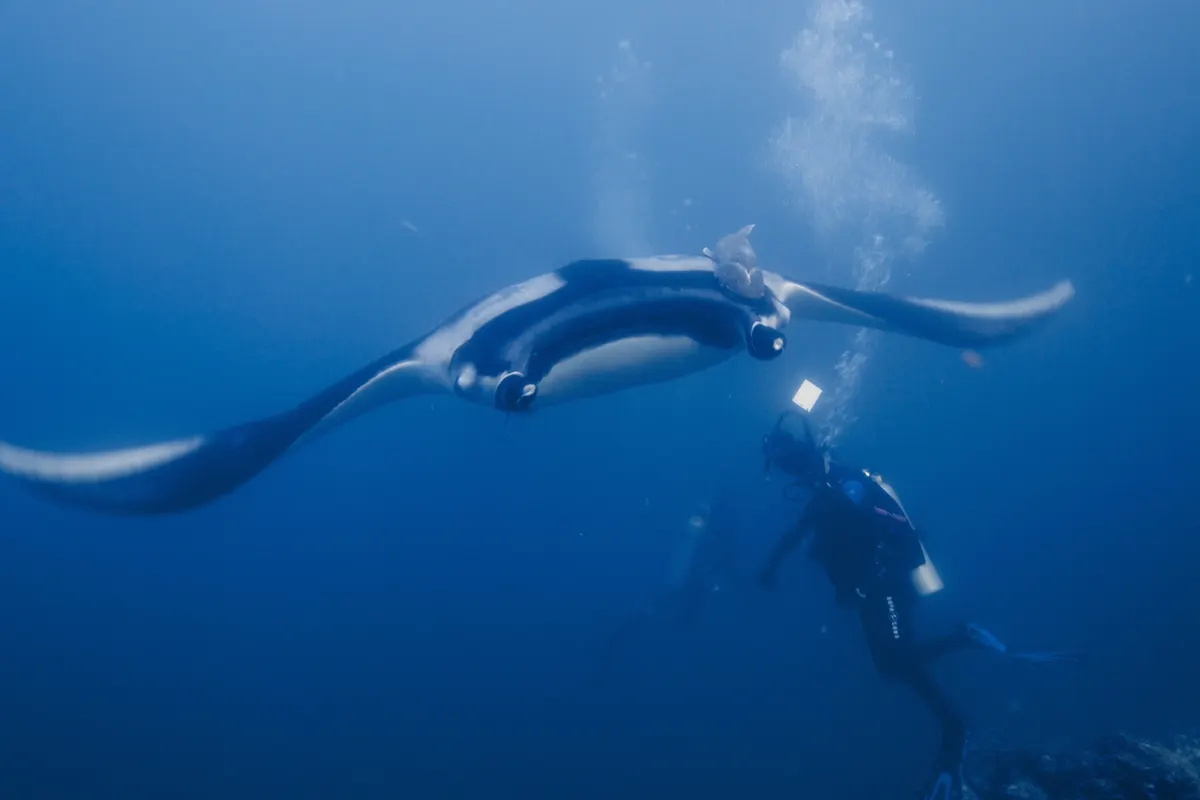
Manta rays possess the largest brain-to-body mass ratio of any cold-blooded fish, possessing a highly developed cerebellum and retia mirabilia (a network of blood vessels that warm the brain). They exhibit intense curiosity toward human divers, often altering their path to investigate bubbles or lingering near a stationary observer. They also engage in a spectacular behavior known as breaching, utilizing their powerful wing strokes to launch their massive bodies entirely out of the water, returning to the surface with a thunderous slap. The exact purpose of breaching remains debated, but it is theorized to aid in parasite removal, communication across vast distances, or perhaps simply play.

The reproductive strategy of the giant oceanic manta ray is one of extreme K-selection, characterized by very late maturity, long lifespans, and extraordinarily low fecundity. Females do not reach sexual maturity until they are 8 to 10 years old. Mating behavior is highly energetic, involving a "mating train" where a single female is pursued relentlessly by multiple males attempting to grasp her pectoral fin in their mouths to align their abdomens for copulation.
Manta rays are ovoviviparous; the embryo develops inside an egg that hatches internally within the mother's uterus. The pup is initially nourished by a yolk sac, but later receives additional nutrition from highly enriched uterine milk (histotrophy) secreted by the mother. The gestation period is incredibly long, lasting approximately 12 to 13 months. The mother typically gives birth to a single, fully independent pup in shallow coastal waters. The newborn pup is a miniature replica of the adult, emerging with a wingspan of roughly 4 to 5 feet and weighing up to 20 pounds. With no parental care, the pup immediately swims away to begin its life. Due to this slow reproductive rate—a female may only give birth to 4 to 6 pups in her entire 40-year lifespan—manta ray populations are exceptionally vulnerable to depletion.
(Population and conservation trend data sourced from the IUCN Red List of Threatened Species)
The giant oceanic manta ray is classified as "Endangered" on the IUCN Red List, with populations experiencing severe, rapid declines globally. The primary and most devastating threat to their survival is targeted commercial fishing. Over the last two decades, a massive international market has emerged for manta ray gill rakers, which are dried and sold primarily in Asia for use in unproven traditional medicine pseudoremedies.
Because they swim slowly and aggregate in predictable locations, manta rays are easily hunted with harpoons and massive gillnets. Furthermore, their immense size makes them highly susceptible to fatal entanglement as bycatch in commercial tuna purse seines, longlines, and discarded ghost nets. Microplastic pollution poses an insidious, growing threat, as filter-feeding mantas inadvertently ingest thousands of toxic plastic particles daily while foraging. Global conservation efforts, including CITES Appendix II listing (regulating international trade) and the establishment of large-scale marine protected areas in nations like Indonesia, the Maldives, and Ecuador, are vital to halting the extinction trajectory of the giant oceanic manta ray.
Manta rays have the largest brain-to-body ratio of any fish.
Their cephalic lobes help scoop food-rich water into the mouth.
Some manta rays leap fully out of the sea in a behavior called breaching.
They often gather at reef cleaning stations where small fish remove parasites.
A newborn manta pup can already have a wingspan of about 4 to 5 feet.
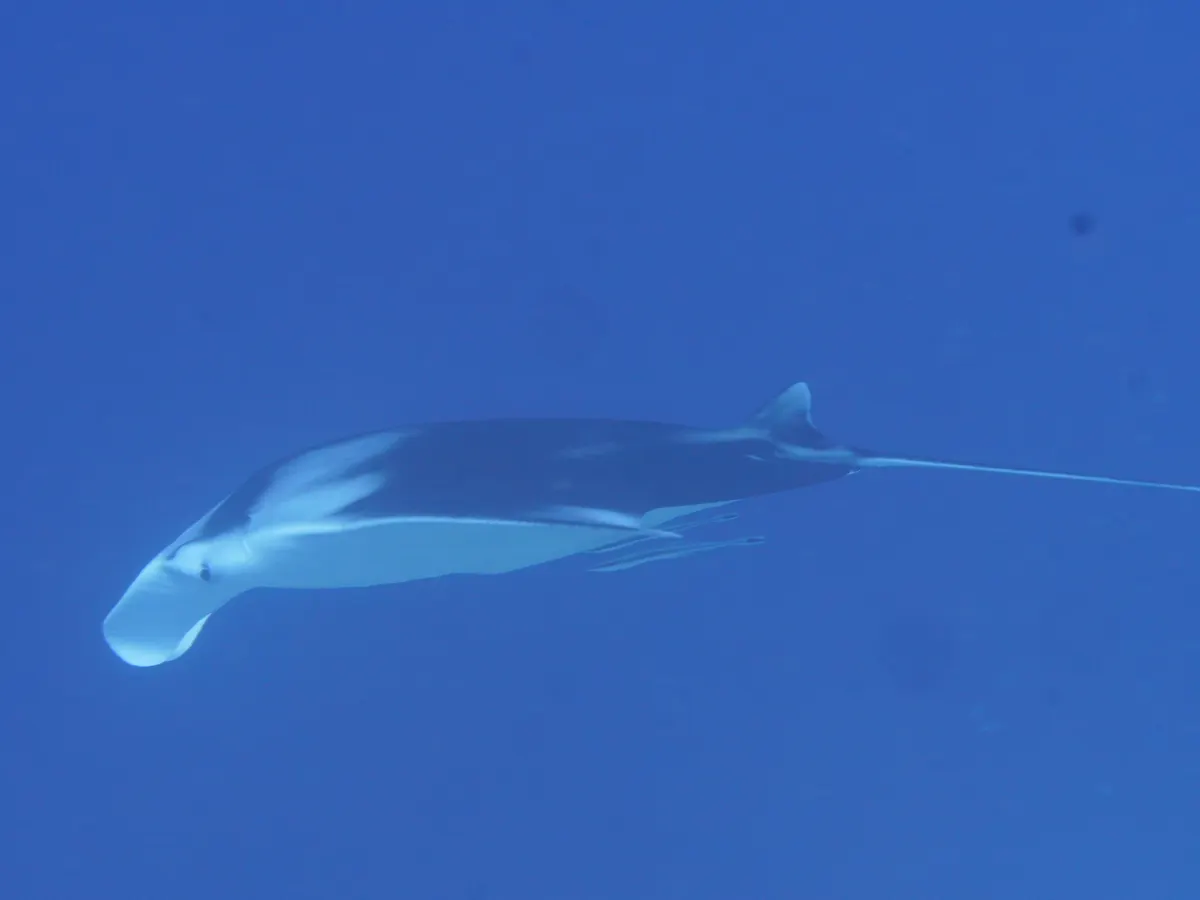
Manta rays do not have a stinging tail like some other rays.
Select a question to reveal the answer.
A manta ray is a giant ray with broad fins that make it look like it is flying underwater. This page focuses on the giant oceanic manta ray.
Giant oceanic manta rays live in warm oceans around the world, especially in tropical and subtropical seas.
They eat tiny animals such as zooplankton, krill, and small fish by filtering seawater through their gills.
No. Manta rays do not have a venomous tail spine, and they are not dangerous to swimmers.
Very large adults can span more than 20 feet from fin tip to fin tip and weigh several thousand pounds.
Yes. Giant oceanic manta rays are listed as Endangered because they reproduce slowly and are threatened by fishing, bycatch, and ocean pollution.