
Dugong dugon / Trichechus manatus
Dugong vs Manatee
Dugongs and manatees are slow-moving aquatic herbivores, but tail shape, snout form, range, and freshwater tolerance separate them.
By An Nguyen · Updated
At a glance
Published species data from both WildlifeDB profiles, aligned trait by trait. Size metrics highlight the larger value with a relative bar.
- Scientific name
- DugongDugong dugon
- ManateeTrichechus manatus
- Classification
- DugongMammalia · Dugongidae
- ManateeMammalia · Trichechidae
- Native range
- DugongAsia, Oceania, Africa
- ManateeNorth America, South America, Africa
- Primary habitat
- DugongCoast
- ManateeCoast
- Diet
- DugongHerbivore
- ManateeHerbivore
- Typical food
- DugongSeagrass, Seagrass roots, Seagrass rhizomes, Algae
- ManateeSeagrass, Mangrove leaves, Water hyacinth, Algae, Aquatic plants
- Body length
- Dugong8 feet – 10 feet
- Manatee8 feet – 13 feet
- Shoulder height
- Dugong2.5 feet – 3.5 feet
- Manatee3 feet – 4 feet
- Weight
- Dugong500 pounds – 1100 pounds
- Manatee440 pounds – 1300 pounds
- Top speed
- DugongUsually about 6 mph; short bursts higher when startled
- ManateeUp to 5 mph; bursts to 15 mph
- Wild lifespan
- DugongUp to 70 years
- ManateeUp to 60 years
- Social pattern
- DugongSeagrass grazing, Surface breathing, Mother and calf bonding
- ManateeSlow grazing, Surface breathing, Warm water seeking
- Key adaptations
- DugongDownturned bristly muzzle for grazing, Crescent-shaped fluke, Dense bones for ballast
- ManateePrehensile lips for grasping vegetation, Flipper-like forelimbs for steering, Low metabolic rate
- Conservation
- DugongVulnerable · Declining
- ManateeVulnerable · Increasing Slowly
- Reproduction
- DugongAbout 13 to 15 months; 1 calf per birth
- ManateeAbout 12 to 14 months; 1 calf per birth; rarely twins
Crescent fluke or rounded paddle
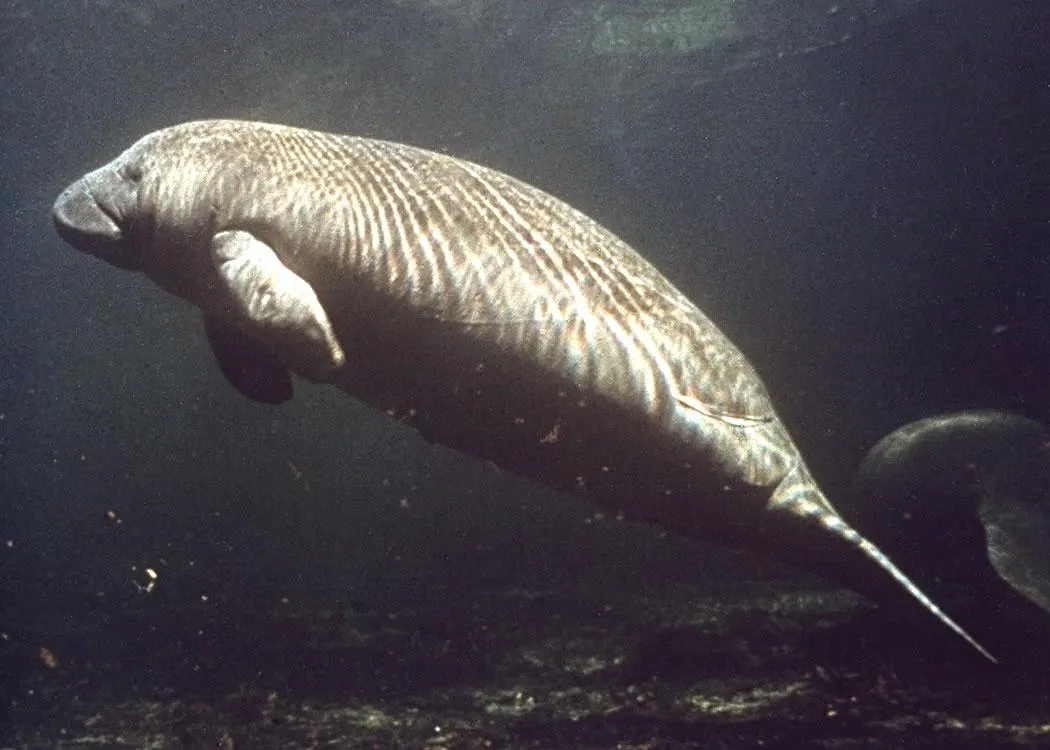
The tail answers this comparison in one look. A dugong has a crescent-shaped fluke with two lobes, like a dolphin's. A manatee has a single broad, rounded paddle.
Tail shape beats size as an identification tool because it does not depend on distance, water clarity, or how much of the animal is visible. Both animals surface to breathe, and the tail is usually the last thing seen as they dive.
Bristly downturned muzzle against prehensile lips
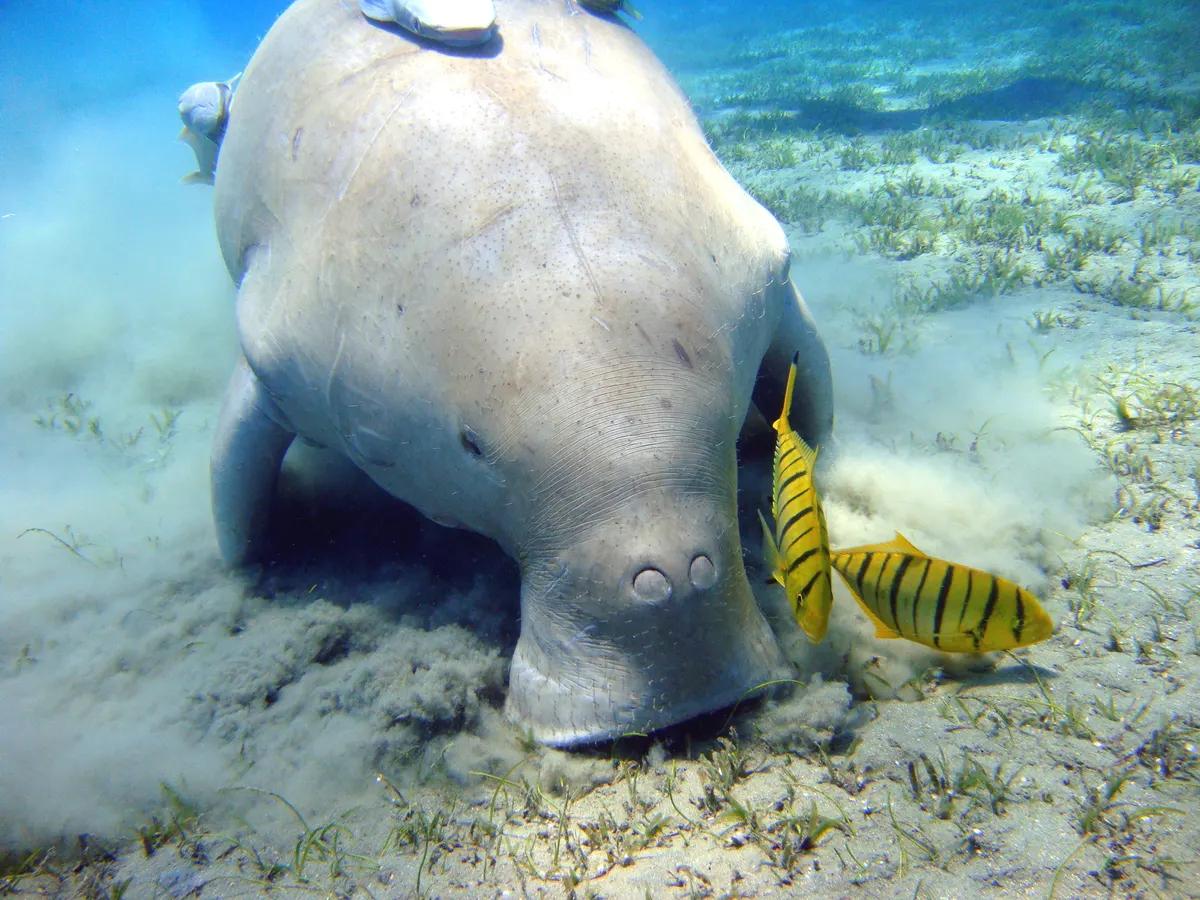
The second reliable mark is the face. A dugong's muzzle is downturned and bristly, built to crop plants at the seabed, and its body tapers behind it. A manatee has flexible prehensile lips that grasp and pull vegetation into the mouth.
Both are the living members of the order Sirenia — fully aquatic herbivorous mammals whose closest living relatives are elephants and hyraxes. Dugongs are the only surviving members of the family Dugongidae; Steller's sea cow, a much larger relative, was hunted to extinction.
Overlapping length, manatees slightly heavier
Dugongs measure about 8–10 feet and weigh 500–1,100 pounds. Manatees measure about 8–13 feet and weigh 440–1,300 pounds. The ranges overlap substantially, with the manatee reaching the higher maximum in these records.
Neither is built for speed. Dugongs usually move around 6 mph with faster bursts when startled; manatees cruise near 5 mph and can burst to about 15 mph. Both are far more specialised for buoyancy control and steady swimming than for acceleration.
Saltwater only, or rivers too
This is the difference that matters ecologically. Dugongs never leave saltwater: they stay in shallow tropical and subtropical coastal seas and do not normally move into freshwater rivers, so their distribution closely follows extensive seagrass habitat from East Africa through South and Southeast Asia to northern Australia and Oceania.
Manatees use coasts, estuaries, rivers, and springs across North America, South America, and Africa. Freshwater access creates an entirely different seasonal pattern — in cooler regions, reaching warm water can become a survival constraint rather than a preference. The two may occur in the same broad tropical coast regions without using the same local water.
Seagrass specialist against mixed grazer
Dugongs specialise on seagrass — leaves, roots, and rhizomes — with algae a smaller part of the recorded diet. An adult can eat tens of pounds in a day, and the downturned muzzle leaves visible feeding trails through a meadow.
Manatees eat seagrass, mangrove leaves, water hyacinth, algae, and other aquatic plants. The broader list matches their use of freshwater and estuarine habitat as well as marine grass beds. A manatee also replaces its teeth throughout life: worn molars drop out at the front while new ones move forward from the back, which suits a lifetime of grinding abrasive plants.
Both are herbivores, but their feeding grounds are not interchangeable. A dugong depends directly on productive marine seagrass; a manatee can switch between vegetation types.
Quiet grazers with the same human problem
Dugongs forage alone or in loose groups over seagrass beds, using dense bones as ballast to stay near the bottom while grazing. Mothers and calves keep close contact and communicate with soft chirps and squeaks. Manatees also spend most of the day feeding, resting, and moving between warm-water refuges, steering with flipper-like forelimbs through shallow, often turbid water. A manatee must surface every three to five minutes even while sleeping, bobbing up automatically.
That surfacing habit, combined with a preference for shallow coastal water, is why both species are so exposed to human activity. Many wild manatees carry permanent propeller scars, which researchers now use to identify individuals.
Both Vulnerable, and the threats are practical
Both species are listed as Vulnerable. The dugong trend is declining; the manatee record shows a slowly increasing trend. The threats are unusually concrete: boat strikes, entanglement in fishing gear, poor water quality, and loss of seagrass or freshwater vegetation. Protection has to reach into the shallow places where they actually feed, not only into deeper protected water.