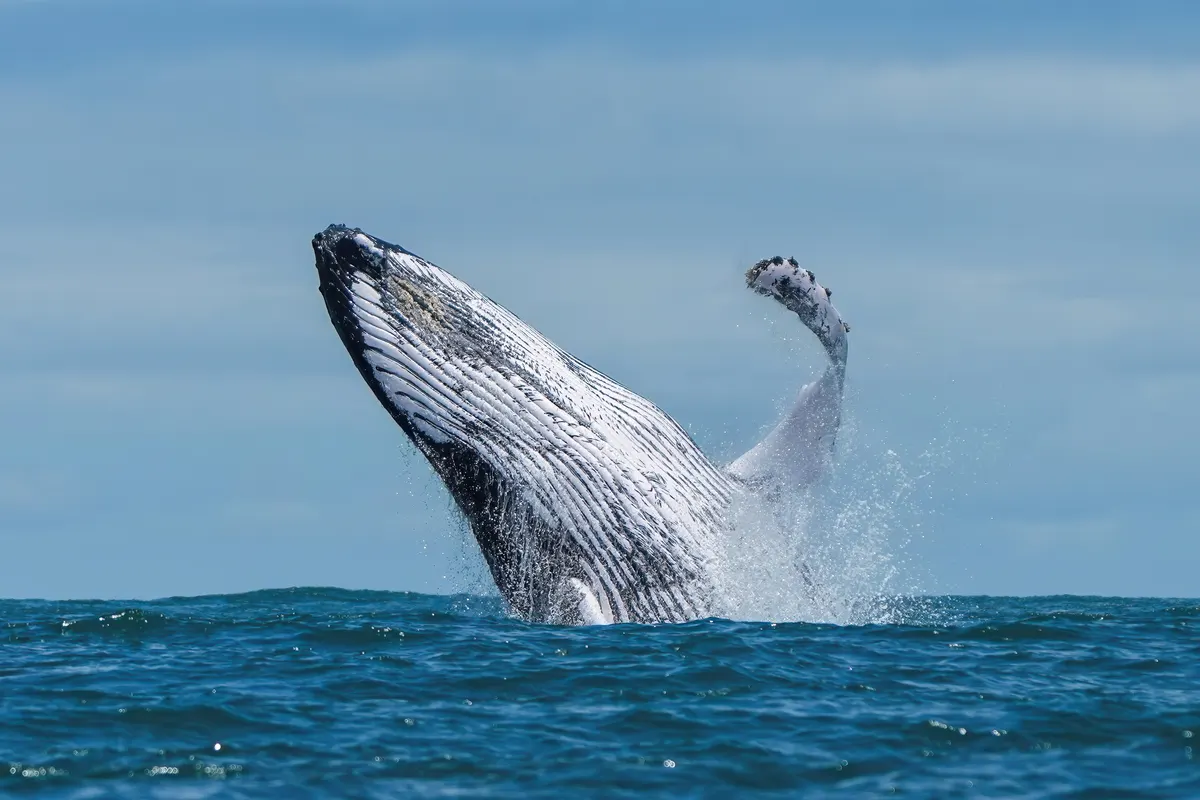
Humpback whale leaping clear of the ocean surface in a full breach
Humpback whales are known for acrobatic breaches and long pectoral fins up to one-third of body length.
MammaliaLeast Concern

Humpback Whale Facts

The genus name Megaptera means big-winged, referring to the long pectoral fins.

Humpback whales are baleen whales found in oceans worldwide. They migrate thousands of miles, feed on krill and small fish, and are known for breaching and complex songs.

By · Updated

Quick Facts

Humpback Whale at a glance

Megaptera novaeangliaeCetaceaBalaenopteridae

About their home

Kind of animal

Mammalia

Where they live

What they eat

How safe?

Least Concern

Size and speed

How heavy

55000 pounds – 88000 pounds

How long

39 feet – 52 feet

How fast

Up to 16 mph sustained; faster in short bursts

Lifespan

45 to 50 years

Core article

Humpback Whale: ecology and life history

A closer look at habitat, diet, behavior, reproduction, and conservation.

Start here

Humpback Whale

The humpback whale (Megaptera novaeangliae) is one of the most recognizable whales alive — long pectoral fins, a knobbly head, and spectacular breaching that make it a whale-watcher's favourite on every coastline. It is a baleen whale, filtering krill and small fish through plates of baleen instead of teeth, and it makes some of the longest migrations of any mammal between cold summer feeding grounds and warm winter breeding waters. Commercial whaling cut its numbers sharply through the mid-1900s, but international protection since the 1960s has let many populations recover.

A Baleen Giant With Winglike Flippers

Adult humpbacks reach 39 to 52 feet and 25 to 40 metric tons, females a little larger than males, mostly black or dark gray above and white below, with up to 35 ventral throat grooves running chin to navel that balloon out when the whale lunges to feed. The pectoral fins are extraordinary — up to a third of the body length, the longest relative to size of any cetacean — and the low hump under the dorsal fin gives the species its name. Knobbly tubercles line the head and jaw, each holding a single stiff hair, and 270 to 400 baleen plates hang on each side of the upper jaw. The tail flukes span up to 18 feet and carry unique pigment patterns that let researchers identify individuals by photo. It belongs to the rorqual family Balaenopteridae alongside the blue whale and fin whale; its scientific name means "big-winged New Englander," for those flippers and where European whalers first described it.

Where Humpback Whales Live

Humpback whale surfacing in cold subarctic waters of Faxaflói Bay, Iceland
Summer feeding grounds in high-latitude seas supply the krill and fish humpbacks need.

Humpbacks live in all major ocean basins — North Atlantic, North Pacific, Southern Ocean, and parts of the Indian Ocean — and most populations migrate seasonally, feeding in cold high-latitude waters where krill and fish concentrate, then traveling to warm tropical bays and reefs to mate and calve. Well-known routes run Alaska to Hawaiʻi and Antarctica to South Pacific islands, while one unusual Arabian Sea population doesn't migrate at all, staying in tropical water year-round. Calving grounds tend to be shallow and warm near coasts; feeding grounds are colder and prey-rich — fjords, shelf edges, and upwelling zones.

What Humpback Whales Eat

Humpback whale lunging upward with mouth open while feeding in a fjord
Humpbacks filter krill and small fish through baleen plates after lunging through prey schools.

Humpbacks are carnivores that filter small prey — herring, capelin, and sand lance in the Northern Hemisphere, Antarctic krill in the Southern — feeding mainly in summer and living off fat reserves while fasting on the breeding grounds. Some populations use the remarkable tactic of bubble-net feeding: one or more whales spiral below a fish school blowing bubbles that form a rising "net," driving the fish into a tight ball, then the whales lunge up through it with mouths open, their throat grooves expanding to take in huge volumes of water that they strain through the baleen. A single humpback may eat up to 3,000 pounds a day at peak season.

Behavior: Solitary Migrants and Singing Males

Adult humpback whale swimming alongside its calf in tropical Pacific waters
Mother-calf pairs stay together through the first year of migration and nursing.

Humpbacks are generally solitary or in small, temporary groups, the strongest bond being mother and calf, and on the breeding grounds males compete for females, often forming boisterous "competitive groups" around one female. Males also produce long, patterned songs in the breeding season — all males in a population sing similar versions that evolve over months and years — whose exact function is debated but likely tied to mating display. Surface behaviors like breaching, tail-slapping, and flipper-slapping are common and may serve communication, parasite removal, or other social roles researchers are still testing.

Life Cycle: A One-Ton Calf

Young humpback whale calf swimming at the ocean surface near Moorea
Newborn calves are about 13 to 16 feet long and nurse on rich milk for months.

A female bears a single calf about every two to three years after an 11-month gestation, giving birth in the warm winter breeding grounds to a calf 13 to 16 feet long and roughly a ton. The calf nurses on rich milk, gaining up to 100 pounds a day in its first months, and stays with the mother 6 to 12 months learning migration routes and feeding grounds, reaching maturity at 5 to 10 years. Wild humpbacks may live 45 to 50 years. Killer whales occasionally take calves, and ship strikes and fishing-gear entanglement are growing human causes of injury and death.

Conservation: A Whaling Recovery

Humpback whale tail fluke raised before a deep dive in Icelandic waters
Populations migrate thousands of miles between polar feeding areas and tropical breeding grounds.

Globally the humpback is Least Concern, with several populations increasing after decades of protection — the International Whaling Commission banned commercial humpback hunting in 1966, and many countries now protect breeding and feeding areas. Threats remain, though: ship strikes, entanglement, ocean noise, and climate-driven shifts in prey all affect recovery, and some distinct populations, including parts of the Arabian Sea and Oceania, are still classed as endangered regionally. Ongoing monitoring by photo ID, song analysis, and satellite tagging tracks whether local stocks keep recovering.

References and Authoritative Sources

Humpback Whale: classification and fun facts

Classification

Scientific Taxonomy
  1. Kingdom

    Animalia

  2. Phylum

    Chordata

  3. Class

    Mammalia

  4. Order

    Cetacea

  5. Family

    Balaenopteridae

  6. Genus

    Megaptera

  7. Species

    M. novaeangliae

Did You Know?

Fun Facts

1

The genus name Megaptera means big-winged, referring to the long pectoral fins.

2

Male humpbacks sing long, structured songs that change from year to year.

3

Some humpbacks migrate more than 5,000 miles between feeding and breeding areas.

4

Bubble-net feeding is a cooperative technique used by some populations.

5

A humpback calf may gain about 100 pounds per day while nursing.

6

Humpbacks were heavily hunted before commercial whaling bans in the 1960s.

Common Questions

FAQ about Humpback Whale

Select a question to reveal the answer.

What is a humpback whale?

A humpback whale is a large baleen whale with long front flippers, a knobby head, and a small dorsal fin set far back on a humped body.

How big is a humpback whale?

Adults usually measure 12 to 16 meters (39 to 52 feet) and weigh about 25 to 40 metric tons. Females are slightly larger than males.

What do humpback whales eat?

They filter krill and small schooling fish such as herring, sardines, and sand lance through baleen plates. They rarely feed on breeding grounds.

Where do humpback whales live?

Humpbacks live in all major oceans. Most populations migrate between cold feeding areas in summer and warm tropical or subtropical breeding grounds in winter.

Why do humpback whales breach?

Scientists are not certain. Breaching may help remove parasites, communicate with other whales, or play a role in social displays.

Are humpback whales endangered?

Globally the species is Least Concern and recovering after whaling bans. Some distinct populations, such as the Arabian Sea stock, remain at risk.

Show 1 more questionsExpand
How are humpback whales related to blue whales?

Both are rorquals in the family Balaenopteridae. Blue whales are filter feeders like humpbacks but grow much larger and feed mainly on krill.