
Ocean life
Why Do Mandarinfish Lack Scales?
Instead of overlapping scales, mandarinfish rely on a specialized outer skin rich in mucus-producing and sacciform cells.
By An Nguyen · Published · Updated
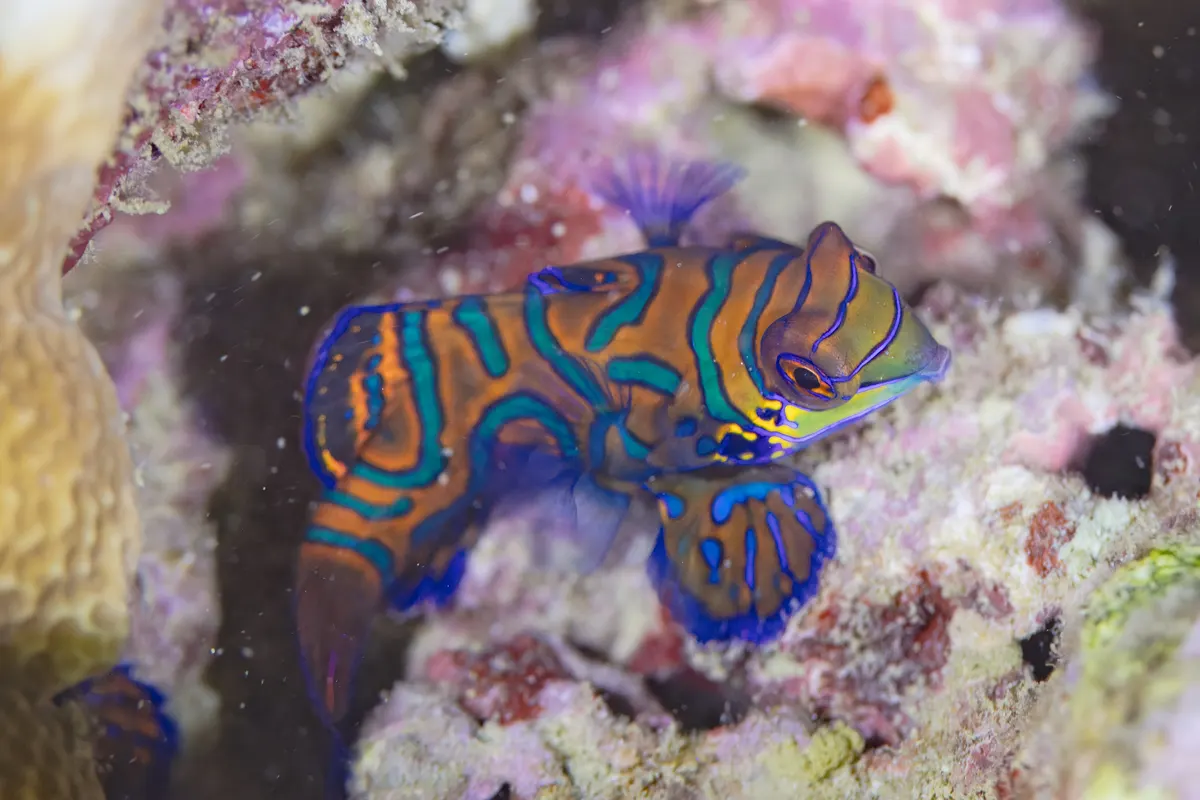
Mandarinfish lack the overlapping scales that armor most familiar bony fish. They are dragonets, a group conventionally described as scaleless, and their outer defense is instead concentrated in the skin. A mucus-rich epidermis covers the body and reduces direct contact with the reef, microbes, and potential predators.
It is better to describe this as an alternative body-covering system than as a fish “missing” a structure it should have. The lineage evolved without conventional scales, while the epidermis developed its own cellular specializations.
What covers a mandarinfish instead?
The surface of a mandarinfish is living epidermis coated in mucus. A microscopic study of Synchiropus splendidus and its close relative S. picturatus found many mucus-producing goblet cells as well as distinctive sacciform cells. The researchers proposed that their secretions have defensive functions related to predators and contact with the substrate.
Mucus can make a small fish slippery and form a chemical and physical boundary between its tissues and seawater. It may also reduce abrasion as the fish hovers over coral rubble and slips into narrow crevices. Those benefits do not make the skin impenetrable. Damage, poor water quality, and infection can still harm a scaleless fish.
An angelfish shows the more familiar alternative: visible overlapping scales on a laterally compressed reef fish. The two animals occupy reefs, but their outer coverings are not versions of the same design.
Is mandarinfish mucus poisonous?
The safest answer is that the mucus appears defensive, while broad claims about a powerful toxin go beyond the available evidence. The skin study identified specialized cells and discussed protection against predation, but it did not establish a standardized toxin dose or show that touching a mandarinfish is dangerous to people.
Bright colors can work with chemical or behavioral defenses, but color alone does not prove toxicity. Mandarinfish are also small, slow-moving, and active close to shelter. Their first defense is often to remain within complex reef structure rather than confront a predator.
This distinction matters because aquarium summaries frequently turn “unpleasant or protective secretion” into “poisonous slime coat.” Those phrases are not biologically interchangeable.
Why not evolve scales as well?
Evolution does not plan toward maximum armor. A trait persists when its overall costs and benefits work in a particular lineage. Scales can protect a fish, but they also add material and affect flexibility, growth, sensation, and how the skin interacts with water.
For a small bottom-associated dragonet, mucus, concealment, skin chemistry, and rapid movement into shelter may provide sufficient protection. The absence of scales is shared with related dragonets, so it should not be explained only by the modern mandarinfish's bright color or aquarium ecology.
The animal's ocean habitat also creates competing demands. It must move over abrasive reef surfaces, detect tiny prey, and enter tight spaces. A flexible, mucus-coated surface fits that way of life, although no single experiment demonstrates that abrasion alone caused scale loss in the lineage.
Does being scaleless change captive care?
Yes. Scaleless fish can be more sensitive to rough handling, skin injury, and some medications. That does not mean mucus replaces good water quality or that a thick coating is always healthy. Excess mucus can be a response to irritation.
Mandarinfish also have a specialized feeding problem unrelated to scales: they search continuously for tiny crustaceans and other benthic invertebrates. A tank can protect their skin while still failing to provide enough appropriate food. Body covering and diet should be evaluated separately.
The short answer
Mandarinfish lack conventional scales because they belong to a scaleless dragonet lineage. Their mucus-rich epidermis, including specialized secretory cells, provides an alternative protective surface. It is a flexible defense rather than proof of an exceptionally toxic or invulnerable skin.
For diet, spawning, distribution, and reef behavior, see the full mandarinfish profile.