
Ocean life
How Do Ocean Sunfish Eat Jellyfish?
A sunfish draws gelatinous prey into its small mouth, breaks it into manageable pieces, and traps it with teeth deeper in the throat.
By An Nguyen · Updated
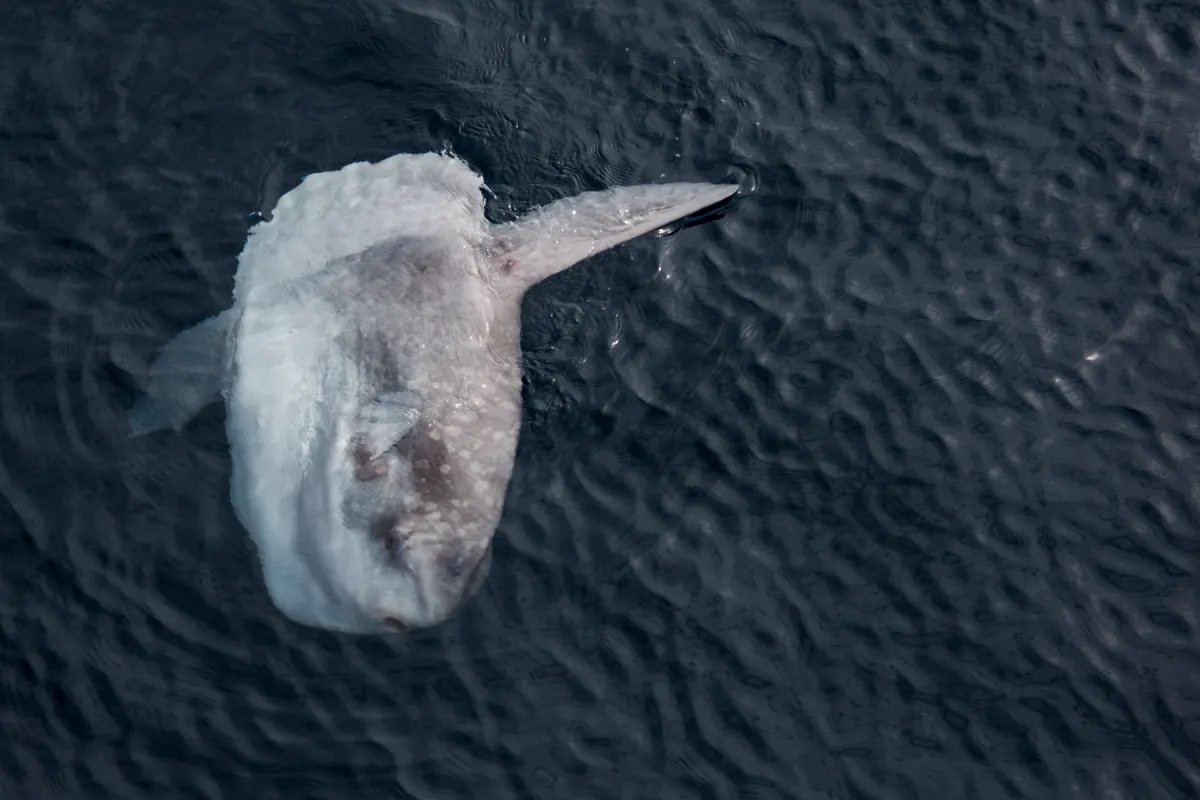
An ocean sunfish eats gelatinous prey with suction and water movement rather than conventional chewing. It draws a jelly or a piece of one toward its small mouth, repeatedly pulls it in and pushes it out when necessary, and passes manageable material to a specialized set of teeth in the throat.
Those pharyngeal teeth are important because the visible mouth does not contain the cutting dentition of a shark. The feeding system must control food that is slippery, delicate, and mostly water.
How does the mouth handle a jelly?
An ocean sunfish can rapidly expand its mouth cavity to create suction. Water and prey move inward together. If the item is too large, the fish can direct a jet of water outward and work at the material in repeated cycles. Aquarium observers describe sunfish sucking food in and expelling it until the piece is small enough to swallow.
The fused, beak-like front teeth help form the mouth opening, but the deeper pharyngeal jaws do much of the securing work. A 2024 biomechanical study tested preserved sunfish throat teeth with simulated gelatinous prey. The immobile teeth caught the material in 70 to 100 percent of trials under the tested conditions, showing how a simple-looking structure can reliably snag a jelly-like food.
This is a different feeding solution from the spring-loaded strike of a mantis shrimp. Both handle marine prey, but the sunfish relies on fluid movement and internal retention rather than impact.
Do jellyfish stings hurt a sunfish?
Jellyfish nematocysts can still fire after contact, and there is no evidence that a sunfish is universally immune to every species. Several aquarium and natural-history accounts describe a mucus-like lining in the digestive tract that may help protect internal tissues. The fish's skin and mouth structure also limit which tissues are exposed.
“Protected” is more accurate than “immune.” Different gelatinous animals have different stings, and feeding may involve damaged pieces rather than an intact large jelly. A sunfish can also choose among prey and does not need to attack every jelly it encounters.
Do ocean sunfish eat only jellyfish?
No. The old picture of a specialist living almost entirely on jellyfish is incomplete. Stomach contents, stable isotopes, and observations indicate a broader diet that can include small fish, crustaceans, mollusks, salps, ctenophores, and other gelatinous organisms. Diet varies with life stage, location, depth, and available prey.
That breadth matters when interpreting the animal's anatomy. Suction works for more than jellies, and pharyngeal teeth can retain several soft or small food types. Gelatinous prey are real and sometimes important, but they are one part of a flexible carnivorous diet.
Young sunfish are tiny and feed at a different scale from a two-meter adult. As the mouth and pharyngeal apparatus grow, the sizes and types of prey they can process change as well.
Why is the mouth so small?
Body size and mouth size do not need to scale equally when prey is soft and can be processed in pieces. A large gape would require more structure and might create other hydrodynamic costs. The sunfish instead uses rapid suction, repeated manipulation, and a hidden throat apparatus.
Its unusual body shape also supports open-water movement across depths rather than high-speed pursuit. The fish can search widely for patchy prey and use a compact feeding mechanism when it encounters them. The small mouth is therefore not evidence that the animal is unable to feed efficiently.
The short answer
Ocean sunfish eat jellyfish by sucking soft material into a small mouth, using water jets and repeated movements to reduce large pieces, then catching the prey with specialized pharyngeal teeth. A protective digestive lining may reduce damage from stinging cells. Jellyfish are only part of a wider diet.
For body shape, diving, size, reproduction, and conservation, see the full ocean sunfish profile.