Angelfish Facts
"Juvenile emperor angelfish look completely different from adults."
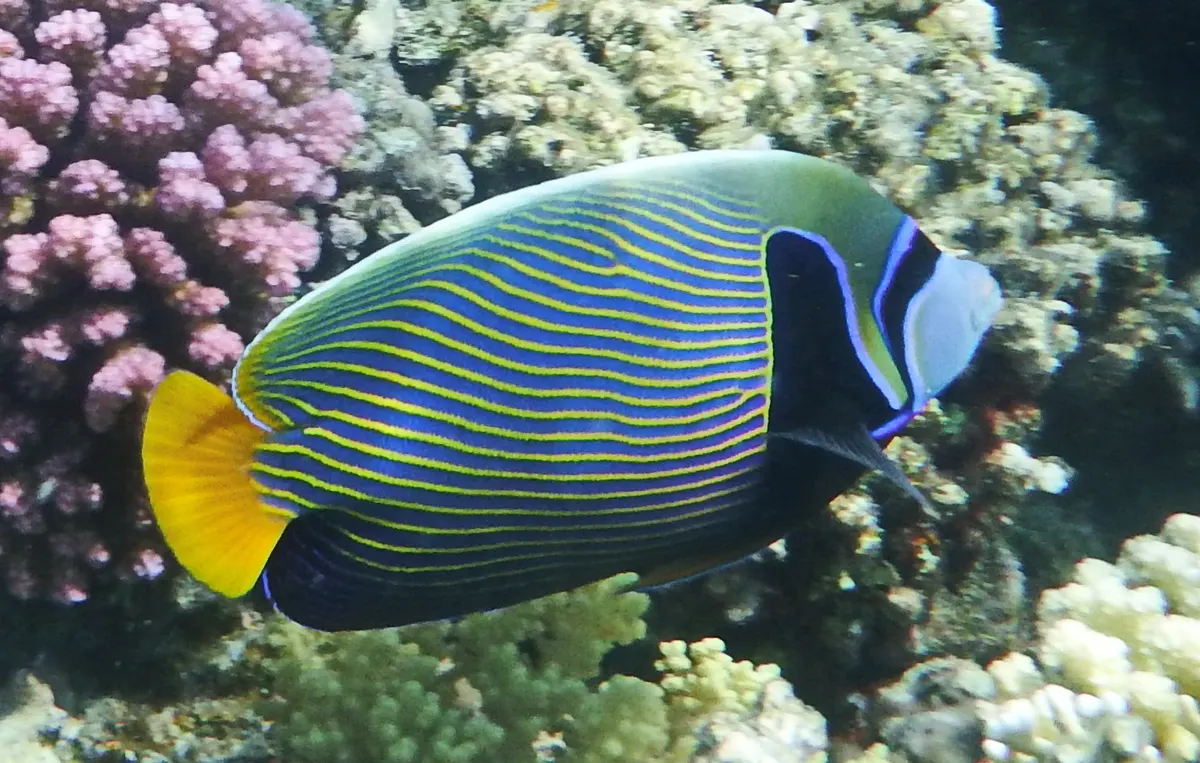
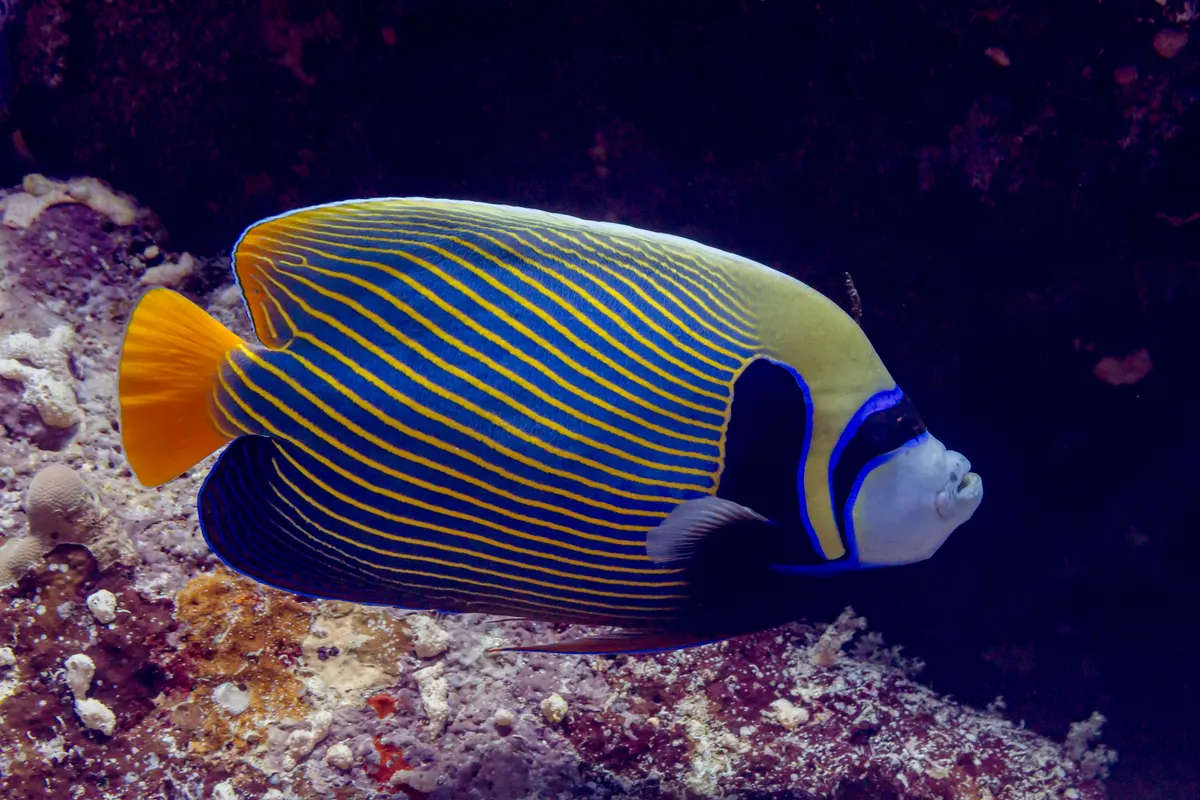
Emperor angelfish are dazzling reef fish with bold blue and yellow stripes. They live on tropical coral reefs from the Red Sea to the Pacific and are famous...
Loading page content

"Juvenile emperor angelfish look completely different from adults."
Emperor angelfish are dazzling reef fish with bold blue and yellow stripes. They live on tropical coral reefs from the Red Sea to the Pacific and are famous...
Pomacanthus imperatorPerciformesPomacanthidae
Explore emperor angelfish photos organized for learning and classroom observation.
Click any photo to view it larger. 8 images available.
Core article
Habitat, diet, behavior, and more — everything on one page.
The emperor angelfish (Pomacanthus imperator) is a dazzling masterpiece of marine biology, a living jewel that brings electric color to the complex topography of tropical coral reefs. Renowned among marine ichthyologists and aquarists alike, this species is famous not only for its striking adult plumage—a bold lattice of electric blue and vibrant yellow—but for one of the most dramatic ontogenetic color transformations in the vertebrate world. Gliding gracefully through the sunlit shallows and dark crevices of the Indo-Pacific, the emperor angelfish is a territorial grazing carnivore whose presence is indicative of a healthy, structurally diverse reef ecosystem.
The scientific classification of the emperor angelfish places it in the kingdom Animalia, phylum Chordata, class Actinopterygii (ray-finned fishes), and order Perciformes. It belongs to the family Pomacanthidae, a group encompassing all marine angelfishes, distinguished biologically by the presence of a strong, backward-facing spine on the lower margin of the preopercle (gill cover). The genus Pomacanthus contains some of the largest and most robust angelfish species, with P. imperator standing out as one of the most widely distributed and visually iconic.
Evolutionarily, the Pomacanthidae diverged from their close relatives, the butterflyfishes (Chaetodontidae), millions of years ago in the warm, shallow seas of the Cenozoic era. The evolutionary divergence was heavily influenced by diet and defense. While butterflyfish evolved elongated snouts for extracting tiny polyps, the angelfish evolved powerful, beak-like jaws equipped with bristle-like teeth, perfectly adapted for tearing tough, toxic sponges. The dramatic color shifting between juvenile and adult life stages is an evolutionary strategy that prevents territorial aggression from adult males, allowing vulnerable juveniles to safely inhabit the same reef zones as fully grown individuals.
Morphologically, Pomacanthus imperator is built for maneuverability within the tight confines of a coral reef. The body is highly laterally compressed (flattened from side to side) and somewhat circular, allowing the fish to slip effortlessly through narrow crevices to escape predation or hunt for hidden prey. Adults typically measure between 10 and 15 inches in length and weigh roughly 2 to 3 pounds.
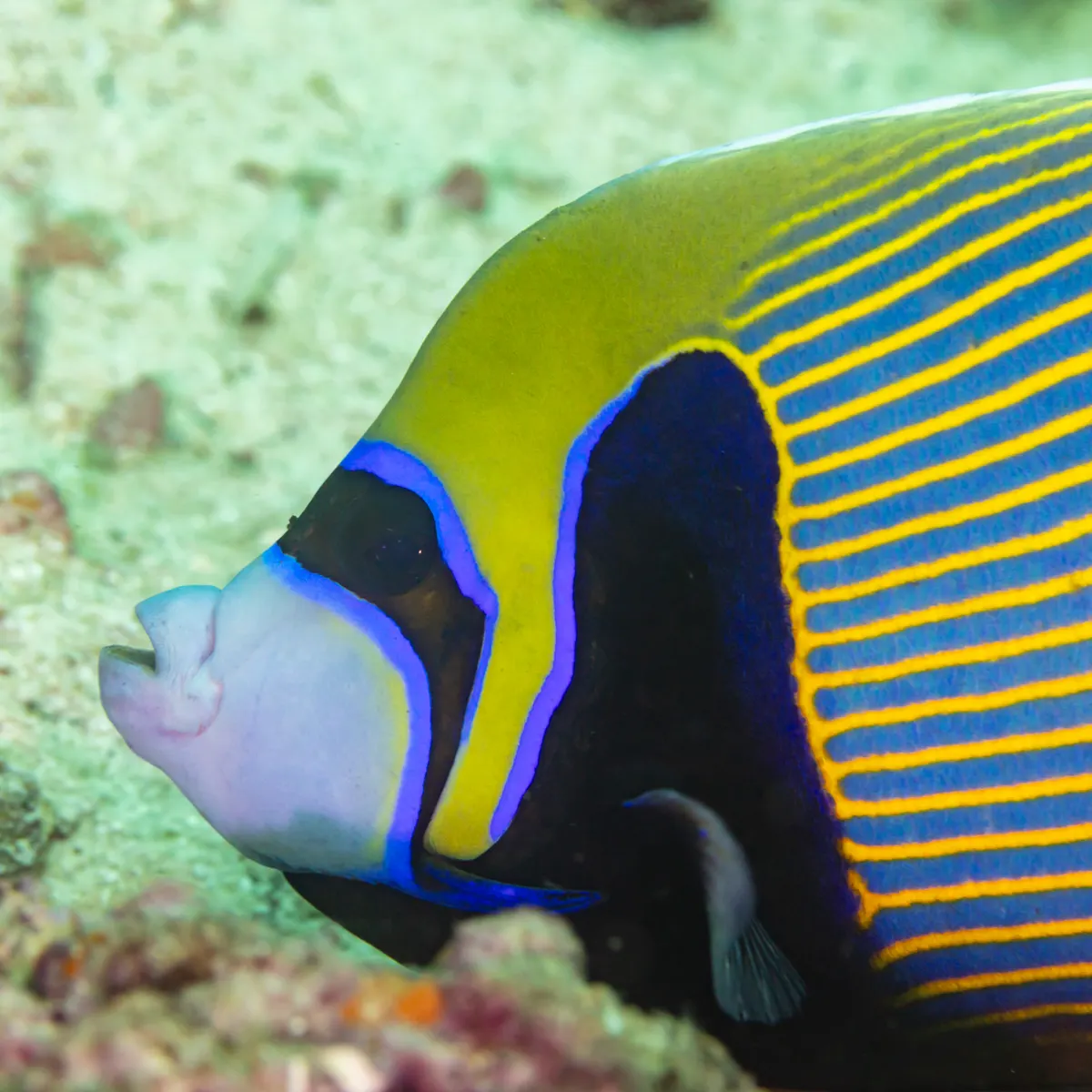
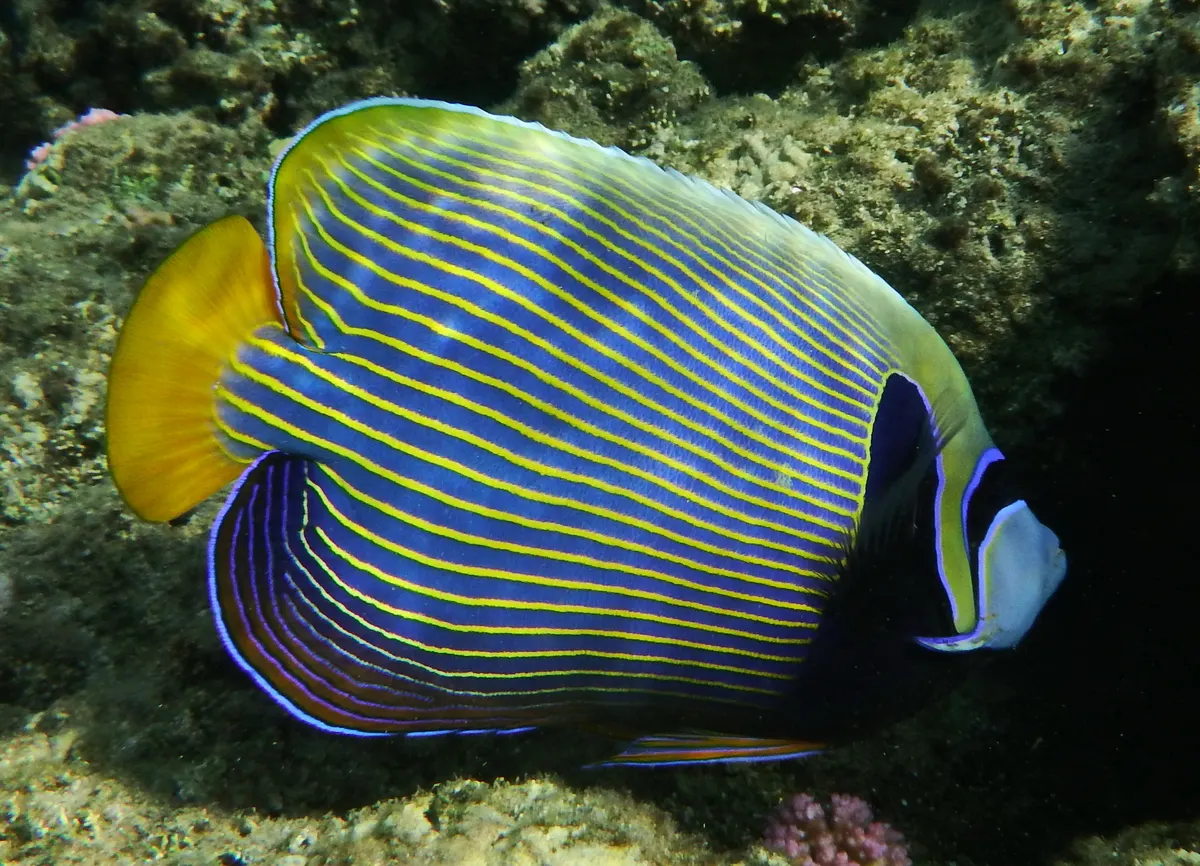
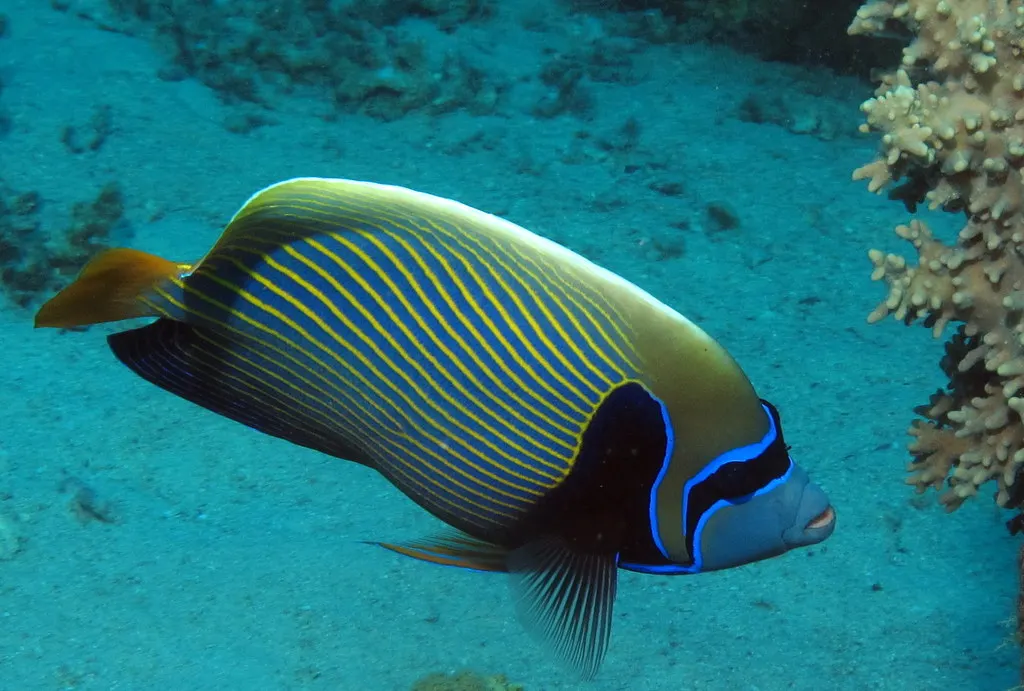
The adult coloration is a bio-optical fascinating example. The body is adorned with alternating, horizontal stripes of vivid yellow and sapphire blue. A dark, mask-like band stretches across the eyes, bordered in iridescent blue, which serves to obscure the pupil from predators. The mouth is striking white, contrasting sharply with the rest of the head. As with all Pomacanthids, the preopercular spine is prominent and sharp, utilized as a defensive weapon against larger piscivores.
However, the most fascinating anatomical feature is the juvenile coloration. A juvenile emperor angelfish possesses a completely distinct morphological appearance: a dark blue to black base body covered in concentric, circular rings of bright white and electric blue. This disruptive camouflage breaks up the fish’s outline against the dappled light of the reef, rendering it nearly invisible to predators when hiding in dark caves. The transition from the juvenile ring pattern to the adult horizontal stripes takes several months to complete and is a period of intense physiological and metabolic reorganization.

The emperor angelfish commands a vast distribution across the tropical Indo-Pacific. Their range spans from the warm, highly saline waters of the Red Sea and the eastern coast of Africa, eastward across the Indian Ocean to Indonesia and Australia's Great Barrier Reef, reaching as far into the Pacific as Hawaii, the Pitcairn Islands, and French Polynesia.
Their primary biome is the marine coral reef, specifically favoring areas of high structural complexity. They are benthic fish, generally found at depths ranging from 3 to 300 feet (1 to 100 meters). Juveniles are exceptionally secretive, typically solitary, and confine themselves to dark surge channels, the undersides of coral ledges, or deep cleaning stations. Adults are more boldly visible, patrolling the outer reef slopes, deep drop-offs, and clear lagoon channels. They require reefs with a high density of benthic invertebrates and expansive networks of caves and overhangs for shelter during the night.

While often generalized as omnivores in the aquarium trade, wild emperor angelfish are specialized grazing carnivores. The bulk of their natural diet is composed of sponges and tunicates (sea squirts), supplemented by small benthic invertebrates and small amounts of macroalgae.
Sponges are notoriously difficult to digest, composed largely of structural silica spicules (glass-like needles) and laced with toxic chemical defenses. Pomacanthus imperator has evolved highly specialized physiological adaptations to exploit this abundant but challenging food source. Their jaws are equipped with rows of overlapping, bristled teeth that function like scraping shears, allowing them to effectively rasp away tough sponge tissue. Furthermore, their digestive tract secretes thick layers of mucus that coat the sharp silica spicules, preventing internal lacerations as the sponge material passes through the gut. By heavily grazing on rapid-growing sponges, emperor angelfish perform a vital ecological service, preventing sponges from overgrowing and smothering slow-growing reef-building corals.

The social structure of the emperor angelfish is rigidly territorial and hierarchical. Unlike schooling pelagic fishes, adult emperor angelfish are generally solitary or found in bonded pairs. A dominant male establishes a massive territory, often encompassing several thousand square meters of prime reef real estate. This territory typically overlaps with the smaller home ranges of two or more females, creating a loosely constructed harem.
The dominant male is fiercely aggressive in defending his territory against rival males of the same species. When confronted, he will engage in aggressive lateral displays, flaring his fins to maximize his apparent size, and forcefully grinding his pharyngeal teeth to produce a loud, low-frequency "grunting" or "thumping" sound. This acoustic warning is surprisingly loud and can be clearly heard by scuba divers passing nearby.
The extreme morphological difference between juveniles and adults plays a crucial role in this territorial dynamic. Because the juvenile coloration is so completely removed from the adult pattern, the territorial male does not recognize the young fish as reproductive competition. Consequently, the aggressive male allows the juvenile to reside within his territory unharassed, affording the young fish a degree of protection from predators.

Reproduction in Pomacanthus imperator is tied directly to the lunar cycle and the rising tides. Like many pelagic spawners, they engage in highly synchronized, rapid reproductive events designed to scatter their offspring into the safety of the open ocean currents.
During the spawning event, the bonded male and female perform an intricate courtship dance, rising rapidly together from the safety of the reef into the open water column. At the apex of their ascent, they simultaneously release thousands of microscopic eggs and sperm into the water. This broadcast spawning ensures rapid fertilization before the pair immediately darts back down into the safety of the coral cover.
The fertilized eggs are buoyant and drift into the pelagic zone, where they hatch within 24 to 48 hours. The resulting larvae are entirely planktonic, drifting at the mercy of the ocean currents for several weeks. This extended pelagic larval stage is the mechanism by which the species maintains such a massive geographic distribution. Once a larva settles onto a suitable reef environment, it undergoes metamorphosis into the iconic, ringed juvenile form. Growth is relatively slow, and it can take up to two years for the fish to initiate its transition into adult coloration. In the wild, an emperor angelfish can boast a lifespan of up to 20 years.
(Population and conservation trend data sourced from the IUCN Red List of Threatened Species)
Currently, the International Union for Conservation of Nature (IUCN) assesses the emperor angelfish as a species of Least Concern. Their immense geographic range and relatively stable, widespread populations provide a significant buffer against immediate extinction.
However, they face localized and escalating threats. As obligate coral reef inhabitants, their survival is intrinsically tied to the health of the reef biome. Ocean acidification and rising sea surface temperatures are driving catastrophic mass coral bleaching events globally. The structural collapse of a coral reef results in the direct loss of the angelfish's primary food sources (sponges) and crucial physical shelter.
Furthermore, their stunning coloration makes them a highly sought-after prize in the global marine aquarium trade. In regions with unregulated collection practices, localized populations can be severely depleted by divers employing destructive collection methods, such as the use of sodium cyanide to stun the fish. Sustainable management of the aquarium trade and aggressive global action to mitigate climate change and protect coral reef habitats are essential to ensure that this electric jewel remains a permanent fixture of the tropical oceans.
Juvenile emperor angelfish look completely different from adults.
Their stripes may help them defend territory on the reef.
Angelfish can live more than 15 years in the wild.
They nip sponges and algae with sharp, beak-like teeth.
Emperor angelfish are popular in aquariums because of their colors.
They live across a huge range from the Red Sea to Hawaii.
Select a question to reveal the answer.
An angelfish is a colorful reef fish. The emperor angelfish is one of the most famous species, known for blue and yellow stripes.
Emperor angelfish live on coral reefs in the Indian and Pacific oceans, from the Red Sea and East Africa to Hawaii and Polynesia.
Angelfish eat sponges, algae, and small invertebrates they find on coral and rocky reefs.
Young angelfish have ring patterns that help them hide. As they grow, their colors slowly change into the bold stripes of adults.
Adult emperor angelfish usually grow about 10 to 15 inches long.
Emperor angelfish are listed as Least Concern, but reef damage and collection for aquariums can harm local populations.
Adults often defend a reef territory and may stay with a partner on the same reef.