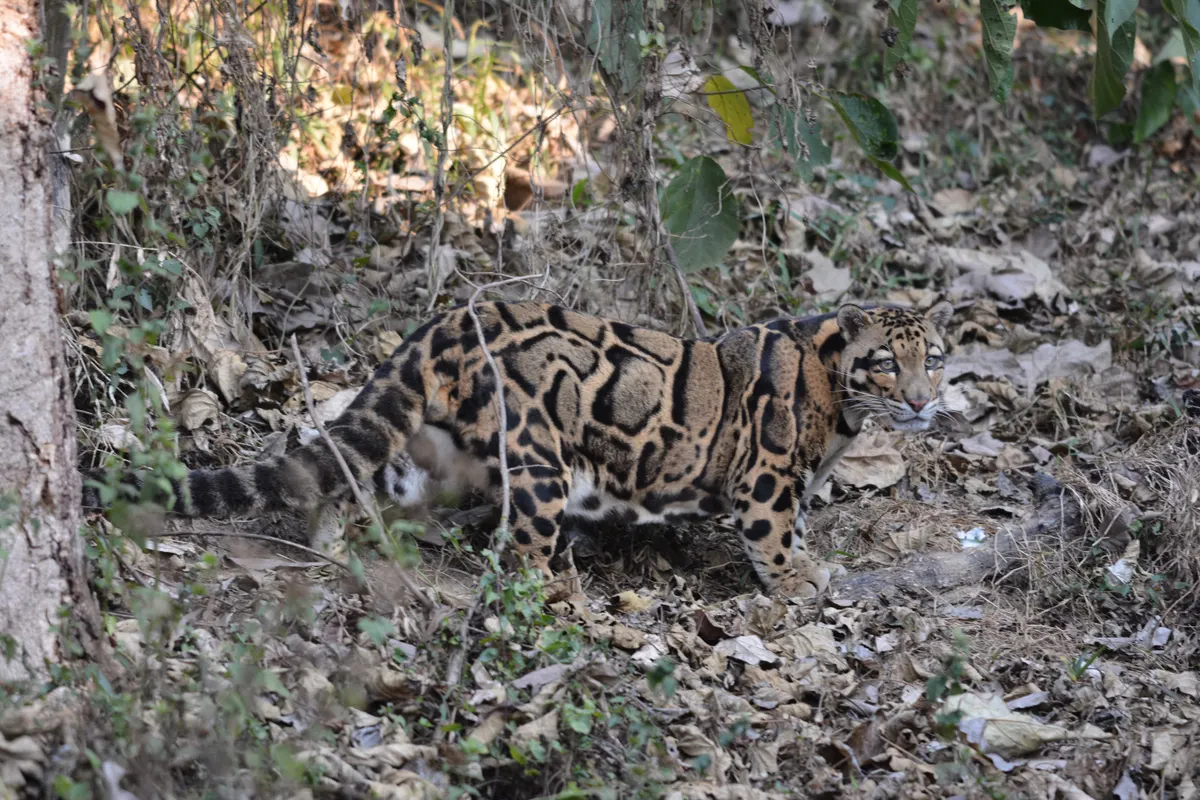
Clouded leopard with large cloud-shaped coat markings in forest
The clouded leopard is a mid-sized Asian cat named for the large cloud-shaped blotches on its coat.
MammaliaVulnerable

Clouded Leopard

Relative to skull size, the clouded leopard has the longest canine teeth of any living cat, sometimes drawing comparisons to sabre-toothed cats.

The clouded leopard is a medium-sized wild cat of forests from the Himalayan foothills through mainland Southeast Asia to southern China. It is named for the large, cloud-shaped blotches on its coat and is known for having the longest canine teeth relative to skull size of any living cat and for exceptional climbing ability.

By · Updated

Quick Facts

Clouded Leopard at a glance

Neofelis nebulosaCarnivoraFelidae

About their home

Kind of animal

Mammalia

Where they live

What they eat

How safe?

Vulnerable

Size and speed

How heavy

11.5 kg – 23 kg

How long

69 cm – 108 cm

How fast

Agile climber rather than a fast runner

Lifespan

Not well documented in the wild

Core article

Clouded Leopard: ecology and life history

A closer look at habitat, diet, behavior, reproduction, and conservation.

Start here

Clouded Leopard

The clouded leopard is a medium-sized wild cat of Asian forests, named for the large, dark, cloud-shaped blotches that mark its coat. It sits between the small cats and the big roaring cats in size, and it is one of the most tree-adapted members of the family. Two features draw the most attention: canine teeth that are the longest of any living cat relative to skull size, and a set of climbing skills that let it move through the canopy in ways most cats cannot.

Much of what is stated confidently about the species comes from a small number of field studies and captive observations. Because the cat is secretive, nocturnal, and thinly distributed, many aspects of its wild behavior remain poorly documented.

Anatomy and Canine Teeth

Head-and-body length ranges from roughly 69 to 108 cm, with a tail of about 61 to 91 cm that can be nearly as long as the body. Adults weigh between about 11.5 and 23 kg. The legs are relatively short and stout, and the paws are broad, giving the cat a low, muscular build suited to climbing rather than sustained running.

The most cited feature is the upper canine teeth, which reach about 4 cm and are the longest of any living cat measured against skull size. This proportion has led some writers to describe the clouded leopard as a "modern-day sabre-tooth," though the comparison is loose; the true sabre-toothed cats were only distant relatives and much larger. The long canines help the cat grip and hold prey.

The coat is the source of the common name. A pale grey to tawny ground color carries large, irregular, partly dark-edged blotches that resemble clouds, with smaller spots on the head and legs and paired markings along the tail. The pattern breaks up the animal's outline in dappled forest light.

Habitat and Distribution

Clouded leopard among branches in a leafy enclosure
Dense forest with heavy tree cover suits the clouded leopard's climbing, ambush-hunting lifestyle.

The clouded leopard is a forest specialist. Its range runs from the foothills of the Himalayas through Northeast India, Bhutan, and Nepal into mainland Southeast Asia, including Myanmar, Thailand, Laos, Vietnam, and Cambodia, and reaches into southern China. It has also been recorded historically in Bangladesh. The cat is considered locally extinct in Singapore and Taiwan.

Across this range it uses dense evergreen and semi-evergreen tropical forest, subtropical broadleaf forest, and montane forest. Records span a wide elevation band, from near sea level to well above 3,000 meters in the Himalayan portion of the range. Camera-trap and radio-collar work suggests the species is closely tied to forest cover, which makes it sensitive to logging and forest fragmentation.

Diet and Hunting

Clouded leopard walking with its long tail extended
Long canines and a wide gape let it seize and hold prey that can be as large as itself.

The clouded leopard is a carnivore that takes both tree-dwelling and ground-living prey. Documented and reported prey include deer, wild pigs, primates such as macaques, squirrels and other rodents, porcupines, and birds. The exact mix varies by location and is not fully described for most of the range.

Hunting appears to be mostly nocturnal. There is a common claim that clouded leopards ambush prey by dropping from branches, but direct field evidence for arboreal ambush is limited; much hunting is thought to happen on the forest floor, with trees used for resting, cover, and travel. The long canines and strong forelimbs suit the capture of prey that can be sizable relative to the cat's own body.

Behavior and Climbing

Clouded leopard sitting alert
Adults hold individual home ranges and come together mainly to breed.

Climbing is the clouded leopard's defining behavior. Its ankle joints are unusually flexible and can rotate, which allows the cat to climb down a vertical trunk headfirst, a skill shared by few cats. It can also hang from a branch by its hind feet, leaving the front paws free, and it uses its long tail as a counterbalance while moving through the canopy. Unfused bones in the lower forelimb add to this flexibility.

Outside the breeding season the species is solitary. Radio-tracking studies have reported home ranges on the order of tens of square kilometers, though sample sizes are small. Animals rest in trees or dense cover during the day and become active around dusk and at night. The clouded leopard is not known to roar; like several mid-sized cats it produces a range of calls but lacks the specialized structures of the big roaring cats.

Reproduction and Young

Breeding data come largely from captivity. After a gestation of about 85 to 95 days, the female gives birth to a litter of one to five cubs, most often three. Newborn cubs are small, weighing on the order of 140 to 280 grams, and are born with dark, solid markings that develop into the adult clouded pattern as they grow.

Cubs open their eyes within about two weeks, begin taking solid food after a few weeks, and become independent at roughly ten months. Captive breeding has been difficult historically, with aggression between paired adults a recurring problem; coordinated breeding programs and, more recently, assisted reproduction have improved results.

Taxonomy and Relatives

The clouded leopard belongs to the cat family, Felidae, in the order Carnivora. Its genus, Neofelis, sits apart from both the small cats and the big cats of the genus Panthera, which includes the leopard, the jaguar, the snow leopard, and the tiger. Despite the shared name, the clouded leopard is not a close relative of the true leopard.

An important distinction is that the mainland clouded leopard (Neofelis nebulosa) is a separate species from the Sunda clouded leopard (Neofelis diardi) of Borneo and Sumatra. Genetic work indicates the two lineages diverged roughly one to two million years ago, and the Sunda cat was recognized as a distinct species in 2006. This page covers the mainland species only.

Conservation and Threats

Clouded leopard resting on a wooden platform
Listed as Vulnerable, the species is declining from forest loss and poaching across its range.

The IUCN Red List classifies the mainland clouded leopard as Vulnerable, with a decreasing population trend. The total number of mature individuals is suspected to be fewer than 10,000, with no single subpopulation thought to exceed about 1,000 adults; some assessments place the figure lower still.

The main threats are habitat loss from large-scale deforestation and poaching for the wildlife trade, where the cat is hunted for its skin, teeth, and bones. Incidental capture in snares set for other animals adds to the pressure. Because the species depends on forest cover and occurs at low densities, continued forest loss and hunting across Southeast Asia are the central conservation concerns.

References and Authoritative Sources

Clouded Leopard: classification and fun facts

Classification

Scientific Taxonomy
  1. Kingdom

    Animalia

  2. Phylum

    Chordata

  3. Class

    Mammalia

  4. Order

    Carnivora

  5. Family

    Felidae

  6. Genus

    Neofelis

  7. Species

    N. nebulosa

Did You Know?

Fun Facts

1

Relative to skull size, the clouded leopard has the longest canine teeth of any living cat, sometimes drawing comparisons to sabre-toothed cats.

2

It can climb down a vertical tree trunk headfirst, a skill few cats share.

3

Flexible ankle joints let it hang from branches by its hind feet, freeing the front paws.

4

The tail can be nearly as long as the head and body, working as a counterbalance in the canopy.

5

The large, dark, cloud-shaped blotches on its coat give the species its common name.

6

The mainland clouded leopard is a separate species from the Sunda clouded leopard (Neofelis diardi) of Borneo and Sumatra, splitting roughly one to two million years ago.

Common Questions

FAQ about Clouded Leopard

Select a question to reveal the answer.

What is a clouded leopard?

The clouded leopard (*Neofelis nebulosa*) is a medium-sized wild cat in the family Felidae, named for the large cloud-shaped blotches on its coat. It is also called the mainland clouded leopard to distinguish it from the Sunda clouded leopard.

Where do clouded leopards live?

They occur in forests from the Himalayan foothills through Northeast India, Bhutan, and Nepal into mainland Southeast Asia and southern China. They favor dense tropical, subtropical, and montane forest.

What do clouded leopards eat?

They are carnivores that hunt both tree-dwelling and ground animals, including deer, wild pigs, primates such as macaques, squirrels, porcupines, and birds.

Why does the clouded leopard have such long canine teeth?

Relative to skull size, its upper canines are the longest of any living cat, reaching about 4 cm. They help the cat grip and subdue prey, and the proportions have led researchers to compare it loosely with sabre-toothed cats.

How well do clouded leopards climb?

They are among the most arboreal of cats. Flexible ankle joints allow them to climb down trunks headfirst and hang from branches by their hind feet, while a long tail provides balance.

Are clouded leopards endangered?

The IUCN Red List classifies the mainland clouded leopard as Vulnerable with a decreasing population, estimated at fewer than 10,000 mature individuals. Habitat loss from deforestation and poaching for the wildlife trade are the main threats.