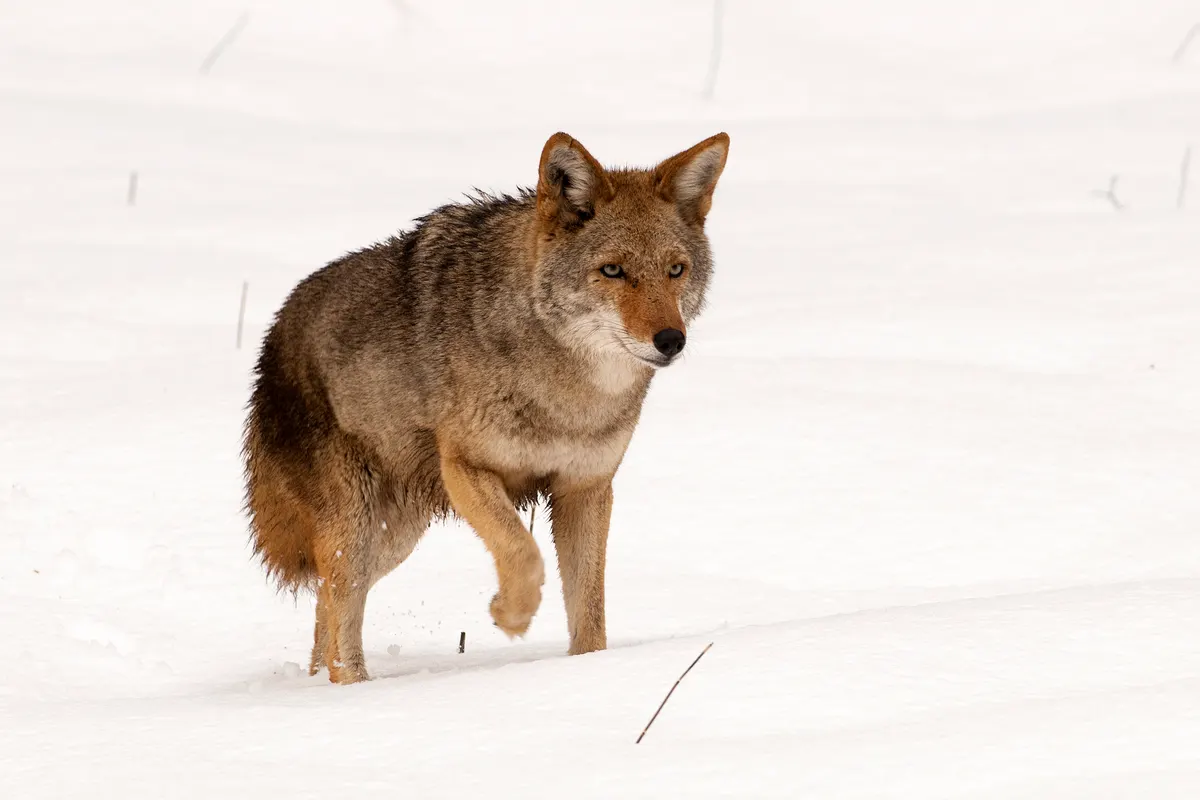
Coyote walking through snow in Yosemite National Park
The coyote is a medium-sized North American canid closely related to wolves.
MammaliaLeast Concern

Coyote Facts

Coyotes are also called prairie wolves, though they are smaller than gray wolves.

The coyote is a medium-sized North American canid adapted to grasslands, forests, and even cities. It hunts rodents and rabbits, howls at night, and ranks as Least Concern.

By · Updated

Quick Facts

Coyote at a glance

Canis latransCarnivoraCanidae

About their home

Kind of animal

Mammalia

Where they live

What they eat

How safe?

Least Concern

Size and speed

How heavy

20 pounds – 50 pounds

How long

30 inches – 40 inches

How fast

Up to about 40 mph in short bursts

Lifespan

About 10 to 14 years

Core article

Coyote: ecology and life history

A closer look at habitat, diet, behavior, reproduction, and conservation.

Start here

Coyote

Lean, sharp-eared, and endlessly adaptable, the coyote (Canis latrans) is one of North America's signature wild dogs. This opportunistic carnivore of the Canidae family thrives in open grasslands and prairie yet also survives in deserts, forest edges, farmland, and cities from Canada to Central America — one of the few large carnivores that has expanded while others declined.

One of the Most Adaptable Wild Dogs

The coyote shares the genus Canis with the gray wolf and domestic dog — its name means "barking dog" — and fills the niche of a mid-sized hunter, lighter than a wolf, larger and more social than most foxes. Adults run 30 to 40 inches in body length with a bushy black-tipped tail, stand 18 to 24 inches at the shoulder, and weigh 20 to 50 pounds, northern animals heavier. The grizzled gray-to-tawny coat with reddish legs blends into dry grass and scrub; pointed ears, a narrow muzzle, and keen senses locate rodents under snow or soil, and long legs give an efficient trot with bursts near 40 mph. Coyotes and wolves can hybridize where ranges meet, and eastern coyotes carry some wolf and dog ancestry, but they remain distinct — a coyote has a narrower muzzle, larger ears, smaller feet, and typically carries its tail low. See coyote vs wolf for a direct comparison.

Where Coyotes Live

Coyote standing in open grassland used for hunting and travel
Prairie and grassland edges give coyotes clear sight lines and abundant rodent prey.

Coyotes prefer open grassland and prairie rich in rodents and rabbits, but they are true generalists, ranging from Alaska and most of Canada through nearly all the contiguous U.S. and Mexico into Central America. They use forest edges, deserts, farmland, and suburban greenbelts wherever cover and food exist, denning in bank burrows, old badger holes, or thick brush. Their expansion was helped by wolf removal, the clearing of eastern forests into farm edges, and an ability to cross developed land using rail corridors, drainage channels, parks, and vacant lots as travel cover. Urban coyotes often rest in secluded patches by day and enter developed areas after dark, adjusting their schedule to avoid people.

What Coyotes Eat

Coyote feeding on a bison carcass in Yellowstone National Park
Besides hunting, coyotes scavenge large carcasses when wolves or other predators leave leftovers.

Coyotes are opportunistic carnivores. Rodents, rabbits, and hares form the core of most diets, but they also take birds and insects, eat fruit and berries in summer, scavenge carrion, and raid pet food and garbage. Hunting is usually at dusk and night, alone or in pairs, with family groups sometimes cooperating on larger prey; unlike wolves, coyotes more often target small prey and leftovers than bring down adult deer. They cache surplus food, and in farm country they remove large numbers of crop-eating rodents — while unsecured livestock carcasses, compost, and outdoor pet food reward repeat visits, so removing those attractants does more for coexistence than displacing one animal.

Behavior: Pairs, Families, and the Night Chorus

Mother coyote sitting alert while watching over her den area
Parents guard dens closely while pups stay underground during their first weeks.

Coyotes form mated pairs that may last several seasons. Outside breeding they often hunt alone, but a family — parents plus that year's young — shares a territory marked with urine, scat, and scent, foraging separately and reuniting through calls. The famous nighttime chorus of yips and howls, which can make a few animals sound like many, keeps family in contact and warns rivals (so a chorus is a poor way to count them). Coyotes usually flee people rather than confront them, though they may defend a den with pups, and defensiveness rises in spring and early summer. A coyote that repeatedly approaches for food has become habituated; keeping pets close and acting assertive if one lingers helps prevent that.

Life Cycle: Dens and Dispersing Pups

Coyote pup exploring grassy ground near wetland cover
Pups begin exploring near the den before joining longer hunting trips.

Breeding peaks in late winter. After about 60 to 63 days' gestation the female bears roughly 4 to 7 pups, born blind, their eyes opening at 10 to 14 days; litter size responds to food supply. Both parents provision, the male and sometimes older offspring bringing food and later regurgitating meals for the growing pups, and families may shift the litter between den or rendezvous sites to escape disturbance or parasites. Pups explore and practice hunting by summer, then many disperse in autumn or the next year — sometimes over long distances — which is a main route by which coyotes colonize empty habitat. Mortality is highest among juveniles and dispersers, especially near roads. Wild coyotes often live 10 to 14 years.

Conservation: Thriving Alongside People

Map of modern North American Canis ranges including coyotes
Coyotes expanded eastward as forests fragmented and large wolf packs declined.

The coyote is Least Concern with an increasing trend, its adaptability making it a rare large carnivore that has spread rather than shrunk. Local threats — road mortality, poisoning, trapping, conflict with people and pets, and diseases like mange and canine distemper — still matter, but conservation today is really about coexistence: securing trash, protecting pets, and not feeding them. Broad eradication campaigns have generally failed, because survivors and dispersers recolonize and litter sizes can rise when groups are disrupted while food stays abundant; targeted action has a place around a documented livestock or safety problem, but indiscriminate removal is no substitute for managing food, fencing, and husbandry. Reporting abnormal behavior, supervising small pets, keeping cats indoors, and using secure livestock enclosures reduce risk while letting this canid keep its role as predator and scavenger.

References and Authoritative Sources

Coyote: classification and fun facts

Classification

Scientific Taxonomy
  1. Kingdom

    Animalia

  2. Phylum

    Chordata

  3. Class

    Mammalia

  4. Order

    Carnivora

  5. Family

    Canidae

  6. Genus

    Canis

  7. Species

    C. latrans

Did You Know?

Fun Facts

1

Coyotes are also called prairie wolves, though they are smaller than gray wolves.

2

Their nighttime choruses mix howls, yips, and barks to contact family members.

3

Coyotes can live in deserts, grasslands, forests, and many cities.

4

A coyote’s hearing can pick up rodents moving under snow or grass.

5

Pups may stay with parents for up to a year before dispersing.

6

Coyotes expanded into eastern North America after large wolf packs declined.

Common Questions

FAQ about Coyote

Select a question to reveal the answer.

What is a coyote?

A coyote is a wild member of the dog family (*Canidae*) native to North America. It is smaller and more adaptable than a gray wolf.

Where do coyotes live?

Coyotes live across North America in grasslands, prairies, forest edges, deserts, farmlands, and many suburban areas.

What do coyotes eat?

Coyotes are carnivores that mainly hunt rodents and rabbits, but they also eat birds, insects, fruit, and scavenged meat.

Why do coyotes howl?

Howls and yips help coyotes find family members, mark territory, and warn rivals — especially at dusk and night.

What is a baby coyote called?

A baby coyote is called a pup. Pups are born in dens and cared for by both parents.

Are coyotes the same as wolves?

No. Coyotes and wolves are related *Canis* species, but coyotes are usually smaller, hunt more alone or in pairs, and thrive closer to people.

Show 2 more questionsExpand
Are coyotes endangered?

Coyotes are listed as Least Concern. Their overall population is stable to increasing across much of North America.

Are coyotes dangerous to people?

Wild coyotes usually avoid people. Conflicts happen most often when pets are left unattended or when coyotes are fed intentionally.