Aye-aye gripping a branch with large ears and a long middle finger visible
The aye-aye is Madagascar's largest nocturnal primate and the only living member of Daubentoniidae.
MammaliaEndangered

Aye-aye

The aye-aye is the world's largest nocturnal primate.

The aye-aye is an endangered, nocturnal lemur found only in Madagascar. It locates wood-boring insect larvae by rapidly tapping branches and listening for hollow spaces, then opens the wood with continuously growing incisors and extracts prey with a thin, flexible middle finger. It is the only living member of the family Daubentoniidae.

By · Updated

Quick Facts

Aye-aye at a glance

Daubentonia madagascariensisPrimatesDaubentoniidae

About their home

Kind of animal

Mammalia

Where they live

What they eat

How safe?

Endangered

Size and speed

How heavy

2.5 kg – 2.8 kg

How long

36 cm head and body – 44 cm head and body; the tail can be longer than the body

How fast

Lifespan

Not well documented

Core article

Aye-aye: ecology and life history

A closer look at habitat, diet, behavior, reproduction, and conservation.

Start here

Aye-aye

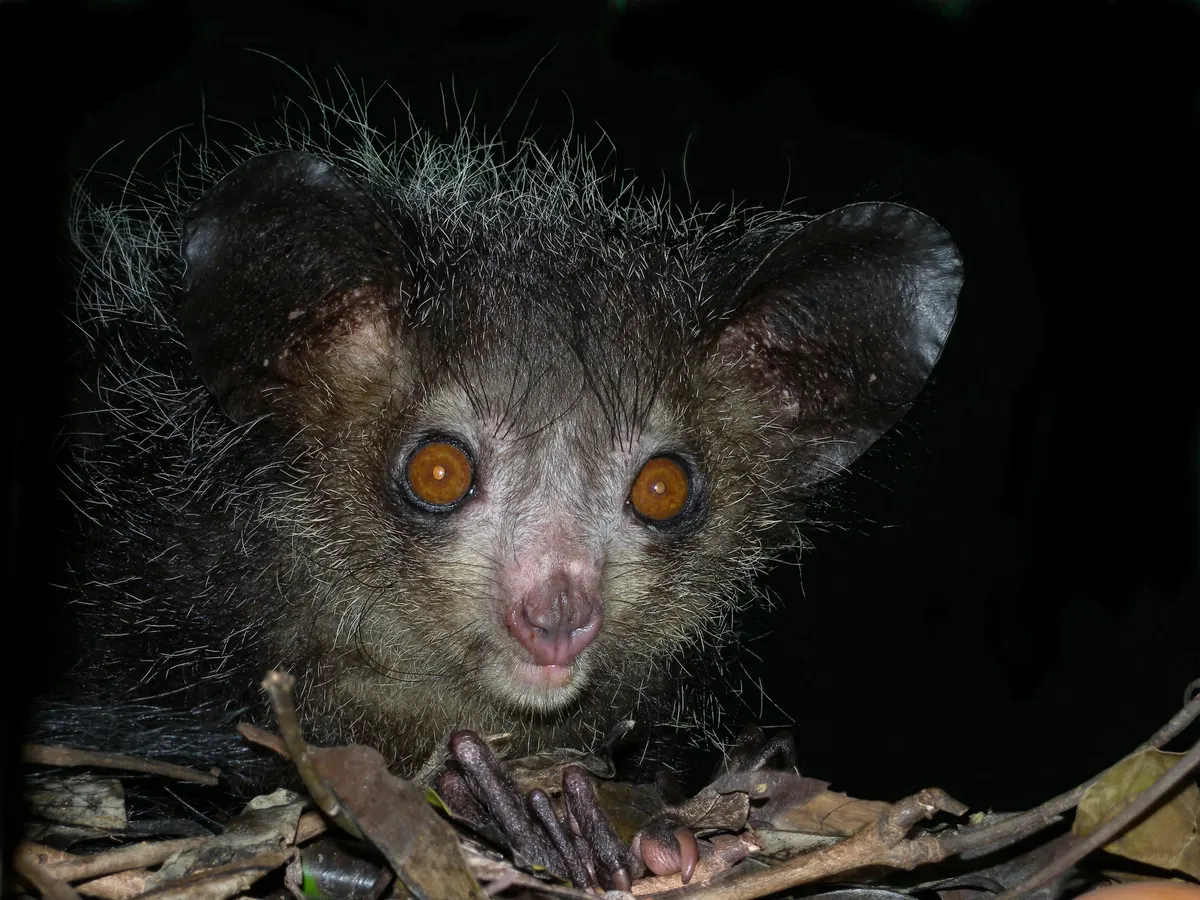
An aye-aye moving through a tree at night can seem assembled from unrelated animals: a lemur's body, a squirrel-like tail, bat-sized ears, rodent-like incisors and hands dominated by one impossibly thin finger. Those features are not random oddities. Together they form one of the most specialized feeding systems among mammals. The aye-aye taps wood, listens for hidden cavities, opens them with its teeth and fishes out insect larvae with its third finger. This is a primate doing ecological work that woodpeckers perform elsewhere.

The species, Daubentonia madagascariensis, lives only in Madagascar and is the sole surviving member of the family Daubentoniidae. It is also the world's largest nocturnal primate. Its unusual form has made it famous, but local persecution and the continuing loss of Madagascar's forests have left it classified as Endangered.

A Finger Built for Tapping

The aye-aye's third finger is long, narrow and unusually mobile. As the animal walks along a branch, it taps the wood rapidly and angles its large ears toward the surface. Differences in the returning sound reveal cavities and tunnels made by wood-boring insects. Researchers call this percussive foraging rather than true echolocation: the aye-aye creates the sound by tapping a solid object and interprets the vibration and echo, instead of emitting calls into open air as a bat does.

Once a likely tunnel is found, the aye-aye uses its incisors to cut through bark and wood. The flexible finger then enters the opening, swivels through the tunnel and hooks out a larva. The same digit can scoop pulp from fruit or the contents of an egg. Its joint is capable of movement in several directions, making the finger more like a precision probe than a conventional primate digit.

The teeth are equally unusual. The front incisors grow continuously and sharpen through use, allowing the animal to gnaw hard wood and seed cases. Aye-ayes lack the toothcomb shared by most other lemurs. Their feeding-specialized hands also make ordinary gripping more difficult, but a small structure discovered near the wrist partly solves that problem. This pseudothumb contains bone and cartilage, has its own muscles and bears a fingerprint-like pad. It acts as an extra point of contact while the animal grips a branch.

Habitat and Range

Wild aye-aye photographed in forest at night in Madagascar
Aye-ayes travel and forage after dark, then sleep by day in spherical leaf nests high in trees.

Aye-ayes are endemic to Madagascar, where they have a wider ecological range than their rarity once suggested. They occur in humid rainforest along the east, dry deciduous forest in the west and northwest, mangroves, secondary growth and some plantations. Camera surveys and direct sightings have documented them in more parts of the island than older accounts recognized, but a broad range does not mean the population is secure.

Trees remain essential. Aye-ayes forage mainly in the canopy and build spherical sleeping nests from leaves, twigs and vines. A nest sits high in a tree fork and has a side entrance. One animal may maintain several nests, and different individuals sometimes use the same structure on different days. During the night aye-ayes also descend to the ground, especially when moving between separated trees.

Forest fragmentation changes that movement. An aye-aye can use secondary vegetation, but isolated patches expose it to people and reduce safe routes between feeding and sleeping sites. Plantations may offer coconuts, mangoes or lychees, yet feeding there can cause the animal to be treated as a crop pest.

Diet and Percussive Foraging

Wild aye-aye leaning along a branch while foraging in Madagascar
Percussive foraging combines rapid tapping, careful listening, gnawing and probing with the middle finger.

The aye-aye is an omnivore, although insect larvae, nuts and seeds are especially important. Wood-boring beetle larvae provide fat and protein. Ramy seeds from Canarium trees are another favored food, and the animal also takes fruit, nectar, fungi and cultivated crops.

Different foods call for different uses of the same toolkit. On wood, the middle finger taps and probes. On a hard nut, the incisors open a small access hole and the finger removes the kernel. With soft fruit, the finger scoops pulp from the skin. Large ears help detect subtle changes beneath bark, while a strong sense of smell may guide the animal toward fruit and plant exudates.

This foraging style takes time to learn. Young aye-ayes follow their mothers for an extended period and practice manipulating food long after they begin eating solids. The slow development is one reason a female cannot produce young frequently.

Solitary Behavior and Communication

Aye-aye resting on branching timber in a wooded enclosure
Male home ranges overlap several females, but adults normally forage alone rather than forming troops.

Aye-ayes forage mostly alone. Female home ranges are commonly reported at roughly 30 to 50 hectares, while males may range across 100 to 200 hectares and overlap several females. Overlap does not create a stable troop like that of a ring-tailed lemur. Adults usually meet briefly, although two or three animals may tolerate one another at a rich feeding site.

Activity begins around dusk and can continue through most of the night. An animal alternates between traveling, tapping, feeding and grooming, sometimes hanging upside down to reach a branch. By day it curls inside a leaf nest.

Scent marks help identify occupied space. Aye-ayes also use several calls, including contact sounds, alarm or protest calls and aggressive screams. Their large ears are not only for locating food; they remain important in communication and in detecting danger in the dark.

Babies and Slow Development

Aye-aye climbing through branches in a dark enclosure
Young aye-ayes spend months learning the precise movements needed to find and extract hidden food.

Breeding can occur throughout the year. A female may mate with more than one male during an estrous period, and gestation lasts about 172 days. She usually gives birth to one infant and may not reproduce again for two or three years.

The infant remains in a nest at first, then begins exploring nearby branches. Solid food may enter the diet at around five months, but nursing and food begging can continue well beyond that point. Young animals need months of practice before their movement and extractive foraging resemble those of adults. Sexual maturity is reached at roughly two to three years.

That slow schedule limits population recovery. Species that produce one dependent infant at long intervals cannot quickly replace adults lost to forest clearing or killing.

Conservation and Human Conflict

Aye-aye looking through forest vegetation
Forest fragmentation and deliberate killing continue to threaten the endangered aye-aye across Madagascar.

The IUCN lists the aye-aye as Endangered and considers the population to be decreasing. Forest conversion for agriculture, timber extraction and development removes and fragments habitat across Madagascar. Even where trees remain, deliberate killing can be a serious local threat.

Some Malagasy communities associate the aye-aye with harmful omens, though beliefs vary greatly from place to place and should not be treated as a single national tradition. In agricultural areas the animal may also be killed after feeding on coconuts, lychees or other crops. These pressures operate alongside a slow reproductive rate and an uncertain wild population size.

Protected areas hold aye-ayes in several regions, and conservation breeding has produced a small managed population outside Madagascar. The fossa, Madagascar's largest native carnivore, can prey on aye-ayes, but human activity is the dominant conservation problem. Protecting connected forest and reducing retaliatory killing matter more than simply proving the animal occurs at additional sites.

Taxonomy and Evolution

The aye-aye is a strepsirrhine primate and a relative of other lemurs, but its lineage separated early. It is the only living species in Daubentonia and Daubentoniidae. A larger relative, Daubentonia robusta, survived into the recent past before disappearing after people reached Madagascar.

Early European naturalists struggled to classify the living species because its incisors and gnawing behavior looked rodent-like. Anatomy and later genetic evidence placed it firmly among primates. The resemblance to a rodent is an example of convergent adaptation: similar feeding demands produced similar tools in animals with very different ancestry.

References and Authoritative Sources

Aye-aye: classification and fun facts

Classification

Scientific Taxonomy
  1. Kingdom

    Animalia

  2. Phylum

    Chordata

  3. Class

    Mammalia

  4. Order

    Primates

  5. Family

    Daubentoniidae

  6. Genus

    Daubentonia

  7. Species

    D. madagascariensis

Did You Know?

Fun Facts

1

The aye-aye is the world's largest nocturnal primate.

2

Its incisors grow continuously, a trait unique among living primates.

3

The thin middle finger works as both a percussion tool and a hook for extracting food.

4

Aye-ayes have a hidden pseudothumb made of bone and cartilage, giving each hand an extra gripping structure.

5

Madagascar has no woodpeckers, and the aye-aye occupies a similar ecological niche by extracting larvae from wood.

6

The aye-aye is the only living species in the family Daubentoniidae.

Common Questions

FAQ about Aye-aye

Select a question to reveal the answer.

What is an aye-aye?

The aye-aye (*Daubentonia madagascariensis*) is a nocturnal lemur found only in Madagascar. It is the sole living member of the family Daubentoniidae and is specialized for extracting insects and seeds from wood.

Why does the aye-aye have such a long middle finger?

The aye-aye taps branches with its thin third finger, listens for hollow insect tunnels, gnaws through the wood and then inserts the finger to hook out larvae. It also uses the finger to scoop pulp from fruit and eggs.

Where do aye-ayes live?

Aye-ayes are endemic to Madagascar. They occur in eastern rainforests, western dry forests, mangroves, secondary forest and some cultivated areas, spending much of their active time in trees.

What do aye-ayes eat?

Their diet includes wood-boring insect larvae, ramy nuts and other seeds, fruit, nectar, fungi and cultivated foods such as coconuts, lychees and mangoes.

Do aye-ayes use echolocation?

Not in the bat or dolphin sense. They use percussive foraging: tapping wood and interpreting changes in the returning sound to locate cavities and insect tunnels beneath the surface.

Why are aye-ayes endangered?

Forest clearing and fragmentation reduce suitable habitat. Aye-ayes are also killed as crop pests or because local taboos portray them as bad omens. Their slow reproduction makes depleted populations difficult to rebuild.