
Neofelis nebulosa / Panthera uncia
Clouded Leopard vs Snow Leopard
Despite the shared name, clouded leopards and snow leopards are different Asian cats: the smaller clouded leopard is a forest climber with cloud-shaped blotches, while the larger snow leopard is a thick-coated cat of high mountains.
By An Nguyen · Updated
At a glance
Published species data from both WildlifeDB profiles, aligned trait by trait. Size metrics highlight the larger value with a relative bar.
- Scientific name
- Clouded LeopardNeofelis nebulosa
- Snow LeopardPanthera uncia
- Classification
- Clouded LeopardMammalia · Felidae
- Snow LeopardMammalia · Felidae
- Native range
- Clouded LeopardAsia
- Snow LeopardAsia
- Primary habitat
- Clouded LeopardForest
- Snow LeopardGrassland
- Diet
- Clouded LeopardCarnivore
- Snow LeopardCarnivore
- Typical food
- Clouded LeopardDeer, Primates, Wild pigs, Birds, Squirrels
- Snow LeopardBlue sheep, Himalayan tahr, Ibex, Marmot, Hare
- Body length
- Clouded Leopard69 cm – 108 cm
- Snow Leopard3 feet – 4.5 feet
- Shoulder height
- Clouded Leopard—
- Snow Leopard1.7 feet – 2 feet
- Weight
- Clouded Leopard11.5 kg – 23 kg
- Snow Leopard55 pounds – 120 pounds
- Top speed
- Clouded LeopardAgile climber rather than a fast runner
- Snow LeopardUp to 40 mph in short bursts
- Wild lifespan
- Clouded LeopardNot well documented in the wild
- Snow Leopard10 to 12 years
- Social pattern
- Clouded LeopardClimbing and resting in trees, Hunting mostly at night, Living a solitary life outside breeding
- Snow LeopardSolitary, Crepuscular activity, Territory marking
- Key adaptations
- Clouded LeopardVery long upper canine teeth relative to skull size, Flexible ankle joints that rotate for headfirst descent, A long tail that acts as a counterbalance in trees
- Snow LeopardThick spotted fur, Wide nasal cavity, Long bushy tail
- Conservation
- Clouded LeopardVulnerable · Decreasing
- Snow LeopardVulnerable · Decreasing
- Reproduction
- Clouded LeopardAbout 85 to 95 days; 1 to 5 cubs, usually 3
- Snow LeopardAbout 90 to 100 days; 2 to 3 cubs per litter
Neither one is the leopard
Both names contain "leopard," and neither animal is Panthera pardus, the species called simply the leopard. The clouded leopard, Neofelis nebulosa, belongs to Neofelis, the sister lineage to Panthera. The snow leopard, Panthera uncia, is inside Panthera and so is a closer relative of lions and tigers than of the clouded leopard.
A further split is worth knowing: the mainland clouded leopard is a separate species from the Sunda clouded leopard, Neofelis diardi, of Borneo and Sumatra. The two lineages diverged roughly one to two million years ago.
Cloud blotches against rosettes on smoke grey
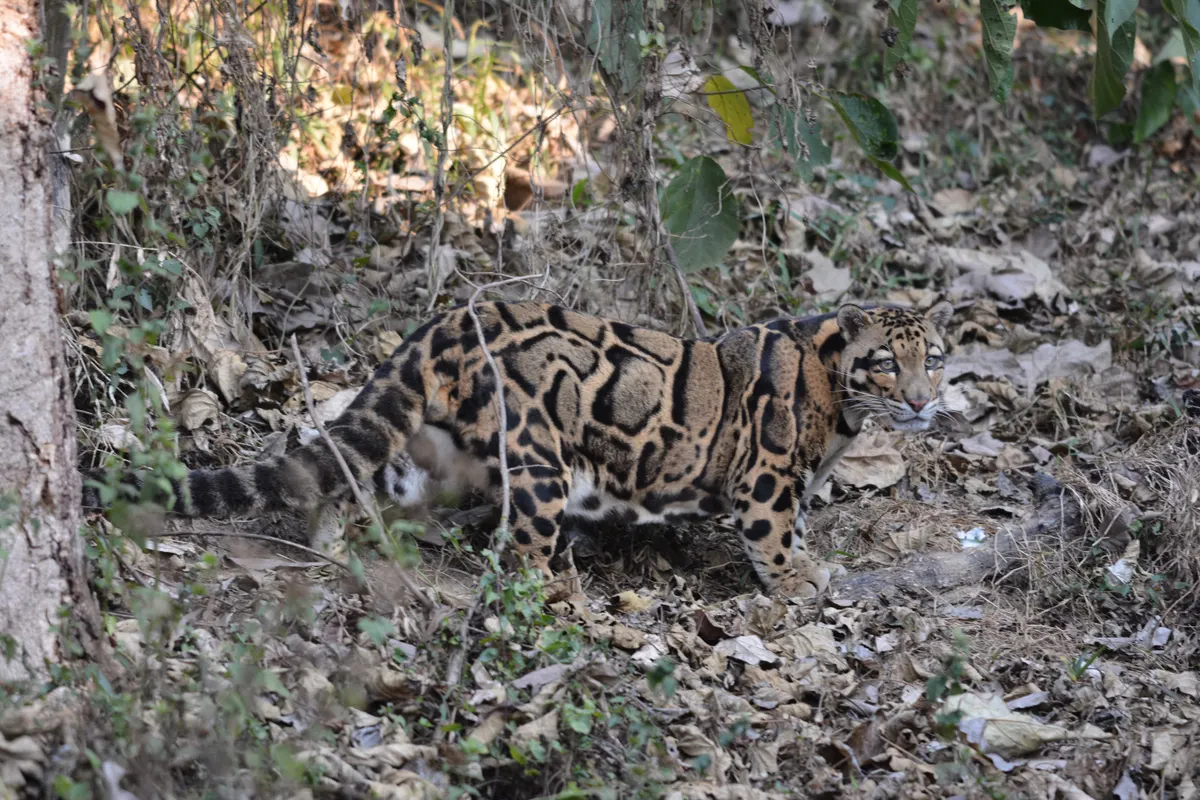
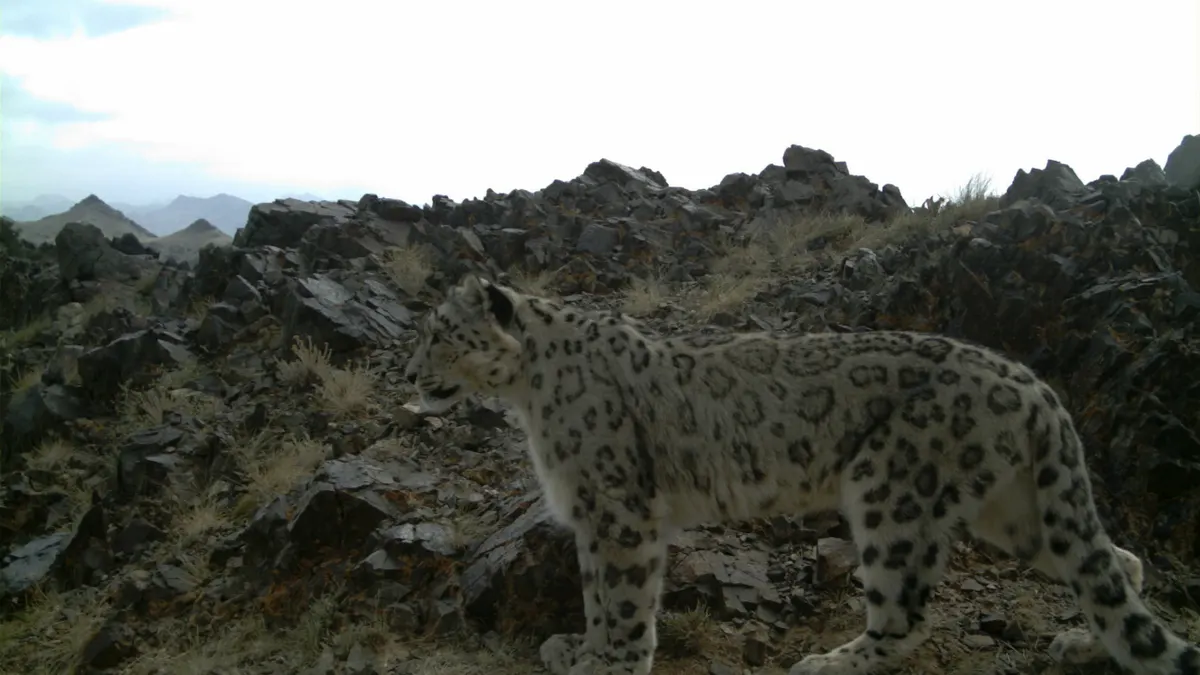
The coats are not similar. The clouded leopard has large, dark, cloud-shaped blotches on a tan ground — the pattern that gives the species its name. The snow leopard has a pale, smoky-grey coat marked with dark rosettes, plus a very long, thick tail.
Each pattern matches its background. Cloud blotches break up an outline among branches and canopy shadow; grey rosettes disappear against snow and bare rock.
The snow leopard is more than twice the weight
The snow leopard is the larger cat, at a head-and-body length of roughly 0.9 to 1.3 metres and about 25 to 55 kg. The clouded leopard measures around 69 to 108 cm and weighs 11.5 to 23 kg — under half the mass at the top of each range.
Body length ranges overlap more than weight does, so a poorly judged length can make the two look comparable when they are not.
The longest canines of any living cat
Relative to skull size, the clouded leopard has the longest upper canine teeth of any living cat, which has drawn comparisons to sabre-toothed cats. That gives a 20 kg animal an outsized bite, and it is one reason a small cat can take deer and wild pigs.
Neither species roars. Both lack the vocal anatomy of a lion or tiger and communicate with other calls; the snow leopard's is a "chuff," or prusten.
Head-first down a trunk, or balanced on a cliff
The clouded leopard is among the most arboreal of all cats. Flexible ankle joints rotate far enough for it to climb down a vertical trunk head-first and to hang from a branch by its hind feet, freeing the front paws. Its tail can be nearly as long as head and body and works as a counterbalance in the canopy.
The snow leopard solves a different balance problem on the ground. Wide paws spread its weight across deep snow like snowshoes, powerful hind legs support leaps across broken mountain terrain, and the long tail steadies it on steep slopes — then wraps around the face for warmth at rest. That tail length has a specific function rather than being decorative.
Both are solitary, secretive, and rarely seen. The snow leopard's nickname, "ghost of the mountains," reflects how seldom it is observed even where it is known to live.
Forest prey against mountain prey
Both are ambush carnivores that rely on stealth and a short rush, not a chase. What they catch follows the habitat.
The clouded leopard takes deer, wild pigs, macaques and other primates, squirrels, birds, and porcupines, hunting both on the ground and in trees. The snow leopard preys mainly on mountain herbivores — blue sheep, ibex, and Himalayan tahr — plus marmots and hares, and can kill animals several times its own weight.
Rainforest canopy against ground above the tree line
Habitat is the sharpest divide. The clouded leopard lives in tropical, subtropical, and montane forest across South and Southeast Asia, from the Himalayan foothills through Nepal, Bhutan, India, Myanmar, Thailand, Laos, and Vietnam.
The snow leopard lives high in the mountains of Central and South Asia — China, Mongolia, Nepal, India, Bhutan, Pakistan, Afghanistan, Kyrgyzstan — in alpine meadows, cliffs, and cold rocky slopes, often above the tree line. Their ranges meet along the Himalaya, but not at the same elevation.
Both Vulnerable, for different reasons
Both are listed as Vulnerable with decreasing populations, and both lose habitat and are poached — but the demand differs. Clouded leopards are killed largely for their skins. Snow leopards are taken for fur and bones, and are also killed in retaliation for livestock losses, which makes herder relations part of the conservation problem rather than a side issue.