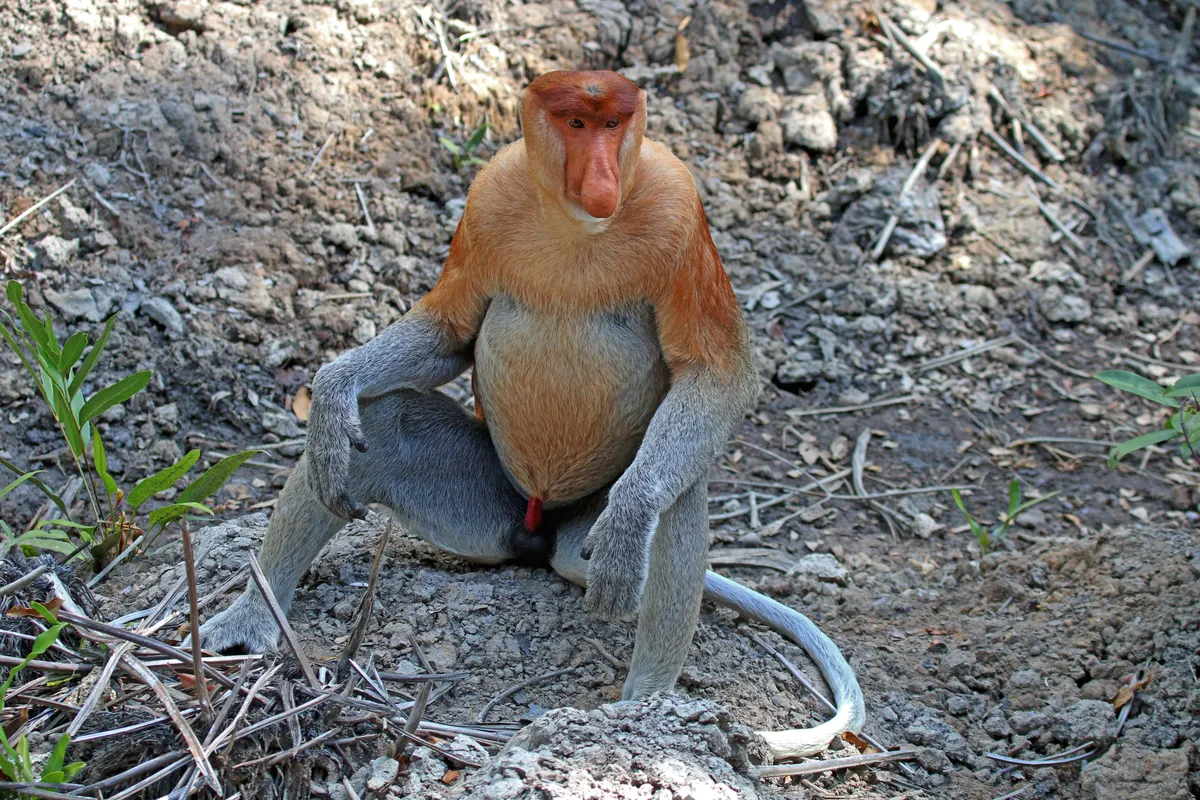
Male proboscis monkey with a large pendulous nose and reddish coat
The proboscis monkey is a Borneo endemic; mature males grow a large drooping nose.
MammaliaEndangered

Proboscis Monkey

Adult males can carry a nose longer than 10 cm that hangs below the mouth and acts as a resonating chamber for their honking calls.

The proboscis monkey is a leaf-eating Old World monkey endemic to Borneo. Males carry an oversized pendulous nose, and both sexes have a chambered, pot-bellied stomach and partially webbed feet that make them capable swimmers.

By · Updated

Quick Facts

Proboscis Monkey at a glance

Nasalis larvatusPrimatesCercopithecidae

About their home

Kind of animal

Mammalia

Where they live

What they eat

How safe?

Endangered

Size and speed

How heavy

7 kg (female) – 22 kg (male)

How long

53 cm (female head-body) – 76 cm (male head-body)

How fast

Agile climber and strong swimmer

Lifespan

Not well documented in the wild

Core article

Proboscis Monkey: ecology and life history

A closer look at habitat, diet, behavior, reproduction, and conservation.

Start here

Proboscis Monkey

The proboscis monkey is a large, reddish-brown Old World monkey found only on the island of Borneo. Two features set it apart from most primates: the drooping, oversized nose carried by adult males, and a rounded belly that houses a chambered stomach built for digesting leaves. It lives close to water and is one of the few monkeys that swims and dives well, using partially webbed hands and feet to cross the rivers and mangrove channels of its home range.

Anatomy and the Nose

Adult males are heavy, thickset animals. Head-and-body length reaches about 66 to 76 cm, with a tail of similar length, and males typically weigh 16 to 22 kg. Females are much smaller, around 53 to 62 cm in head-and-body length and 7 to 12 kg. This roughly two-to-one weight difference is one of the largest between the sexes of any Old World monkey.

The male's nose is the species' signature. It can grow longer than 10 cm and hangs down past the mouth. Two functions are supported by research. The nose acts as a resonating chamber that makes a male's honking calls louder and lower in pitch, and its size correlates with body size, testis volume, and the number of females a male holds. In other words, it works as both an amplifier and an honest signal of condition to rivals and potential mates. Females and young have much smaller, upturned noses.

Both sexes show a pronounced pot belly. This is not fat but a large, multi-chambered stomach, described below. The coat is reddish-brown over the back and shoulders, paler on the limbs and underside, with a grey tail and pinkish face in adults.

Habitat and Distribution

Proboscis monkey in dense riverine forest canopy
Tidal mangrove and riverside forest supply the young leaves that dominate the diet.

The proboscis monkey is endemic to Borneo, the large island divided among Indonesia, Malaysia, and Brunei. It does not occur naturally anywhere else. Within Borneo it is tied to lowland habitats near water: coastal mangrove forest, riverine forest along the banks of rivers and estuaries, and freshwater peat-swamp forest. Many of these sites are influenced by tides.

The species rarely moves far from rivers. Groups feed and travel through the canopy during the day and gather at riverside trees to sleep at night, which is why the animals are so often seen from boats. This attachment to waterways is central to the species' ecology and, as habitat is cleared, a major reason it is vulnerable. It is a wetland specialist that also depends on standing forest for food and shelter.

Diet and Digestion

Proboscis monkey among leaves
The pot-bellied look comes from a large, chambered stomach that ferments leaves like a cow's.

The proboscis monkey is a herbivore, more precisely a seasonal folivore and frugivore. Its diet is dominated by young leaves and unripe fruit, along with seeds, shoots, and flowers drawn from dozens of plant species. Feeding shifts through the year: fruit tends to make up more of the diet in the early months and leaves more of it later on.

Digestion is unusual for a monkey. The species is a foregut fermenter with a large, sacculated stomach divided into chambers, much like the arrangement seen in ruminants such as cattle. Symbiotic bacteria in these chambers break down cellulose and neutralize some plant toxins, which lets the animal extract nutrition from mature foliage that many other primates cannot use. Animals sometimes regurgitate and re-chew food to aid the process. This fermentation system is why the belly looks so distended, and it also explains why the monkeys avoid very sweet, ripe fruit: rapid fermentation of sugars can cause dangerous bloating.

Behavior and Social Groups

Proboscis monkey carrying a baby across a rope bridge
Harem groups travel together, and bachelor males form separate all-male bands.

Proboscis monkeys live in one-male groups, usually a single adult male with several females and their young, alongside separate all-male bachelor groups. These units are not fixed. Multiple groups often converge at riverside sleeping sites in the evening, forming loose aggregations, then disperse again to feed, a fission-fusion pattern. Larger gatherings at sleeping trees can number several dozen animals.

Much of the day is spent resting, which suits an animal that must ferment bulky, low-energy food. The dominant male leads group movement and uses honking calls, amplified by his nose, to coordinate the group and warn of disturbance.

The species is strongly associated with water. It is often called the most aquatic of the monkeys. Partially webbed hands and feet aid swimming, and individuals can travel underwater for roughly 20 metres. Animals will drop from branches into rivers to cross channels or to escape a predator, a risky move given the crocodiles that share these waters.

Reproduction and Young

Females reach maturity at around five years. Breeding is not tightly seasonal across the range. After a gestation of about 166 to 200 days, a female usually gives birth to a single infant, most often at night. Newborns have a dark, almost blue-grey face that lightens as they grow.

Infants nurse for roughly seven months and stay dependent on the mother for about a year. Young males eventually leave to join bachelor groups, while females may remain in or move between one-male groups. As with many primates, a new dominant male taking over a group can be a dangerous period for unweaned infants.

Taxonomy and Relatives

The proboscis monkey (Nasalis larvatus) is the only species in the genus Nasalis. It belongs to the family Cercopithecidae, the Old World monkeys, and within it the subfamily Colobinae, the leaf monkeys, a group defined by the chambered, fermenting stomach described above. Its closest relatives are other Asian colobines rather than the great apes.

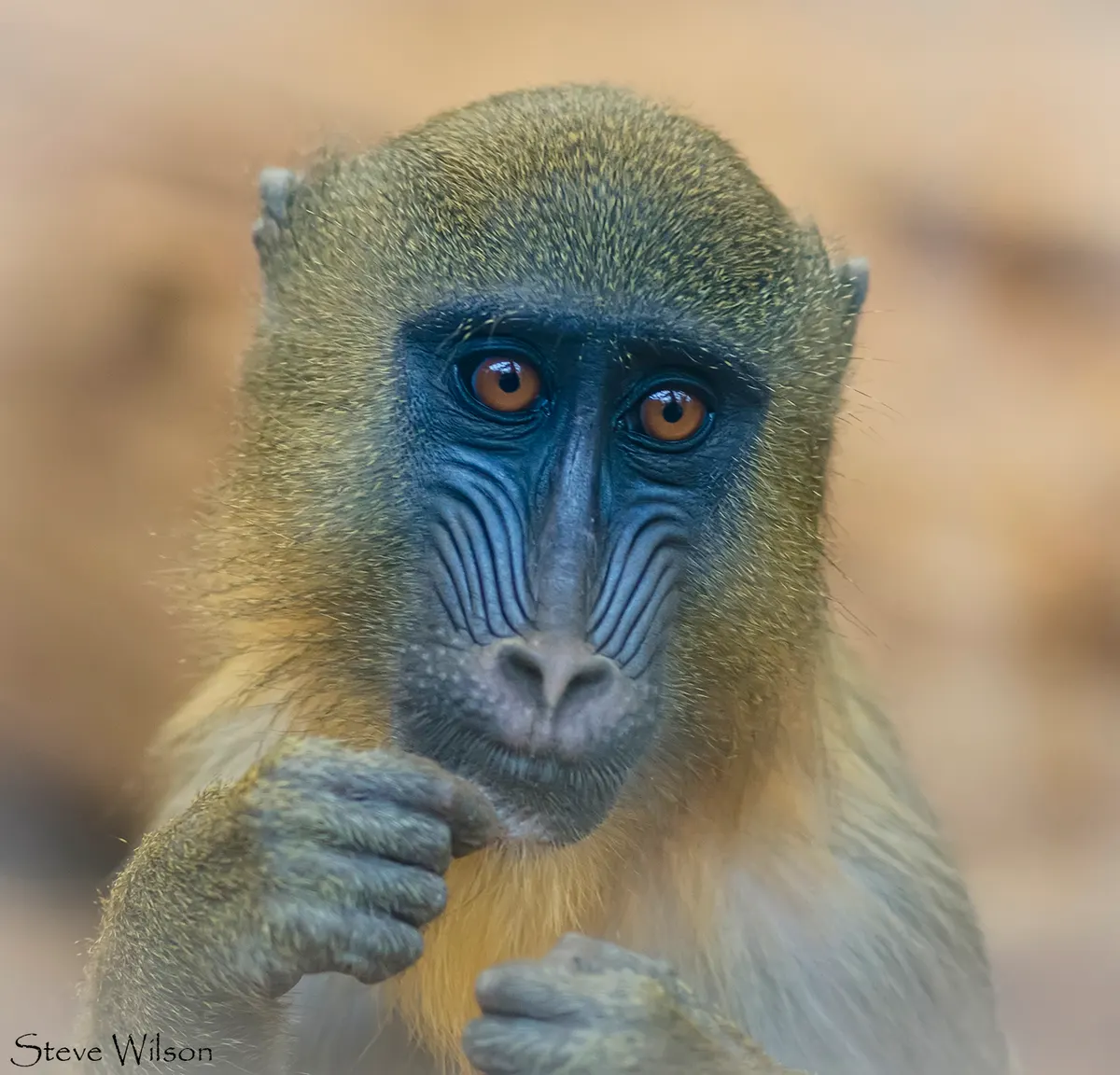
It is easy to confuse "monkey" and "ape," so the distinction is worth noting. The proboscis monkey is a true monkey with a long tail, unlike the tailless great apes such as the orangutan, which shares Borneo with it, and the African gorilla and chimpanzee. Among monkeys, another striking example of an exaggerated, sexually selected feature is the brightly colored face of the mandrill of Central Africa.

Conservation and Threats

Proboscis monkey in riverside vegetation
Endangered and declining, the species depends on protected coastal and riverine forests.

The IUCN Red List classifies the proboscis monkey as Endangered, with a decreasing population trend. Assessments have documented a decline of more than half over roughly the past four decades. The central problem is habitat loss: mangrove, riverine, and peat-swamp forests are being cleared and drained for oil palm plantations, aquaculture, logging, and coastal development. Because the species is confined to these waterside lowlands and does not disperse far from rivers, fragmentation cuts groups off from one another.

Hunting for meat and for a bezoar stone used in traditional medicine adds further pressure in some areas, and human disturbance along rivers can displace groups from feeding and sleeping sites. Conservation depends heavily on protecting intact riverine and mangrove forest, including reserves and sanctuaries in Malaysian and Indonesian Borneo where the monkeys are also a draw for wildlife tourism.

References and Authoritative Sources

Proboscis Monkey: classification and fun facts

Classification

Scientific Taxonomy
  1. Kingdom

    Animalia

  2. Phylum

    Chordata

  3. Class

    Mammalia

  4. Order

    Primates

  5. Family

    Cercopithecidae

  6. Genus

    Nasalis

  7. Species

    N. larvatus

Did You Know?

Fun Facts

1

Adult males can carry a nose longer than 10 cm that hangs below the mouth and acts as a resonating chamber for their honking calls.

2

The proboscis monkey is often called the most aquatic of all monkeys and can swim underwater for around 20 metres.

3

Its partially webbed hands and feet help it cross rivers and escape predators by diving in.

4

The rounded pot belly is a multi-chambered stomach where bacteria ferment tough leaves.

5

Males are roughly twice the weight of females, one of the largest size gaps among Old World monkeys.

6

Local Indonesian names include bekantan; in some regions it is nicknamed after the pot-bellied, large-nosed traders of colonial times.

Common Questions

FAQ about Proboscis Monkey

Select a question to reveal the answer.

What is a proboscis monkey?

The proboscis monkey (*Nasalis larvatus*) is a large, leaf-eating Old World monkey in the subfamily Colobinae. It is the only species in the genus *Nasalis* and is best known for the male's oversized nose and the species' pot-bellied build.

Where do proboscis monkeys live?

They are endemic to the island of Borneo, shared by Indonesia, Malaysia, and Brunei. They stay close to water in mangrove, riverine, and freshwater swamp forest, rarely straying far from rivers and estuaries.

What do proboscis monkeys eat?

They are herbivores that eat mainly young leaves, unripe fruit, and seeds. Their diet shifts seasonally, with more fruit early in the year and more leaves later. They avoid sweet ripe fruit, which can ferment dangerously in their specialized stomach.

Why do male proboscis monkeys have such big noses?

The male's large nose serves two roles. It acts as a resonating chamber that makes his honking calls louder and lower, and its size is a signal of body condition and social status. Studies link larger noses to larger body size and more mates.

Can proboscis monkeys swim?

Yes. They are among the most aquatic primates. Partially webbed hands and feet help them swim, and they can move underwater for roughly 20 metres, often crossing rivers or diving in to escape predators such as crocodiles.

Are proboscis monkeys endangered?

Yes. The IUCN Red List classifies the proboscis monkey as Endangered with a decreasing population. Clearance of mangrove and swamp forest for oil palm and other development, along with hunting, has driven a sharp decline over recent decades.