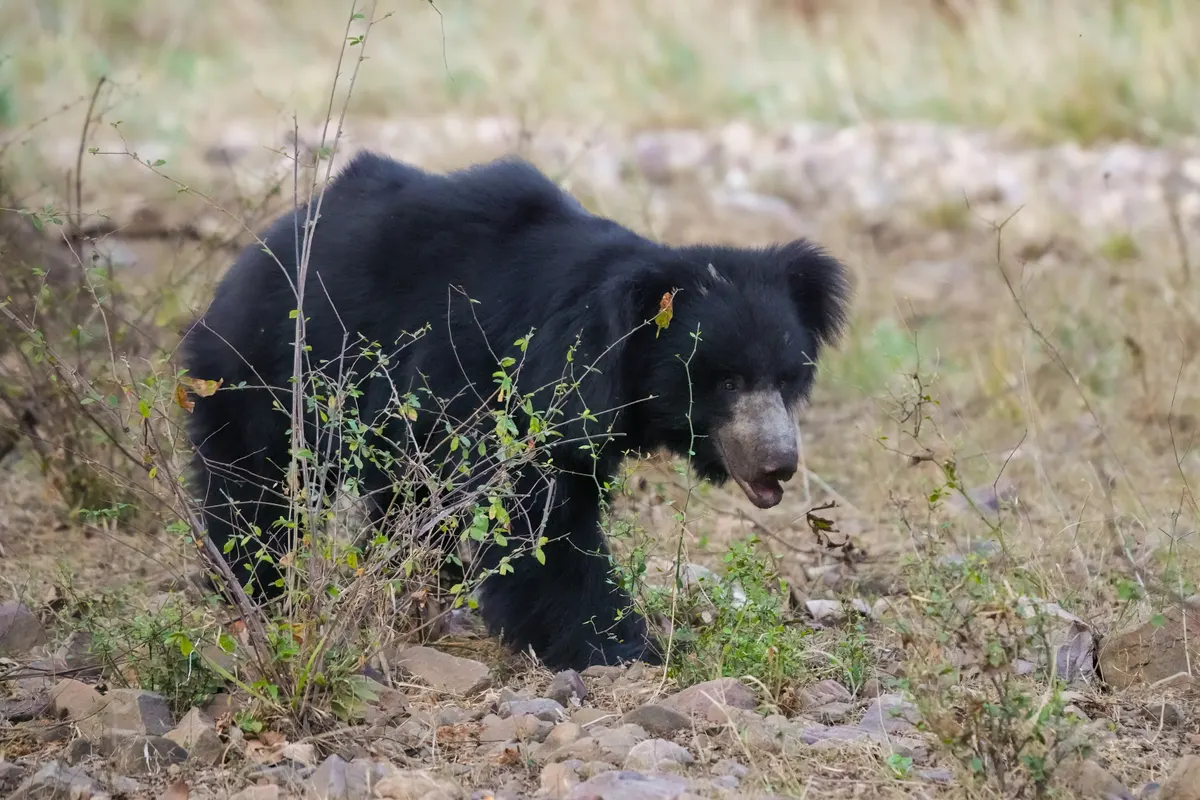
Shaggy black sloth bear with a pale chest mark walking in dry forest
The sloth bear is a shaggy, insect-eating bear of the Indian subcontinent.
MammaliaVulnerable

Sloth Bear

Sloth bears vacuum termites and ants through a gap in their front teeth, producing a loud sucking noise reported to carry up to about 180 metres.

The sloth bear is a shaggy, insect-eating bear of the Indian subcontinent and Sri Lanka. A gap in its front teeth and closable nostrils let it vacuum up termites and ants, and mothers carry their cubs on their backs.

By · Updated

Quick Facts

Sloth Bear at a glance

Melursus ursinusCarnivoraUrsidae

About their home

Kind of animal

Mammalia

Where they live

What they eat

How safe?

Vulnerable

Size and speed

How heavy

55 kg (female) – 145 kg (male)

How long

140 cm – 190 cm

How fast

Can gallop faster than a running person

Lifespan

About 16 years on average

Core article

Sloth Bear: ecology and life history

A closer look at habitat, diet, behavior, reproduction, and conservation.

Start here

Sloth Bear

The sloth bear (Melursus ursinus) is a medium-sized bear of the Indian subcontinent, built around one unusual habit: eating insects. Where most bears are broad omnivores that take insects opportunistically, the sloth bear is a specialist that locates termite and ant colonies by smell and vacuums them out through its muzzle. Its shaggy black coat, pale chest mark, and long, curved claws are all part of that way of life. The species was first described from a live animal so odd-looking that early naturalists mistook it for a kind of sloth, which is how it earned a name that has nothing to do with its actual behavior.

Anatomy and Shaggy Coat

An adult sloth bear measures roughly 1.4 to 1.9 m in body length and stands about 60 to 92 cm at the shoulder. Males are considerably heavier than females: males commonly weigh 80 to 145 kg, while females weigh 55 to 105 kg, with exceptional individuals exceeding those ranges. The coat is long, coarse, and shaggy, usually completely black, occasionally with a rusty tinge, and marked by a whitish Y- or V-shaped patch on the chest. A loose mane of longer hair frames the face and neck.

Several features connect directly to feeding. The bear is missing its upper incisors, leaving a permanent gap at the front of the mouth that acts as a nozzle. Its lips are long, bare, and highly mobile, able to stretch over the outer edge of the nose, and its nostrils can be closed at will to keep out swarming insects and loose soil. The claws are sickle-shaped and reach about 10 cm, well suited to tearing open hardened termite mounds. The sloth bear also has the longest tail of any bear, roughly 15 to 18 cm.

Habitat and Distribution

Sloth bear with cubs in forest habitat
Forests and rocky hills with termite mounds and fruiting trees provide year-round food.

Sloth bears live in India, Sri Lanka, Nepal, and Bhutan. They are regionally extinct in Bangladesh, where they once occurred. Across this range they occupy moist and dry tropical forest, savanna, scrubland, and grassland, generally below about 1,500 m on the mainland and below roughly 300 m in Sri Lanka's dry forests.

The species is fairly flexible about vegetation type as long as food and denning sites are available. Rocky outcrops, dense thickets, and termite-rich ground all feature in occupied habitat. This adaptability has allowed sloth bears to persist in landscapes that are increasingly fragmented by farmland and settlement, though that proximity to people also drives frequent conflict.

Diet and Foraging

Sloth bear foraging on the ground
The loud suction of a feeding sloth bear can be heard from many metres away.

The sloth bear is an omnivore with a strong specialization in social insects. Termites and ants form the core of the diet, supplemented by honey and bees, fruit such as mango, jackfruit, and figs, and flowers, notably the petals of the mahua tree. Crops including maize and sugar cane are eaten where bears range near agriculture.

Foraging is a distinctive, noisy process. A bear locates a colony by scent, digs into the mound or nest with its claws, then closes its nostrils and blows away loose debris. Using the gap in its front teeth and its tube-like lips, it sucks up insects with a loud slurping sound that has been reported to carry a considerable distance. This suction-feeding method is the behavioral centerpiece of the species and the reason for so much of its unusual anatomy.

Behavior and Defense

Mother sloth bear and cub crossing open ground
Outside the breeding season and family groups, adult sloth bears are largely solitary.

Sloth bears are largely nocturnal, foraging through the night and resting in cover or in caves and hollows during the day, though females with young cubs may shift toward more daytime activity. They walk in a slow, shambling, flat-footed gait, but this appearance is misleading: a sloth bear can gallop faster than a person can run.

The species has a serious reputation for aggression. Sloth bears are among the bears that most regularly attack humans, usually when surprised at close range in dense vegetation rather than as predators. Standing and slashing with the foreclaws is a primary defense, effective against the tigers and leopards that share their range and against people who stumble upon them. Encounters are best avoided by making noise in bear country and keeping well clear of any animal that is seen.

Reproduction and Young

Breeding in India generally occurs from April to June, with births in December and early January. Gestation is often reported at around 210 days and includes a period of delayed implantation, so the interval from mating to birth overstates the true development time. Litters usually consist of one or two cubs, rarely three.

Maternal care is prolonged and physically distinctive. Cubs open their eyes at about four weeks and soon begin riding on the mother's back while she walks, runs, and climbs, a behavior that continues until they reach roughly a third of her size. This piggyback habit keeps vulnerable cubs mobile and close to a defending adult. Young bears stay with the mother for two to three years and reach sexual maturity at about three years, with females producing litters only every two to three years.

Taxonomy and Relatives

The sloth bear belongs to the family Ursidae and is the sole living species in the genus Melursus. Its separation into its own genus reflects the specialized skull, dentition, and lips tied to insect feeding, traits that set it apart from other bears.

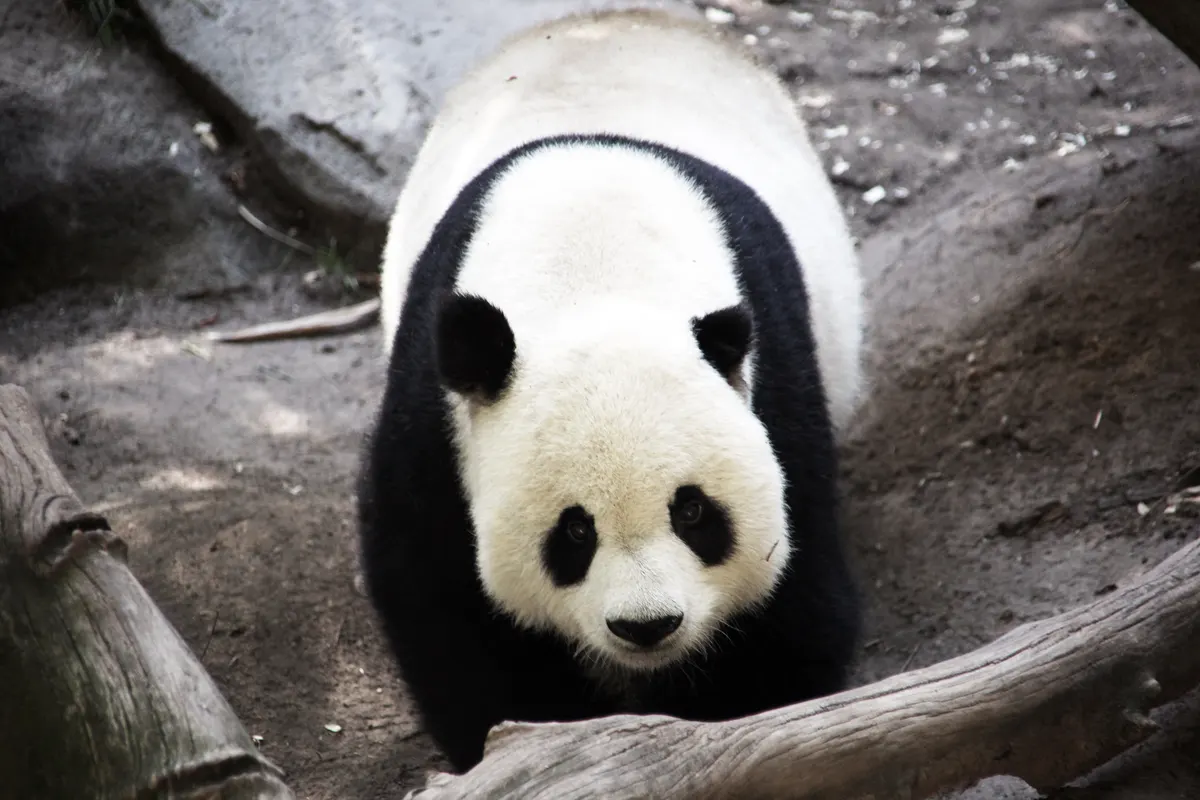
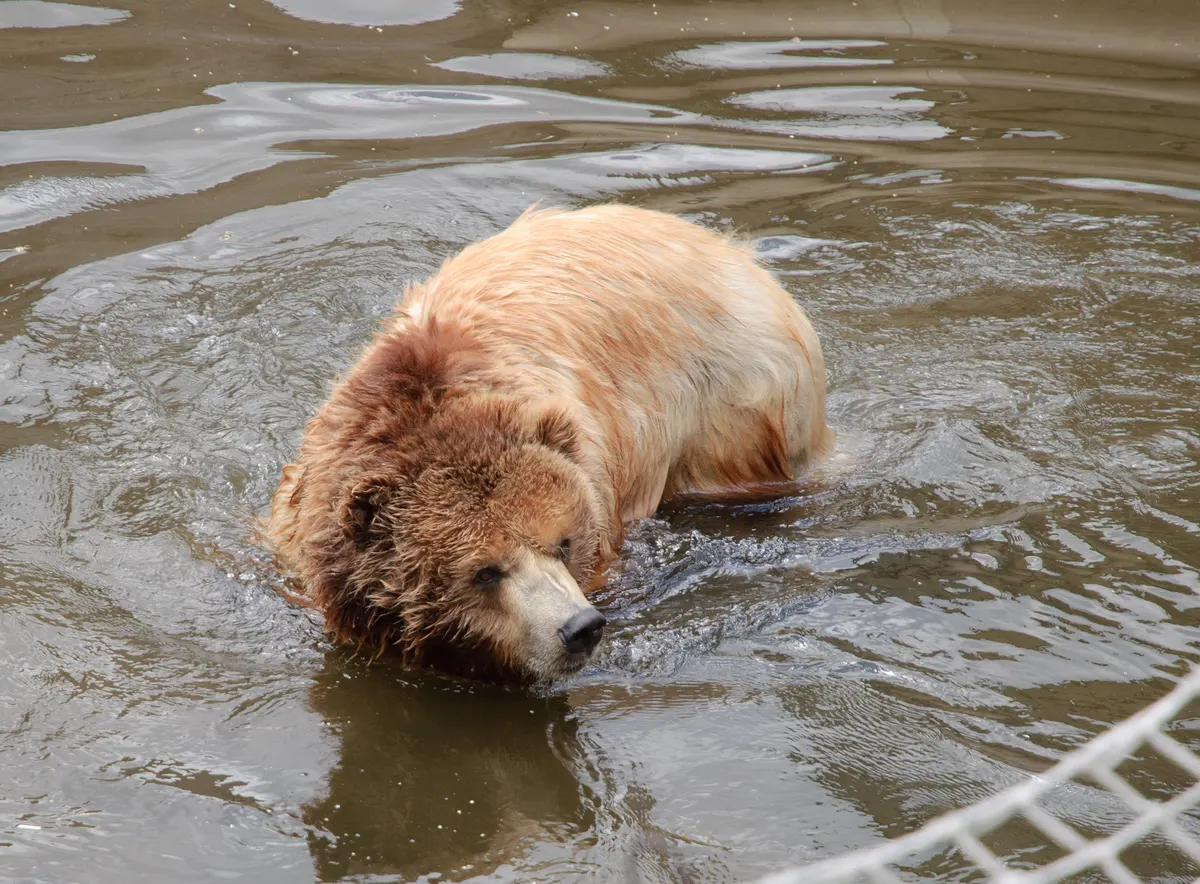
Its closest living relatives are the other members of the bear family. Among them, the sun bear of Southeast Asia is another small, insect- and honey-eating species and the sloth bear's nearest ecological counterpart. The larger grizzly bear and polar bear illustrate the broader size and dietary range of the family, while the giant panda, an early offshoot of the bear lineage, shows how far ursid diets can diverge, in its case toward almost pure bamboo.

Conservation and Threats

Female sloth bear with a cub in dry habitat
Listed as Vulnerable, the sloth bear is declining from habitat loss and conflict with people.

The IUCN Red List classifies the sloth bear as Vulnerable, with a decreasing population trend. Fewer than an estimated 20,000 individuals are thought to remain across the Indian subcontinent and Sri Lanka, and the species is judged to have undergone a substantial decline over recent decades.

The main pressures are habitat loss and degradation as forests are converted to farmland and settlement, which also increases dangerous encounters between bears and people. Poaching for body parts and, historically, the capture of cubs for use as performing "dancing bears" have added to the toll, though organized campaigns ended the dancing-bear trade in India in the 2000s. The sloth bear is protected under Schedule I of India's Wildlife Protection Act and listed on CITES Appendix I. Conservation now centers on protecting habitat corridors and reducing human-bear conflict.

References and Authoritative Sources

Sloth Bear: classification and fun facts

Classification

Scientific Taxonomy
  1. Kingdom

    Animalia

  2. Phylum

    Chordata

  3. Class

    Mammalia

  4. Order

    Carnivora

  5. Family

    Ursidae

  6. Genus

    Melursus

  7. Species

    M. ursinus

Did You Know?

Fun Facts

1

Sloth bears vacuum termites and ants through a gap in their front teeth, producing a loud sucking noise reported to carry up to about 180 metres.

2

Mothers carry their cubs on their backs while walking, running, and climbing until the young reach about a third of the mother's size.

3

The species can close its nostrils at will, sealing out the insects and dust it stirs up while digging.

4

It has the longest tail in the bear family, roughly 15 to 18 cm long.

5

Its sickle-shaped claws reach about 10 cm and are used to rip open rock-hard termite mounds.

6

Despite a slow, shambling walk, a sloth bear can gallop faster than a sprinting human.

Common Questions

FAQ about Sloth Bear

Select a question to reveal the answer.

What is a sloth bear?

The sloth bear (*Melursus ursinus*) is a shaggy, insect-eating bear native to the Indian subcontinent and Sri Lanka. It is the only living species in the genus *Melursus* and belongs to the bear family, Ursidae.

Where do sloth bears live?

They occur in India, Sri Lanka, Nepal, and Bhutan, mainly in moist and dry tropical forests, scrublands, and grasslands below about 1,500 m. They are regionally extinct in Bangladesh.

What do sloth bears eat?

They are omnivores that specialize in termites and ants, supplemented by honey, bees, fruit such as mango and jackfruit, and flowers including mahua. They locate insect colonies by smell and dig them out with long claws.

How do sloth bears eat termites?

A gap in the front teeth, caused by missing upper incisors, lets the bear form a tube with its lips. It closes its nostrils, then blows away loose soil and sucks up insects with a sound that can be heard from a distance.

Why do sloth bears carry cubs on their backs?

Cubs are vulnerable to predators such as leopards and tigers. Riding on the mother's back keeps them close and mobile, and the behavior continues until the cubs reach about a third of the mother's size.

Are sloth bears dangerous to humans?

Yes. Sloth bears are among the most aggressive bears and account for frequent attacks on people in parts of their range, often when surprised at close quarters. They should be given a wide berth in the wild.