The morphology of the southern cassowary is striking, intimidating, and deeply specialized. They are immense birds, with adult females standing up to 5.6 feet tall and weighing a staggering 167 pounds. The species exhibits reverse sexual dimorphism; males are noticeably smaller, generally weighing around 110 pounds, and possess slightly less vibrant plumage.
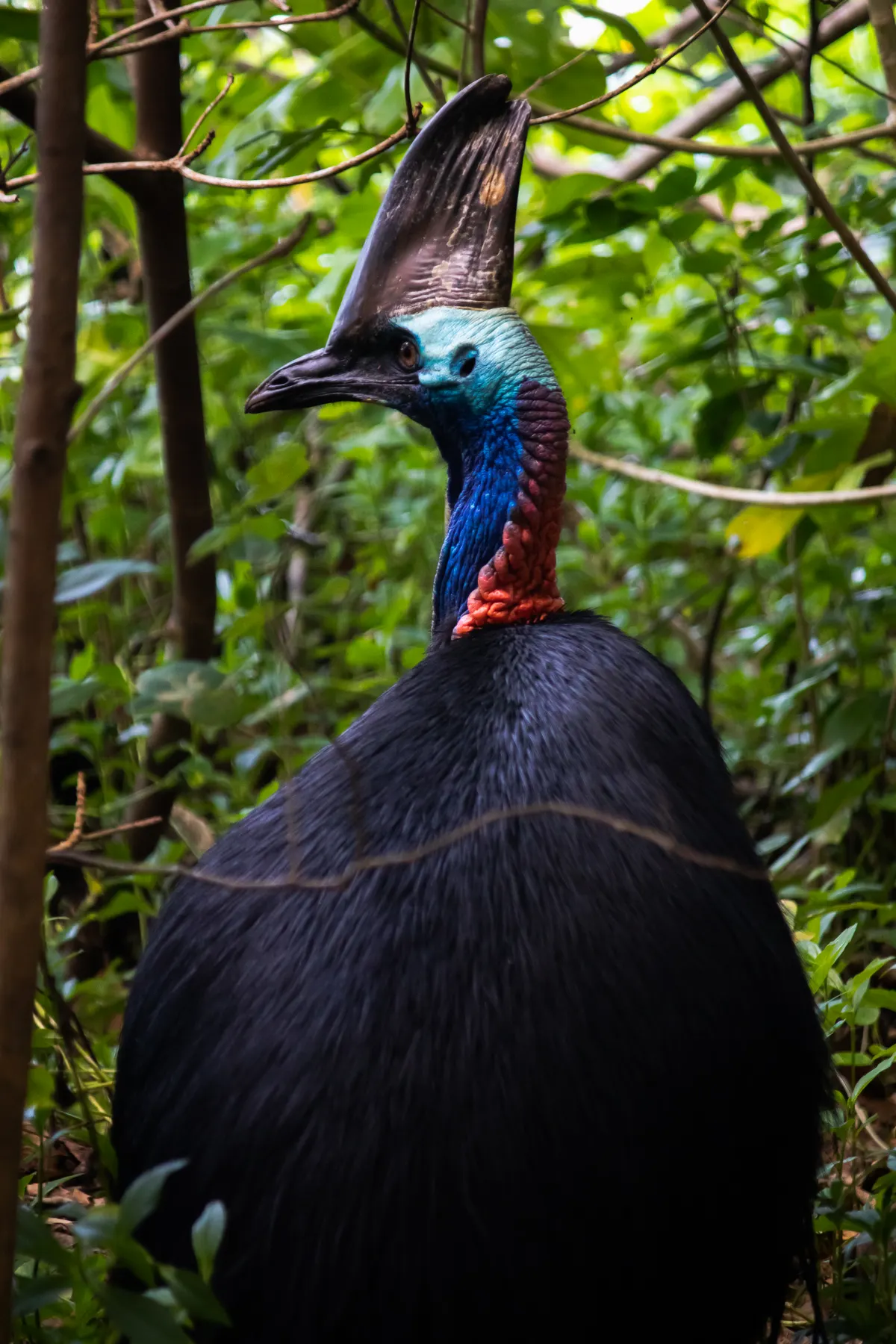
Their bodies are covered in dense, coarse, hair-like black feathers designed not for insulation or flight, but as heavy physical armor. As the bird charges through the tangled undergrowth, this thick plumage shields its skin from the lacerating thorns and razor-sharp vines of the rainforest. The wings are vestigial and completely useless for flight, reduced to small stubs terminating in five or six bare, stiff keratinous quills.
The most visually arresting features are located on the head and neck. The neck is completely bare, revealing vividly colored, wrinkled skin in shades of neon blue, deep purple, and bright red, adorned with two long, fleshy red wattles that hang from the throat. Atop the skull sits the casque—a tall, blade-like, keratinous helmet supported by a spongy bone interior. The exact biological function of the casque is heavily debated; hypotheses suggest it acts as a crash helmet for pushing through dense brush, a resonant chamber for amplifying their low-frequency booming calls, or a thermoregulatory organ that dissipates excess heat in the humid forest.
However, the cassowary's most infamous anatomical feature is its weaponry. The inner toe of each massive, three-toed foot is armed with a straight, dagger-like claw that can reach 4 to 5 inches in length. Driven by the immense muscular power of their legs, a defensive forward kick can effortlessly sever flesh and bone, rendering the cassowary a lethal opponent when cornered or defending its chicks.