Ostrich Facts
"Ostriches are the largest birds alive today."
Ostriches are the tallest and heaviest birds on Earth. They sprint across African savannas on powerful legs, lay the biggest eggs of any bird, and cannot fly.
Loading page content

"Ostriches are the largest birds alive today."
Ostriches are the tallest and heaviest birds on Earth. They sprint across African savannas on powerful legs, lay the biggest eggs of any bird, and cannot fly.
Struthio camelusStruthioniformesStruthionidae
Explore common ostrich photos organized for learning and classroom observation.
Click any photo to view it larger. 8 images available.
Core article
Habitat, diet, behavior, and more — everything on one page.
The common ostrich (Struthio camelus) stands as an evolutionary fascinating example of the African savanna, holding the undisputed title of the largest and heaviest living bird on Earth. Completely abandoning the power of flight millions of years ago, the ostrich has instead mastered terrestrial locomotion, evolving into an unparalleled avian sprinter capable of reaching astonishing speeds across the arid plains. Armed with massive, muscular legs and the largest eyes of any terrestrial vertebrate, the ostrich is a highly adaptable omnivore uniquely equipped to survive the scorching temperatures, scarce water resources, and formidable predators of the African continent.
The ostrich is classified within the kingdom Animalia, phylum Chordata, class Aves (birds), and the order Struthioniformes. This order consists exclusively of ratites—a diverse group of flightless birds that includes emus, cassowaries, rheas, and kiwis. Within the family Struthionidae, the genus Struthio contains only two extant species: the common ostrich (Struthio camelus) and the critically endangered Somali ostrich (Struthio molybdophanes), which was elevated to full species status in 2014 based on reproductive isolation and distinct mitochondrial DNA.
The evolutionary history of ratites is characterized by the complete loss of the keel on their sternum (breastbone). In flying birds, the keel serves as the anchor point for massive flight muscles; its absence in the ostrich physically precludes flight. As the lineage evolved in expansive, open environments following the extinction of non-avian dinosaurs, natural selection overwhelmingly favored extreme cursorial (running) adaptations and massive body size to deter mammalian predators, rendering flight metabolically unnecessary and physically impossible.
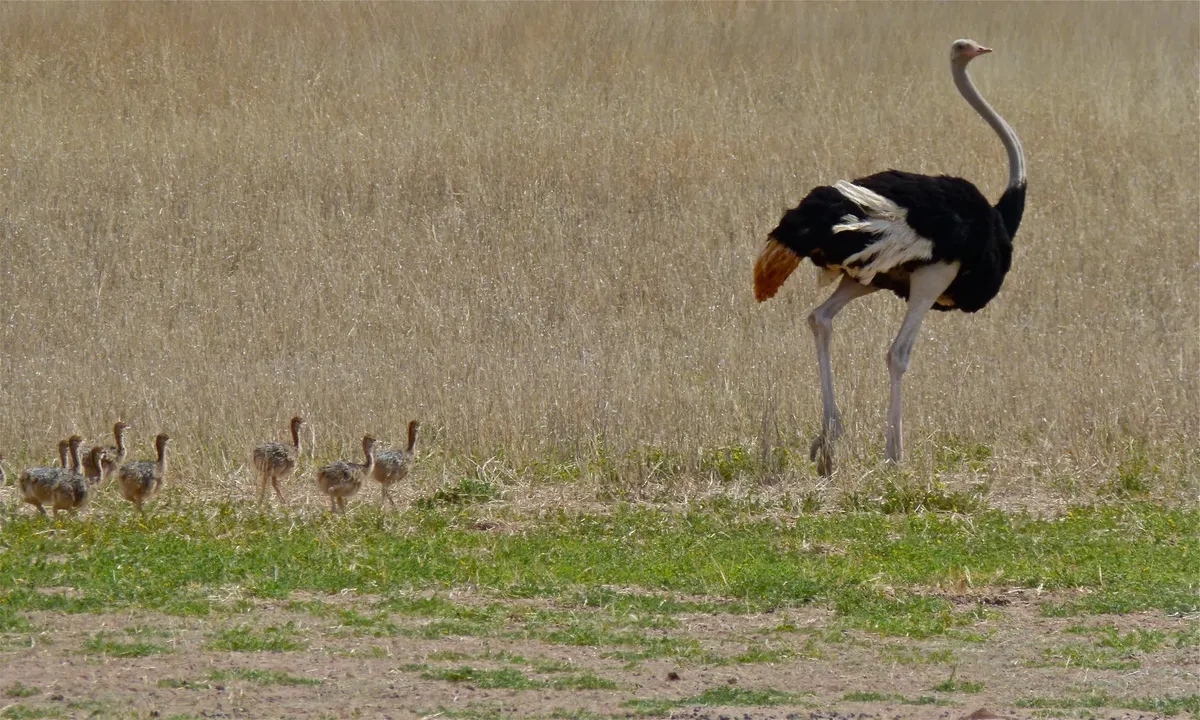
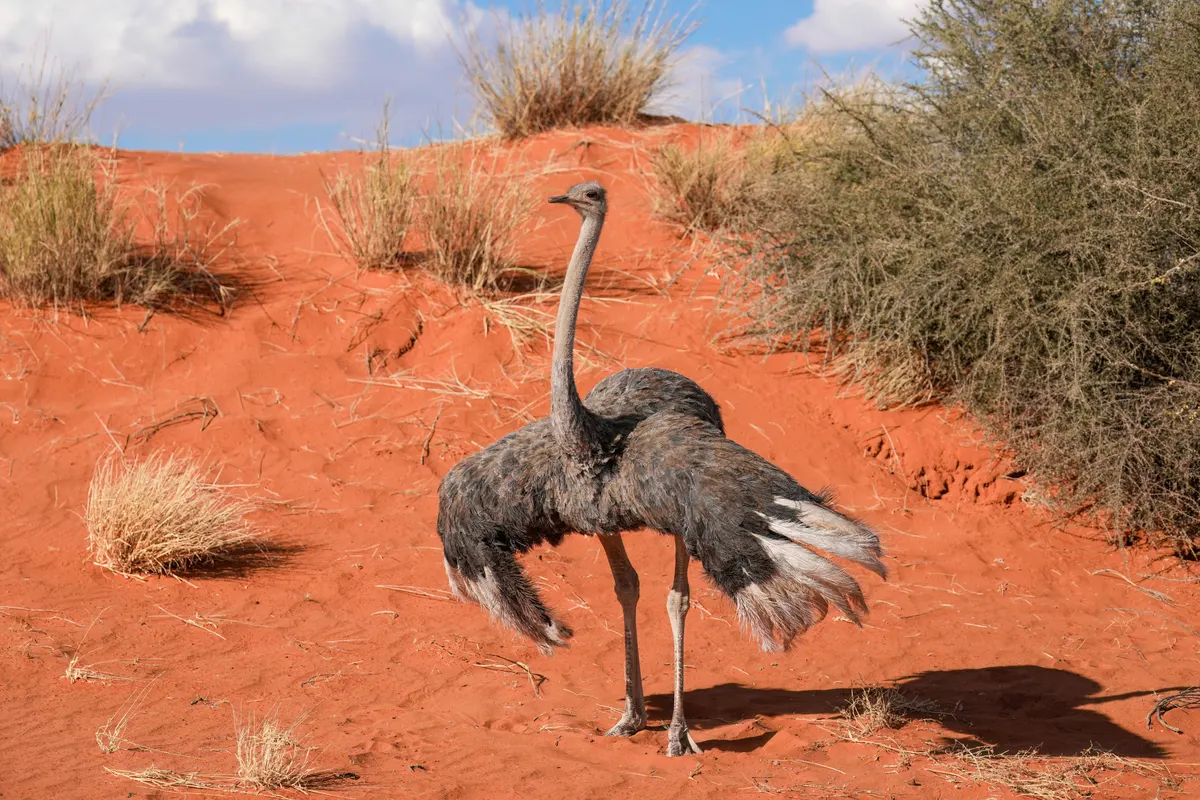
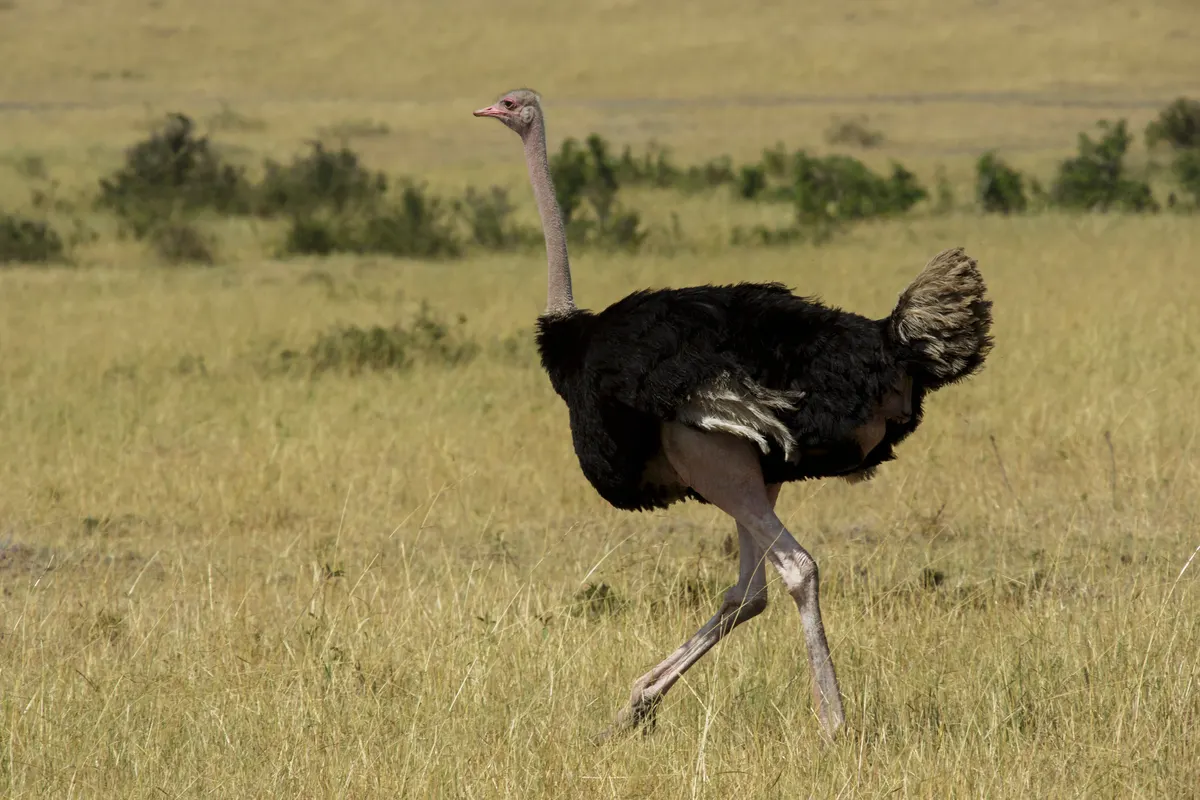
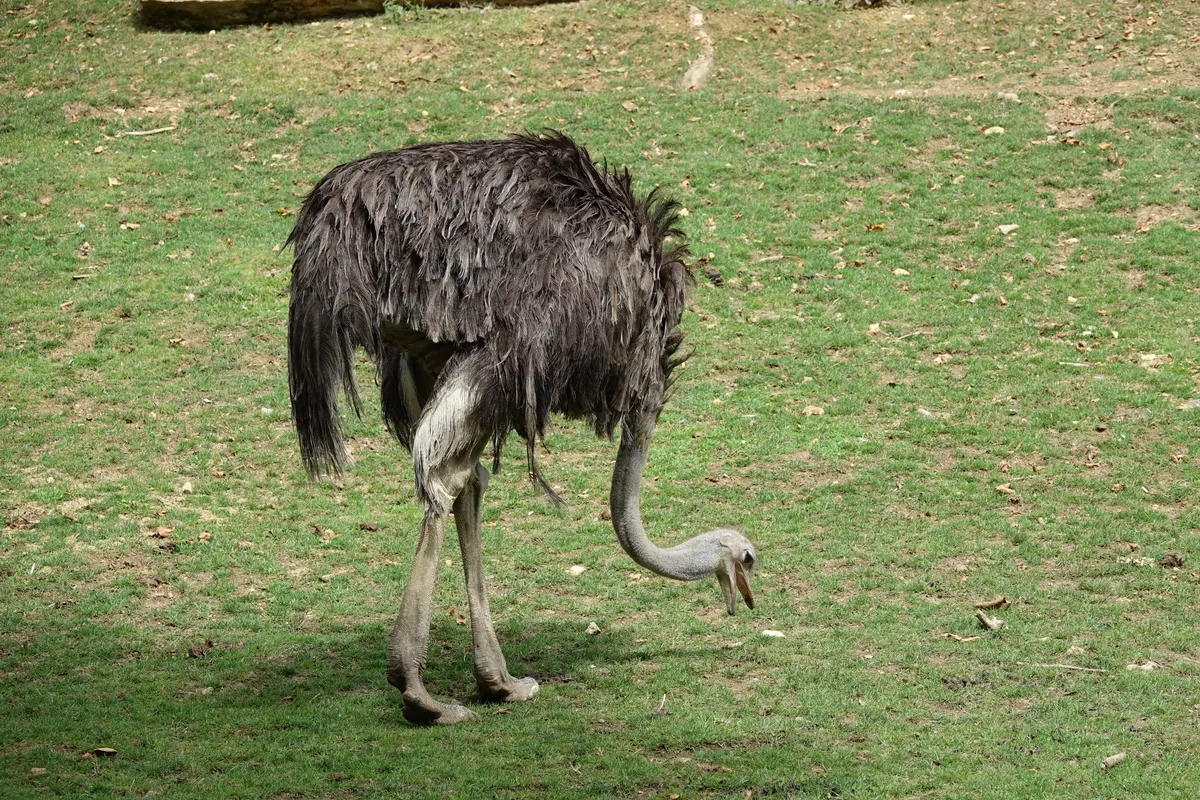
The physical dimensions of an adult common ostrich are staggering. They display profound sexual dimorphism. Adult males can stand a towering 7 to 9 feet tall and weigh up to 320 pounds, sporting striking jet-black plumage with contrasting brilliant white primary feathers on the wings and tail. Females are slightly smaller and exhibit highly effective camouflage, covered entirely in earthy, grayish-brown plumage.
The anatomy of the ostrich is meticulously engineered for high-speed cursorial locomotion. Their incredibly long, heavily muscled legs lack feathers entirely, aiding in rapid thermoregulation by dissipating heat. Unlike most birds which possess three or four toes, the ostrich is the only bird in the world possessing just two toes (didactyly) on each foot. The main, inner toe is massive and equipped with a formidable, hoof-like claw, while the outer toe acts as an outrigger for balance. This reduction in toes drastically minimizes contact with the ground, maximizing running efficiency and speed.
Their eyes are biological masterpieces, measuring over two inches in diameter—larger than their actual brain. This grants them acute, panoramic binocular vision, allowing them to detect the subtle movements of predators like lions or leopards from miles away across the open savanna. Because they lack teeth, ostriches must regularly swallow stones and coarse pebbles (gastroliths), which are stored in their muscular gizzard to mechanically grind up tough, fibrous plant material.

Historically, the common ostrich roamed across vast expanses of Africa and the Middle East. Today, their range is restricted entirely to the African continent, predominantly occupying the sub-Saharan regions. Major populations are distributed across Kenya, Tanzania, South Africa, Namibia, Botswana, Ethiopia, and Sudan.
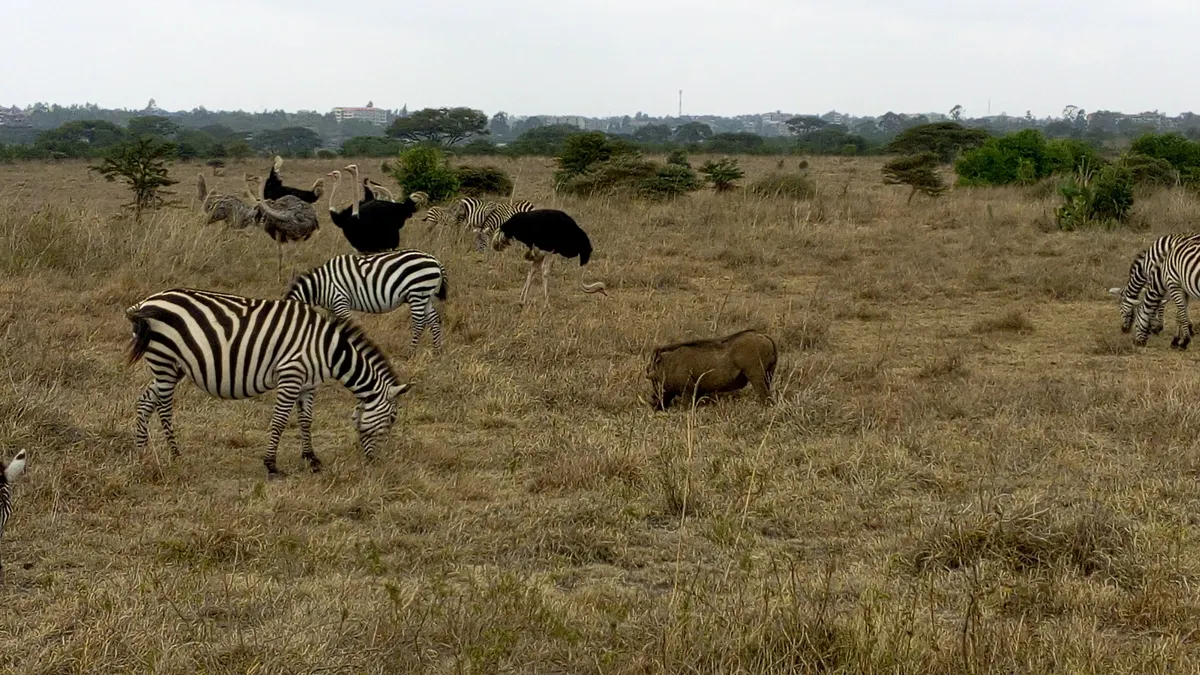
Ostriches are highly specialized for arid and semi-arid biomes. They are predominantly found in expansive, open habitats including the classic African savanna, dry grasslands, scrublands, and true deserts like the Namib and Kalahari. They actively avoid dense tropical forests and thick brush, as these environments completely neutralize their primary defense mechanism: early visual detection and high-speed cursorial evasion. They are incredibly resilient to drought, capable of surviving for long periods without access to standing water by extracting sufficient moisture directly from their succulent plant diet.

The common ostrich is an opportunistic omnivore, though the vast majority of its diet is strictly herbivorous. They spend the majority of their day slowly grazing and browsing across the savanna, utilizing their long, flexible necks to reach a wide variety of vegetation.
Their primary food sources include dry grasses, seeds, tough shrubs, roots, and the leaves and flowers of various succulents. Their highly acidic digestive tract and specialized, elongated intestines (measuring up to 46 feet long) allow them to efficiently ferment and extract maximum nutrients from heavily lignified, low-quality forage that many mammalian herbivores cannot digest.
While predominantly herbivorous, ostriches are highly opportunistic and will readily consume animal protein when available. They are known to quickly snap up locusts, beetles, small lizards, snakes, and even the occasional small rodent that fails to evade their rapid, pecking strikes.

Ostriches are highly gregarious birds, forming complex, nomadic flocks to maximize predator detection and foraging efficiency. During the dry season, these flocks typically consist of 10 to 50 individuals, though in areas of high resource abundance, temporary aggregations of over 100 birds can occur.
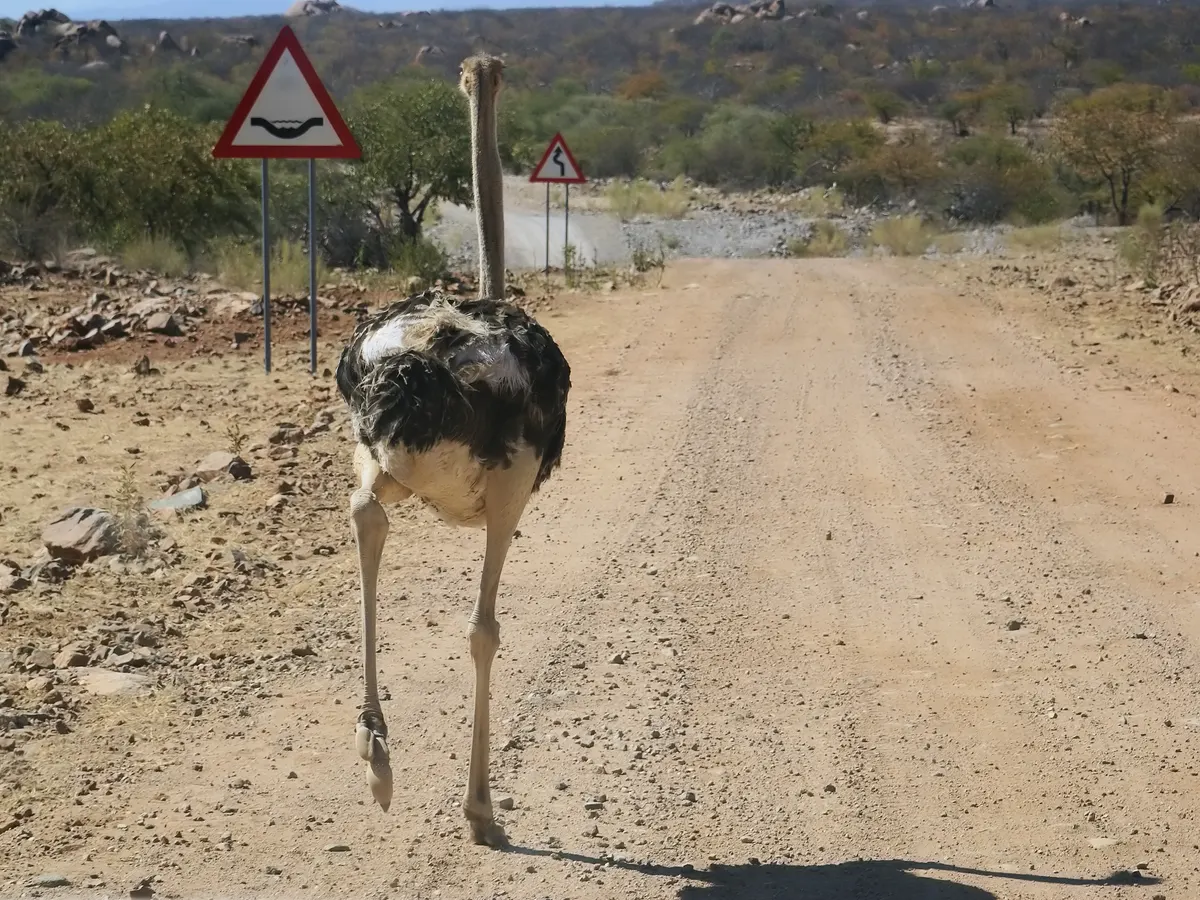
The social hierarchy is dominated by a dominant alpha male and a primary "major" female. Ostriches are strictly diurnal and highly vigilant. When a predator such as a lion, leopard, or pack of hyenas is detected, their primary defense is explosive evasion. An ostrich can sprint at speeds exceeding 40 miles per hour, sustaining a pace of 30 mph for several miles to exhaust pursuing predators.
If cornered or defending a nest, they abandon flight for a brutally aggressive physical defense. An ostrich utilizes its massive legs to deliver a devastating, forward-directed kick. Armed with the lethal, four-inch claw on their primary toe, an ostrich kick carries enough kinetic force to disembowel a lion or shatter a human femur.
Contrary to popular myth, ostriches absolutely do not bury their heads in the sand when threatened. This misconception likely arose from their defensive posture of lying flat on the ground and stretching their neck out parallel to the soil to blend in with the landscape when a predator approaches.

The reproductive strategy of the ostrich is a fascinating display of communal nesting and intense physical displays. During the breeding season, the alpha male establishes a large territory and engages in a dramatic courtship dance, dropping to his knees, violently rolling his head, and rapidly alternating the flapping of his black and white wings to impress the females.
Once mated, the male scrapes a shallow depression in the dirt to serve as the nest. The primary "major" female lays her eggs first in the center of the nest. Following this, several subordinate "minor" females will also lay their eggs in the exact same nest. A single communal nest can contain an astonishing 15 to 60 eggs. Each ostrich egg is immense, weighing over 3 pounds—the equivalent of 24 chicken eggs—and possessing a massive, glossy shell capable of supporting the weight of a grown human.
Incubation is a strictly shared duty. To maximize camouflage, the drab-colored female incubates the eggs during the heat of the day, while the jet-black male assumes incubation duties during the dark night. Hatching occurs after approximately 42 days. The precocial chicks are roughly the size of a domestic chicken upon hatching and are immediately capable of running and following their parents. The parents are fiercely protective, frequently utilizing distraction displays to lure predators away from the vulnerable brood. Ostriches exhibit impressive longevity, living 30 to 40 years in the wild.
(Population and conservation trend data sourced from the IUCN Red List of Threatened Species)
The IUCN Red List currently classifies the common ostrich (Struthio camelus) as a species of "Least Concern." They possess a massive geographic range, and their global population remains large and viable.
However, this broad classification masks the reality that wild populations are experiencing a steady, long-term decline. The primary threat to the wild ostrich is the rapid expansion of human agricultural settlements, which drastically fragments their open savanna habitat. Furthermore, the construction of vast, impenetrable livestock fences across the African plains violently disrupts their crucial nomadic migration routes, frequently leading to mass starvation or fatal entanglement.
While commercial ostrich farming (for meat, leather, and large feathers) is a massive global industry, wild ostriches are still subject to illegal poaching for meat, and their massive eggs are frequently harvested by local populations for food and to utilize the shells as water containers. Conservation efforts heavily rely on the maintenance of massive, unfenced national parks and protected transfrontier conservation areas that allow these giant ratites the immense space they require to thrive.
Ostriches are the largest birds alive today.
They lay the biggest eggs of any bird.
An ostrich kick can be strong enough to hurt a lion.
Ostriches have the largest eyes of any land animal.
They swallow pebbles to help grind food.
Contrary to myth, ostriches do not bury their heads in sand.
Select a question to reveal the answer.
An ostrich is a huge flightless bird with a long neck and powerful legs. The common ostrich lives in Africa.
Common ostriches live in dry grasslands and savannas across much of Africa, especially in the east and south.
Ostriches eat plants, seeds, and insects. They also swallow small stones to help digest food.
No. Ostriches are too heavy to fly, but they run very fast on their strong legs.
Ostriches can sprint faster than 40 miles per hour, making them the fastest birds on land.
Ostriches can stand about 7 to 9 feet tall, taller than most adult humans.
Common ostriches are listed as Least Concern, but habitat loss has reduced numbers in some regions.