Chimpanzee Facts
"Chimpanzees share about 98 percent of their DNA with humans."
Chimpanzees are intelligent great apes that live in African forests. They use tools, eat fruit and plants, and share strong social bonds in close-knit...
Loading page content

"Chimpanzees share about 98 percent of their DNA with humans."
Chimpanzees are intelligent great apes that live in African forests. They use tools, eat fruit and plants, and share strong social bonds in close-knit...
Pan troglodytesPrimatesHominidae
Explore chimpanzee photos organized for learning and classroom observation.
Click any photo to view it larger. 8 images available.
Core article
Habitat, diet, behavior, and more — everything on one page.
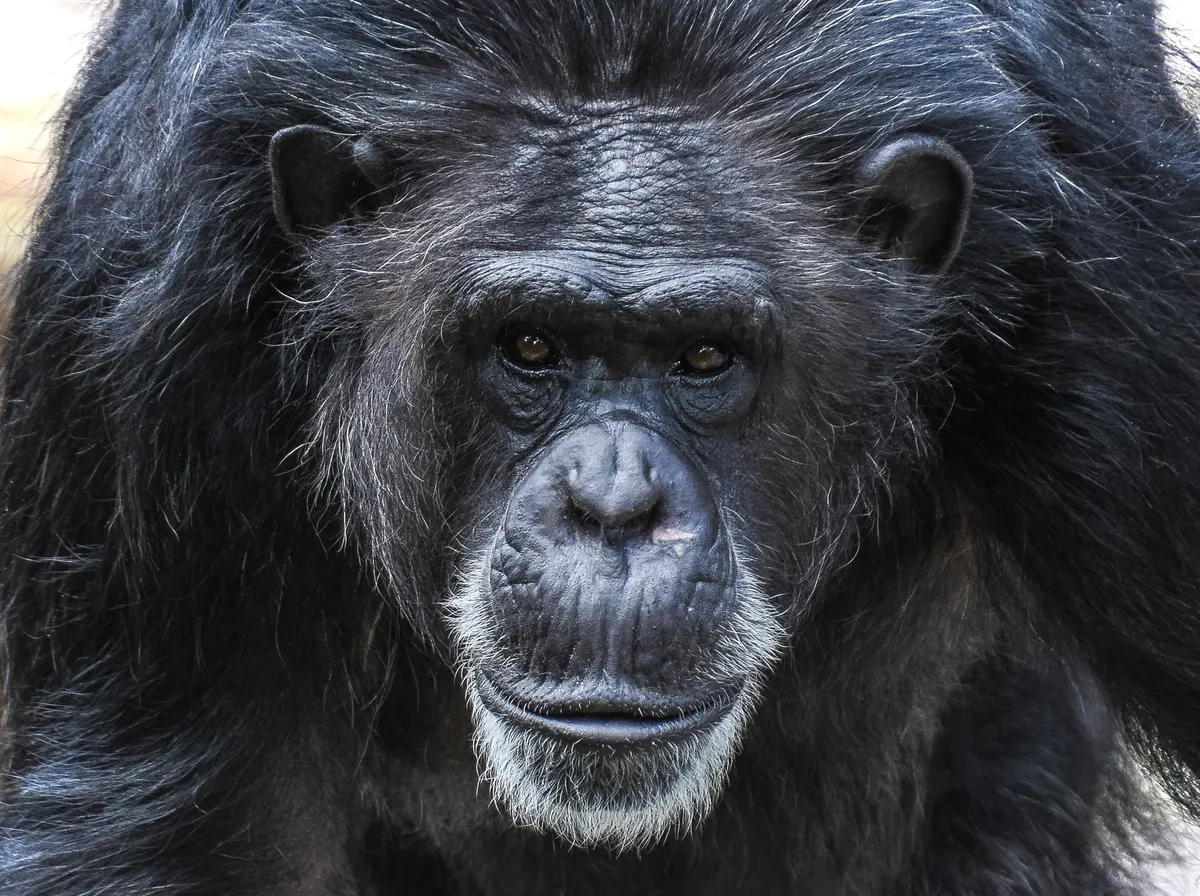
The chimpanzee (Pan troglodytes), one of our closest living relatives in the animal kingdom, is an exceptionally intelligent and socially complex great ape native to the forests of Central and West Africa. Sharing roughly 98 percent of their DNA with humans, these primates demonstrate remarkable problem-solving intelligence, profound emotional depth, and intricate community dynamics. Ranging from 70 to 130 pounds and reaching heights up to 4.5 feet, the chimpanzee has evolved long, powerful arms for arboreal navigation and opposable thumbs for sophisticated tool use. Their daily lives are a compelling blend of cooperative foraging, fierce territoriality, and intricate social politics.
The chimpanzee is scientifically designated as Pan troglodytes. In the biological classification system, it belongs to the kingdom Animalia, phylum Chordata, class Mammalia, and the order Primates. Crucially, chimpanzees fall under the family Hominidae, categorizing them as great apes alongside gorillas, orangutans, bonobos, and humans.
Evolutionary biology indicates that the Pan lineage (which includes both chimpanzees and bonobos) diverged from the Homo lineage (human ancestors) approximately 6 to 8 million years ago. Despite this divergence, chimpanzees retain numerous morphological and cognitive traits that provide a living window into the evolutionary history of early hominids, particularly their reliance on learned, culturally transmitted behaviors.
The anatomy of the chimpanzee is perfectly adapted for a life that alternates between dense forest canopies and the woodland floor. They exhibit significant muscular hypertrophy compared to humans, possessing immense upper-body strength. Their arms extend significantly longer than their legs, allowing them to excel at brachiation (swinging from branch to branch) and knuckle-walking when traveling terrestrial routes.
A chimpanzee's hands and feet both feature opposable digits. The opposable thumb is relatively short but highly functional, enabling a precision grip essential for complex tool manipulation, while their prehensile feet allow them to securely grasp branches. Their forward-facing eyes provide excellent binocular vision for depth perception, and their prominent brow ridges protect their eyes from the harsh sunlight filtering through the canopy. Lacking a tail, they rely entirely on their powerful limbs and core musculature for balance.

Wild chimpanzees inhabit a wide belt across central and western Africa, spanning countries from Senegal to Uganda and Tanzania. They are highly adaptable primates capable of thriving in a variety of biomes, though they predominantly favor dense tropical rainforests, secondary forests, and open woodland savannas.
Their habitat requires a dense canopy for safety and foraging. Every evening, chimpanzees construct elaborate sleeping nests high in the trees, weaving branches and leaves together to create a secure platform far away from nocturnal ground predators. The continuous fragmentation of these continuous forest tracts remains one of the most critical challenges to their long-term survival.

While frequently characterized as frugivores due to their heavy reliance on ripe fruit, chimpanzees are true omnivores with a highly varied and opportunistic diet. They consume fruits, young leaves, seeds, blossoms, and bark. However, their diet extends significantly into the animal kingdom; they routinely forage for insects, raid bird nests for eggs, and hunt small mammals.
The chimpanzee's foraging strategies highlight their remarkable cognitive abilities. They exhibit advanced tool use, employing stripped twigs to "fish" for termites in deep mounds, or using large rocks as hammers and anvils to crack open tough nuts. Furthermore, hunting is a highly cooperative, strategic endeavor. Male chimpanzees frequently form hunting parties to corner and capture colobus monkeys in the canopy, a gritty, violent process that often concludes with the hunters sharing the meat to solidify social bonds and political alliances.

Chimpanzee communities operate under a strict, male-dominated fission-fusion social structure. A single community can encompass dozens of individuals, but they rarely travel together in one large group. Instead, they constantly split into smaller, fluid foraging subgroups (fission) and later rejoin (fusion).
The social hierarchy is intense and often ruthlessly political. The alpha male maintains his position not just through sheer physical dominance, but by cultivating strategic alliances with other high-ranking males and senior females. Grooming is the primary currency of these political alliances; individuals spend hours meticulously cleaning each other's fur to reduce tension and cement bonds.
Inter-community relations are incredibly hostile. Chimpanzees are highly territorial, and groups of adult males routinely patrol the borders of their territory. If they encounter an isolated individual from a rival community, the patrol may engage in lethal, coordinated attacks. Infanticide is also a documented, brutal reality within their social dynamic, often utilized by dominant males to eliminate a rival's offspring and bring females back into estrus.

The life cycle of a chimpanzee is characterized by an extended period of childhood dependency, which is crucial for learning complex survival skills and social etiquette. Following a gestation period of roughly 8 months, a female typically gives birth to a single infant.
For the first five years, the infant remains in near-constant physical contact with its mother, suckling and riding on her back as she navigates the forest. This prolonged juvenile phase is an evolutionary necessity; young chimpanzees must learn intricate behaviors like tool construction, which plants are edible, and how to navigate the fraught political landscape of the community. Females reach sexual maturity around 13 years of age, often emigrating to neighboring communities to prevent inbreeding, while males remain in their natal group. In the wild, chimpanzees can live 40 to 45 years, while those in captivity frequently reach up to 60 years of age.
(Population and conservation trend data sourced from the IUCN Red List of Threatened Species)
The IUCN classifies the chimpanzee as an "Endangered" species, with wild populations experiencing a steady, alarming decrease.
Habitat destruction driven by commercial logging, agriculture, and mining is the primary threat, systematically dismantling the continuous forests chimpanzees require. Additionally, the illegal bushmeat trade relentlessly targets wild populations. Because chimpanzees reproduce slowly and invest years in a single offspring, populations cannot quickly recover from poaching. Finally, their genetic proximity to humans makes them highly susceptible to human respiratory diseases; outbreaks of viruses like Ebola and even the common cold have devastated entire chimpanzee communities.
Chimpanzees share about 98 percent of their DNA with humans.
Chimpanzees use sticks to fish for termites and stones to crack nuts.
They build leafy nests in trees to sleep each night.
Chimpanzees greet friends with hugs, kisses, and grooming.
A chimpanzee community may have dozens of members with complex social rules.
Infants stay with their mothers for years while learning forest skills.
Select a question to reveal the answer.
A chimpanzee is a great ape that lives in African forests. Chimpanzees are intelligent, social, and closely related to humans.
Wild chimpanzees live in tropical forests and woodlands across central and western Africa.
Chimpanzees are omnivores. They eat fruit, leaves, seeds, insects, and sometimes small animals.
Yes. Chimpanzees are listed as Endangered because of habitat loss, disease, and hunting.
Chimpanzees are great apes and are among our closest living relatives in the animal kingdom.
Yes. Chimpanzees use sticks, leaves, and stones as tools to reach food such as insects and nuts.
Chimpanzees live in communities where members travel, feed, groom, and raise young together.