
Melursus ursinus / Helarctos malayanus
Sloth Bear vs Sun Bear
Sloth bears and sun bears are both small Asian bears with pale chest marks, but the sloth bear is larger and shaggy with a termite-eating snout, while the sun bear is the smallest bear, sleek-coated, and the most tree-dwelling.
By An Nguyen · Updated
At a glance
Published species data from both WildlifeDB profiles, aligned trait by trait. Size metrics highlight the larger value with a relative bar.
- Scientific name
- Sloth BearMelursus ursinus
- Sun BearHelarctos malayanus
- Classification
- Sloth BearMammalia · Ursidae
- Sun BearMammalia · Ursidae
- Native range
- Sloth BearAsia
- Sun BearAsia
- Primary habitat
- Sloth BearForest
- Sun BearForest
- Diet
- Sloth BearOmnivore
- Sun BearOmnivore
- Typical food
- Sloth BearTermites, Ants, Fruit, Honey, Flowers
- Sun BearTermites, Ants, Bees and honey, Fruit, Beetle larvae
- Body length
- Sloth Bear140 cm – 190 cm
- Sun Bear100 cm – 140 cm
- Shoulder height
- Sloth Bear—
- Sun Bear—
- Weight
- Sloth Bear55 kg (female) – 145 kg (male)
- Sun Bear25 kg – 65 kg
- Top speed
- Sloth BearCan gallop faster than a running person
- Sun BearAgile climber rather than a fast runner
- Wild lifespan
- Sloth BearAbout 16 years on average
- Sun BearEstimated around 20 to 25 years
- Social pattern
- Sloth BearVacuuming termites and ants through a noisy muzzle, Foraging mainly at night, Carrying cubs on the mother's back
- Sun BearClimbing and resting in trees, Foraging for insects and honey, Active by day but more nocturnal near people
- Key adaptations
- Sloth BearA gap in the front teeth from missing upper incisors for suction feeding, Nostrils that can be closed to keep out insects and dust, Long, curved, sickle-shaped claws for digging
- Sun BearExceptionally long tongue for reaching honey and insects, Long curved claws for climbing and tearing open wood, Loose skin around the neck that helps it twist free
- Conservation
- Sloth BearVulnerable · Decreasing
- Sun BearVulnerable · Decreasing
- Reproduction
- Sloth BearAbout 210 days, including delayed implantation; 1 to 2 cubs, rarely 3
- Sun BearAbout 95 days, though delayed implantation can extend it considerably; Usually 1, occasionally 2
Shaggy coat against sleek coat
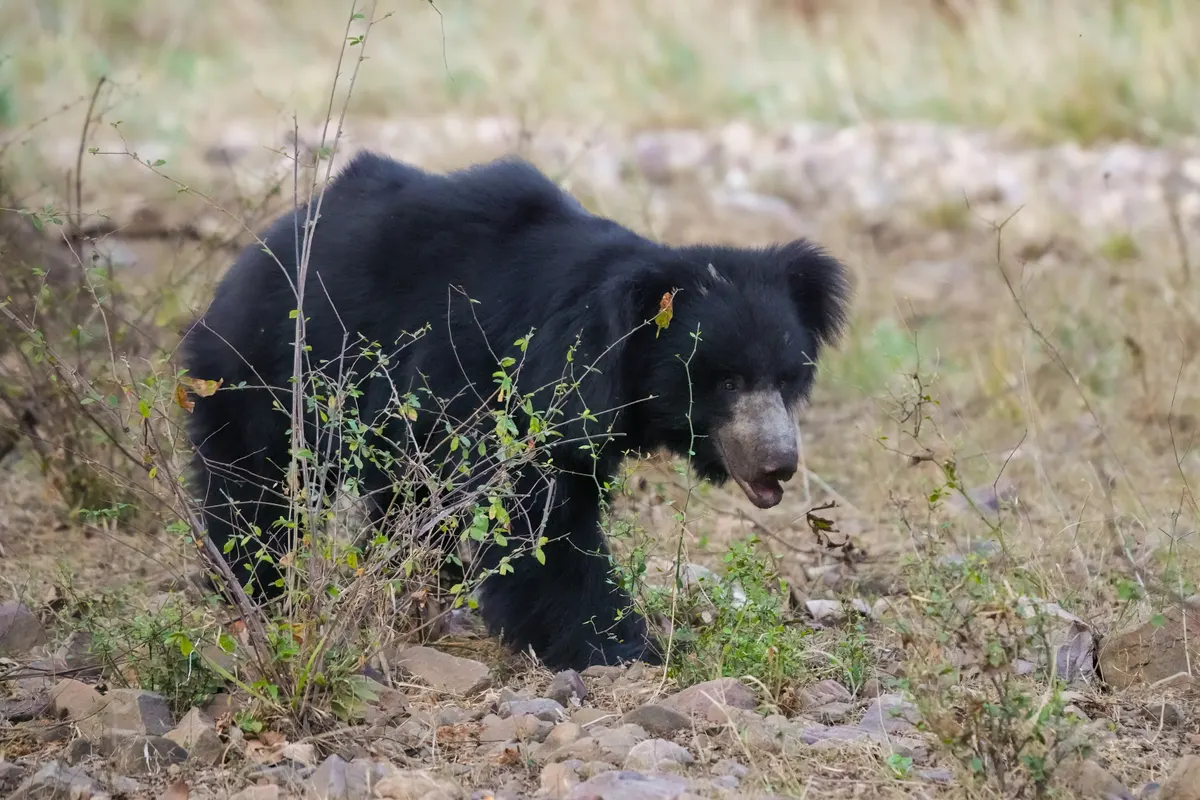
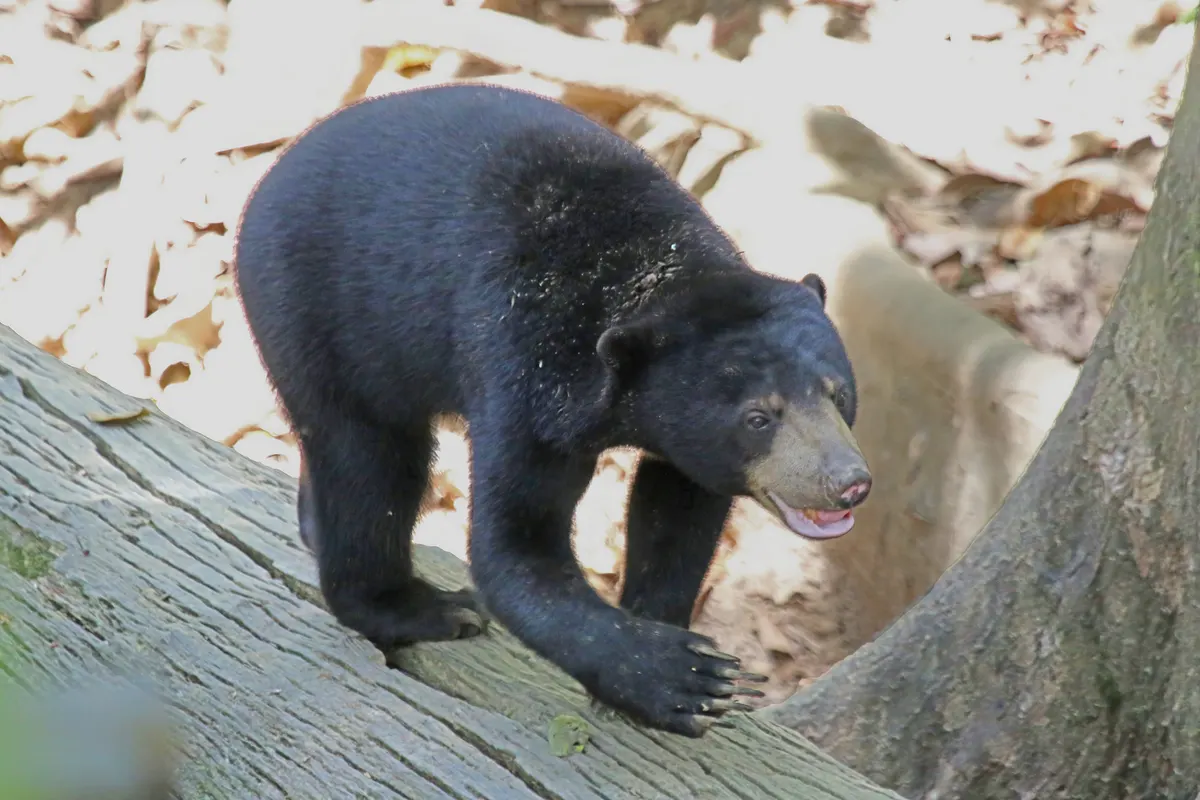
Both bears are black with a pale chest mark, which is where the confusion starts. The coat settles it immediately.
The sloth bear, Melursus ursinus, has a long, shaggy black coat, a pale muzzle, and a mobile, protruding snout. The sun bear, Helarctos malayanus, has a short, sleek black coat suited to a hot, humid climate, a broad pale face, and a bold orange-to-cream chest patch said to resemble a rising sun — the source of its name.
Both belong to the family Ursidae but to separate genera, each the only living member of its own: Melursus and Helarctos.
The sloth bear is about twice the weight
The sloth bear is clearly larger, at roughly 140 to 190 cm in length, with males around 80 to 145 kg and females lighter, near 55 kg. The sun bear runs about 100 to 140 cm and 25 to 65 kg.
The sun bear is the smallest of the eight living bear species, standing only about 70 cm at the shoulder. At the top of each range the sloth bear is around twice the mass. The sloth bear also has the longest tail in the bear family, roughly 15 to 18 cm — short by most standards, but the longest among bears.
A gap in the teeth for vacuuming termites
The sloth bear is an insect specialist, and its skull is built for it. It is missing its upper incisors, leaving a gap in the front teeth that works as a suction channel; it can close its nostrils at will to keep out the insects and dust it stirs up, and highly mobile, protrusible lips gather prey.
The result is audible. A sloth bear rips open a termite mound with sickle-shaped claws reaching about 10 cm, then noisily vacuums the insects out — a sucking noise reported to carry up to about 180 metres.
The longest tongue of any bear
The sun bear solves the same problem from the other direction. Its tongue extends up to about 20 to 25 cm, the longest of any bear, and it draws honey, insects, and larvae out of crevices and hollow wood rather than excavating a mound.
That is why it is often called the honey bear. Long curved claws tear open bark and wood, and loose skin around the neck helps it twist free if something grabs it.
Termite specialist against forest generalist
Both are omnivores that lean heavily on insects, but the balance differs. The sloth bear is a termite and ant specialist, adding fruit, honey, flowers, and beetles. The sun bear takes termites and ants too, but relies more on fruit, bee nests and honey, beetle larvae, and small vertebrates.
That broader diet gives the sun bear an ecological role beyond feeding itself: it disperses seeds and opens up nests and deadwood in the forest.
The most arboreal bear against the strongest digger
The sun bear is the most arboreal of all bears. It builds nests and sunbathes on branches several metres up, resting and feeding in the canopy, and is an agile climber rather than a fast runner.
The sloth bear spends far more time on the ground and is the stronger digger, though it climbs trees for honey and fruit. Despite a slow, shambling walk, it can gallop faster than a sprinting person. It also has a reputation for reacting aggressively when startled, which is generally linked to sharing its range with tigers and with people.
Neither hibernates. Both live in warm climates with food available year-round, so the seasonal denning cycle of northern bears does not apply. Both are mainly solitary outside mother-and-cub pairs, and the sloth bear is largely nocturnal while the sun bear is active by day but shifts toward night near human activity.
Cubs on the mother's back
Sloth bear mothers carry their cubs on their backs while walking, running, and climbing, continuing until the young reach about a third of the mother's size. It is unusual among bears and is a practical response to predation risk from tigers and leopards.
Sloth bears have 1 to 2 cubs, rarely 3, after about 210 days including delayed implantation. Sun bears usually have a single cub, occasionally two, after about 95 days that delayed implantation can extend considerably.
India and Sri Lanka against Southeast Asia
The sloth bear lives on the Indian subcontinent — India, Sri Lanka, Nepal, and Bhutan — in tropical and dry forest, grassland, and scrub.
The sun bear lives farther east, in the tropical forests and rainforests of mainland and island Southeast Asia: Malaysia, Indonesia, Thailand, Myanmar, Vietnam, Laos, Cambodia, and parts of India. The ranges meet only at the margins, so location alone identifies most animals.
Both list tigers, leopards, and dholes among their predators, and the sun bear also faces reticulated pythons.
Both Vulnerable, with an extra trade in one
Both are listed as Vulnerable with decreasing populations, and habitat loss drives the decline for each, alongside poaching. The sun bear carries additional, specific pressures: it is taken for the bile trade and for the pet trade, which target live animals rather than habitat.