Orangutan Facts
"Orangutans share about 97 percent of their DNA with humans."
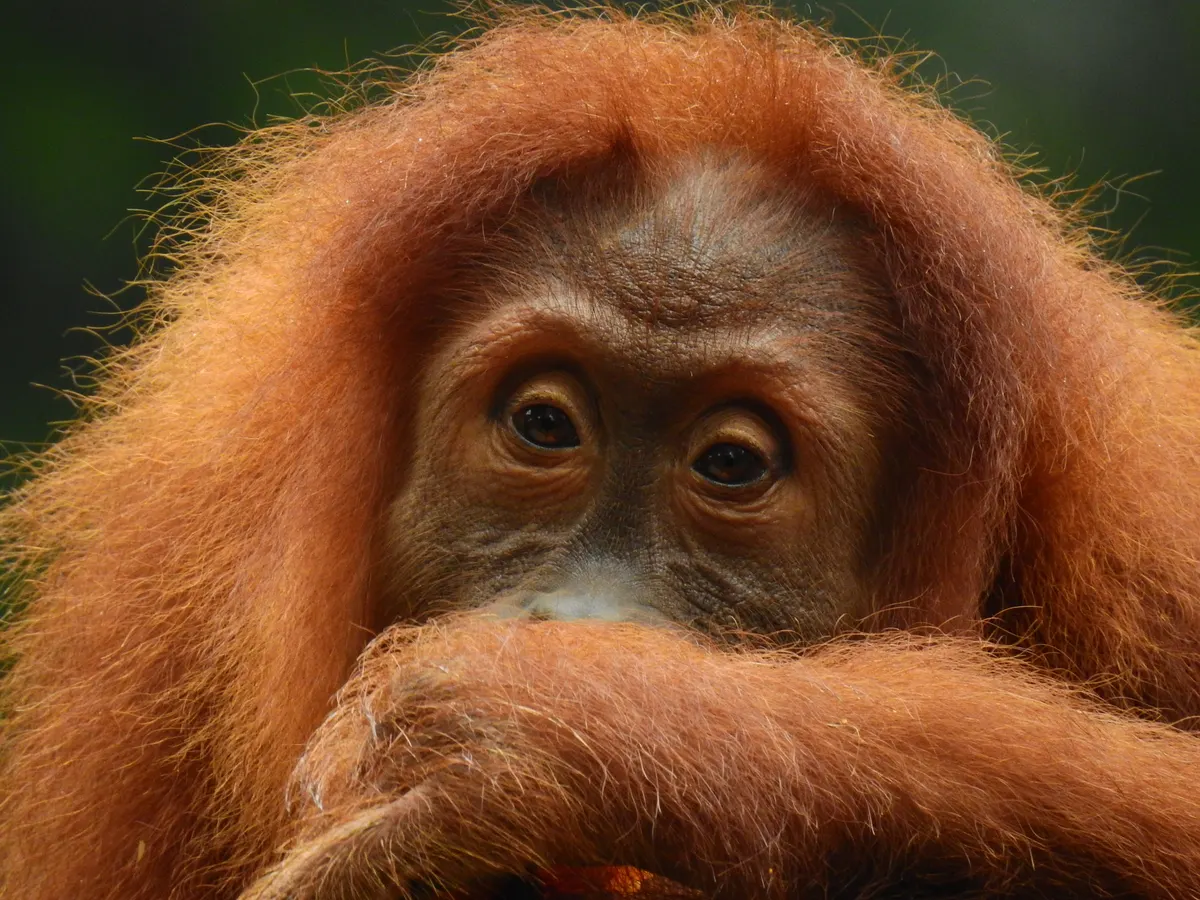
Bornean orangutans are great apes that live in Asian rainforests. They climb with long arms, eat forest fruit, and spend years raising their young.
Loading page content

"Orangutans share about 97 percent of their DNA with humans."
Bornean orangutans are great apes that live in Asian rainforests. They climb with long arms, eat forest fruit, and spend years raising their young.
Pongo pygmaeusPrimatesHominidae
Explore bornean orangutan photos organized for learning and classroom observation.
Click any photo to view it larger. 8 images available.
Core article
Habitat, diet, behavior, and more — everything on one page.
The Bornean orangutan (Pongo pygmaeus) is a magnificent and deeply intelligent great ape, serving as a vital keystone species within the ancient rainforest ecosystems of Southeast Asia. Deriving their name from the Malay words "orang hutan," meaning "person of the forest," these highly arboreal primates are globally recognized by their sparse, striking reddish-orange hair and remarkably expressive faces. Spending nearly their entire lives suspended in the high forest canopy, orangutans possess profound cognitive abilities, complex spatial memory, and an extensive period of maternal investment. Yet, despite their evolutionary brilliance, the Bornean orangutan is currently locked in a desperate battle for survival against catastrophic habitat destruction.
Classified within the kingdom Animalia, phylum Chordata, class Mammalia, and the order Primates, the orangutan belongs to the family Hominidae, proudly holding the title of great ape alongside gorillas, chimpanzees, bonobos, and humans. The genus Pongo contains three extant species: the Bornean orangutan (Pongo pygmaeus), the Sumatran orangutan (Pongo abelii), and the recently described Tapanuli orangutan (Pongo tapanuliensis).
Genomic sequencing reveals that orangutans share approximately 97% of their DNA with humans, indicating a deep evolutionary divergence from the common hominid ancestor roughly 12 to 16 million years ago. Unlike African great apes which evolved a more terrestrial, knuckle-walking lifestyle, the Pongo lineage committed strictly to an arboreal evolutionary trajectory, developing extreme morphological adaptations perfectly suited for navigating the complex vertical architecture of the Asian tropical rainforests.
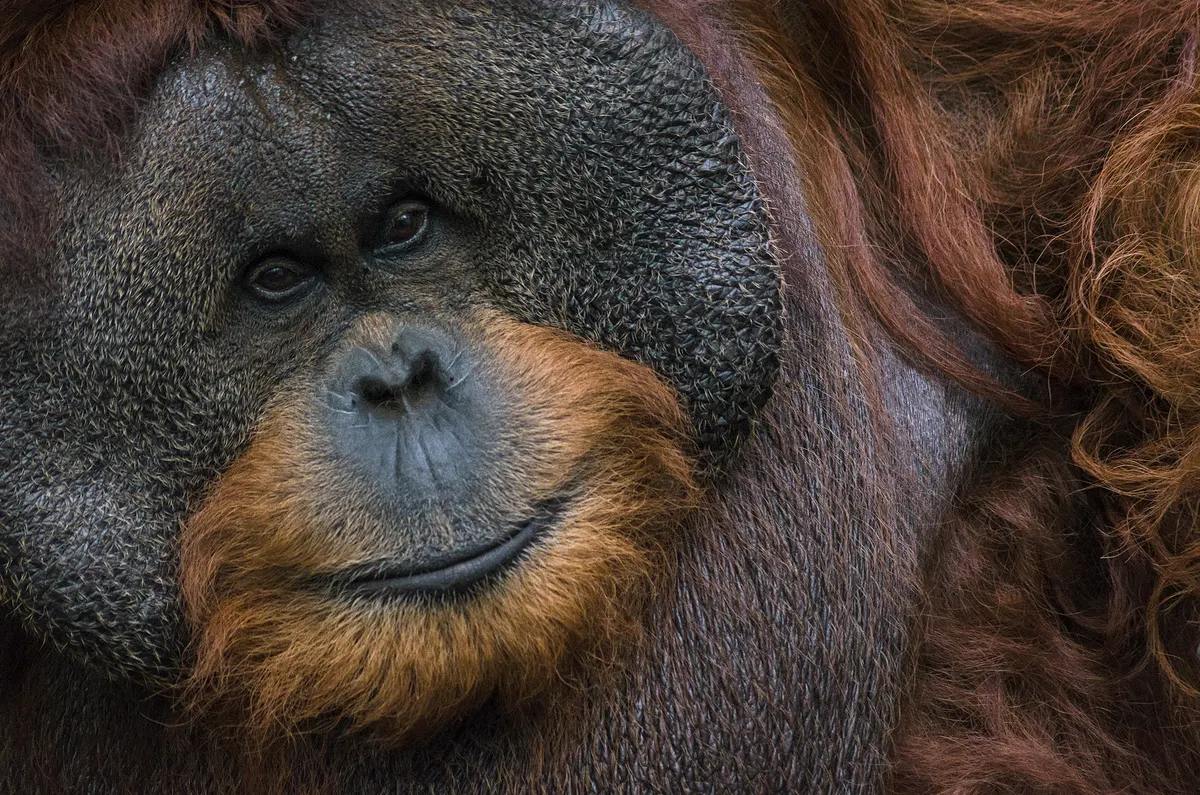
The Bornean orangutan is the largest strictly arboreal mammal on Earth. They exhibit profound sexual dimorphism. Adult males can reach heights of up to 4.5 feet and weigh a robust 220 pounds (100 kg), while females are significantly smaller, typically weighing around 80 pounds (37 kg). Fully mature, dominant males develop striking secondary sexual characteristics: massive, fleshy cheek pads known as flanges, and a large, pendulous laryngeal sac utilized to project deep, resonant vocalizations known as "long calls."
Their morphology is a masterclass in arboreal engineering. Orangutans possess exceptionally long, powerful arms that possess a span of over 7 feet in large males—significantly longer than their standing height. Their shoulder, hip, and ankle joints are uniquely modified for extreme multidirectional flexibility, allowing them to hang at bizarre angles and bridge wide gaps between swaying branches.
Both their hands and feet are hook-like, featuring four long, curved digits and shorter, fully opposable thumbs and big toes. This quadrumanous (four-handed) anatomy grants them a vice-like grip capable of easily supporting their massive body weight. To minimize the energetic cost of swinging, they employ a methodical, deliberate method of locomotion known as quadrumanous scrambling, slowly distributing their mass across multiple branches to avoid snapping fragile vegetation.

The Bornean orangutan is strictly endemic to the massive island of Borneo, its range politically divided between the Indonesian provinces of Kalimantan and the Malaysian states of Sabah and Sarawak.
They are obligate residents of lowland dipterocarp tropical rainforests and extensive peat swamp forests. These primary and mature secondary forests provide the necessary vertical stratification and dense canopy required for their arboreal lifestyle. They rarely venture above elevations of 500 meters, as the cooler montane forests do not support the high density of fruit-bearing trees necessary to sustain their massive caloric requirements.

Orangutans are predominantly frugivorous herbivores, devoting up to 60% of their foraging time to locating and consuming ripe fruit. They possess incredibly strong jaws and broad, flat molars perfectly adapted for crushing heavily heavily armored, hard-shelled fruits and seeds that other primates cannot process.
Their diet is highly diverse and temporally dynamic, tracking the complex fruiting cycles of the rainforest. They consume figs, lychees, mangosteens, and heavily rely on lipid-rich fruits during masting events. When preferred fruits are scarce during seasonal fluctuations, they demonstrate remarkable dietary plasticity, shifting their foraging efforts to consume young leaves, shoots, tree bark, lianas, orchids, and mineral-rich soils (geophagy). They also opportunistically consume insects, utilizing their dexterous fingers or fashioned sticks to extract termites, ants, and honey from tree hollows.
To navigate this highly dispersed and unpredictable food supply, orangutans rely on an immense, highly detailed spatial memory, capable of recalling the precise location, fruiting phenology, and nutritional yield of thousands of individual trees across a vast home range.

In stark contrast to the highly gregarious, troop-living nature of gorillas and chimpanzees, the Bornean orangutan maintains a highly semi-solitary social structure. This lack of social cohesion is heavily dictated by the ecological constraints of their environment; the scattered distribution of fruit in the Bornean rainforest simply cannot support large aggregations of giant apes without inducing massive intragroup food competition.
Adult males are violently territorial and fiercely solitary, emitting deafening "long calls" that echo for miles through the canopy to advertise their presence to receptive females and warn away rival flanged males. Encounters between adult males frequently result in brutal, physically devastating combat.
The highest expression of orangutan intelligence is observed in their daily construction of sleeping nests. Every evening, an orangutan will meticulously bend, weave, and interlock leafy branches high in the canopy to construct a sturdy, comfortable sleeping platform, often supplementing it with a "roof" of broad leaves during heavy rainstorms. They possess sophisticated problem-solving skills and routinely demonstrate the ability to fashion and utilize tools in the wild, such as using leafy branches as umbrellas or sticks to extract seeds from prickly fruits.

Orangutans possess one of the slowest reproductive rates and longest periods of maternal dependency of any terrestrial mammal on Earth, rendering them incredibly vulnerable to population decline.
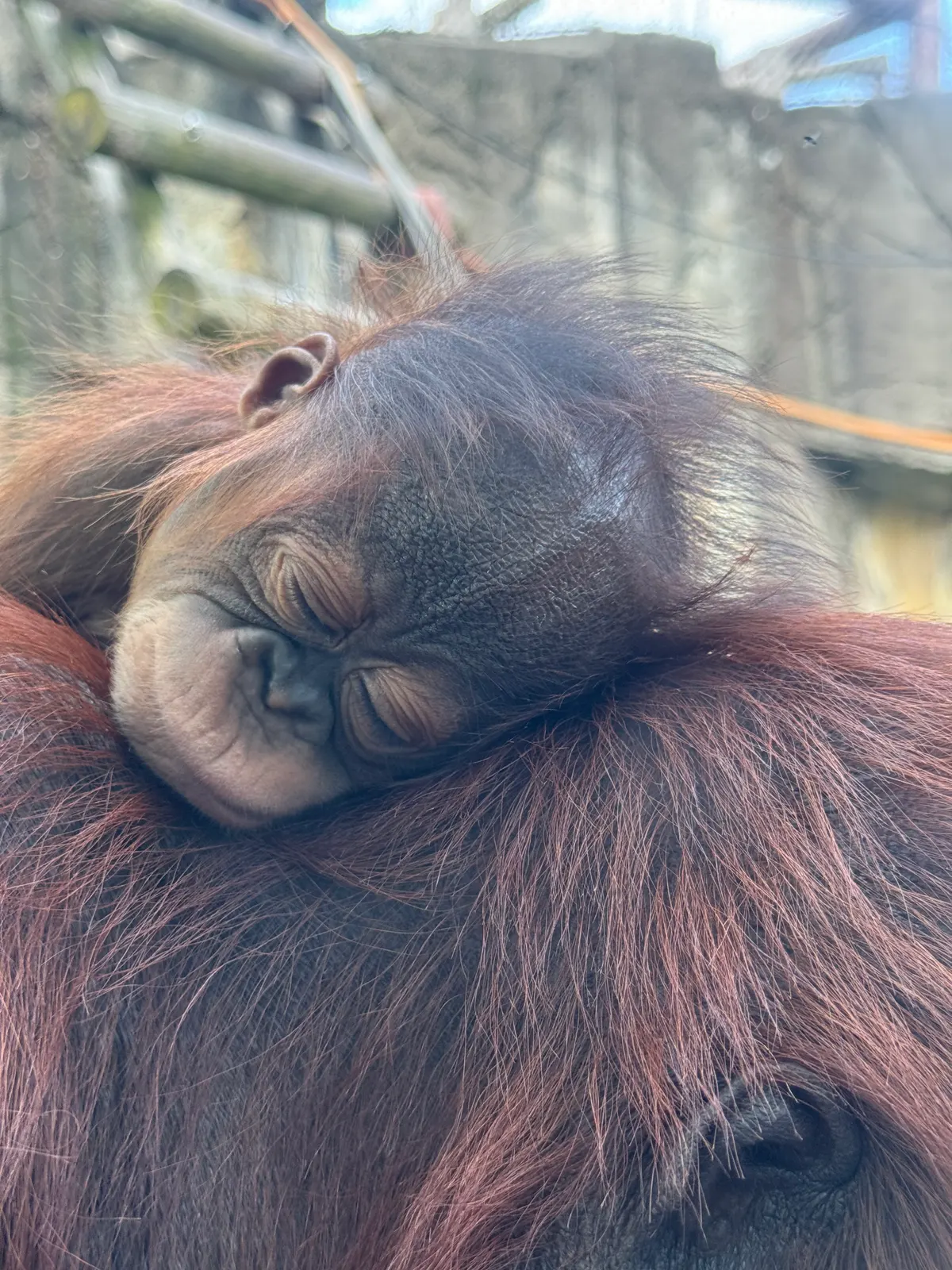
Following an 8.5-month gestation period, a female gives birth to a single infant. The newborn is entirely helpless and relies on the mother for continuous physical contact and thermoregulation. The nursing period is extraordinarily prolonged; infants will nurse for up to six years.
More critically, the juvenile remains fiercely dependent on the mother for up to eight years to acquire the complex ecological knowledge required for survival. The mother painstakingly teaches the juvenile how to identify hundreds of edible plant species, how to navigate the canopy, the complex mechanics of nest-building, and how to safely process toxic or heavily armored foods. Females reach sexual maturity around 15 years of age and typically produce a calf only once every 6 to 8 years. Due to this glacial reproductive timeline, an orangutan population may take decades to recover from even minimal losses. In the wild, Bornean orangutans boast a lifespan of 35 to 45 years.
(Population and conservation trend data sourced from the IUCN Red List of Threatened Species)
The conservation crisis facing the Bornean orangutan is nothing short of catastrophic. The IUCN Red List definitively classifies the species as "Critically Endangered," documenting a staggering population decline of over 60% over the past sixty years. Currently, an estimated 104,700 individuals remain in the wild, fragmented across isolated forest patches.
The primary driver of their impending extinction is the systematic, industrial-scale destruction of their lowland rainforest habitat. Millions of hectares of ancient peat swamps and dipterocarp forests have been systematically logged, drained, and burned to clear land for vast, monoculture agricultural plantations, predominantly producing palm oil for the global market. Furthermore, rampant forest fires—often intentionally set for land clearing and exacerbated by El Niño-induced droughts—regularly incinerate vast swaths of critical orangutan habitat.
As their habitat violently contracts, orangutans are forced into direct conflict with humans. Starving apes frequently raid agricultural crops and are subsequently shot as agricultural pests. Furthermore, despite stringent legal protections, females are continuously poached to capture their highly dependent infants, which are sold into the lucrative and illegal international exotic pet trade. Averting the extinction of the Bornean orangutan demands immediate halts to illegal logging, a massive shift toward certified sustainable palm oil production, and the rigorous protection of remaining primary forest corridors.
Orangutans share about 97 percent of their DNA with humans.
The word orangutan means person of the forest in Malay.
Orangutans build a fresh leafy nest to sleep in almost every night.
A male orangutan's arm span can reach more than 7 feet.
Orangutans are mostly solitary, unlike chimpanzees and gorillas.
Infants stay with their mothers for up to eight years.
Select a question to reveal the answer.
An orangutan is a great ape that lives in Asian rainforests. Orangutans are expert climbers with long red hair and very long arms.
Bornean orangutans live only on the island of Borneo in Indonesia and Malaysia.
Orangutans eat fruit, leaves, bark, flowers, and sometimes insects. Fruit is an important food when trees are fruiting.
Yes. Bornean orangutans are listed as Critically Endangered because rainforests are being cleared for palm oil and logging.
Orangutans are great apes and are closely related to humans, gorillas, and chimpanzees.
Orangutans build leafy nests in trees to sleep safely above the forest floor each night.
Adult orangutans usually live alone, though mothers stay with their infants for many years.