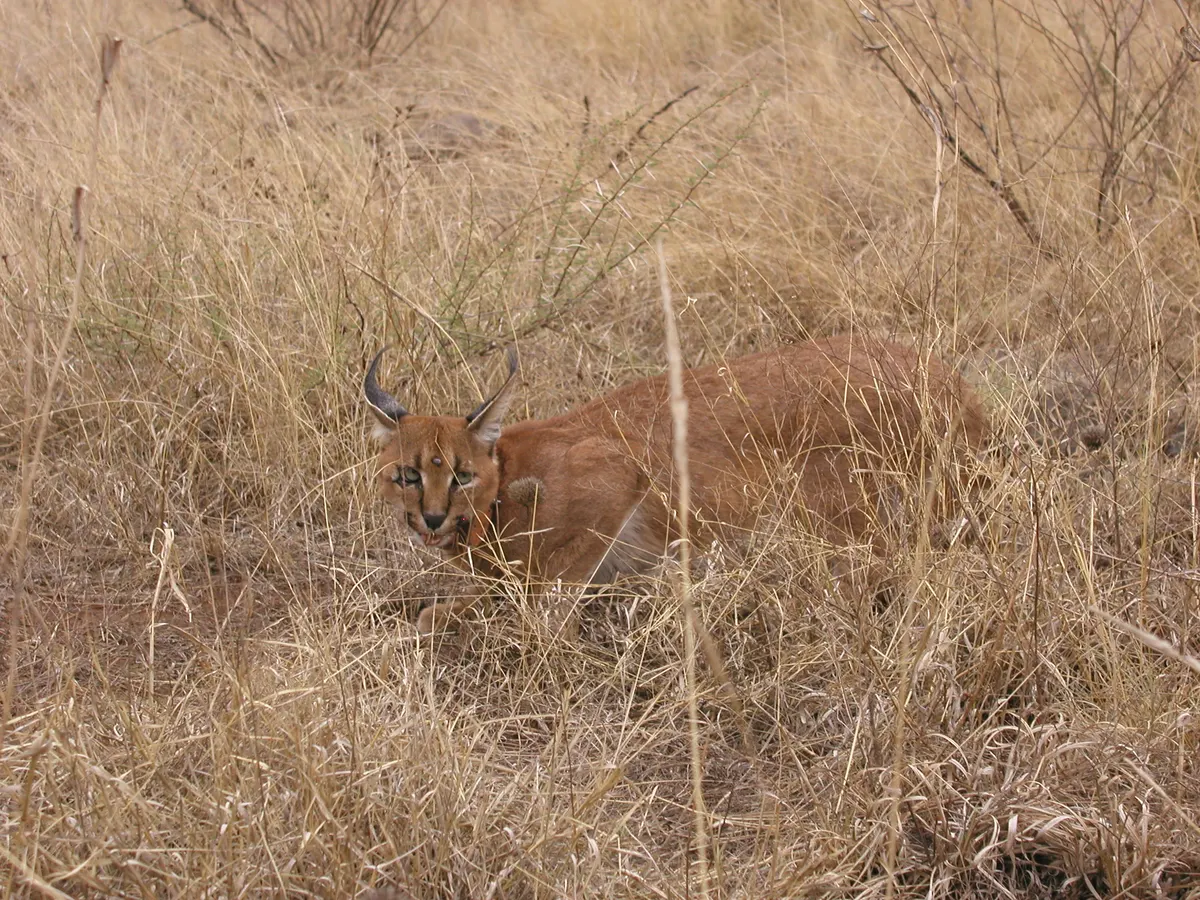
Caracal with long black ear tufts sitting in dry African scrub
The caracal is a medium-sized wild cat known for the long black tufts on its pointed ears.
MammaliaLeast Concern

Caracal

Caracals can leap more than 3 metres straight up to knock birds out of the air with a swipe of a forepaw.

The caracal (Caracal caracal) is a medium-sized wild cat of the family Felidae, native to Africa, the Middle East, Central Asia, and drier parts of South Asia. It is recognized by its long, black-tufted ears and powerful hind legs, which let it make vertical leaps of more than 3 metres to seize birds in flight. The IUCN Red List classifies it as Least Concern across its broad range.

By · Updated

Quick Facts

Caracal at a glance

Caracal caracalCarnivoraFelidae

About their home

Kind of animal

Mammalia

Where they live

What they eat

How safe?

Least Concern

Size and speed

How heavy

8 kg – 19 kg

How long

60 cm – 92 cm

How fast

Fast over short distances; leaps more than 3 m vertically

Lifespan

About 12 years

Core article

Caracal: ecology and life history

A closer look at habitat, diet, behavior, reproduction, and conservation.

Start here

Caracal

The caracal (Caracal caracal) is a slender, reddish wild cat of dry country across Africa and southwestern Asia. It is easiest to recognise by its ears: narrow, held upright, and topped with long black tufts. Behind that distinctive profile is a compact, muscular hunter that relies on hearing, patience, and an unusual jumping ability rather than long chases. This guide covers what the caracal looks like, where it lives, how it hunts, how it raises young, where it fits among the cats, and what is known about its conservation.

Anatomy: Ears, Legs, and Coat

The caracal is a medium-sized member of the Felidae, standing about 40 to 50 cm at the shoulder. Head-and-body length runs from roughly 60 to 92 cm, with an additional tail of about 18 to 34 cm. Males are heavier than females, spanning about 8 to 19 kg across the species.

Two features stand out. The first is the ears, each carrying a tuft of black hair about 4.5 cm long. These tufts are most likely used for visual signalling between individuals; the popular claim that they improve hearing is not well supported. The ears themselves are large and mobile, driven by numerous muscles that let the cat pinpoint faint sounds. The second feature is the hind limbs, which are noticeably long and powerfully muscled and provide the drive behind the caracal's leaps.

The coat is short and uniform, ranging from pale tawny to a deep brick red, with a paler, sometimes lightly spotted underside. Dark markings on the face frame the eyes and muzzle. The tail is comparatively short for a cat of this build, ending well above the ground when the animal stands.

Habitat and Distribution

Caracal resting in dry grassland
Good cover and steady prey let caracals live across a wide band of drylands.

Caracals occupy a wide band of drier country. In Africa they are found across most of the continent outside the true Sahara and the equatorial rainforest belt, and they are most common in southern and eastern Africa. From there the range extends through the Arabian Peninsula and the Middle East, across Central Asia, and into arid parts of Pakistan and northwestern India.

The species favours open and semi-open landscapes: dry grassland and savanna, scrub, semi-desert, and rocky hills and gorges. It reaches the edges of true desert but avoids the most extreme sand seas, and it is generally absent from dense forest. Transitions between woodland and open ground, where cover and prey meet, suit it well. Compared with the closely related serval, the caracal tolerates markedly drier and more broken terrain.

Diet and Hunting

Caracal crouched low and focused while stalking
A stalk-and-pounce hunter, the caracal can take prey larger than itself, including small antelope.

The caracal is a strict carnivore. Across its range the diet centres on small and medium prey: rodents, hares, and rock hyraxes, together with a substantial share of birds. Where opportunity allows, a caracal will also kill prey much larger than itself, including small antelope and the young of larger ungulates, and it is capable of taking animals two to three times its own mass.

Hunting is mostly a matter of stealth followed by a short, explosive rush. The cat locates prey by hearing and sight, stalks into range, and closes with a burst of speed. Its best-known behaviour is aerial: powered by its long hind legs, a caracal can leap more than 3 metres straight up to strike birds as they flush from the ground, often knocking them down with a swipe of a forepaw before they gain height. Larger kills may be dragged into cover or, in some areas, hauled up and cached to be eaten over more than one visit.

Behavior and Territory

Caracal standing alone in an enclosure
Adult caracals defend home ranges and interact mainly during the brief breeding period.

Caracals are largely solitary and mainly active at night, though they may move in the cooler hours around dawn and dusk. By day they rest in dense vegetation, rock crevices, or abandoned burrows. Individuals occupy home ranges that they mark with scent and, in the case of males, defend against other males; ranges of the sexes often overlap, and male ranges tend to be larger.

The cat is a capable climber and jumper, and it uses elevated resting and vantage points where they are available. Away from the spectacular hunting leaps, its daily behaviour is quiet and inconspicuous, which is part of why the species can persist near human activity without being frequently seen. Vocalisations, scent marks, and the movement of the ear tufts all appear to play a part in communication between animals that rarely meet face to face.

Reproduction and Kittens

Caracals can breed through much of the year, with timing influenced by local conditions and prey availability. Gestation lasts roughly 68 to 81 days, about two and a half months, after which the female gives birth in a sheltered den such as a burrow, rock cleft, or dense thicket.

A typical litter is one to four kittens, and occasionally as many as six. The young are born blind and helpless and open their eyes within the first week or two. They begin taking solid food after a few weeks, nurse for several months, and gradually accompany and learn from the mother before dispersing to establish their own ranges at around nine to ten months of age. Females provide all of the parental care.

Taxonomy and Relatives

The caracal is the type species of the genus Caracal within the family Felidae. Despite older common names such as "African lynx" or "desert lynx", it is not a member of the true lynx genus; the resemblance to the lynx lies mainly in the tufted ears and short tail rather than close kinship.

Genetic work places the caracal in the so-called caracal lineage alongside its nearest relatives, the serval and the African golden cat. More distantly, it sits within the broader radiation of cats that also includes larger species such as the cheetah and the leopard. Several subspecies have been described across the range, though the details of subspecies boundaries continue to be revised as new data appear.

Conservation and Threats

Caracal in open dry habitat
Widespread and adaptable, the caracal is listed as Least Concern across most of its range.

The IUCN Red List classifies the caracal as Least Concern. That assessment reflects its broad distribution and its relative abundance in southern and eastern Africa rather than detailed population counts; the global population trend is listed as Unknown. Least Concern at the global scale does not mean every population is secure.

Regional pictures differ sharply. Populations in North Africa and parts of the Middle East and South Asia are much smaller and more fragmented, and the species is considered highly threatened in several of those areas. The main pressures are habitat loss and fragmentation, depletion of wild prey, and conflict with livestock farmers, who may kill caracals in response to attacks on small stock. In parts of southern Africa the caracal is treated as a problem animal and controlled, while elsewhere hunting and the illegal wildlife trade add further pressure. Monitoring is most important where several of these factors overlap.

References and Authoritative Sources

Caracal: classification and fun facts

Classification

Scientific Taxonomy
  1. Kingdom

    Animalia

  2. Phylum

    Chordata

  3. Class

    Mammalia

  4. Order

    Carnivora

  5. Family

    Felidae

  6. Genus

    Caracal

  7. Species

    C. caracal

Did You Know?

Fun Facts

1

Caracals can leap more than 3 metres straight up to knock birds out of the air with a swipe of a forepaw.

2

The name 'caracal' comes from the Turkish 'karakulak', meaning 'black ear'.

3

In India and Persia, caracals were historically tamed and trained to hunt birds and small game for royalty.

4

The distinctive ear tufts are about 4.5 cm long and are thought to help caracals signal to one another.

5

A caracal can take down prey two to three times its own body mass.

6

Despite old names like 'African lynx', the caracal is not a true lynx; its closest relatives are the serval and the African golden cat.

Common Questions

FAQ about Caracal

Select a question to reveal the answer.

What is a caracal?

The caracal (*Caracal caracal*) is a medium-sized wild cat in the family Felidae. It is best known for its long, black-tufted ears, reddish coat, and powerful hind legs, and it lives across much of Africa, the Middle East, Central Asia, and drier parts of South Asia.

Where do caracals live?

Caracals range across most of Africa outside the Sahara and equatorial rainforest, through the Middle East and Central Asia, and into arid parts of Pakistan and northwestern India. They favour dry grassland, savanna, scrub, semi-desert, and rocky hills rather than dense forest.

What do caracals eat?

Caracals are strict carnivores. They mainly hunt rodents, hares, hyraxes, and birds, and can also kill small antelope and other prey larger than themselves. The exact mix depends on what is locally available.

How high can a caracal jump?

Caracals are among the most acrobatic of the wild cats. Using their strong hind legs, they can leap more than 3 metres into the air to catch birds as they take flight, often striking them down with a swipe of a paw.

Why do caracals have tufted ears?

Each ear carries a tuft of black hair about 4.5 cm long. The tufts are most likely used for visual communication between caracals; suggestions that they sharpen hearing are not well supported. The ears themselves are large and mobile, giving the cat acute hearing for locating prey.

Is the caracal endangered?

Globally the IUCN Red List classifies the caracal as Least Concern because it is widespread and reasonably common in southern and eastern Africa. The global population trend is listed as Unknown, and some regional populations, particularly in North Africa and parts of Asia, are far more threatened.