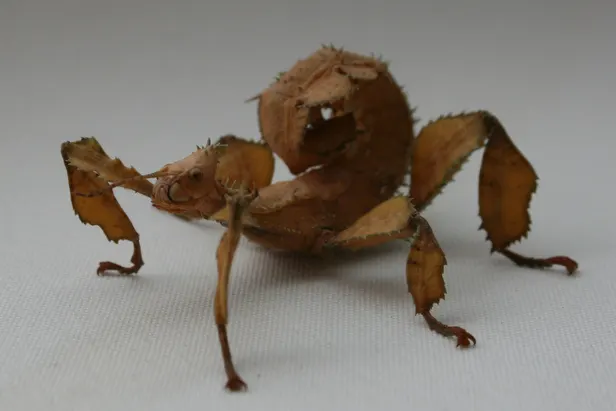
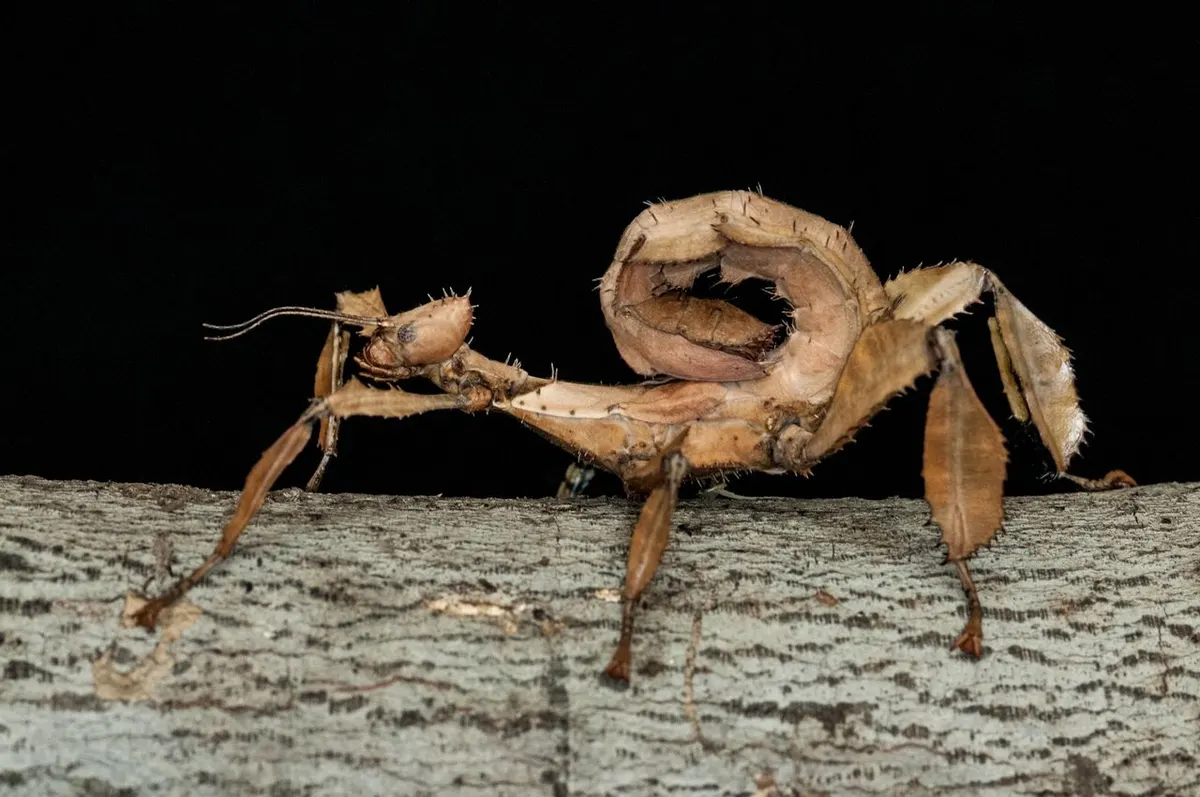
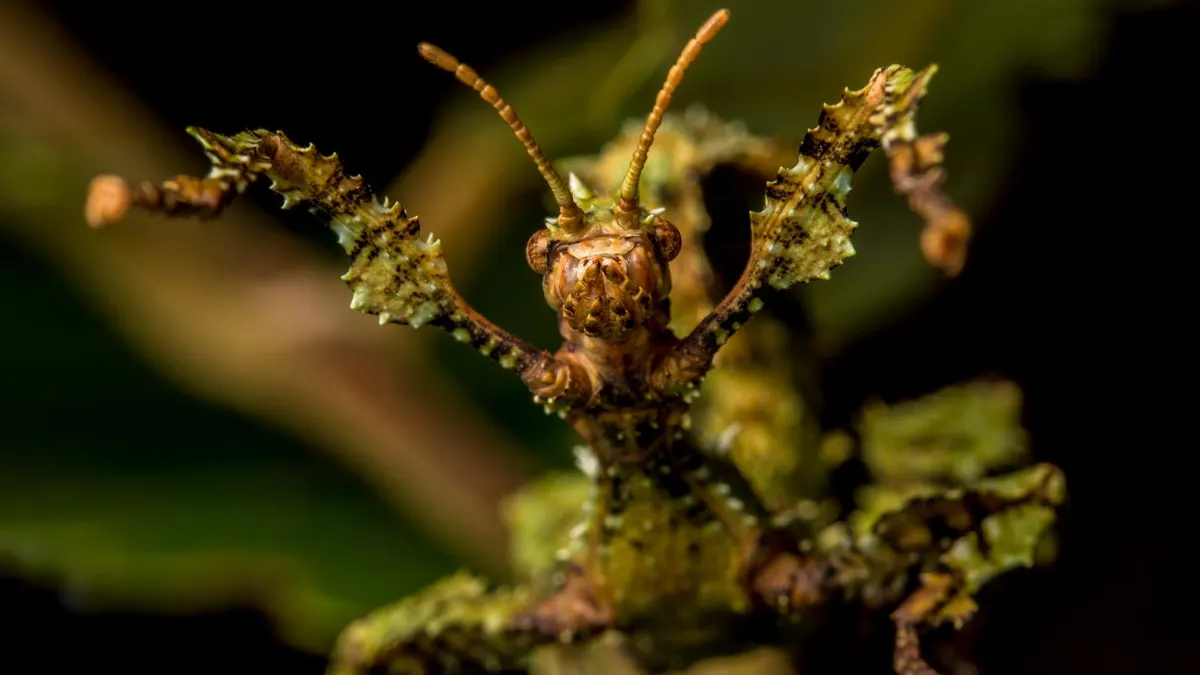
Giant prickly stick insect curling its abdomen up in a scorpion-like defensive posture
When threatened, this stick insect curls its abdomen up over its body, mimicking a scorpion's tail.
InsectaLeast Concern

Giant Prickly Stick Insect Facts

When threatened, this species curls its abdomen over its body and raises its spined hind legs in a scorpion-like display, even though it has no sting of any kind.

The giant prickly stick insect spends its days motionless, its curled abdomen and spiny legs mimicking a dead, curled-up eucalyptus leaf, and drops into a scorpion-like defensive pose if disturbed. Native to eastern Australia, it is one of the most widely kept species in the exotic insect-keeping hobby.
By · Updated

Quick Facts

Giant Prickly Stick Insect at a glance

Extatosoma tiaratumPhasmida (also called Phasmatodea)Phasmatidae

About their home

Kind of animal

Insecta

Where they live

What they eat

How safe?

Least Concern

Size and speed

How heavy

2 g – 10 g

How long

10 cm (males) – 20 cm (females, abdomen curled)

How fast

Slow-moving; relies on stillness and camouflage rather than speed to avoid detection

Lifespan

About 1 year total (egg to adult)

Core article

Giant Prickly Stick Insect: ecology and life history

A closer look at habitat, diet, behavior, reproduction, and conservation.

Start here

Giant Prickly Stick Insect

At rest on a eucalyptus branch, the giant prickly stick insect (Extatosoma tiaratum) looks like a curled, dead leaf, not an animal. This large, flightless-in-females herbivore from eastern Australia is best known for two things: its leaf-mimicking body and a bluff scorpion-like defense with no sting behind it. It is also one of the most widely kept species in the exotic insect-keeping hobby.
Taxonomy and Evolution

The giant prickly stick insect belongs to the order Phasmida, also called Phasmatodea, the stick and leaf insects, within the family Phasmatidae. It is the sole member of the genus Extatosoma. Common names include Australian walking stick, Macleay's spectre, and spiny leaf insect, reflecting both its stick-and-leaf lineage and its individually distinctive, spine-covered body.

Phasmids as a group evolved elaborate camouflage and mimicry as their primary survival strategy, since most species lack chemical defenses, speed, or strong bites. Extatosoma tiaratum represents an extreme version of this strategy, combining leaf mimicry with a secondary bluff display rather than relying on disguise alone.

Anatomy and Physical Characteristics

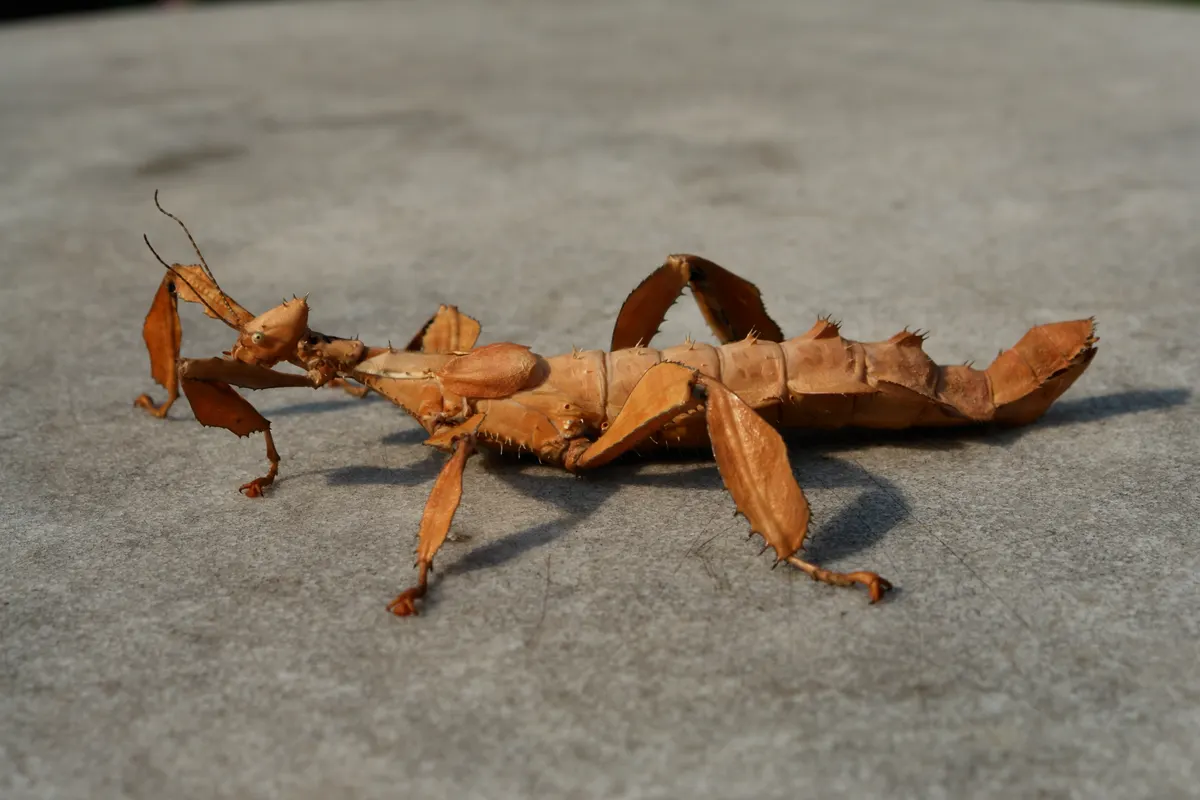
Sexual dimorphism in this species is dramatic. Females are the larger sex, reaching up to about 20 cm (8 inches) in length with the abdomen curled forward over the body, and have only small, non-functional wing pads, leaving them flightless. Males are considerably smaller and slimmer, typically around 10 to 11 cm, and carry functional wings that let them fly in search of mates.

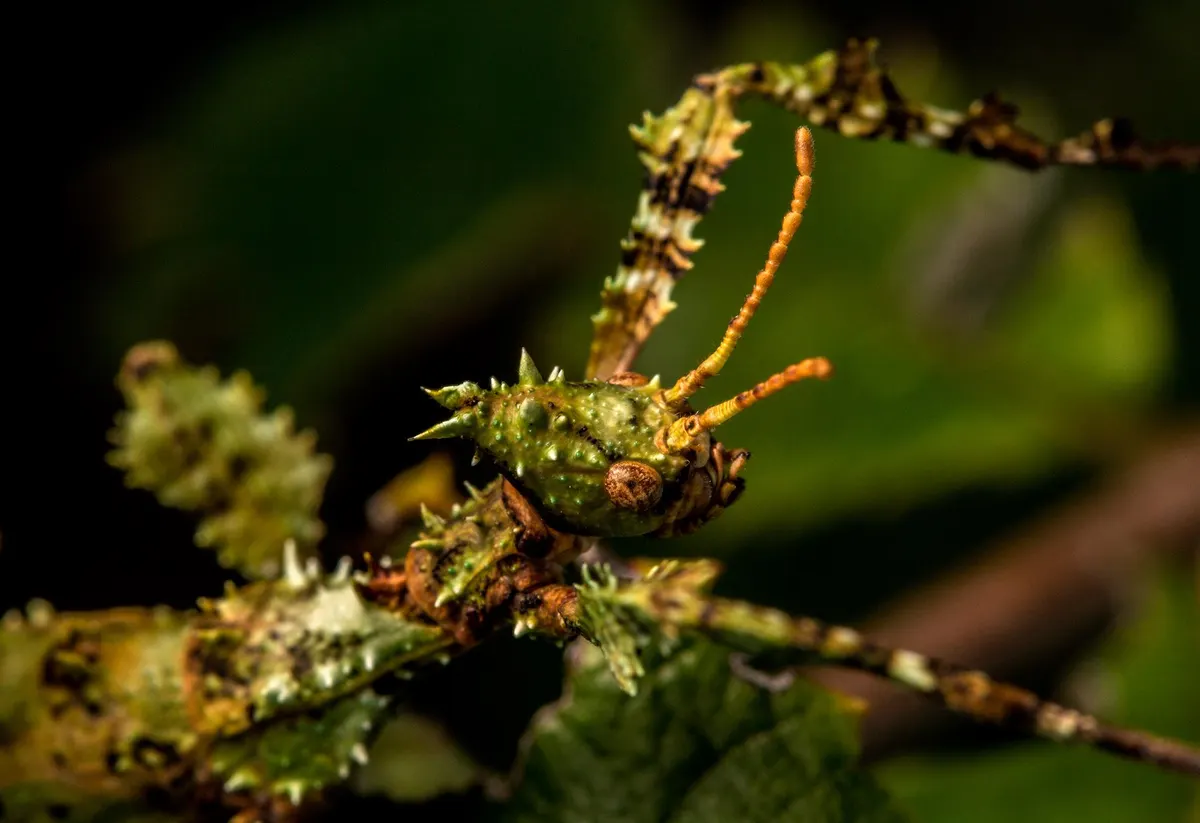
Both sexes have a body covered in irregular spines and lobed, leaf-shaped extensions on the legs, breaking up their outline and reinforcing the impression of dead or curling foliage. Coloration ranges through browns, tans, and mottled greens depending on the individual and its rearing conditions. Body mass is modest in absolute terms, typically a few grams, but the species is often cited as one of the heaviest stick insects by body mass.

Habitat and Distribution

Giant prickly stick insect clinging to vegetation
In the wild, this species hides among eucalyptus leaves and woody vegetation in eastern Australia.

The species is native to forest and woodland habitat in eastern Australia, chiefly Queensland and New South Wales, where eucalyptus forest and subtropical scrub dominate. It is generally found in the forest canopy and understory, clinging to branches and foliage during the day.

Within this range it is common and widely distributed, and its camouflage-dependent lifestyle ties it closely to eucalyptus and related native vegetation rather than open or cleared ground.

Diet and Feeding Strategies

Giant prickly stick insect resting on leafy vegetation
Giant prickly stick insects feed on eucalyptus in the wild and accept bramble leaves in captivity.

Extatosoma tiaratum is a strict herbivore. In the wild its diet is centered on eucalyptus leaves, supplemented by other native plants. Feeding happens mainly at night, when the insect is less exposed to visually hunting predators, and it remains still and camouflaged through daylight hours.

In captivity, keepers commonly rear it on bramble, raspberry, oak, or guava leaves as substitutes for eucalyptus, all of which the species readily accepts. This dietary flexibility, combined with its calm temperament, is a major reason it has become a staple beginner species in the insect-keeping hobby.

Social Structure and Behavior

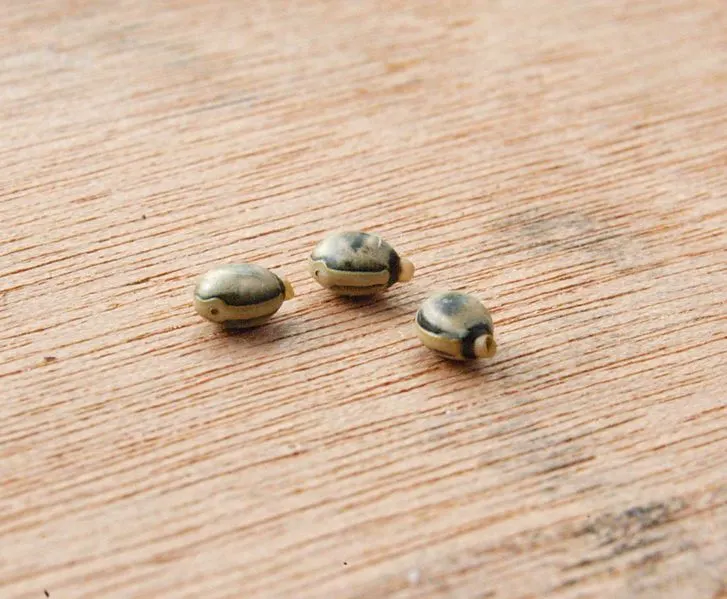
Seed-like eggs of the giant prickly stick insect
The eggs mimic seeds, and ants may carry them underground where embryos develop in relative safety.

This species is solitary and shows no parental care or group structure beyond incidental proximity on shared food plants. Its main behavioral repertoire centers on avoiding predation. By day it rests motionless, its curled abdomen and leg lobes resembling a dead, curling leaf.

If disturbed, it can respond in two escalating ways. It may drop suddenly to the ground and lie still, a form of playing dead known as thanatosis, relying on the fall and stillness to break a predator's tracking. Alternatively, it may curl its abdomen up and over its body while raising its spined hind legs into a scorpion-like posture, a bluff display intended to look threatening even though the species has no sting or comparable weapon. Nymphs that lose a leg to a predator or accident can regenerate it to some degree across subsequent molts.

Life Cycle and Reproduction

Young female giant prickly stick insect with curled abdomen
Nymphs resemble small, spiny leaves and become more elaborate with each molt.

Females lay eggs a few at a time by flicking them onto the forest floor rather than depositing them in a fixed nest. The eggs are shaped and colored much like small seeds, and ants frequently collect and carry them into their own nests as they would a seed, incidentally sheltering the developing embryo underground. Depending on conditions, eggs can take anywhere from several months to over a year to hatch.

A notable trait of this species is facultative parthenogenesis: an unmated female can still produce viable eggs. Offspring from unmated mothers are typically female clones of the parent, while mating with a male produces both sons and daughters. Total lifetime egg output is often cited in the range of 200 to over 1,000 eggs. From egg to adult, individuals typically live around a year in total, with captive adults commonly surviving several months to about a year past maturity.

Conservation Status and Threats

Female giant prickly stick insect showing leaf-like camouflage
This Australian species is native to eastern forests and woodlands from Queensland to New South Wales.

(Extatosoma tiaratum has not been formally assessed on the IUCN Red List; the status below reflects its common, widespread status in the wild based on field observation rather than a completed IUCN evaluation.)

The giant prickly stick insect is treated as Least Concern, with a stable population across its native Australian range. It remains common in eucalyptus forest and woodland habitat in Queensland and New South Wales.

Localized habitat clearing and pesticide use can affect populations at a local scale, but the species faces no known range-wide threat. Its camouflage and defensive bluff display remain effective against its natural predators, chiefly birds and other insectivorous animals.

Body shape points to different survival problems across insects. Compare this camouflage specialist with the horn, grip, and leverage system examined in how strong a Hercules beetle is for its size.

References and Authoritative Sources

Giant Prickly Stick Insect: classification and fun facts

Classification

Scientific Taxonomy
  1. Kingdom

    Animalia

  2. Phylum

    Arthropoda

  3. Class

    Insecta

  4. Order

    Phasmida (also called Phasmatodea)

  5. Family

    Phasmatidae

  6. Genus

    Extatosoma

  7. Species

    E. tiaratum

Did You Know?

Fun Facts

1

When threatened, this species curls its abdomen over its body and raises its spined hind legs in a scorpion-like display, even though it has no sting of any kind.

2

Its eggs are shaped and colored like small seeds, and ants often collect and bury them, unknowingly protecting the developing embryos.

3

Females can grow to roughly 20 cm and are flightless, while males are barely half that length but have functional wings and can fly.

4

If grabbed or startled, it may simply go rigid and drop to the ground, playing dead until the threat passes.

5

Females can produce viable eggs without mating; unmated females mainly produce daughters that are genetic clones of themselves.

6

It is one of the most common beginner species in the pet insect hobby because of its docile temperament and straightforward eucalyptus- or bramble-leaf diet.

Common Questions

FAQ about Giant Prickly Stick Insect

Select a question to reveal the answer.

What is a giant prickly stick insect?

The giant prickly stick insect (Extatosoma tiaratum) is a large herbivore native to eastern Australia. Its body mimics a curled, dead leaf, making it one of the more distinctive camouflage specialists among stick and leaf insects (order Phasmatodea).

Is the giant prickly stick insect dangerous or does it sting?

No. It has no sting or venom. When threatened it raises its abdomen and hind legs into a scorpion-like pose purely as a bluff display to startle predators, not to attack.

Where does the giant prickly stick insect live?

It is native to forest and woodland habitat in eastern Australia, mainly in Queensland and New South Wales, where it lives among eucalyptus and other native trees and shrubs.

What does the giant prickly stick insect eat?

It is a strict herbivore, feeding mainly on eucalyptus leaves in the wild. In captivity it also readily eats bramble, raspberry, oak, and guava leaves.

Why does it look like a scorpion?

Its scorpion-like posture, curling the tail-like abdomen up and raising the spiny hind legs, is a bluff defense meant to make it look threatening to predators, even though it cannot sting or bite in any comparable way.

How big do giant prickly stick insects get?

Females are the larger sex, reaching up to about 20 cm (8 inches) with the abdomen curled. Males are slimmer and shorter, typically around 10 to 11 cm, and unlike females they have functional wings and can fly.

Show 2 more questionsExpand
Can females reproduce without males?

Yes. This species is capable of facultative parthenogenesis: an unmated female can lay eggs that develop into viable offspring, which are typically female clones of the mother, though reproduction with a male produces a mix of sons and daughters.

Are giant prickly stick insects endangered?

No. They are considered common and widespread within their native range and are not currently listed as threatened, though they have not been formally assessed by the IUCN Red List.