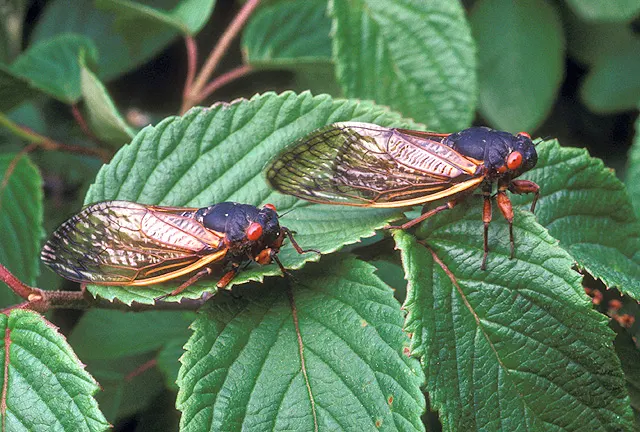
Magicicada septendecim
Seventeen-year cicadas spend most of their lives underground feeding on fluid from tree roots.
InsectaLeast Concern

Cicada Facts

Periodical cicadas live underground as nymphs for a whopping 17 years, sucking fluid from tree roots, before coming out all at once!

Seventeen-year cicadas spend most of their lives underground feeding on fluid from tree roots. In an emergence year, enormous numbers surface together, molt into adults, and fill eastern North American forests with the synchronized calls of males.

By · Updated

Quick Facts

Cicada at a glance

Magicicada septendecimHemipteraCicadidae

About their home

Kind of animal

Insecta

Where they live

What they eat

How safe?

Least Concern

Size and speed

How heavy

1 g – 2 g

How long

2.4 cm – 3.3 cm

How fast

Slow flight, loud sound

Lifespan

17 years (mostly underground)

Core article

Cicada: ecology and life history

A closer look at habitat, diet, behavior, reproduction, and conservation.

Start here

Cicada

The Roaring Chorus of the [Forest](/habitats/forest)

Cicada in its natural habitat
Cicada is recorded in temperate forest habitats.

The periodical cicada (Magicicada septendecim) spends most of its 17-year life cycle underground as a nymph feeding on fluids from tree roots. Synchronized broods later emerge in vast numbers across eastern North American forests, where adults molt, mate, and lay eggs over several weeks. Calling males can collectively produce sound levels near 100 decibels, making the emergence conspicuous even where individual insects are difficult to see.

Taxonomy and Evolution

Scientifically classified as Magicicada septendecim, the 17-year periodical cicada falls within the kingdom Animalia, the phylum Arthropoda, and the class Insecta. As a member of the order Hemiptera (the "true bugs"), it is closely related to aphids and leafhoppers, and is placed in the family Cicadidae.

Evolutionary entomologists theorize that the cicada's extreme, prime-numbered life cycle (13 or 17 years) evolved during the Pleistocene epoch as a mechanism to avoid climatic fluctuations and strictly outpace the life cycles of potential predators. By synchronizing their emergence precisely every 17 years, Magicicada prevents any specialized predator population from matching their exact schedule.

Anatomy and Physical Characteristics

The adult periodical cicada is a striking creature. Measuring between 2.4 and 3.3 cm in length, they are characterized by stark black bodies, brilliant ruby-red eyes set wide apart on their heads, and delicate, membranous wings laced with stark orange veins.

Like all true bugs, they possess highly specialized mouthparts. Rather than chewing mandibles, they possess a rigid, needle-like structure called a rostrum. This anatomical feature functions as a hypodermic straw, allowing the cicada to pierce the dense bark of twigs to access the vascular tissue beneath.

The most defining anatomical feature, exclusive to the males, is the tymbal organ. Located on the abdomen, the tymbal consists of a series of ribbed, drum-like membranes. Using powerful muscles, the male buckles and unbuckles these ribs hundreds of times per second. The resulting sound is amplified by the insect's largely hollow abdomen, creating the deafening drone that defines a cicada emergence.

Habitat and Distribution

Periodical cicadas are exclusively endemic to the eastern and central United States, heavily distributed across deciduous and temperate forests. Because their survival strategy relies entirely on overwhelming numbers, they are deeply tethered to environments with a high density of mature, deciduous trees such as oak, maple, and hickory.

Their habitat is effectively split into two distinct biomes across their lifespan: the subterranean soil biome, where nymphs reside up to two feet beneath the surface attached to tree roots, and the arboreal canopy, which they briefly occupy as winged adults to mate and lay eggs.

Diet and Feeding Strategies

Cicadas are strict herbivores, feeding entirely on the xylem fluid (sap) of trees and woody plants.

Their feeding strategy changes drastically between their developmental stages. For the 17 years spent underground as a nymph, the cicada utilizes powerful, digging front claws to excavate small chambers around tree roots. It inserts its rostrum into the root to continuously siphon fluid, growing agonizingly slowly due to the incredibly low nutritional value of root xylem.

When they emerge as adults, their feeding is minimal and secondary to reproduction. However, they still utilize their rostrum to pierce the tender branches and twigs of canopy trees to drink sap, sustaining themselves just long enough to complete their mating rituals before dying a few weeks later.

Social Structure and Behavior

Magicicada septendecim, teneral stage, Brood X
Documented Cicada behavior includes loud singing by males, emerging from ground in massive swarms, and shedding exoskeleton on tree trunks.

The defining behavioral strategy of the periodical cicada is "predator satiation." They do not possess stingers, venom, or evasive speed. Instead, they rely on mass emergence. Millions, sometimes billions, of cicadas erupt from the soil within the exact same week. Predators—birds, squirrels, wasps, spiders, and domestic pets—gorge themselves until they are physically incapable of eating more. By providing an infinite all-you-can-eat buffet, a massive percentage of the cicada population guarantees their own survival.

The adult phase is entirely consumed by a chaotic mating frenzy. The deafening sound of the forest is driven by male choruses attempting to attract females. Females respond to preferred males with a quiet, clicking flick of their wings.

Life Cycle and Reproduction

Seventeen-year cicada emerging from its nymphal exoskeleton
At the end of the underground nymph stage, a periodical cicada splits its exoskeleton and emerges as a soft-bodied adult.

The reproductive cycle of the 17-year cicada is an exercise in extreme patience and sudden urgency. After mating, the female uses a specialized appendage called an ovipositor to slice tiny, V-shaped slits into living tree branches. She deposits roughly 400 to 600 eggs across several branches.

After an incubation period of 6 to 10 weeks, the eggs hatch into tiny, ant-sized nymphs. These neonate nymphs immediately free-fall from the canopy to the forest floor and burrow into the soil. Once underground, they attach themselves to a root and remain there for 17 years. When their internal biological clocks signal the 17th spring, and soil temperatures reach exactly 64°F (18°C), the nymphs burrow to the surface en masse. They climb the nearest vertical surface—a tree trunk, fence, or wall—and undergo their final molt. They split their brown, crusty exoskeletons down the back, emerging as soft, pale adults that must wait hours for their new wings to harden before taking flight.

Conservation Status and Threats

Mass emergence of periodical cicadas at Flint Ridge in Ohio
A mass emergence at Flint Ridge, Ohio, illustrates the localized North American broods formed by seventeen-year periodical cicadas.

(Population and conservation trend data sourced from the IUCN Red List of Threatened Species)

Currently, Magicicada septendecim is classified as a species of "Least Concern." The sheer scale of their emergences makes them seemingly invulnerable.

However, they are highly susceptible to long-term environmental changes. Widespread deforestation and urban development effectively pave over their subterranean habitats, entombing sleeping nymphs under concrete. Because a brood relies on massive, undisturbed root systems for 17 years, clear-cutting a forest guarantees the total eradication of that specific local population. Additionally, climate change and unseasonal warming trends have begun to trigger "straggler" emergences, causing small fractions of a brood to emerge years early, immediately falling victim to predators because they lack the protection of numbers.

References and Authoritative Sources

Cicada: classification and fun facts

Classification

Scientific Taxonomy
  1. Kingdom

    Animalia

  2. Phylum

    Arthropoda

  3. Class

    Insecta

  4. Order

    Hemiptera

  5. Family

    Cicadidae

  6. Genus

    Magicicada

  7. Species

    M. septendecim

Did You Know?

Fun Facts

1

Periodical cicadas live underground as nymphs for a whopping 17 years, sucking fluid from tree roots, before coming out all at once!

2

The loud buzzing sound of cicadas is made only by males, using special vibrating drum-like organs on their stomachs called tymbals to attract females.

3

Cicadas are the loudest insects in the world, with their songs reaching up to 100 decibels—as loud as a lawnmower or a chainsaw!

4

When they emerge, they leave behind their hollow, crunchy brown skins (exoskeletons) clinging to tree bark and fences.

5

By emerging all at once in billions (a strategy called predator satiation), cicadas overwhelm predators, ensuring plenty of them survive to lay eggs.

6

Adult cicadas do not chew leaves; they have a needle-like straw mouth that they use to poke into twigs and drink sweet tree sap.

Common Questions

FAQ about Cicada

Select a question to reveal the answer.

What is a periodical cicada?

A periodical cicada is an insect famous for spending 17 years living underground as a nymph before emerging in massive swarms to live as a flying adult for a few weeks.

Where do periodical cicadas live?

They live in the deciduous forests and woodlands of the eastern and central United States.

What do cicadas eat?

They are herbivores that drink sap. Nymphs drink fluid from tree roots underground, while adults drink sap from tree branches and twigs.

Why do cicadas buzz?

Male cicadas make loud buzzing songs to attract mates. Special body parts called tymbals vibrate rapidly to create the sound.

How long do cicadas live underground?

Periodical cicadas can spend 13 or 17 years underground as nymphs before emerging together as adults.

Are cicadas harmful to people?

No. Cicadas do not bite or sting people, though large emergences can be noisy and may damage small tree branches when females lay eggs.