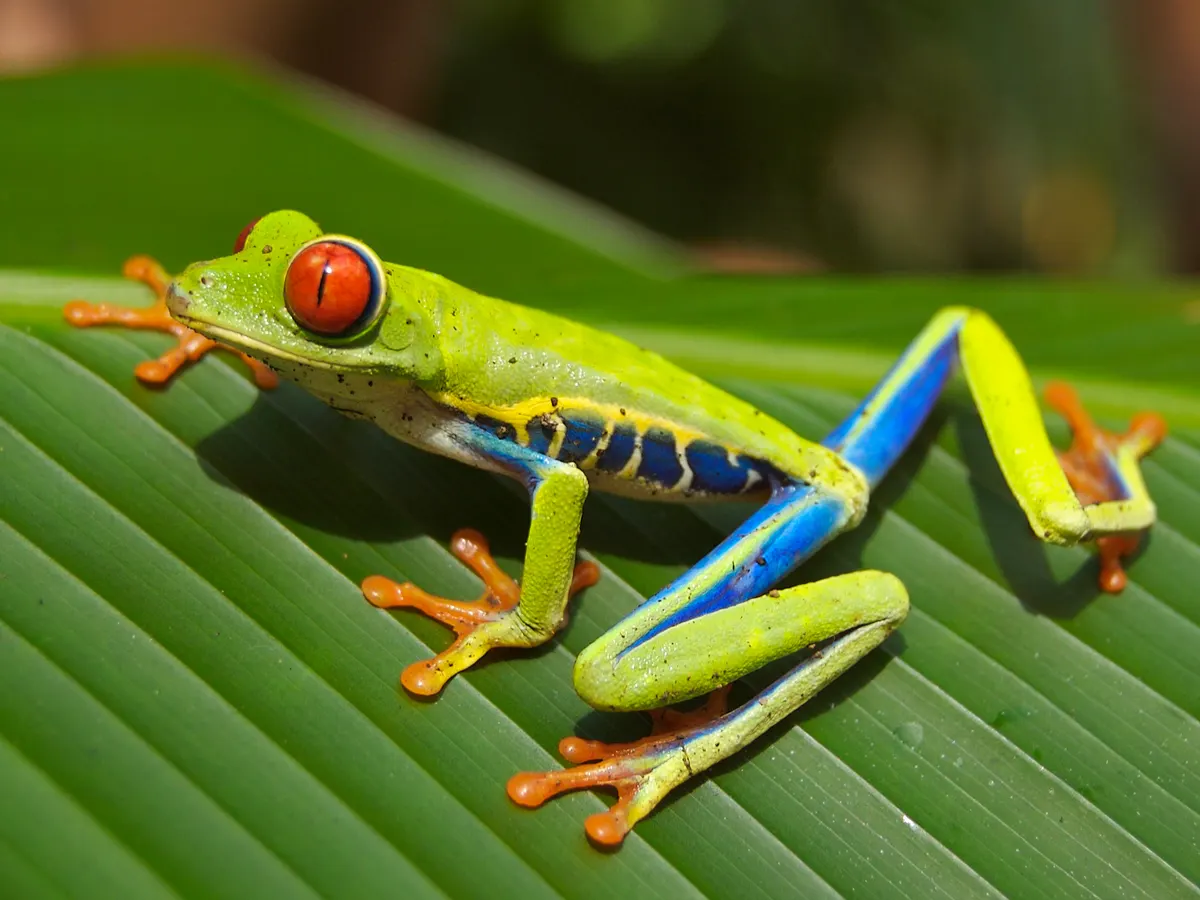
Red-eyed tree frog with bright red eyes and green body clinging to a leaf
The red-eyed tree frog is famous for its vivid red eyes and neon-green body.
AmphibiaLeast Concern

Red-eyed Tree Frog Facts

Red-eyed tree frogs flash their huge red eyes to startle predators.

The red-eyed tree frog is a colorful amphibian of Central American rainforests. Its bright red eyes, green body, and orange feet make it one of the most recognizable frogs in the world.

By · Updated

Quick Facts

Red-eyed Tree Frog at a glance

Agalychnis callidryasAnuraPhyllomedusidae

About their home

Kind of animal

Amphibia

Where they live

What they eat

How safe?

Least Concern

Size and speed

How heavy

0.2 ounces – 0.5 ounces

How long

2 inches – 3 inches

How fast

Quick leaps between leaves and branches

Lifespan

About 5 years

Core article

Red-eyed Tree Frog: ecology and life history

A closer look at habitat, diet, behavior, reproduction, and conservation.

Start here

Red-eyed Tree Frog

Perched on a rain-soaked leaf in a Central American rainforest, the red-eyed tree frog (Agalychnis callidryas) looks almost too colorful to be real — neon-green back, fiery red eyes, blue-and-yellow flanks, orange toes. By day it hides in plain sight; by night it becomes an agile insect hunter of the forest canopy, and it is one of the most photographed amphibians on Earth.

Camouflage by Day, a Startle Flash by Night

Adults are small — 2 to 3 inches snout to vent and a fraction of an ounce — with slender bodies and long, grasping legs for leaping between branches. The huge red eyes have vertical night-vision pupils, but their real job may be defense: resting by day, the frog tucks its bright legs against its body and shuts its eyes, showing only green for near-perfect leaf camouflage, then, if disturbed, snaps its red eyes open and flashes its blue-and-yellow sides and orange feet in a sudden "startle display" that can make a predator hesitate. Each toe ends in a round adhesive pad that grips smooth leaves, branches, even glass, and permeable skin absorbs oxygen and water straight from the humid air. It belongs to the leaf-breeding tree frog family Phyllomedusidae — not a close relative of the aquatic axolotl, though both are amphibians.

Where Red-eyed Tree Frogs Live

Red-eyed tree frog on a leaf at night in Costa Rican rainforest
These frogs live in humid lowland rainforests from Mexico south to Colombia.

Red-eyed tree frogs live in humid tropical and subtropical forest from southern Mexico through Central America to northwestern Colombia, especially common in Costa Rica and Panama. Within the forest they keep to the understory and lower canopy, typically 2 to 20 feet up, staying near the temporary or permanent pools, ponds, and slow streams where their tadpoles develop. Rainfall, humidity, and intact vegetation are all essential — cleared forest and polluted water erase breeding sites fast.

What Red-eyed Tree Frogs Eat

Red-eyed tree frog perched ready to hunt insects in Costa Rica
At night they hunt crickets, moths, flies, and other small insects.

They are carnivores that hunt only at night, sitting motionless on a leaf and lashing out with a sticky tongue faster than the eye can follow. The diet is mainly crickets, flies, moths, grasshoppers, beetles, and other small insects, with larger females taking bigger prey. As ambush hunters they depend on that daytime camouflage — a frog that gives away its position too early loses the element of surprise.

Behavior: Solitary, With a Sudden Startle Display

Clutch of red-eyed tree frog eggs in jelly on a leaf above water
Pairs leave egg clutches on leaves overhanging pools where tadpoles will drop.

Red-eyed tree frogs are largely solitary outside breeding, and in the rainy months males turn territorial, calling a short, repetitive "chock-chock-chock" from vegetation overhanging water. The startle display is their signature move: when a snake or bird approaches a resting frog, it opens its eyes, lifts its body, and flashes its brightest colors in a fraction of a second, perhaps buying the split second it needs to leap clear. At night it jumps powerfully between plants, landing securely on its toe pads.

Life Cycle: Eggs on a Leaf, Tadpoles Below

Young red-eyed tree froglet with developing color on a green leaf
Froglets leave the water after metamorphosis and climb into the canopy.

Breeding follows the rainy season. A male clasps a female (amplexus) on a leaf above water, and she lays 20 to 40 eggs on the leaf's underside for him to fertilize externally. After 6 to 10 days the eggs hatch and the tadpoles wriggle free, dropping into the water below, where they live for several weeks feeding on algae and detritus. They metamorphose — growing legs, absorbing the tail, developing lungs — and climb out as tiny froglets with miniature red eyes, the whole process taking about 6 to 8 weeks.

Conservation: Least Concern but Habitat-Sensitive

The red-eyed tree frog is Least Concern with a stable trend and remains common in many protected areas. The main threats are habitat loss and degradation — rainforest cleared for agriculture, cattle pasture, and development destroys breeding pools and humid microclimates, while pesticide runoff pollutes tadpole water and climate change may shift the rainfall that triggers breeding. It is also collected for the pet trade, though captive breeding has eased pressure on wild populations in some areas.

References and Authoritative Sources

Red-eyed Tree Frog: classification and fun facts

Classification

Scientific Taxonomy
  1. Kingdom

    Animalia

  2. Phylum

    Chordata

  3. Class

    Amphibia

  4. Order

    Anura

  5. Family

    Phyllomedusidae

  6. Genus

    Agalychnis

  7. Species

    A. callidryas

Did You Know?

Fun Facts

1

Red-eyed tree frogs flash their huge red eyes to startle predators.

2

They sleep on leaves during the day, hiding their bright colors with closed eyes.

3

Females lay eggs on leaves above water so tadpoles can drop into ponds below.

4

Sticky toe pads let them climb smooth leaves and glass-like surfaces.

5

Their bright orange feet are hidden while resting but visible when jumping.

6

Tadpoles can metamorphose into tiny froglets in just a few weeks.

Common Questions

FAQ about Red-eyed Tree Frog

Select a question to reveal the answer.

What is a red-eyed tree frog?

A red-eyed tree frog is a small, brightly colored amphibian from Central American rainforests. It has vivid red eyes, a green body, blue sides, and orange feet.

Where do red-eyed tree frogs live?

They live in humid forest habitats from southern Mexico through Central America to northwestern Colombia.

Why do red-eyed tree frogs have red eyes?

Their red eyes are a startle display. When a predator approaches, the frog opens its eyes suddenly, flashing bright red to surprise the attacker and escape.

What do red-eyed tree frogs eat?

Red-eyed tree frogs are carnivores that hunt insects such as crickets, flies, moths, and grasshoppers at night.

How do red-eyed tree frogs reproduce?

Females lay eggs on leaves overhanging water. When the eggs hatch, tadpoles fall into ponds below and later metamorphose into froglets.

Are red-eyed tree frogs poisonous?

They are not dangerously poisonous to humans, but their skin may carry mild toxins that deter some predators.

Show 1 more questionsExpand
Are red-eyed tree frogs endangered?

They are listed as Least Concern, but rainforest loss and pollution threaten local populations across their range.