
Animal guides
How Strong Is a Hercules Beetle for Its Size?
The beetle's real advantage is a horn-and-body system adapted to grip, lift, and dislodge rival males—not one viral strength number.
By An Nguyen · Updated
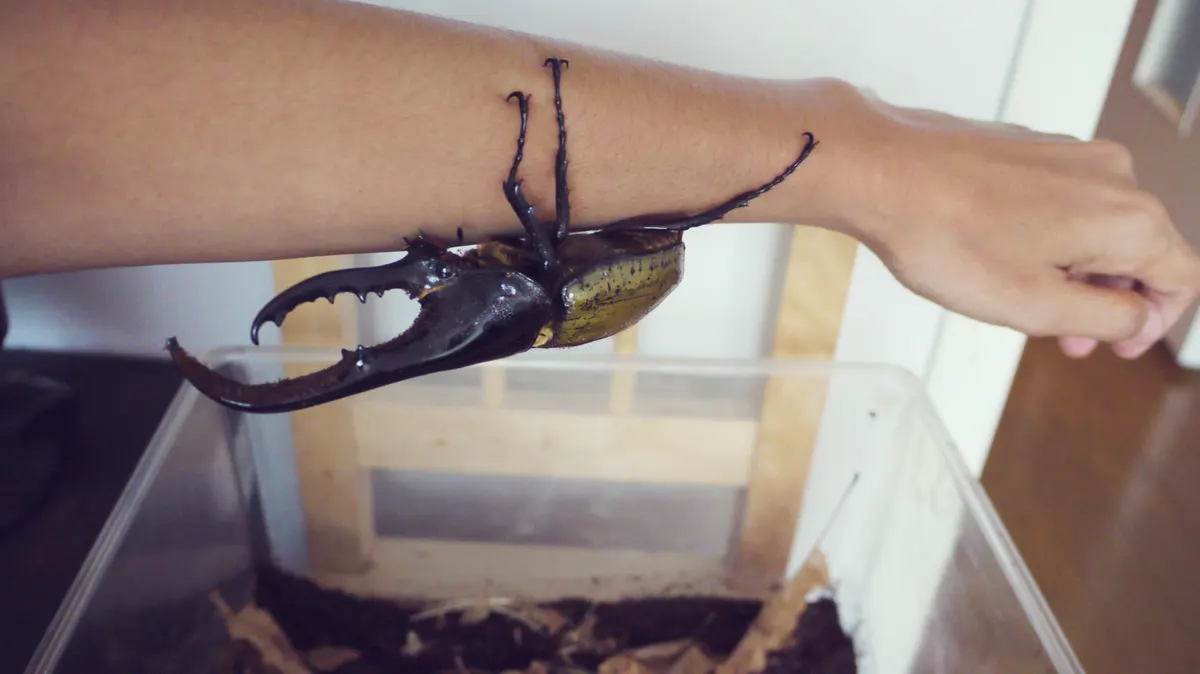
Hercules beetles are strong for their size, but there is no single, well-supported number that captures that strength. Popular claims that one can lift hundreds of times its body weight usually circulate without a reproducible test of Dynastes hercules. The defensible answer is more specific: an adult male is built to grip a branch, clamp a rival between its horns, lift him, and dislodge him.
That is different from asking how much weight a beetle could pull on a smooth laboratory track. Strength changes with the task, the surface, the beetle's sex and body size, and where the load is applied.
How does a Hercules beetle use its strength?
Male Hercules beetles compete over access to females and feeding sites. The long thoracic horn above and shorter head horn below act like opposing jaws. A male works the lower horn under a rival, closes the gap, and uses his legs and body as a base while lifting or throwing the opponent.
The goal is usually removal rather than injury. A displaced male loses his position on the branch. That makes grip and leverage as important as raw muscle force. Clawed feet provide purchase, the body transfers force, and the horns extend the reach of the lifting system.
This is also why a comparison with the long, narrow body of a stick insect can mislead. Both are insects with six legs and a lightweight external skeleton, but natural selection has emphasized camouflage in one and male wrestling equipment in the other.
Why can small animals lift high relative loads?
Muscle force is related largely to the cross-sectional area of muscle, while body mass increases with volume. As similar shapes get smaller, mass falls faster than cross-sectional area. Small animals can therefore support and move larger loads relative to their own body weight than a geometrically similar large animal.
This scaling principle helps explain why insects often look disproportionately strong. It does not establish a species-specific record. A valid “times body weight” result still requires a stated method: lifting or dragging, horizontal or vertical movement, duration, surface, sample size, and whether the load includes the apparatus.
Hercules beetles also have the mechanical advantage of an exoskeleton. It provides rigid attachment points for muscles and resists deformation. The tradeoff is that adults cannot grow continuously; body and horn size are fixed when the beetle completes its final molt.
Are the enormous horns strong or fragile?
The horns are not simply decorative. A structural study comparing rhinoceros-beetle species found that horn shapes and internal structure correspond to the loads imposed by each species' characteristic fighting style. Hercules beetles use a pincer-like motion, and their horns resist the bending and twisting generated during that maneuver.
Long horns still involve tradeoffs. They add material, affect movement through vegetation, and can experience substantial leverage at the base. Horn length also varies among males because larval nutrition and developmental conditions affect adult size. The largest-looking male is not automatically the strongest in every contest.
What should replace the “850 times” claim?
A precise-sounding viral multiple should be treated as unverified unless it is tied to a study of the correct species and a clear procedure. Different beetles have been tested in traction, pulling, or load-carrying experiments, and a number from one method cannot be transferred to every beetle.
A more useful statement is that the Hercules beetle's relative strength, grip, horn geometry, and behavior form a specialized wrestling system. It can lift and toss another beetle of comparable scale on a branch. That observed biological task is impressive without assigning an unsupported record.
For its larval life in decaying wood, adult diet, range, and reproduction, see the full Hercules beetle profile and the broader insect directory.