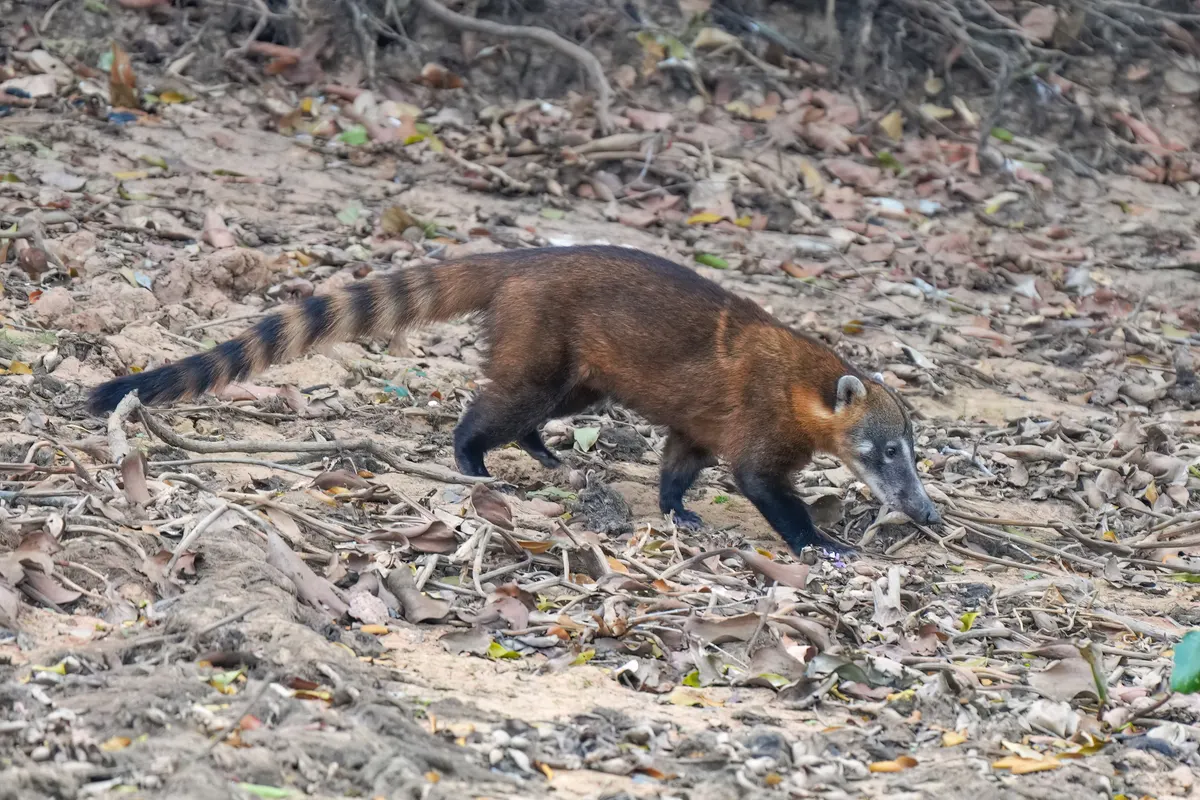
South American coati with a long ringed tail foraging in the open
The South American coati is a raccoon relative known for its long, upright ringed tail.
MammaliaLeast Concern

South American Coati

Female coatis and their young live in bands of up to about 30 animals, while adult males are usually solitary; early naturalists mistook lone males for a separate animal, the coatimundi.

The South American coati is a diurnal member of the raccoon family (Procyonidae) from the forests of tropical and subtropical South America. It is known for its long ringed tail carried upright, its flexible upturned snout, and the large foraging bands formed by females and young while adult males live alone.
By · Updated

Quick Facts

South American Coati at a glance

Nasua nasuaCarnivoraProcyonidae

About their home

Kind of animal

Mammalia

Where they live

What they eat

How safe?

Least Concern

Size and speed

How heavy

3 kg – 7 kg

How long

41 cm – 67 cm

How fast

Agile climber, quick on the ground

Lifespan

About 7 to 8 years

Core article

South American Coati: ecology and life history

A closer look at habitat, diet, behavior, reproduction, and conservation.

Start here

South American Coati

The South American coati is a slender, long-tailed mammal that moves through the forests of tropical and subtropical South America in noisy, busy groups. It belongs to the raccoon family, and it shares that family's ringed tail and dexterous forepaws. Most of the day is spent foraging: nose to the ground, tail held high, the animal probes leaf litter, flips stones, and works its way from the forest floor into the canopy and back. Two features stand out to anyone who watches a band for long. The first is the upturned, constantly moving snout. The second is the tail, carried straight up like a flag while the group travels.

Anatomy and the Ringed Tail

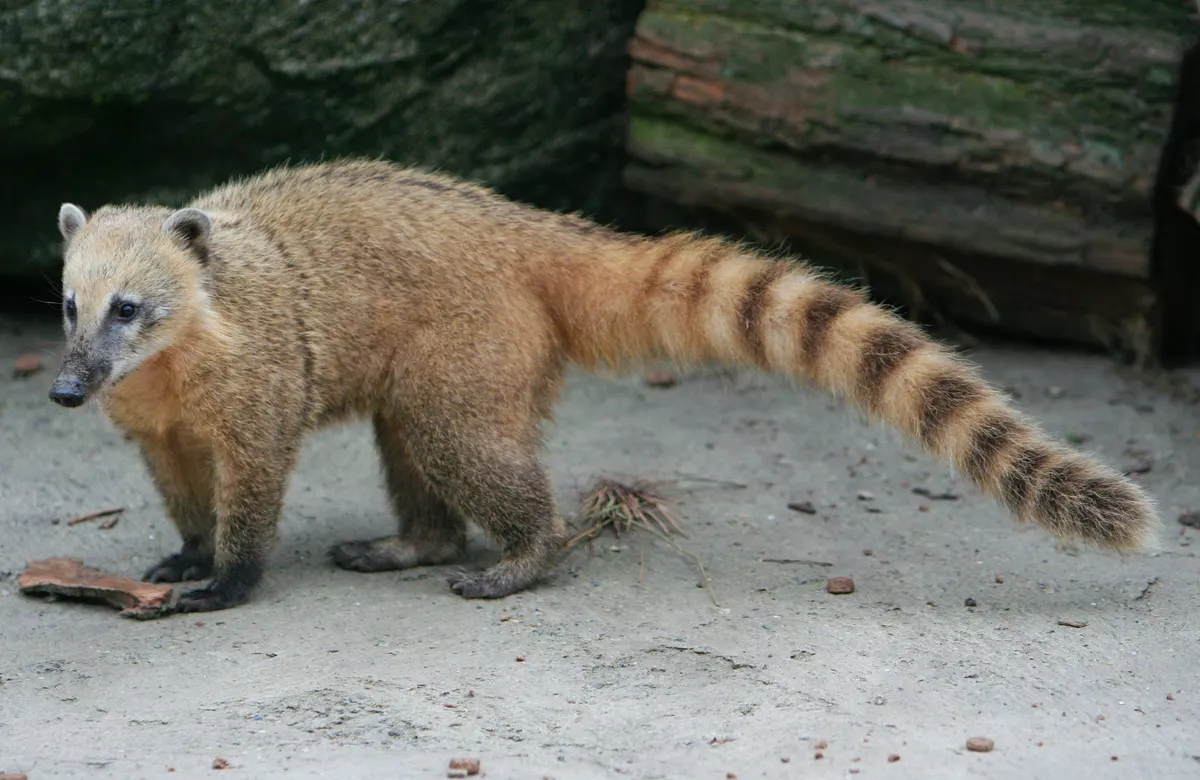
An adult South American coati has a head-and-body length of roughly 41 to 67 cm, with a tail that adds another 32 to 69 cm. Standing about 30 cm at the shoulder and weighing between 3 and 7 kg, it is a lightly built animal for its length, because so much of that length is tail. The coat is dark brown, grey, or rust above and paler below, and the tail carries a series of rings that can be faint or clearly marked depending on the individual and the population.

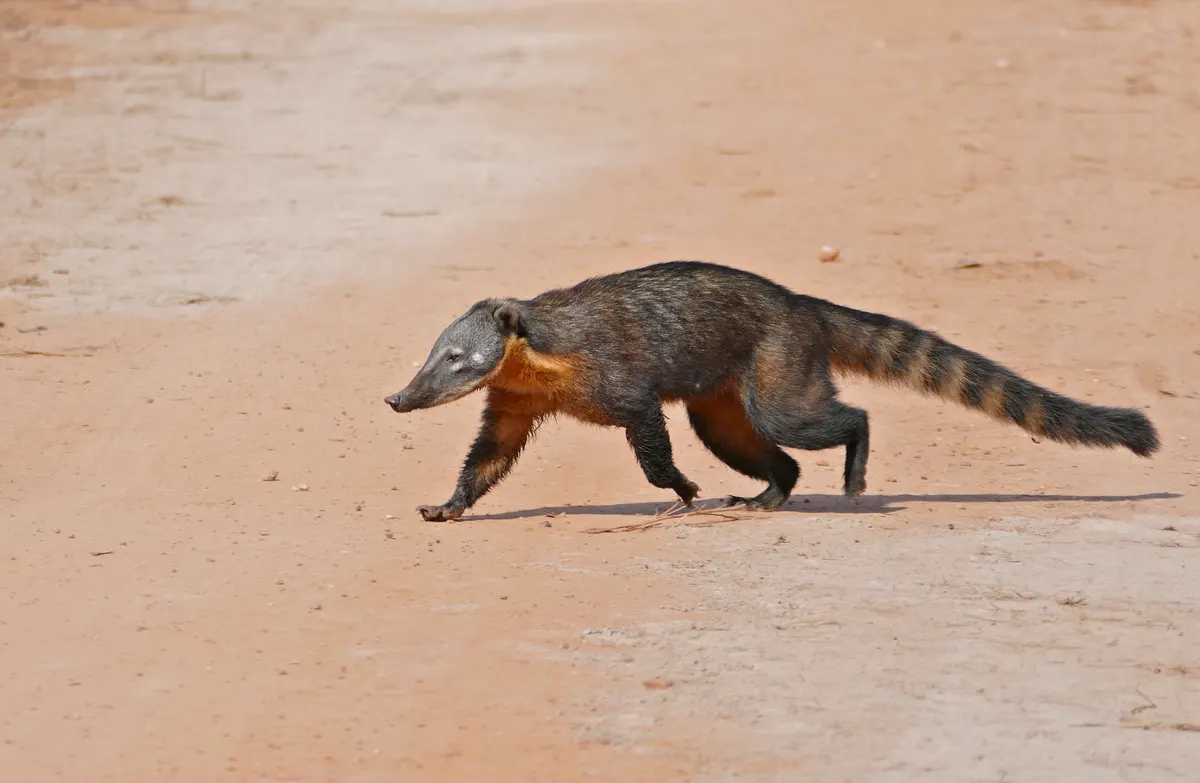
The tail is not prehensile, but it is central to how coatis live. On the ground and while climbing, it works as a balancing rod. In a moving band it also works as a signal: raised vertically with its rings exposed, it is easy for other group members to follow through dense undergrowth.

The head narrows to a long, flexible snout that turns slightly upward at the tip. This snout is the animal's main foraging tool. It bends and probes into crevices, under bark, and through soil, guided by a keen sense of smell. The forelimbs are strong and end in robust, curved claws used for digging and climbing. A less obvious adaptation lies in the ankles: the joints can rotate so that the hind feet turn backward, letting a coati grip a trunk and descend headfirst rather than backing down.

Habitat and Distribution

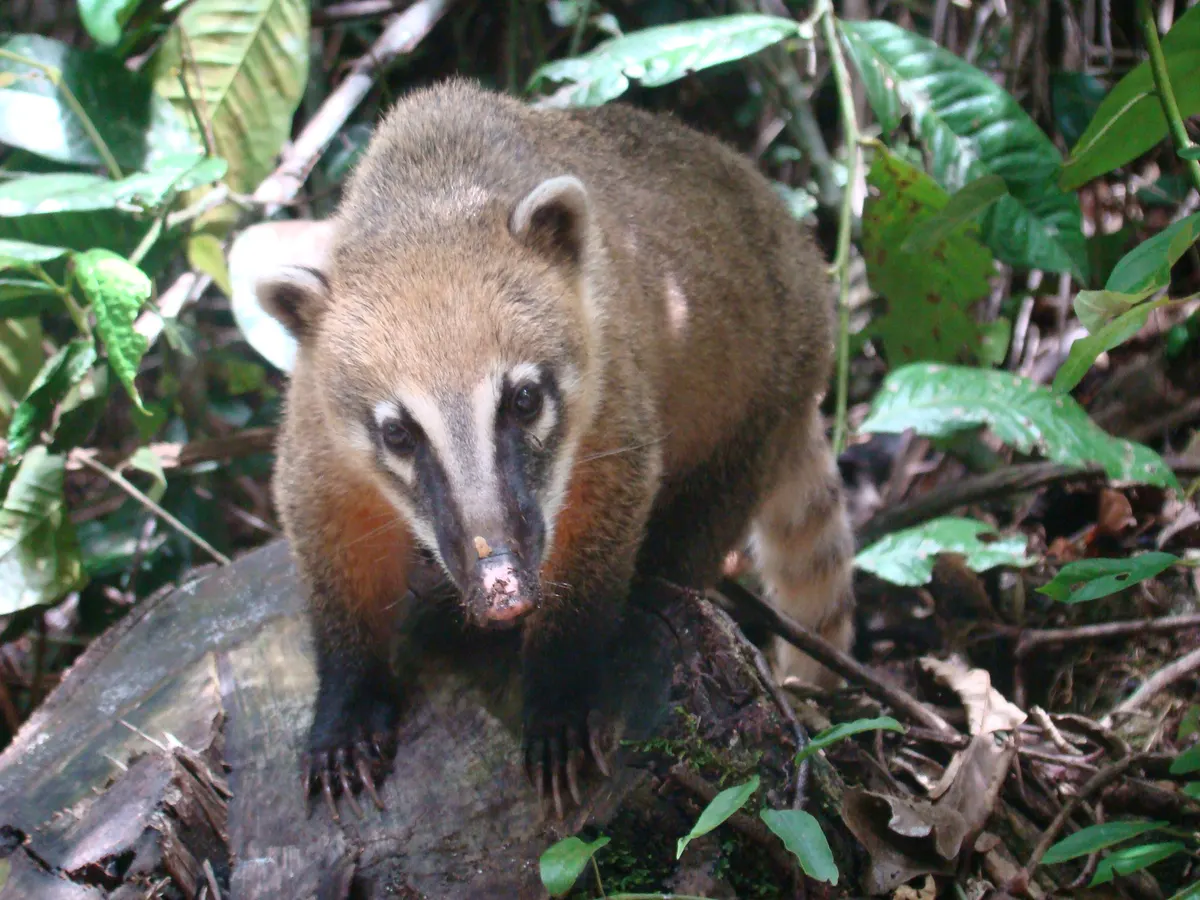
Coati in a Brazilian national park
Coatis are agile climbers and forage both in the trees and on the forest floor.

The South American coati ranges widely across the continent east of the Andes, from Colombia, Venezuela, and the Guianas south through Brazil, Ecuador, Peru, Bolivia, and Paraguay to Uruguay and northern Argentina. It lives from lowland forest up to about 2,500 metres on Andean slopes.

It is not tied to a single forest type. Records span evergreen rainforest, deciduous and cloud forest, riverine gallery forest along watercourses, and drier habitats such as Chaco woodland, cerrado, and xeric scrub. Coatis often do well in secondary forest and along forest edges, including landscapes altered by people, which is part of why the species remains widespread. A population has also become established outside its native range on the island of Mallorca, where it is treated as an invasive species.

Within this range coatis are mainly terrestrial foragers but thoroughly at home in trees. They sleep, mate, and give birth in the canopy, moving up and down trunks with the reversible-ankle grip described above.

Diet and Foraging

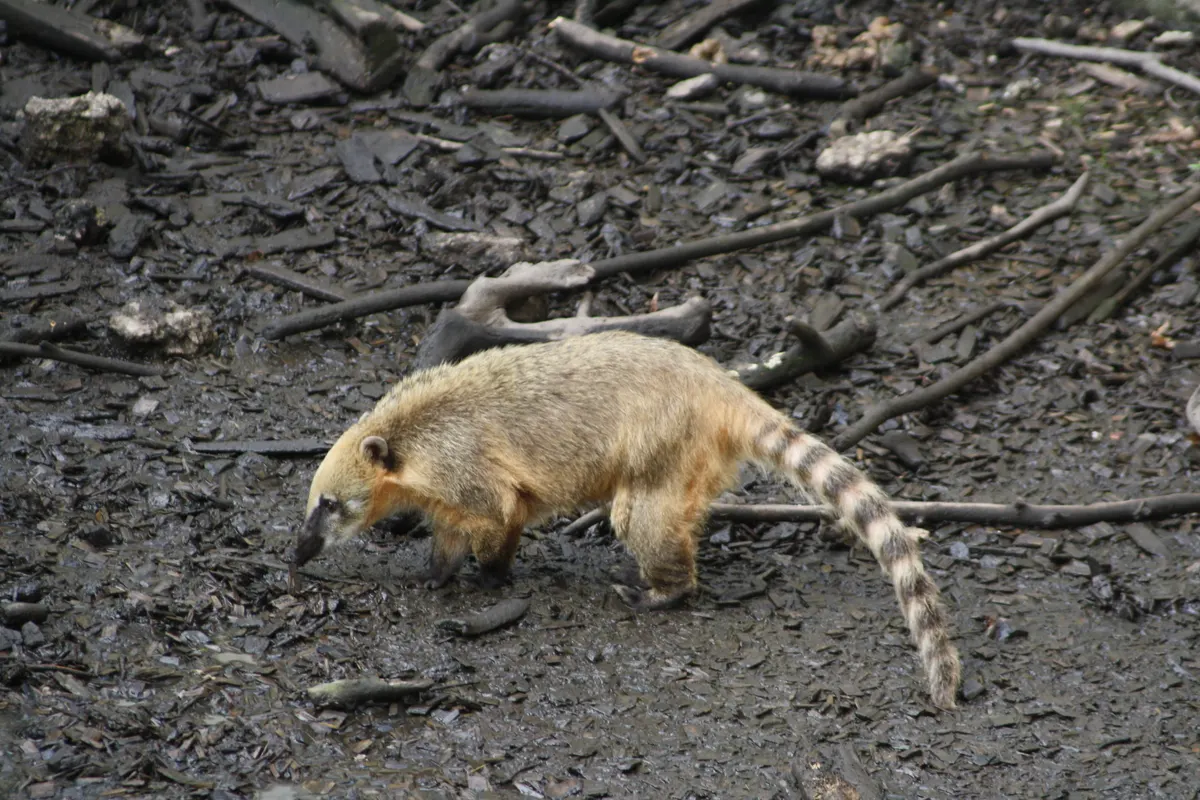
Coati foraging on the ground
Double-jointed ankles let a coati climb down trunks headfirst to reach fallen fruit and prey.

The South American coati is an omnivore, and its diet shifts with what is locally available. Fruit and invertebrates make up the bulk of it. Reported prey includes beetle larvae, ants, termites, spiders, scorpions, and centipedes, along with fruit from palms and other trees. Coatis also take eggs, lizards, small rodents and other small mammals, and carrion, and they will occasionally raid poultry near settlements.

Foraging is active and physical. A coati probes the ground and leaf litter with its snout, flips over rocks, and tears open rotting logs to reach the animals inside. The same flexibility that lets the snout work into tight spaces makes the animal an effective generalist, able to switch between fruiting trees in one season and ground invertebrates in another. Feeding usually happens as a group, with band members spread out but within sight of one another.

Behavior and Bands

Coatis moving together across open ground
A band can include a dozen or more related females and their young.

Coati social life is split along age and sex lines, and this is one of the most distinctive things about the species. Females and their young live together in bands that can number up to about 30 animals. These bands forage, travel, and rest together, and the raised, ringed tails help keep the group coordinated as it moves.

Adult males, by contrast, are generally solitary. They range on their own for most of the year and associate with a band mainly during the breeding season. Neither males nor bands defend strict exclusive territories; home ranges overlap. The difference in habits between grouping females and lone males was striking enough that early naturalists described the solitary males as a separate kind of animal, the "coatimundi" — a name that survives today even though it refers to the same species.

Coatis are diurnal, spending most daylight hours on the move and foraging, then retreating to trees to rest overnight. They are agile climbers and capable swimmers.

Reproduction and Young

Breeding is seasonal and timed so that most births fall in a favourable period, commonly around April to June across much of the range, following mating in the preceding months. When a female is ready to give birth she leaves her band and builds a nest in a tree.

Gestation lasts about 74 to 77 days. A litter usually contains three to seven kits, with around four being typical. The kits are born in the tree nest and remain there while very young. After roughly five to six weeks the female brings her kits down and rejoins the band, and the young are then reared within the group. Females generally reach breeding age at about two years and males somewhat later, around three years.

Taxonomy and Relatives

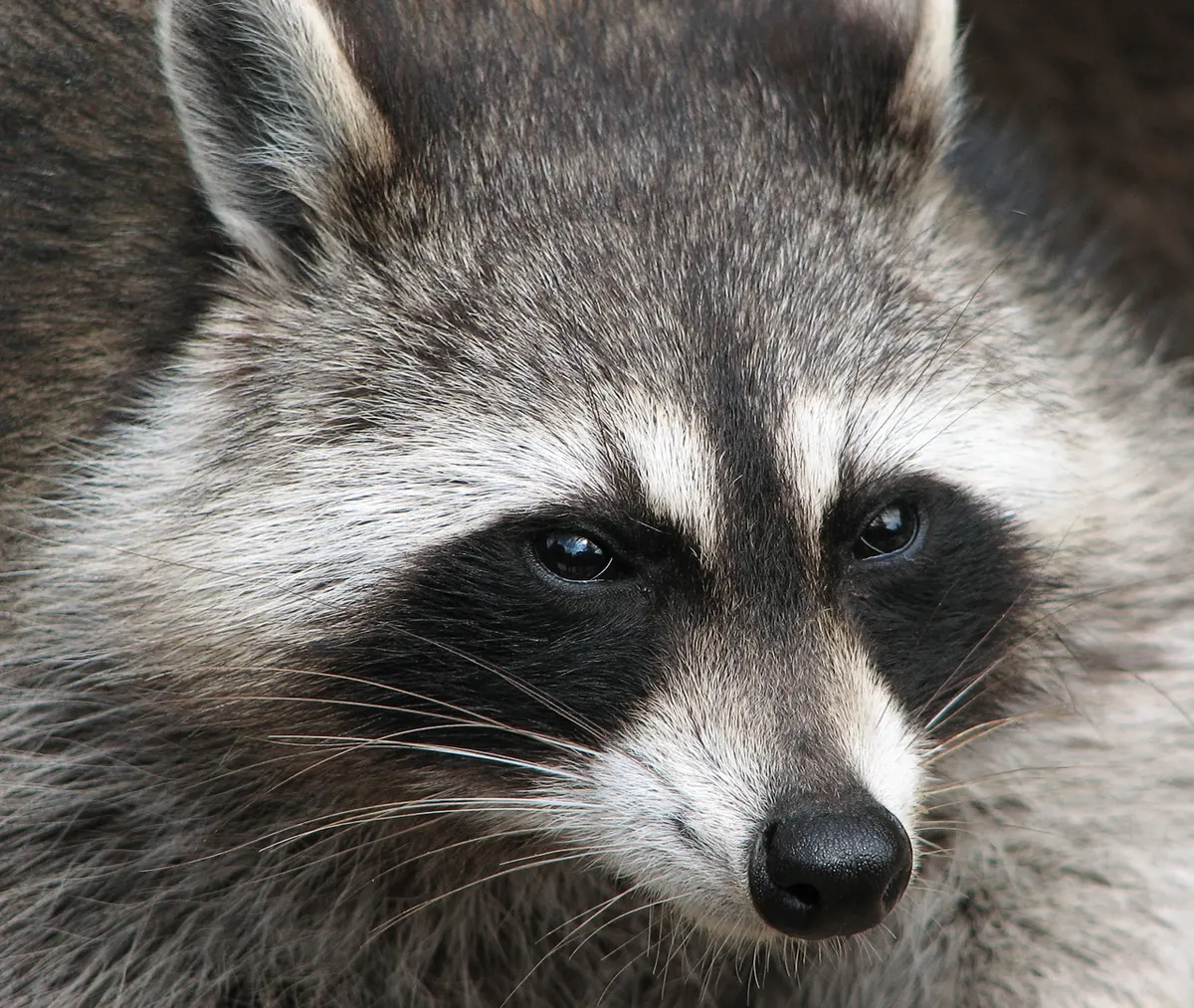
The South American coati is Nasua nasua, a member of the family Procyonidae — the raccoon family — within the order Carnivora. Its closest well-known relative is the raccoon, and the two share the ringed tail and nimble forepaws typical of the family. The genus Nasua also contains the white-nosed coati of Central and North America; the South American species can be told apart by its lack of a broadly white snout. Numerous subspecies have been described across its wide range.

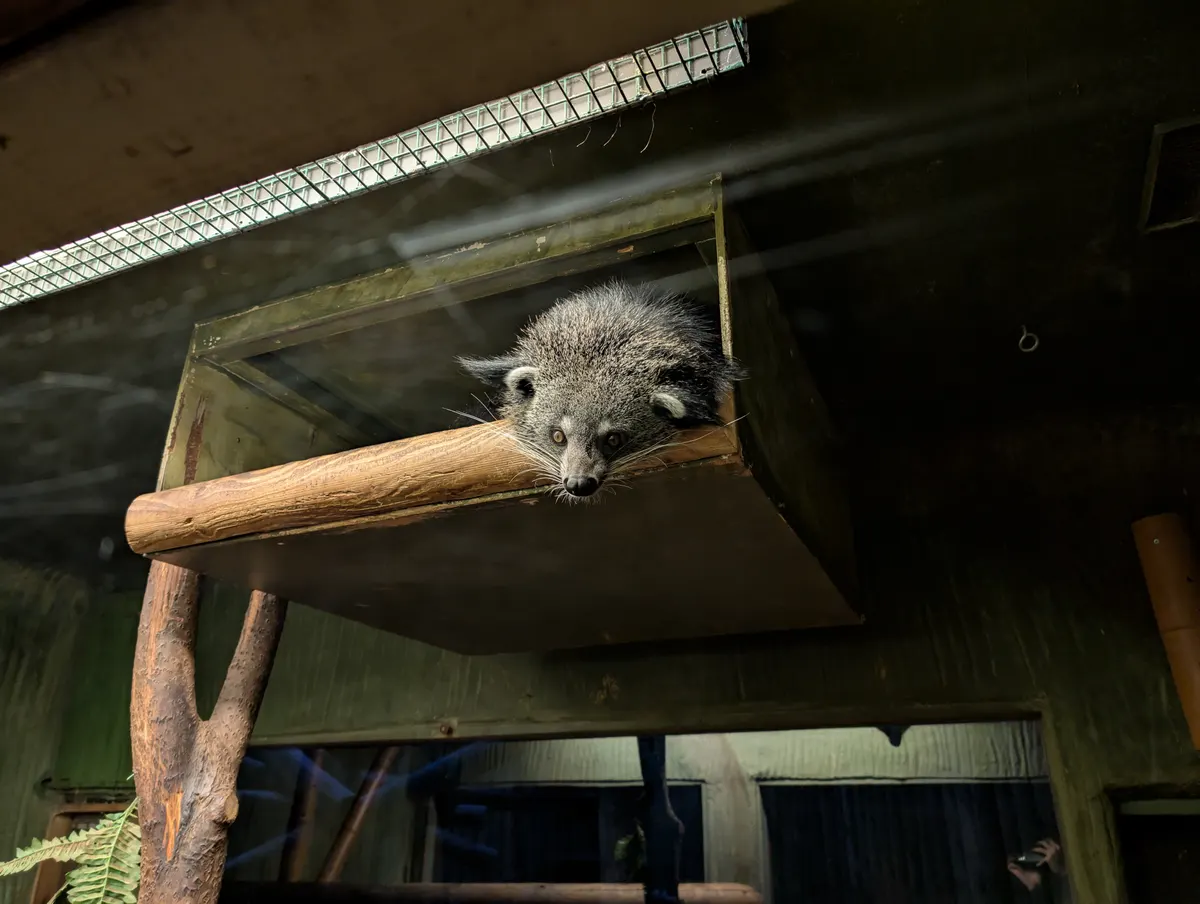
Although coatis sit within the carnivore order, their omnivorous, invertebrate-and-fruit diet is closer to that of other flexible feeders than to that of dedicated meat-eaters. Comparable ecological roles are filled elsewhere by animals such as the binturong in Southeast Asian forests, the fruit-and-bamboo-eating red panda of the Himalayas, and the group-living, insect-hunting meerkat of southern Africa, none of them close relatives but all illustrating how carnivoran lineages have taken up varied diets and social systems.

Conservation and Threats

Coati standing alert
Widespread and adaptable, the South American coati is listed as Least Concern.

The IUCN Red List classifies the South American coati as Least Concern. The species is widespread, tolerant of a range of forest types, present in many protected areas, and able to persist in edge and secondary habitats. Its global population trend is listed as unknown, so the Least Concern rating should not be read as evidence that every local population is secure.

Where pressures concentrate, coatis can decline locally. The main threats are hunting for meat and habitat loss through deforestation and fragmentation. In heavily cleared or heavily hunted areas these factors can reduce numbers even while the species as a whole remains common. Because coatis are diurnal, conspicuous, and often live near people, they are also relatively easy to hunt, which makes local monitoring the most useful conservation measure in regions under pressure.

References and Authoritative Sources

South American Coati: classification and fun facts

Classification

Scientific Taxonomy
  1. Kingdom

    Animalia

  2. Phylum

    Chordata

  3. Class

    Mammalia

  4. Order

    Carnivora

  5. Family

    Procyonidae

  6. Genus

    Nasua

  7. Species

    N. nasua

Did You Know?

Fun Facts

1

Female coatis and their young live in bands of up to about 30 animals, while adult males are usually solitary; early naturalists mistook lone males for a separate animal, the coatimundi.

2

A foraging band often carries its long ringed tails straight up, which helps members keep one another in view through dense undergrowth.

3

The coati's snout is highly flexible and turns slightly upward, letting it probe crevices, flip rocks, and root through soil for hidden invertebrates.

4

Coatis can rotate their ankle joints backward, so they are able to climb down tree trunks headfirst.

5

The coati belongs to the raccoon family, Procyonidae, and its ringed tail echoes that of its North American relative.

6

Pregnant females leave the band to build a nest in a tree, give birth there, and rejoin the group with their kits after about five to six weeks.

Common Questions

FAQ about South American Coati

Select a question to reveal the answer.

What is a South American coati?

The South American coati (*Nasua nasua*) is a diurnal, omnivorous mammal in the raccoon family (Procyonidae). It is recognized by a long ringed tail, a slender flexible snout, and a habit of foraging on the forest floor and in trees.

Where do South American coatis live?

They range across tropical and subtropical South America east of the Andes, from Colombia and the Guianas south to Uruguay and northern Argentina. They occupy many kinds of forest, from rainforest and gallery forest to drier scrub, up to about 2,500 metres in elevation.

What do South American coatis eat?

They are omnivores. Fruit and invertebrates make up most of the diet, supplemented by eggs, lizards, small mammals, and carrion. They forage by probing the ground with the snout, flipping rocks, and tearing open logs.

Why do coatis hold their tails up?

Coatis often carry the long ringed tail upright while moving in a group. The raised, banded tail is easy to see and helps band members stay together as they forage through dense vegetation.

Do male and female coatis live differently?

Yes. Females and their young form bands of up to about 30 individuals, while adult males are generally solitary and join a band mainly during the breeding season. This difference once led naturalists to describe lone males as a separate animal, the coatimundi.

Are South American coatis endangered?

No. The IUCN Red List classifies the species as Least Concern because it is widespread and occurs in many habitats, including protected areas. Local populations can still decline where hunting and forest clearing are heavy, and the global trend is listed as unknown.