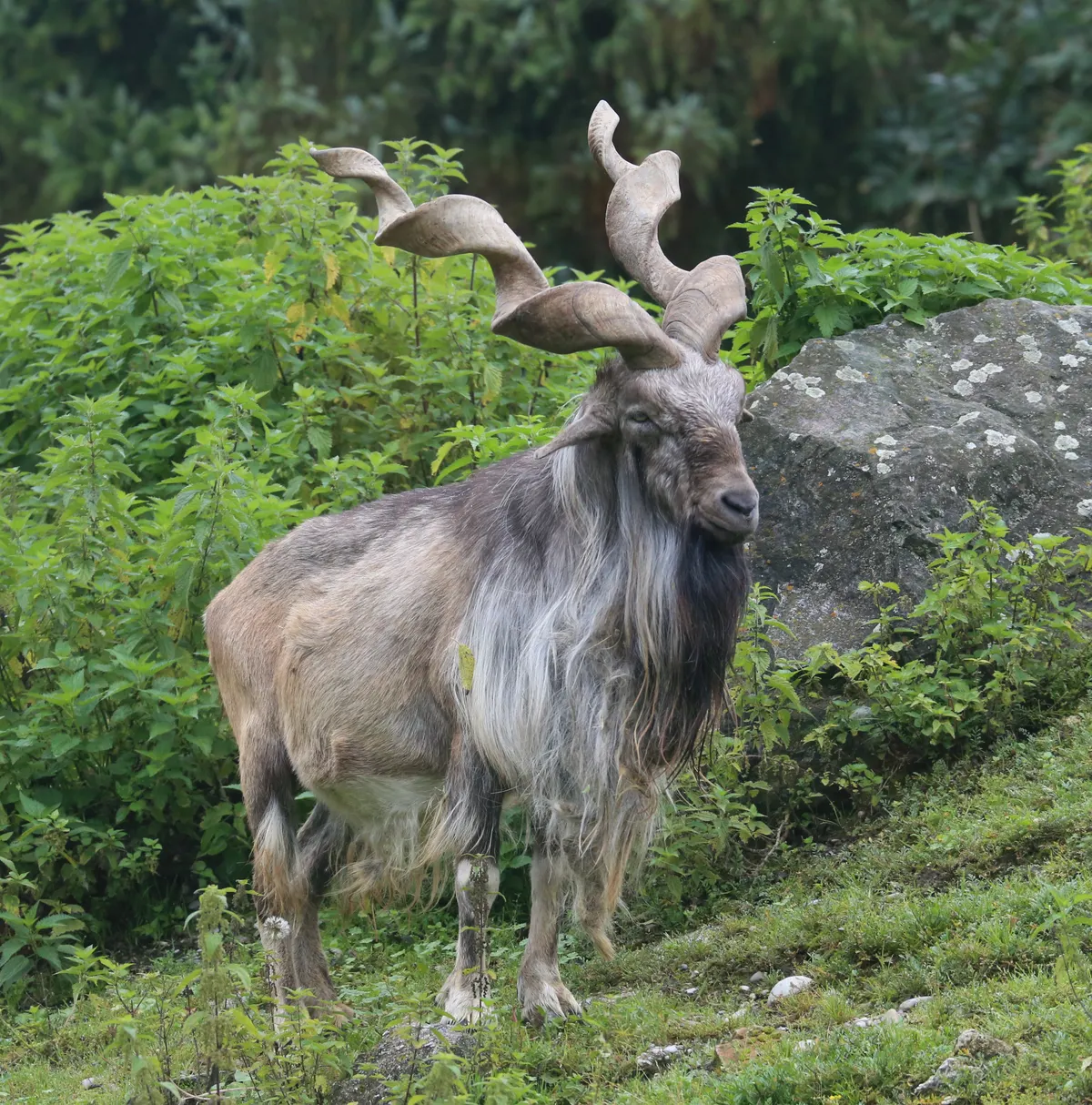
Male markhor with long spiral horns and a shaggy mane on a green slope
The markhor is the largest wild goat; males carry spectacular corkscrew horns and a heavy mane.
MammaliaNear Threatened

Markhor

The markhor is the national animal of Pakistan, appearing in national emblems and on currency.

The markhor is the largest of the wild goats, a mountain species of Central and South Asia known for the spiralling corkscrew horns of adult males. It lives on steep, rocky slopes with scattered oak, pine, and juniper woodland and is the national animal of Pakistan.

By · Updated

Quick Facts

Markhor at a glance

Capra falconeriArtiodactylaBovidae

About their home

Kind of animal

Mammalia

Where they live

What they eat

How safe?

Near Threatened

Size and speed

How heavy

32 kg (female) – 110 kg (male)

How long

65 cm shoulder height – 115 cm shoulder height

How fast

Agile climber on near-vertical rock

Lifespan

About 11 to 13 years

Core article

Markhor: ecology and life history

A closer look at habitat, diet, behavior, reproduction, and conservation.

Start here

Markhor

The markhor is the largest of the wild goats, a mountain animal of Central and South Asia. Adult males are best known for their horns: two long, spiralling shafts that twist like a corkscrew above the head. The species lives on steep, broken ground where scrub woodland gives way to bare rock, and it moves across that terrain with a surefootedness that few large mammals can match. It is the national animal of Pakistan, and its recent history is one of the better-documented conservation recoveries among Asian mountain ungulates.

Anatomy and Spiral Horns

Markhors are heavy-bodied goats with a marked difference in size between the sexes. Males stand taller at the shoulder, up to about 115 cm, and can weigh as much as roughly 110 kg. Females are considerably smaller, often around 32 to 50 kg. Both sexes carry a beard and a coat that ranges from light tan to grey-brown, growing long and thick in winter and shedding to a shorter summer coat.

The defining feature is the horn. Both sexes grow them, but they are dramatically larger in males, where they can reach roughly 1.6 m measured along the spiral. Female horns are far shorter, on the order of 25 cm. The horns twist in a tight corkscrew in some populations and flare more openly in others, which is one reason older accounts split the species into several named forms. The horns serve two purposes at once: a visual signal of a male's size and condition, and a weapon used in the shoving and locking contests of the rut.

Habitat and Distribution

Markhor standing on rocks
Sure-footed hooves let markhor feed and escape predators on near-vertical rock.

The markhor occupies mountainous country across Pakistan, Afghanistan, Tajikistan, Uzbekistan, Turkmenistan, and the Indian region of Jammu and Kashmir. Within that range it is patchily distributed, clinging to areas of suitable terrain rather than spreading evenly across the mountains.

Its preferred ground is steep and rocky, typically between about 600 and 3,600 metres in elevation. The classified forest habitat here is montane rather than lowland: open scrub woodland of oak, pine, and juniper on slopes that are too steep and too dry for dense timber. Cliffs and rock faces are never far away, because they are the markhor's escape terrain. When alarmed, the animals climb rather than run across open ground, using ledges and outcrops that predators cannot easily follow.

Elevation use shifts with the seasons. In summer, markhors range higher onto meadows and upper slopes; in winter, deep snow pushes them down to lower, more sheltered ground where forage is still reachable.

Diet and Foraging

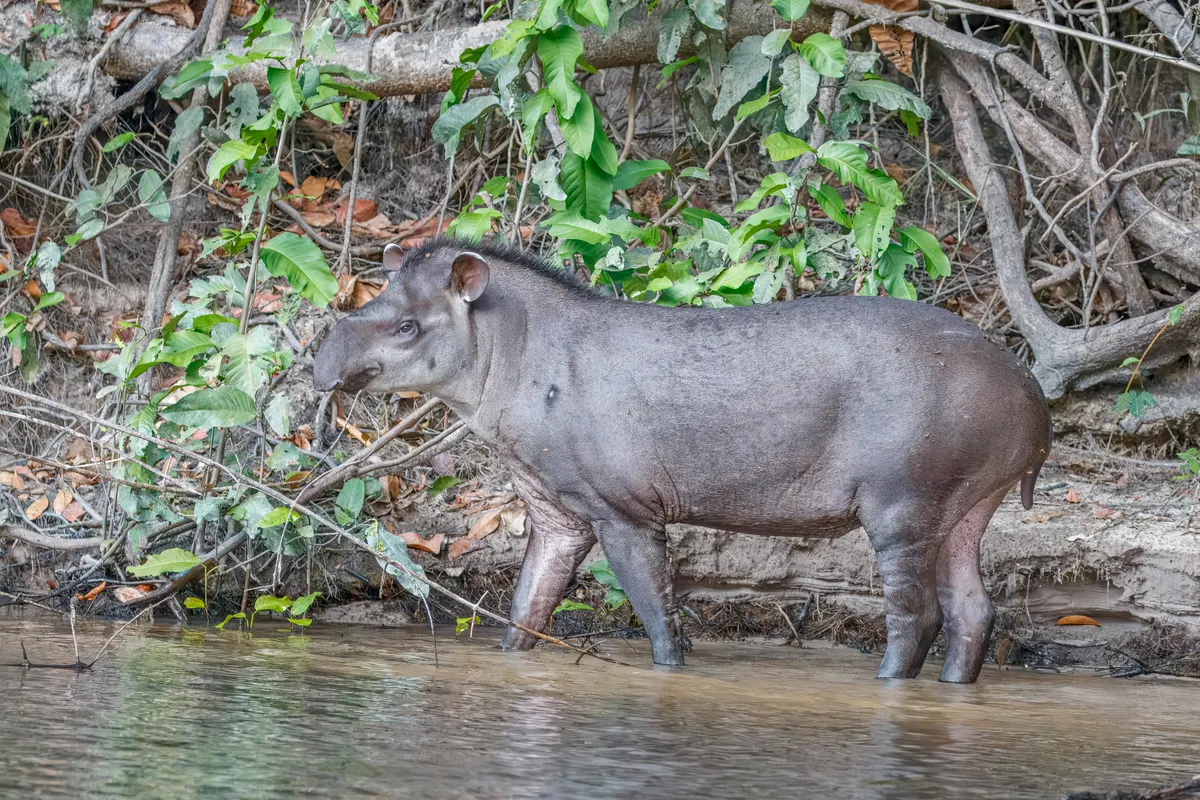
Markhor standing in profile
Seasonal migration up and down the mountains follows the changing supply of plants.

The markhor is a herbivore, and its feeding style changes through the year. In spring and summer it behaves mainly as a grazer, cropping grasses and herbs on the slopes. As autumn and winter set in and green growth fades, it shifts toward browsing, taking leaves, twigs, and the foliage of shrubs and trees. Where snow buries the ground layer, browse becomes the more reliable food.

This flexibility matters on terrain where any single food source is seasonal and scattered. Markhors will stand on their hind legs to reach higher branches, and they feed for long stretches during daylight, spending much of the day moving slowly across the slope between bouts of feeding and rest.

Behavior and Herds

Two markhor together
During the rut, males clash horns to compete for the chance to breed.

Markhors are diurnal, most active in the cooler hours of morning and late afternoon. Outside the breeding season the sexes tend to live apart. Females and their young form small herds, often fewer than ten animals, while adult males are more solitary or gather in loose bachelor groups.

That pattern changes during the autumn rut. Males join the female herds and compete for access to breeding females, clashing with their horns in pushing and locking contests that test size and stamina. Throughout the year, the response to danger is consistent: rather than outrun a predator across open ground, markhors head for the nearest cliff and use their climbing ability to reach footing that larger predators cannot. Seasonal movement up and down the mountain is a regular part of their behavior, tracking snow line and forage.

Reproduction and Young

Breeding takes place in autumn and early winter. After a gestation of roughly 135 to 170 days, females give birth in spring, usually to one or two kids, occasionally three. The timing places births near the flush of new growth, when food for nursing females is at its best.

Kids are able to stand and follow their mothers soon after birth, an advantage on terrain where staying with the herd is a matter of survival. They are weaned over their first several months and reach breeding age between roughly 18 and 36 months, with females maturing earlier than males. In the wild, markhors generally live around 11 to 13 years; captive animals may reach close to 19.

Taxonomy and Relatives

The markhor (Capra falconeri) is a member of the genus Capra, the true goats, within the family Bovidae. It is placed in the order Artiodactyla, the even-toed ungulates. Several named forms, such as the Astor, Kabul, and Bukharan markhors, are recognised as subspecies or regional populations, distinguished largely by horn shape and locality; the exact divisions have been revised as genetic data has accumulated.

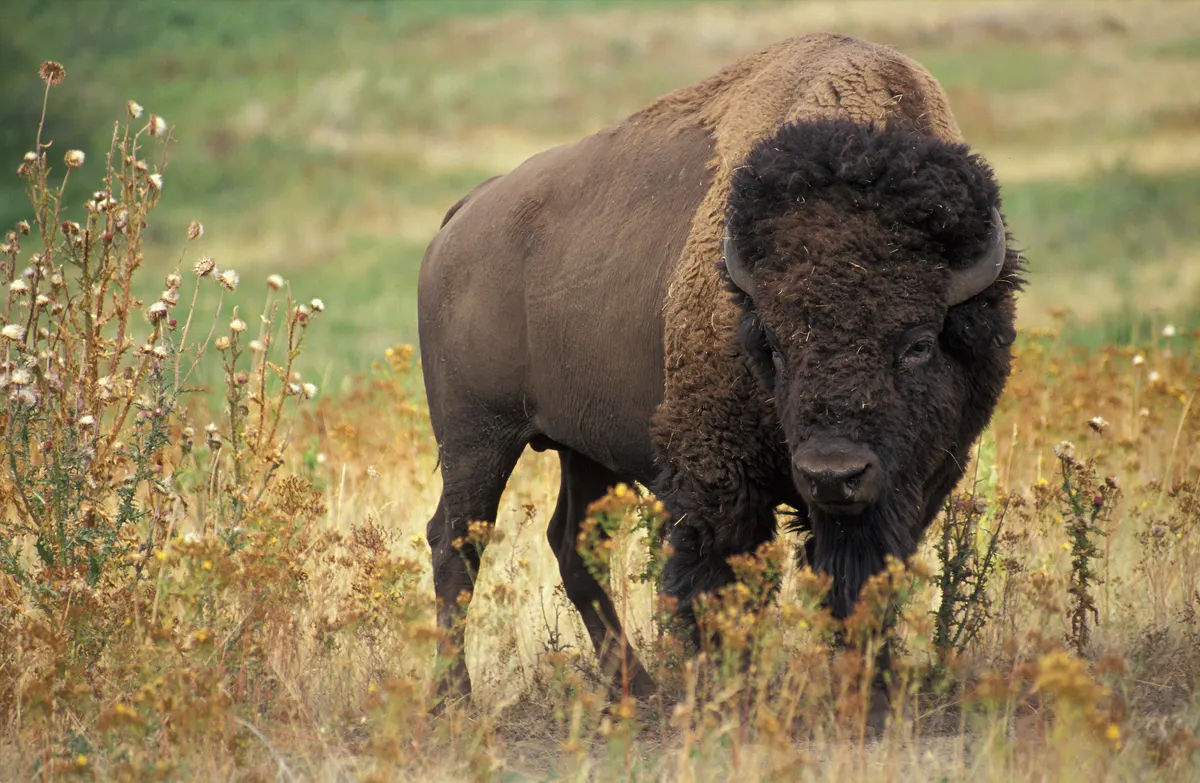
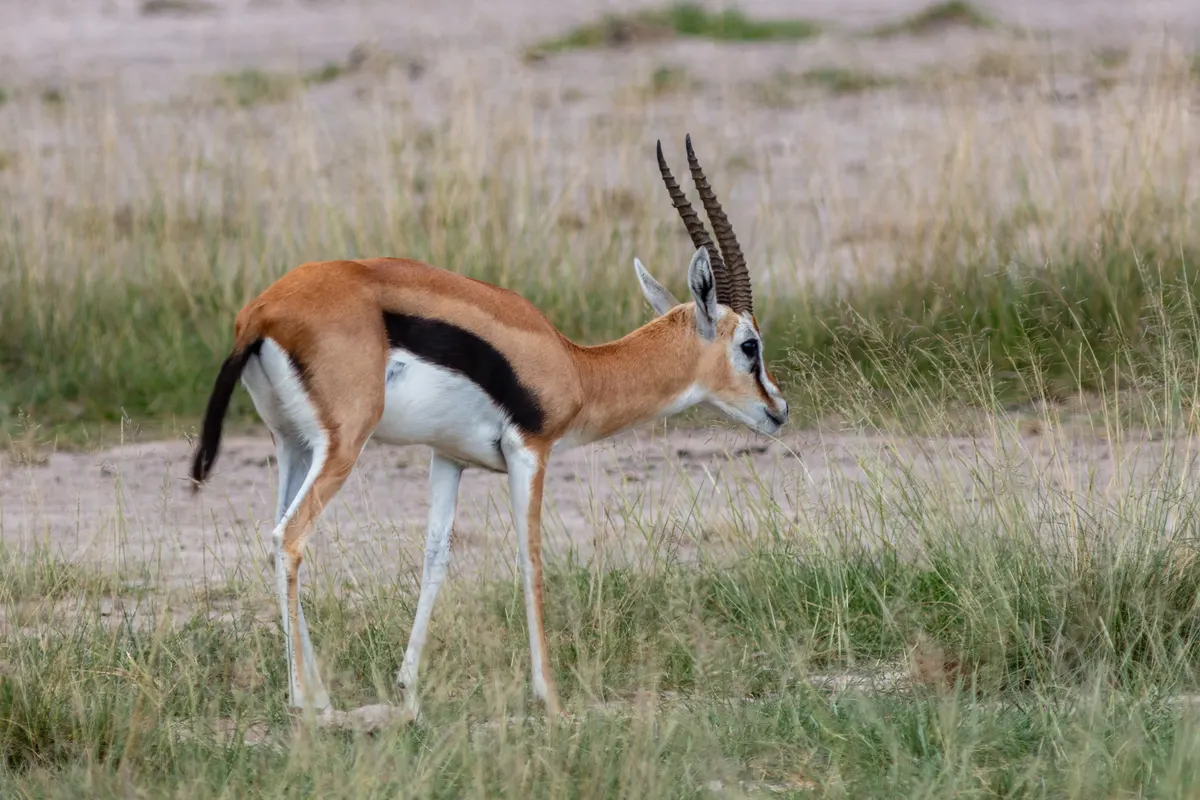
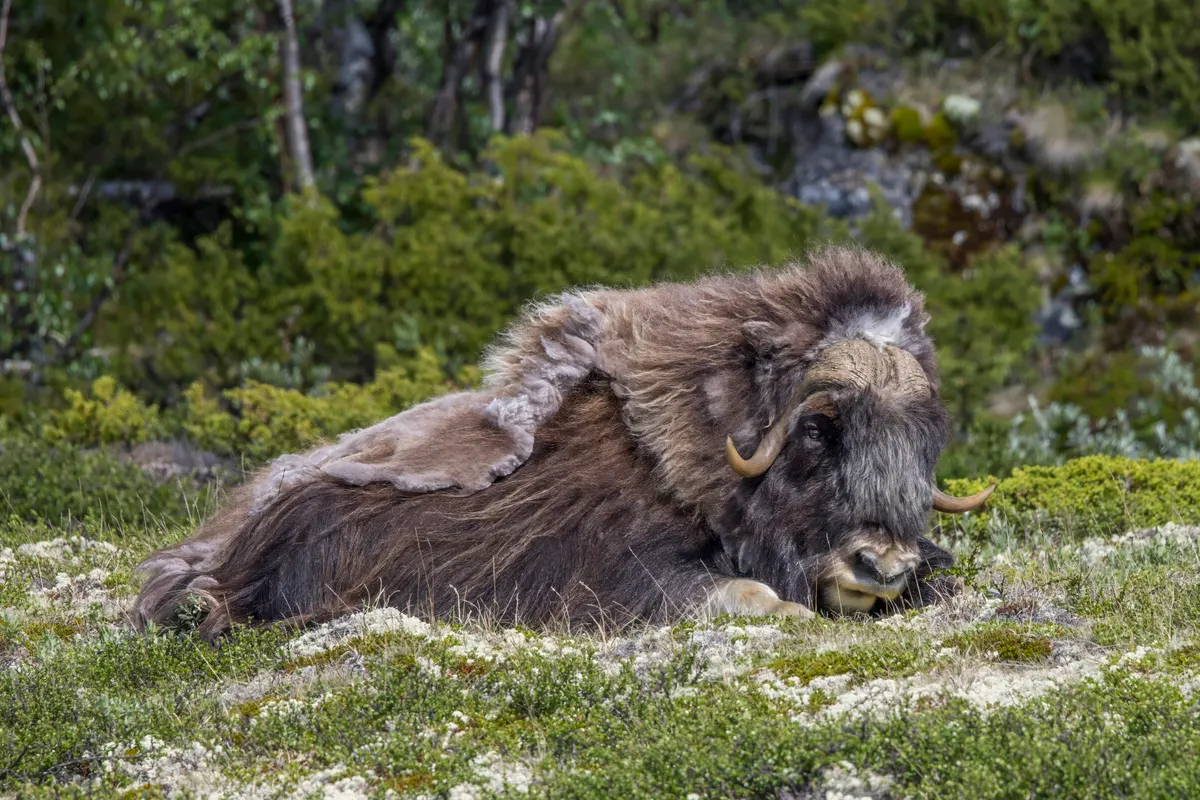
As a bovid, the markhor shares the family with a wide spread of horned mammals. Among the encyclopedia's other bovids are the musk-ox of the Arctic, the gazelle of open grasslands, the migratory wildebeest of Africa, and the American bison of the North American plains. These relatives show how varied the family is in size, habitat, and horn form, from the markhor's mountain cliffs to the wildebeest's savanna.

Conservation and Threats

Markhor walking across open ground
Now Near Threatened and recovering, the markhor is the national animal of Pakistan.

The markhor's recent conservation history is unusual for a large Asian ungulate. It was listed as Endangered on the IUCN Red List until 2015, when it was reassessed as Near Threatened after monitoring showed populations recovering. Estimates in the years around that reassessment put the global total in the range of several thousand mature animals, with numbers increasing by an estimated fifth over the previous decade. The population trend is currently regarded as increasing.

The main historical pressures were unregulated hunting and competition with domestic livestock for grazing, compounded by habitat loss and disturbance. The turnaround has been linked to community-based conservation, particularly regulated trophy-hunting programs in Pakistan. Under these schemes, a small number of expensive permits are issued to hunt selected older males past their breeding prime, and much of the fee is returned to local communities. That gives residents a direct financial stake in keeping markhor populations healthy and in curbing poaching. The approach is debated, but it is widely credited with much of the species' recovery.

Near Threatened is not the same as secure. Populations remain fragmented, and continued monitoring, habitat protection, and management of livestock overlap are needed to hold the gains, especially in parts of the range where enforcement and survey data are weaker.

References and Authoritative Sources

Markhor: classification and fun facts

Classification

Scientific Taxonomy
  1. Kingdom

    Animalia

  2. Phylum

    Chordata

  3. Class

    Mammalia

  4. Order

    Artiodactyla

  5. Family

    Bovidae

  6. Genus

    Capra

  7. Species

    C. falconeri

Did You Know?

Fun Facts

1

The markhor is the national animal of Pakistan, appearing in national emblems and on currency.

2

It is the largest of the wild goats, with big males weighing up to about 110 kg.

3

Adult males grow spiralling, corkscrew-shaped horns that can reach roughly 1.6 m along the curve.

4

The name is often traced to Persian roots meaning 'snake-eater', tied to old folklore rather than actual diet.

5

It is an expert climber and can scale near-vertical cliffs and even lean into trees to browse high branches.

6

Community-based trophy-hunting programs in Pakistan helped reverse its decline, and the IUCN downlisted it from Endangered to Near Threatened in 2015.

Common Questions

FAQ about Markhor

Select a question to reveal the answer.

What is a markhor?

The markhor (*Capra falconeri*) is a large wild goat of the family Bovidae, native to the mountains of Central and South Asia. It is the largest of the wild goats and is best known for the spiralling horns carried by adult males.

Where do markhors live?

Markhors live on steep, rocky mountain slopes across Pakistan, Afghanistan, Tajikistan, Uzbekistan, Turkmenistan, and the Indian region of Jammu and Kashmir. They occupy scrub woodland of oak, pine, and juniper, mostly between about 600 and 3,600 metres.

What do markhors eat?

Markhors are herbivores. They graze on grasses and herbs in spring and summer, then switch to browsing leaves, twigs, and shrubs in autumn and winter, sometimes standing on their hind legs to reach higher branches.

How big do markhor horns get?

Both sexes carry the corkscrew horns, but they are far larger in males. Male horns can reach roughly 1.6 m measured along the spiral, while female horns are much shorter, around 25 cm.

Is the markhor endangered?

The markhor was listed as Endangered until 2015, when the IUCN reassessed it as Near Threatened after populations increased. The trend is now considered increasing, largely because of community-based conservation and regulated trophy hunting.

Why is the markhor the national animal of Pakistan?

The markhor is a cultural and ecological symbol of Pakistan's northern mountains, and its recovery there is treated as a national conservation success. It features in official emblems and appears on Pakistani currency.