Great White Shark Facts
"Great white sharks can replace lost teeth again and again."
Great white sharks are huge ocean fish with strong jaws, sharp teeth, and excellent senses. They swim through coastal and offshore seas, hunt marine...
Loading page content

"Great white sharks can replace lost teeth again and again."
Great white sharks are huge ocean fish with strong jaws, sharp teeth, and excellent senses. They swim through coastal and offshore seas, hunt marine...
Carcharodon carchariasLamniformesLamnidae
Explore great white shark photos for learning and classroom observation, from surface swimming to close-up shark features.
Click any photo to view it larger. 8 images available.
Core article
Habitat, diet, behavior, and more — everything on one page.
Patrolling the coastal and offshore waters of the world's oceans is an apex predator that commands both primal fear and profound respect: the great white shark (Carcharodon carcharias). Often depicted in popular media as a mindless killing machine, biological reality paints a far more complex portrait of a highly intelligent, specialized, and vital component of marine ecosystems. As the largest predatory fish on Earth, the great white shark represents the pinnacle of millions of years of elasmobranch evolution, combining staggering size, hydrodynamic perfection, and an arsenal of unique sensory capabilities. Ranging across vast oceanic distances, this formidable carnivore plays a crucial role in regulating populations of marine mammals and maintaining the delicate balance of the oceanic food web. Understanding the great white shark requires peeling back the layers of sensationalism to reveal a masterfully adapted predator perfectly synchronized with the relentless rhythms of the sea.
In the realm of scientific classification, the great white shark is an undisputed sovereign of the sea. It belongs to the kingdom Animalia, phylum Chordata, and the class Chondrichthyes, a specialized group of cartilaginous fishes whose skeletons are composed entirely of cartilage rather than true bone. Within the order Lamniformes—the mackerel sharks—it is placed in the family Lamnidae. It is the sole surviving species of the genus Carcharodon, with its scientific name, Carcharodon carcharias, translating roughly to "ragged-tooth pointer."
The evolutionary lineage of the great white shark is a subject of intense paleontological debate, largely due to the fact that cartilaginous skeletons fossilize poorly, leaving teeth as the primary historical record. While once widely believed to be a direct descendant of the prehistoric megalodon (Otodus megalodon), modern dental morphology and isotopic analysis strongly suggest that the great white shark evolved from a lineage of broad-toothed mako sharks during the mid-Miocene epoch, roughly 16 million years ago. This evolutionary trajectory favored agility, endothermy (warm-bloodedness), and specialized dentition over sheer, monstrous size.
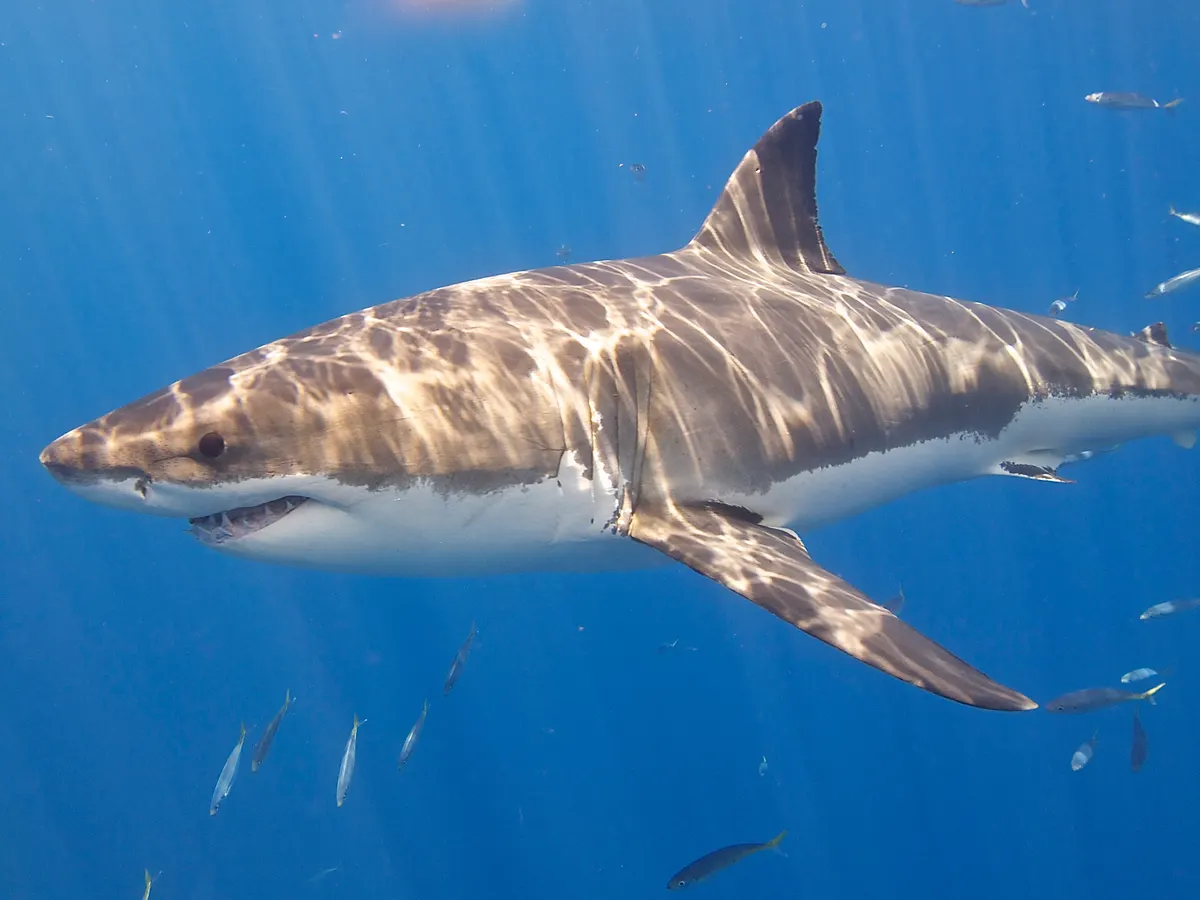
The physical structure of the great white shark is a masterpiece of hydrodynamics and predatory efficiency. They are immense creatures, exhibiting notable sexual dimorphism where females are typically larger than males. An adult great white shark ranges from 11 to 20 feet in length, boasting a formidable weight that can span from 1,500 pounds to a staggering 5,000 pounds. Their torpedo-shaped, highly streamlined bodies are propelled by a powerful, crescent-shaped caudal fin (tail fin) driven by massive lateral musculature, enabling them to achieve short-burst swimming speeds of up to 35 mph when ambushing prey.
One of their most iconic adaptations is their countershading camouflage. The dorsal (top) side of the shark is a slate gray or brownish hue, blending seamlessly with the dark ocean depths when viewed from above. Conversely, their ventral (belly) side is stark white, rendering them virtually invisible against the sunlit surface when viewed from below. This allows them to approach unsuspecting prey completely undetected.
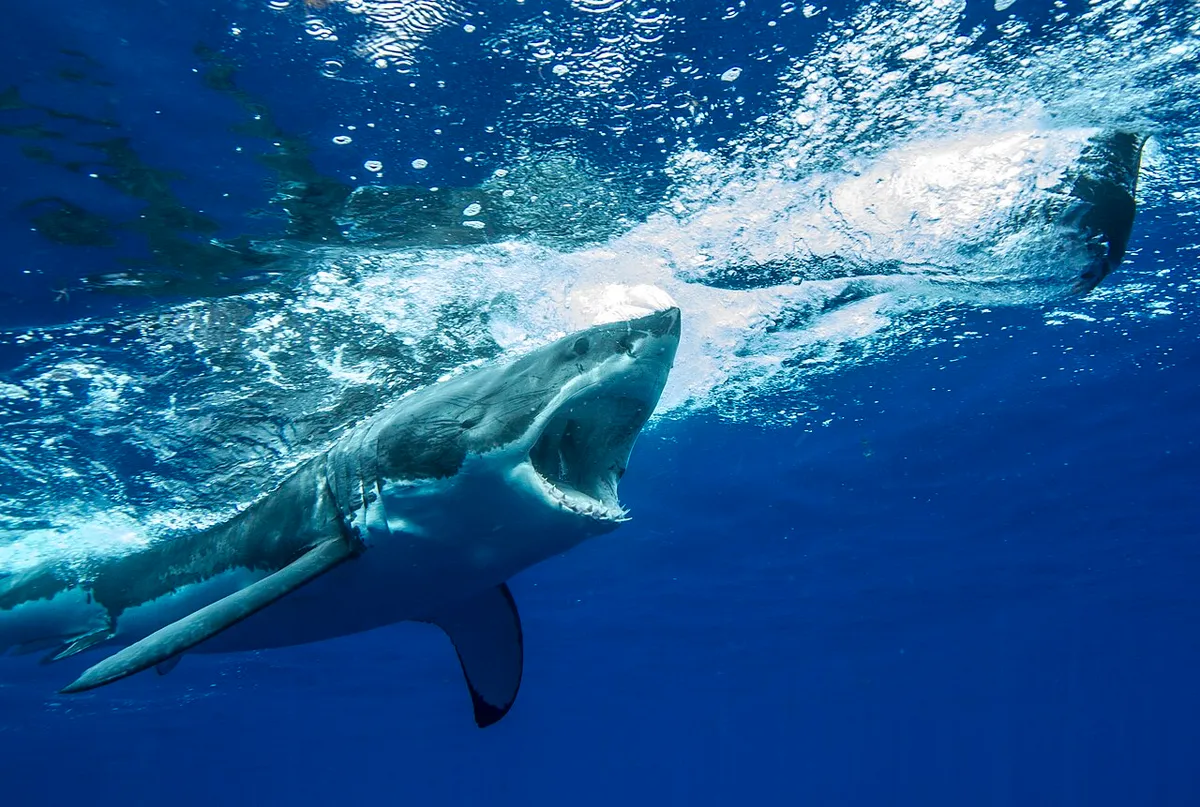
The jaw of a great white shark is legendary, equipped with up to 300 highly serrated, triangular teeth arranged in multiple rows. These teeth are continuously shed and rapidly replaced throughout the shark's life via a specialized conveyor-belt-like membrane, ensuring their primary weapons are always razor-sharp. Furthermore, unlike most fish, great white sharks possess regional endothermy, facilitated by a complex circulatory system called the rete mirabile (wonderful net). This counter-current heat exchange system allows them to maintain a core body temperature significantly higher than the surrounding water, granting them enhanced muscular efficiency, faster digestion, and heightened neurological processing in cold environments.

The great white shark is a highly migratory, cosmopolitan species, possessing one of the widest geographic distributions of any marine animal. They are predominantly found in the coastal and offshore waters of temperate and subtropical oceans worldwide. Key populations are clustered around regions with abundant marine mammal life, including the coasts of the United States (particularly California and the Northeastern seaboard), South Africa, southern Australia, Mexico (notably Guadalupe Island), and New Zealand.
Their preferred biome is the open ocean and dynamic coastal shelf environments. While they are frequently observed cruising near the surface or patrolling rocky reefs and kelp forests in search of pinniped prey, telemetry data from tagged individuals reveals that they routinely dive to pelagic depths exceeding 3,000 feet. They undertake massive, transoceanic migrations—such as the famous journey from the California coast to the "White Shark Café" in the mid-Pacific, or from South Africa to Australia—demonstrating their remarkable capacity to navigate vast expanses of open, featureless ocean using complex navigational cues, potentially including the Earth's geomagnetic field.

As obligate, apex carnivores, great white sharks possess a highly caloric diet that shifts dramatically as they mature. Juvenile great whites, lacking the massive bulk of adults, are primarily piscivorous, feeding heavily on smaller fish, rays, and other smaller shark species. As they transition to adulthood and their jaws broaden, their diet shifts entirely toward energy-rich marine mammals. Their preferred prey includes seals, sea lions, and even small cetaceans.
The hunting strategy of the adult great white shark is a masterclass in calculated ambush predation. Utilizing their countershading, they cruise deeply below their prey. Upon targeting a seal silhouetted against the surface, the shark initiates a massive, vertical upward charge driven by explosive tail thrusts. This often results in a devastating, high-speed impact known as a breach, where the sheer force of the strike lifts the massive shark entirely out of the water. Following the initial, catastrophic bite, the shark typically retreats, allowing the prey to exsanguinate (bleed out) before returning to consume it safely, minimizing the risk of injury from a thrashing, desperate animal.
Their sensory suite is exquisitely tuned for tracking. They possess an incredibly acute olfactory system capable of detecting a single drop of blood in 100 liters of water. Visually, a specialized tapetum lucidum behind their retina provides excellent low-light vision. Most impressively, the ampullae of Lorenzini—a network of gel-filled pores concentrated on their snout—grants them highly sensitive electroreception, allowing them to detect the minute electrical fields generated by the muscular contractions and heartbeats of hidden prey.

Contrary to the myth of the solitary, mindless killer, great white sharks exhibit complex and highly structured, albeit poorly understood, social behaviors. While they typically forage alone, they frequently congregate in specific seasonal feeding grounds. Within these aggregations, a clear, size-based dominance hierarchy emerges to prevent fatal physical conflict over resources. Larger sharks naturally dominate smaller individuals, and established residents generally outrank newcomers.
When disputes arise—often over a scavenging opportunity like a whale carcass—great white sharks utilize a distinct vocabulary of agonistic body language. Behaviors such as parallel swimming, jaw gaping, exaggerated tail beats, and pectoral fin depression serve as visual warnings to rivals. Physical combat is a last resort, as injury to an apex predator can mean starvation.
Interestingly, these sharks are highly inquisitive. Their behavior of "surface investigating" involves poking their heads above the water (spyhopping) to visually inspect objects on the surface. Many documented "attacks" on humans are actually investigatory bites; because sharks lack hands, they use their highly sensitive teeth and jaws to tactilely explore unfamiliar objects like surfboards, usually releasing them immediately once they realize the object is not their natural, fat-rich prey.

The reproductive biology of the great white shark is characterized by a "K-selected" life history: slow growth, late sexual maturity, and low fecundity. These traits make their populations incredibly vulnerable to depletion. Females do not reach sexual maturity until they are approximately 15 to 30 years old, while males mature around 10 to 12 years.
Great white sharks are aplacental viviparous, meaning they give birth to live young without the use of a true mammalian placenta. The gestation period is exceptionally long, estimated to be roughly 12 months. During this prolonged development within the mother's uterus, the unborn pups practice a remarkable survival strategy known as oophagy (egg-eating). The largest, most developed embryos consume unfertilized eggs continuously produced by the mother to sustain their massive growth rate before birth.
A female typically gives birth to a small litter of 2 to 10 fully developed pups, each measuring an astonishing 4 to 5 feet in length at birth. Immediately upon entering the marine environment, the pups are entirely independent and must rely on their innate predatory instincts to survive, as there is absolutely no maternal care. Those that survive the perilous juvenile years can look forward to a long lifespan, with recent radiocarbon dating of their vertebrae suggesting they can live for 40 to 70 years in the wild.
(Population and conservation trend data sourced from the IUCN Red List of Threatened Species)
Despite their position at the apex of the marine food web, the great white shark faces significant existential threats and is currently listed as Vulnerable on the IUCN Red List, with global population trends decreasing. Their low reproductive rate severely hampers their ability to recover from population crashes.
The primary danger they face is anthropogenic. Great white sharks are frequently victims of accidental bycatch in commercial pelagic longline and gillnet fisheries. Furthermore, they are still targeted in illegal fishing operations for their highly prized fins (for shark fin soup) and their massive jaws and teeth, which fetch exorbitant prices on the black market as macabre trophies.
Coastal habitat degradation and the depletion of their natural marine mammal prey bases due to overfishing also contribute significantly to their decline. Moreover, sensationalist media portrayals and irrational public fear have historically led to lethal culling programs and a lack of political will to enforce protective legislation. Protecting the great white shark is not merely about saving a single species; it is about preserving the vital, top-down regulatory pressures necessary to maintain the health, biodiversity, and stability of the global oceanic ecosystem.
Great white sharks can replace lost teeth again and again.
They can sense tiny electrical signals made by other animals.
A great white shark is a fish, not a mammal.
Young great whites usually eat more fish than adults do.
Great white sharks can travel long distances across the ocean.
Their dark top and pale belly help them blend into ocean water.
Select a question to reveal the answer.
A great white shark is a large ocean fish with a strong body, rows of sharp teeth, and excellent senses for hunting.
Great white sharks live in coastal and offshore oceans around the world, especially in temperate seas.
They are carnivores that eat fish, rays, seals, sea lions, and other marine animals.
They are fish. Great white sharks breathe through gills and do not feed milk to their young.
Adults can grow to about 11 to 20 feet long, and some weigh several thousand pounds.
A baby great white shark is called a pup. Pups can swim and hunt on their own soon after birth.
Great white sharks are listed as Vulnerable, so they need protection from overfishing and accidental capture.
They use smell, hearing, eyesight, and special sensors that can detect electrical signals from nearby animals.