
Orcinus orca / Carcharodon carcharias
Orca vs Great White Shark
Orcas and great white sharks can hunt some of the same marine prey, but one is a social air-breathing mammal and the other is a solitary gill-breathing fish.
By An Nguyen · Updated
At a glance
Published species data from both WildlifeDB profiles, aligned trait by trait. Size metrics highlight the larger value with a relative bar.
- Scientific name
- OrcaOrcinus orca
- Great White SharkCarcharodon carcharias
- Classification
- OrcaMammalia · Delphinidae
- Great White SharkChondrichthyes · Lamnidae
- Native range
- OrcaWorldwide
- Great White SharkWorldwide
- Primary habitat
- OrcaOcean
- Great White SharkOcean
- Diet
- OrcaCarnivore
- Great White SharkCarnivore
- Typical food
- OrcaFish, Squid, Seals, Penguins, Other marine animals
- Great White SharkFish, Seals, Sea lions, Rays, Smaller sharks
- Body length
- Orca16 feet – 32 feet
- Great White Shark11 feet – 20 feet
- Shoulder height
- Orca—
- Great White Shark—
- Weight
- Orca3,000 pounds – 12,000 pounds
- Great White Shark1,500 pounds – 5,000 pounds
- Top speed
- OrcaUp to 34 mph
- Great White SharkUp to 35 mph in bursts
- Wild lifespan
- Orca30 to 80 years
- Great White Shark40 to 70 years
- Social pattern
- OrcaPod living, Echolocation, Cooperative hunting
- Great White SharkOcean cruising, Ambush hunting, Surface investigating
- Key adaptations
- OrcaEcholocation, Powerful tail flukes, Streamlined body
- Great White SharkRows of sharp teeth, Strong sense of smell, Electroreception
- Conservation
- OrcaData Deficient · Varies By Population
- Great White SharkVulnerable · Decreasing
- Reproduction
- OrcaAbout 17 months; Usually 1 calf
- Great White SharkProbably about 12 months; 2 to 10 pups
Air and milk against gills and cartilage
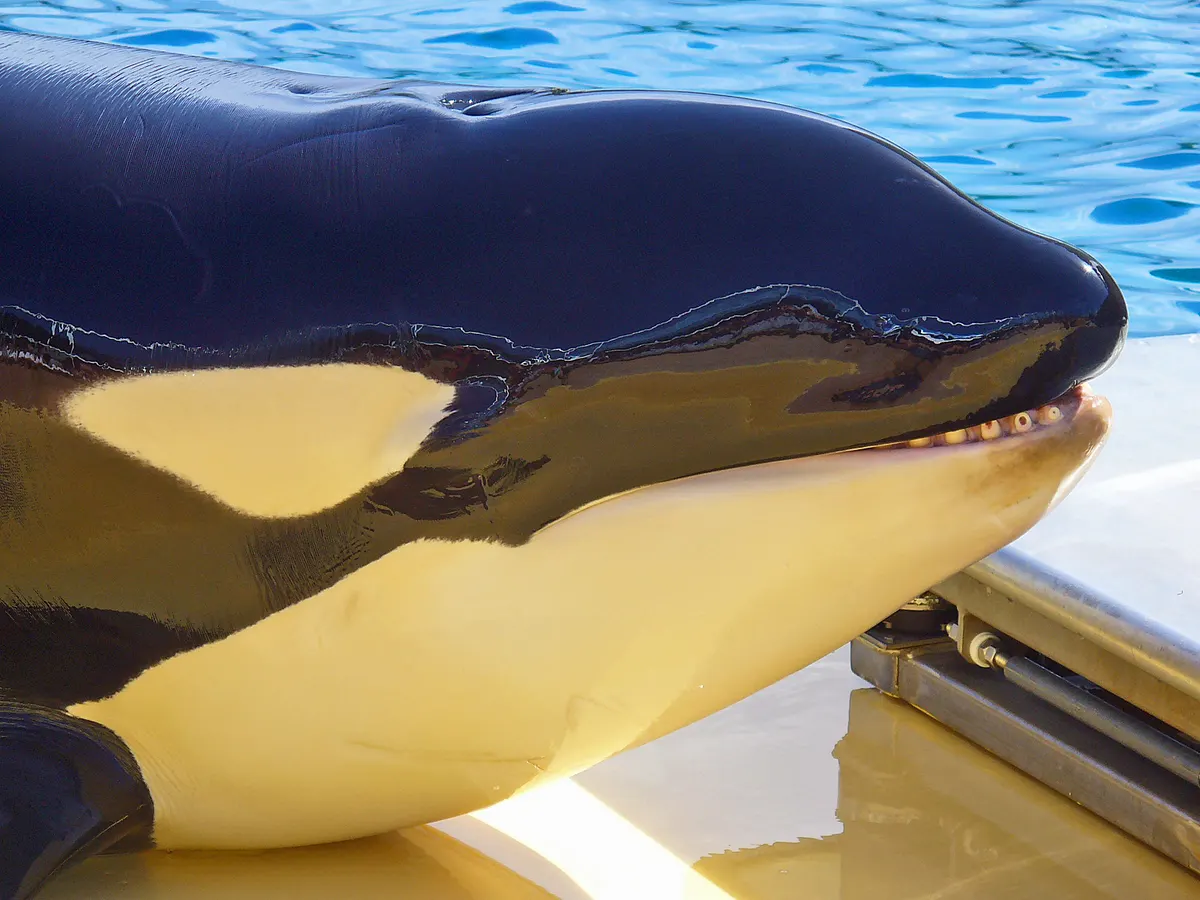
An orca, Orcinus orca, is a mammal — in fact the largest member of the dolphin family, Delphinidae. It breathes air through a blowhole, gives birth to live young, nurses calves, and maintains a warm body temperature.
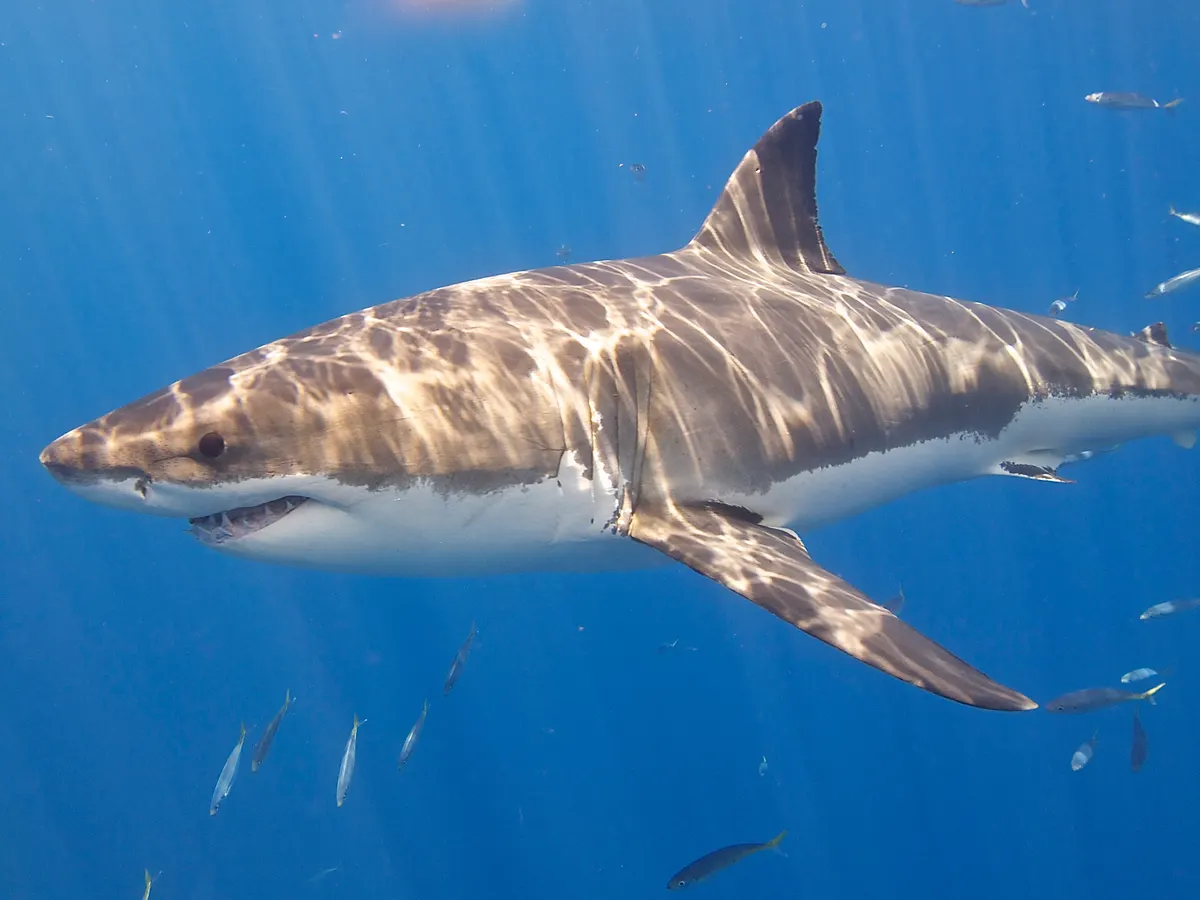
A great white shark, Carcharodon carcharias, is a fish. It breathes through gills, has a skeleton of cartilage rather than bone, and detects weak electrical fields through specialised sensory organs. The two animals share a streamlined body, a powerful tail, teeth, and a worldwide ocean range, and almost nothing below the surface of that list.
Horizontal flukes against a vertical tail
At a distance both show a dorsal fin and tail-driven swimming, which is why silhouettes get confused. The tails move in different planes: an orca's horizontal flukes rise and fall, while a shark's vertical tail sweeps side to side.
The fins differ too. An orca's dorsal fin is tall and upright, especially in adult males, and is used to identify individuals. The shark's is triangular, and visible gill slits sit behind the head. An orca must surface regularly to breathe; a great white never does.
The orca is far heavier
An adult orca spans approximately 16–32 feet and weighs 3,000–12,000 pounds. Great white sharks reach about 11–20 feet and 1,500–5,000 pounds. A large adult orca is therefore longer and roughly twice the mass at the top of each range.
Raw weight is only one comparison point. A shark's dense, hydrodynamic body and an orca's muscular mammalian body do not use mass the same way, and neither figure predicts anything about an encounter between individuals.
Pod culture against a solitary cruiser
Orcas live in pods and learn hunting behaviour inside family groups. Some populations specialise strongly on fish while others take marine mammals, and each pod can have its own calls and techniques. Echolocation, vocal communication, coordination, and long social memory are central to how many pods work. Calves stay close to their mother for years.
Great white sharks are usually seen alone, though several may gather near a rich food source. They cruise widely, investigate at the surface, migrate seasonally, and often attack from below when targeting seals or sea lions. Smell, vision, and electroreception work together during a hunt, and lost teeth are replaced continuously.
Echolocation against electroreception
The sensory systems are the deepest difference. An orca builds a picture of its surroundings by emitting sound and reading the returns — active sensing it generates itself. A great white reads the environment passively: dissolved scent at very low concentration, and the faint electrical signals that any moving animal produces.
That distinction shapes the hunt more than size does. One predator can coordinate with others over distance using sound; the other detects a hidden animal by the electricity of its own muscles.
Overlapping prey, incompatible methods
Both are carnivores and their prey lists overlap around marine mammals. Orcas take fish, squid, seals, penguins, and other marine animals, and a pod may cooperate to isolate prey, herd fish, or work a shoreline or ice edge. The mix differs sharply between populations.
Great white sharks eat fish, seals, sea lions, rays, and smaller sharks, with teeth built for gripping and cutting and a strong tail for short bursts. Young great whites eat more fish than adults do, and their long-distance travel means a shark at a seal colony may have crossed an ocean basin to reach it.
A seal colony can attract both animals. That is habitat overlap, not a shared strategy.
Why "who wins" is the wrong question
Interactions between the two vary by population, location, group size, and circumstance, and the great white's predator list includes larger orcas — which records that such encounters happen without establishing a general rule. A hypothetical duel between individuals is not a useful comparison, and it would not tell you anything about either species' biology.
Data Deficient against Vulnerable
The great white shark is Vulnerable with a decreasing trend. Orca status is less tidy: the global entry is Data Deficient, and trends vary by population, because "orca" covers ecologically distinct groups that may not share a conservation outlook at all.
Both range from polar seas to the tropics and may use coastal water, fjords, shelves, or open ocean. Local monitoring and the health of the wider marine food web matter far more for either species than any single dramatic encounter.