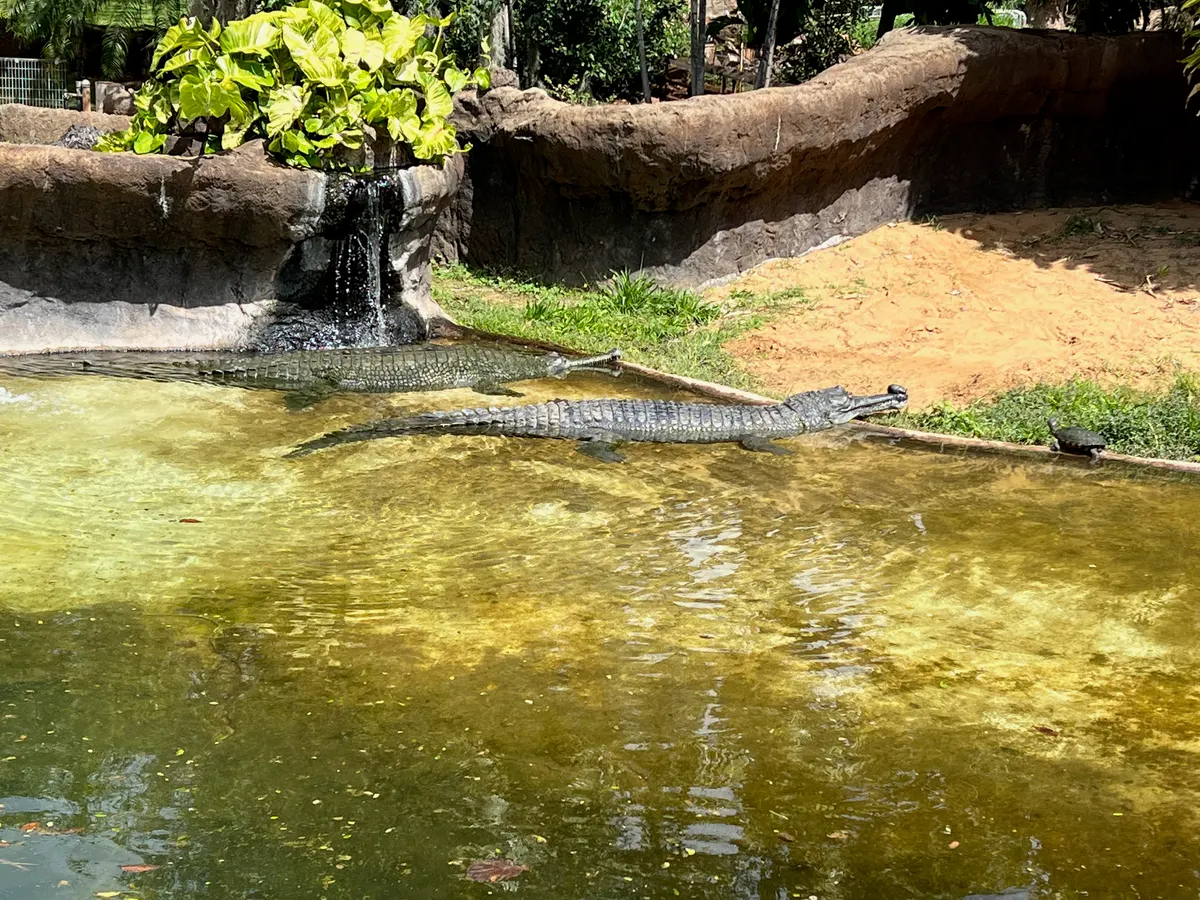
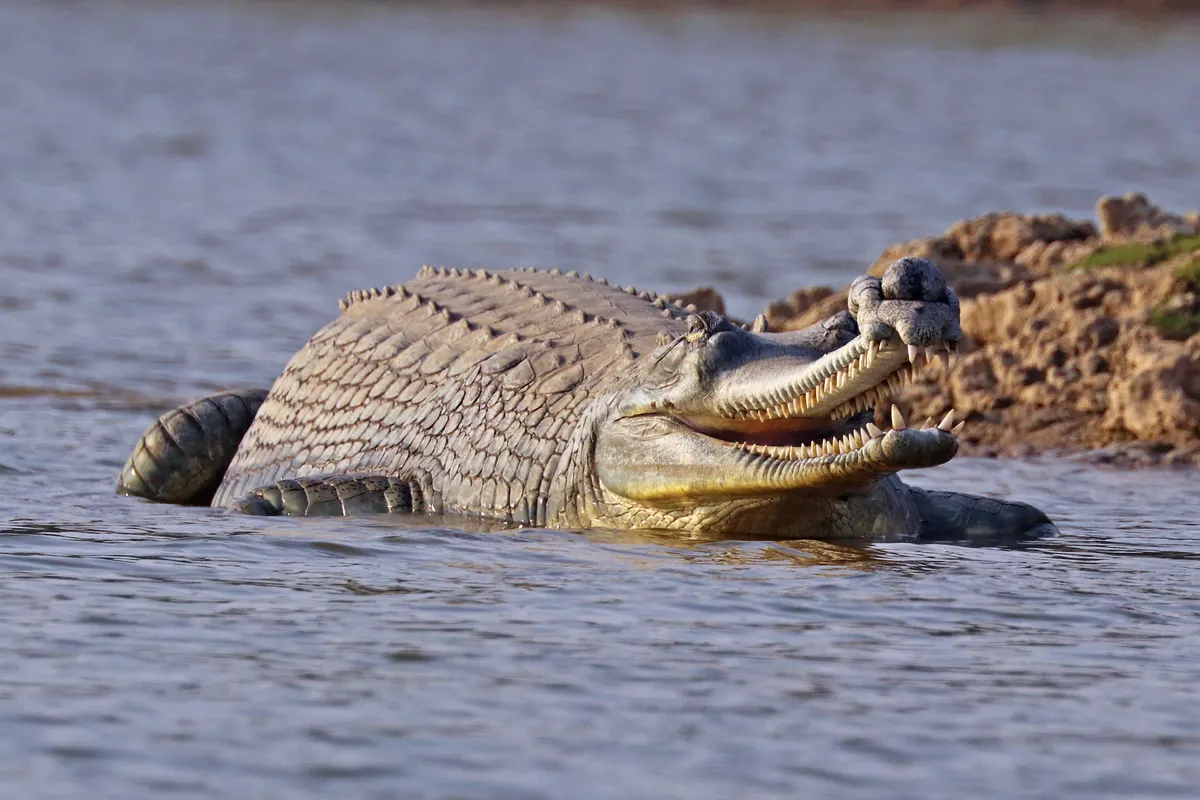
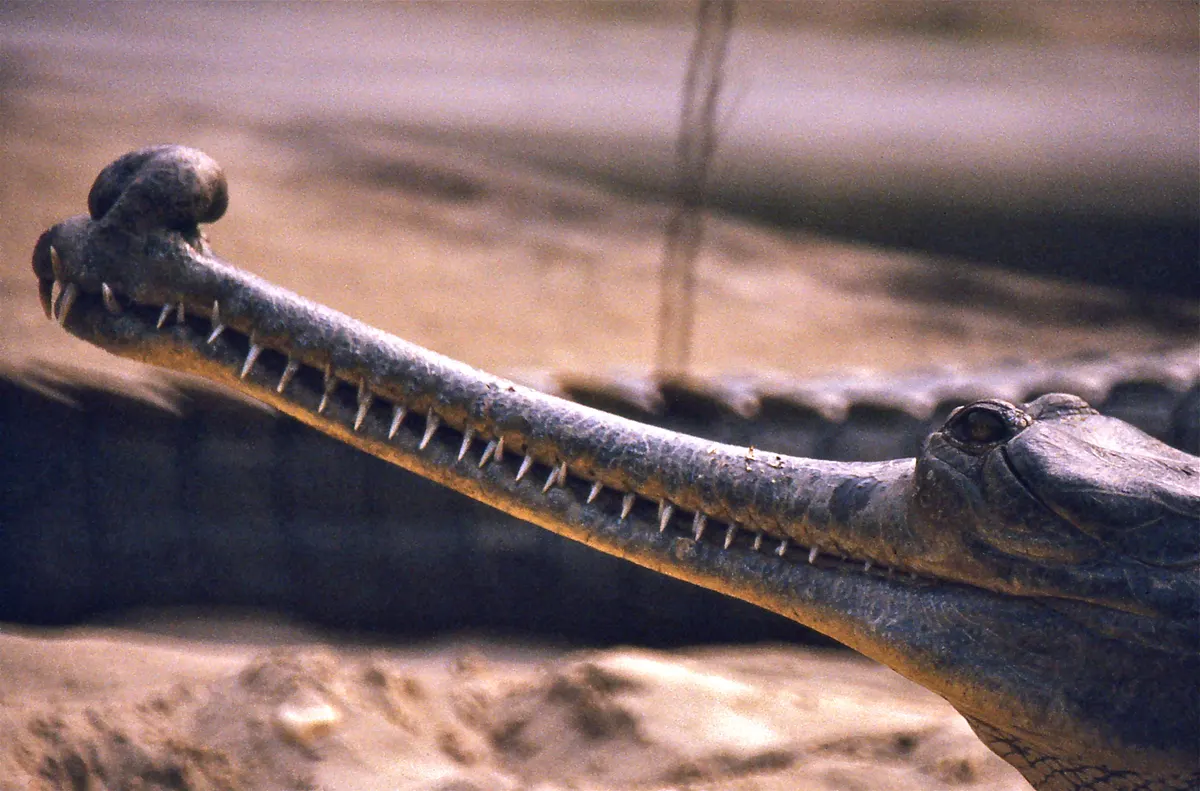
Male gharial resting with its long narrow snout and bulbous nose tip
The gharial is a fish-eating crocodilian; adult males grow a rounded nasal growth called a ghara.
CrocodyliaCritically Endangered

Gharial

The gharial is among the longest of all living crocodilians, with large males reaching about 6 m.

The gharial is a critically endangered, fish-eating crocodilian of the family Gavialidae and one of the longest of all living crocodilians, with males reaching about 6 m. Its extremely long, narrow snout and interlocking teeth are specialized for catching fish, and adult males carry a bulbous nasal growth called a ghara. Confirmed breeding populations now survive only in a few river systems of India and Nepal.
By · Updated

Quick Facts

Gharial at a glance

Gavialis gangeticusCrocodiliaGavialidae

About their home

Kind of animal

Crocodylia

Where they live

What they eat

How safe?

Critically Endangered

Size and speed

How heavy

160 kg – Up to about 977 kg (largest recorded male)

How long

2.6 m – 6 m

How fast

Agile in water; belly-slides awkwardly on land

Lifespan

Not well documented; likely several decades

Core article

Gharial: ecology and life history

A closer look at habitat, diet, behavior, reproduction, and conservation.

Start here

Gharial

The gharial is unlike the animals most people picture when they hear the word crocodile. Instead of a broad, powerful jaw, it carries a slender snout that can look almost fragile, tipped in adult males by a rounded growth that gives the species its name. It is one of the longest living crocodilians, yet it is built for a narrow way of life: catching fish in deep, fast rivers. That specialization made it successful for millions of years and now leaves it exposed, because the rivers it depends on have changed faster than the animal can. Today the gharial survives in only a fraction of its former range and is classed as Critically Endangered.

The Long, Thin Snout

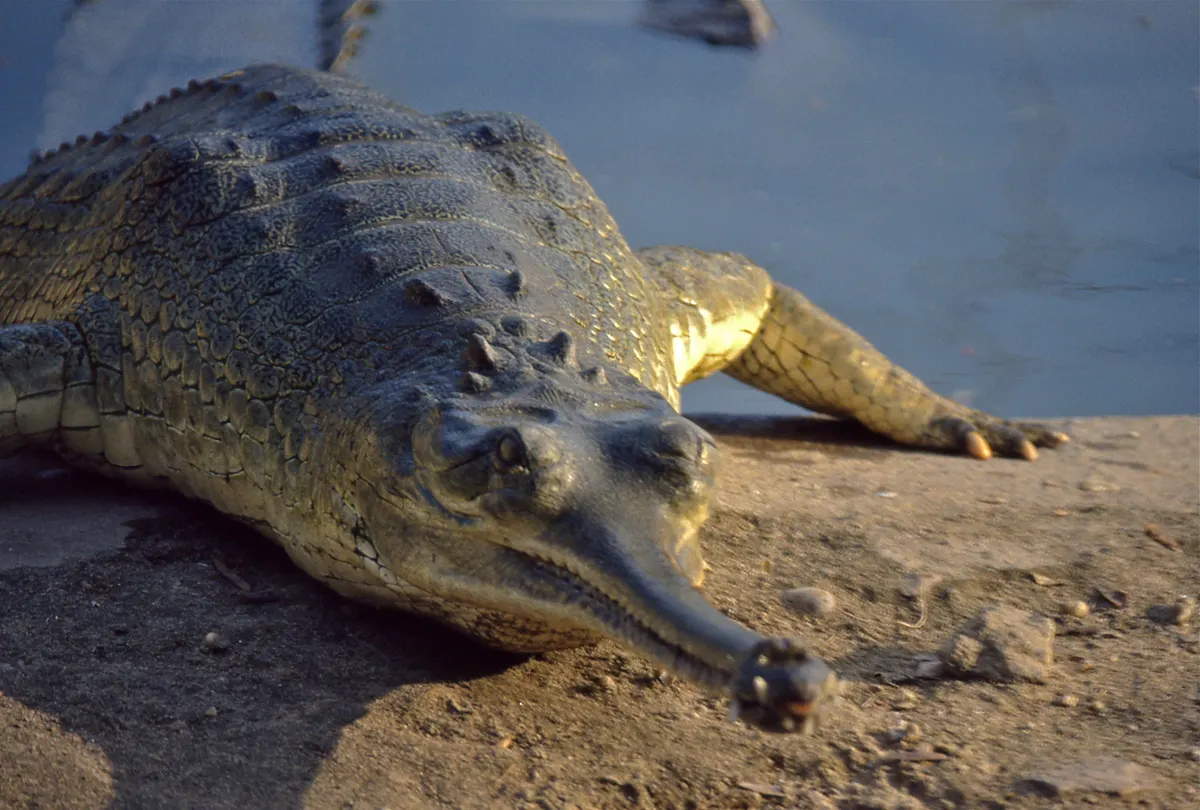
The gharial's most obvious feature is its rostrum, an extremely long and narrow snout that widens only slightly at the tip. This shape meets little resistance when swept sideways through water, which is exactly how the gharial hunts. Rather than lunging with a wide bite, the animal moves its head quickly across a school of fish and snaps the jaws shut on prey.

The jaws hold more than 100 teeth, generally counted at around 106 to 110 in adults. They are thin, sharp, and set so that the upper and lower teeth interlock when the mouth closes. This arrangement works like a trap, gripping slippery fish that a broader jaw would struggle to hold. The trade-off is strength: the delicate snout is poorly suited to seizing large mammals, which is one reason the gharial poses little danger to people.

The Ghara

Adult males develop a hollow, bulbous growth on the tip of the snout, around the nostrils. It resembles an Indian earthenware pot called a ghara, and that word gives the animal its common name. The structure appears as males mature, usually once they pass roughly 4 m in length, and it is one of the clearest examples of a visible sex difference among crocodilians.

The ghara is not decoration alone. It acts as a resonator, giving males a distinctive buzzing hiss used during courtship, and it doubles as a visual signal to females. In this respect the gharial differs from its wider-snouted relatives, which lack any comparable ornament.

Habitat and Distribution

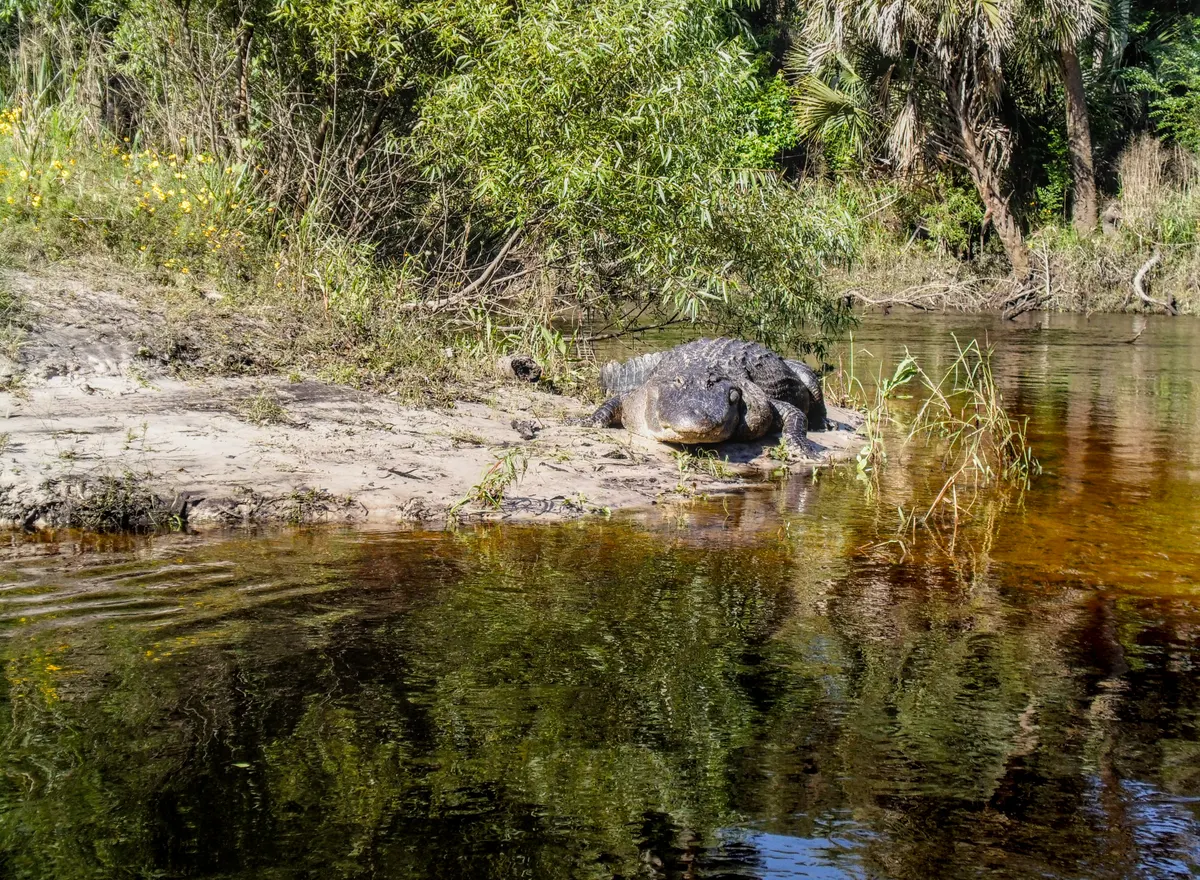
Gharial resting half-submerged at the water's edge
Gharials are highly aquatic and depend on deep river pools with sandbanks for basking and nesting.

The gharial is among the most aquatic of all crocodilians. Its legs are weak and splayed, so it cannot walk with its body raised the way a crocodile or an alligator can; on land it pushes itself forward in a belly-slide and rarely moves far from water. It favors deep, clear, fast-flowing stretches of river with sandy banks for basking and nesting. That habitat requirement is central to its wetland ecology and to its decline, because such rivers are exactly the ones people dam and mine for sand.

Historically the gharial ranged across the river systems of the northern Indian subcontinent, from the Indus in the west to the rivers of Myanmar in the east. By the most recent assessments it occupies roughly 2 percent of that former range. Confirmed breeding populations now persist only in India and Nepal, in the Ganges, Chambal, Gandaki, and a few connected rivers. The National Chambal Sanctuary in India is the single most important stronghold. The species is functionally extinct in the Indus, Godavari, and Koshi rivers, and in Bhutan and Myanmar; a small number have been reported in Pakistan, but these do not represent an established breeding population.

Diet and Fishing Behavior

Gharial floating at the surface with its long snout resting on the water
The narrow jaws move through water with little resistance, letting the gharial sweep sideways after fish.

The gharial is a carnivore, and among adults it is a near-exclusive fish-eater, or piscivore. The specialized snout and teeth reflect this: they are efficient for catching and holding fish but little else. Prey is generally maneuvered head-first and swallowed whole, and gharials, like other crocodilians, swallow stones that sit in the stomach and may aid digestion or buoyancy control.

Juveniles have a broader diet. Young gharials take insects, crustaceans, tadpoles, and frogs alongside small fish, shifting toward an almost purely fish diet as they grow. This change tracks the animal's increasing size and the strengthening of its hunting technique.

Basking and Thermoregulation

As an ectotherm, the gharial relies on its surroundings to regulate body temperature, and basking is a central part of its daily routine. Individuals haul out onto sandbanks and exposed shores, particularly in the cooler months, to absorb heat from the sun. In the cold season gharials often gather in groups at favored basking sites, so a single sandbank may hold many animals at once.

To shed excess heat they gape, holding the mouth open so that evaporation cools the tissues, and on hot days they retreat into the water with only the eyes and nostrils exposed. These behaviors tie the animal tightly to open, sandy riverbanks, which is why the loss of such banks affects far more than nesting alone.

Reproduction and Nesting

Breeding follows the river's seasonal rhythm. Mating takes place toward the end of the cold season, around February, and nesting occurs as water levels are low, roughly from late March into April or May. Females dig nest holes in sandy banks above the waterline and lay large clutches, commonly reported between 20 and 95 eggs, with records approaching 100. Gharial eggs are among the largest of any crocodilian.

Incubation lasts about 70 to 90 days, and the temperature of the sand influences development. Females guard the nest through this period and remain with the hatchlings for some time after they emerge, protecting them in the shallows. Unlike some crocodilians, the gharial's narrow snout makes it difficult to carry young in the mouth, so the guarding behavior takes other forms. Eggs and hatchlings face heavy pressure from predators such as monitor lizards, jackals, mongooses, and wild pigs, and few young reach adulthood even in healthy populations.

Taxonomy and Evolution

The gharial belongs to the family Gavialidae and is its only living member widely accepted under the name Gavialis gangeticus. The family has a deep fossil record, and the modern gharial is the last survivor of a once far more diverse lineage.

Its closest living relative is the false gharial, Tomistoma schlegelii, of Southeast Asia. The relationship has been debated: on skull anatomy alone the false gharial was long grouped with true crocodiles, while molecular genetic studies place it firmly as the gharial's sister species, with the two lineages diverging tens of millions of years ago. Current genetic evidence supports treating the false gharial as part of Gavialidae, a case where DNA and bone anatomy told different stories until the molecular data settled the question. The gharial's own resemblance to slender-snouted true crocodiles is now understood as convergence driven by a shared fish-eating lifestyle rather than close kinship.

Conservation and Threats

Two gharials resting together at the edge of the water
Recovery programs and river sanctuaries in India and Nepal support the remaining breeding populations.

The IUCN Red List has classified the gharial as Critically Endangered since 2007. The scale of the collapse is stark: estimates put the population at several thousand adults in the mid-twentieth century, falling to fewer than 250 by 2006, a decline on the order of 96 to 98 percent within a few generations. Encouragingly, coordinated conservation has produced an increasing trend at several sites over the past decade or two, though numbers remain very low overall.

The threats are largely tied to the loss and alteration of rivers. Dams and barrages change flow and fragment populations; water extraction lowers river levels; and sand mining and farming strip away the banks the animals need for basking and nesting. Drowning in gill nets kills adults directly, and pollution has been linked to mortality events, including deaths in the Chambal associated with heavy metals. Conservation work centers on protected river sanctuaries and on captive breeding and reintroduction, with programs in India and Nepal having released thousands of young gharials since the late 1970s. These efforts, unlike those for wide-ranging reptiles such as the Komodo dragon or marine species like the sea turtle, depend almost entirely on keeping a handful of specific river stretches intact.

References and Authoritative Sources

Gharial: classification and fun facts

Classification

Scientific Taxonomy
  1. Kingdom

    Animalia

  2. Phylum

    Chordata

  3. Class

    Crocodylia

  4. Order

    Crocodilia

  5. Family

    Gavialidae

  6. Genus

    Gavialis

  7. Species

    G. gangeticus

Did You Know?

Fun Facts

1

The gharial is among the longest of all living crocodilians, with large males reaching about 6 m.

2

Its name comes from the ghara, a pot-shaped growth on the snout of adult males that resembles an Indian earthenware vessel.

3

The ghara acts as a resonator, giving males a distinctive buzzing hiss during courtship.

4

The narrow snout holds more than 100 interlocking teeth that grip slippery fish like a trap.

5

Weak, splayed legs make the gharial one of the most aquatic crocodilians; it can barely support its weight on land and moves by belly-sliding.

6

The population fell by roughly 96 to 98 percent between the 1940s and 2006 before conservation breeding began to reverse the decline.

Common Questions

FAQ about Gharial

Select a question to reveal the answer.

What is a gharial?

The gharial (*Gavialis gangeticus*) is a large, fish-eating crocodilian in the family Gavialidae. It is recognized by its very long, thin snout and, in adult males, a bulbous nasal growth called a ghara.

Where do gharials live?

Confirmed breeding populations survive only in India and Nepal, in deep, fast-flowing river systems such as the Chambal, Ganges, and Gandaki. The Chambal River holds the largest remaining population.

What do gharials eat?

Adults feed almost entirely on fish, which they catch with a rapid sideways sweep of the narrow snout. Juveniles also take insects, crustaceans, tadpoles, and frogs.

What is the ghara on a gharial?

The ghara is a hollow, pot-shaped growth that develops on the snout tip of mature males. It works as a vocal resonator during courtship and serves as a visual signal to females, making it one of the few externally visible sex differences in crocodilians.

Are gharials dangerous to humans?

Gharials are not considered a threat to people. Their thin snout and needle-like teeth are built for gripping fish, not large prey, and they generally avoid humans. Reports of items found in gharials relate to scavenged jewelry rather than attacks.

Why are gharials critically endangered?

The population collapsed through habitat loss and change. Dams and water extraction altered river flow, sand mining and farming destroyed nesting banks, and drowning in fishing nets killed adults. The IUCN has listed the gharial as Critically Endangered since 2007.