
Gavialis gangeticus / Crocodylus niloticus
Gharial vs Crocodile
Gharials and crocodiles are both crocodilians, but the gharial has an extremely narrow fish-catching snout and is harmless to people, while the broad-snouted crocodile is a powerful generalist predator that can be dangerous.
By An Nguyen · Updated
At a glance
Published species data from both WildlifeDB profiles, aligned trait by trait. Size metrics highlight the larger value with a relative bar.
- Scientific name
- GharialGavialis gangeticus
- Nile CrocodileCrocodylus niloticus
- Classification
- GharialCrocodylia · Gavialidae
- Nile CrocodileReptilia · Crocodylidae
- Native range
- GharialAsia
- Nile CrocodileAfrica
- Primary habitat
- GharialWetland
- Nile CrocodileWetland
- Diet
- GharialCarnivore
- Nile CrocodileCarnivore
- Typical food
- GharialFish, Crustaceans, Frogs, Insects, Tadpoles
- Nile CrocodileFish, Birds, Mammals, Reptiles, Carrion
- Body length
- Gharial2.6 m – 6 m
- Nile Crocodile11 feet – 16 feet
- Shoulder height
- Gharial—
- Nile Crocodile—
- Weight
- Gharial160 kg – Up to about 977 kg (largest recorded male)
- Nile Crocodile500 pounds – 1,650 pounds
- Top speed
- GharialAgile in water; belly-slides awkwardly on land
- Nile CrocodileFast lunges from water; strong swimmer
- Wild lifespan
- GharialNot well documented; likely several decades
- Nile Crocodile50 to 70 years
- Social pattern
- GharialBasking on sandbanks to thermoregulate, Sweeping the snout sideways to catch fish, Gathering in groups for communal basking in the cold season
- Nile CrocodileAmbush hunting, Basking, Nest guarding
- Key adaptations
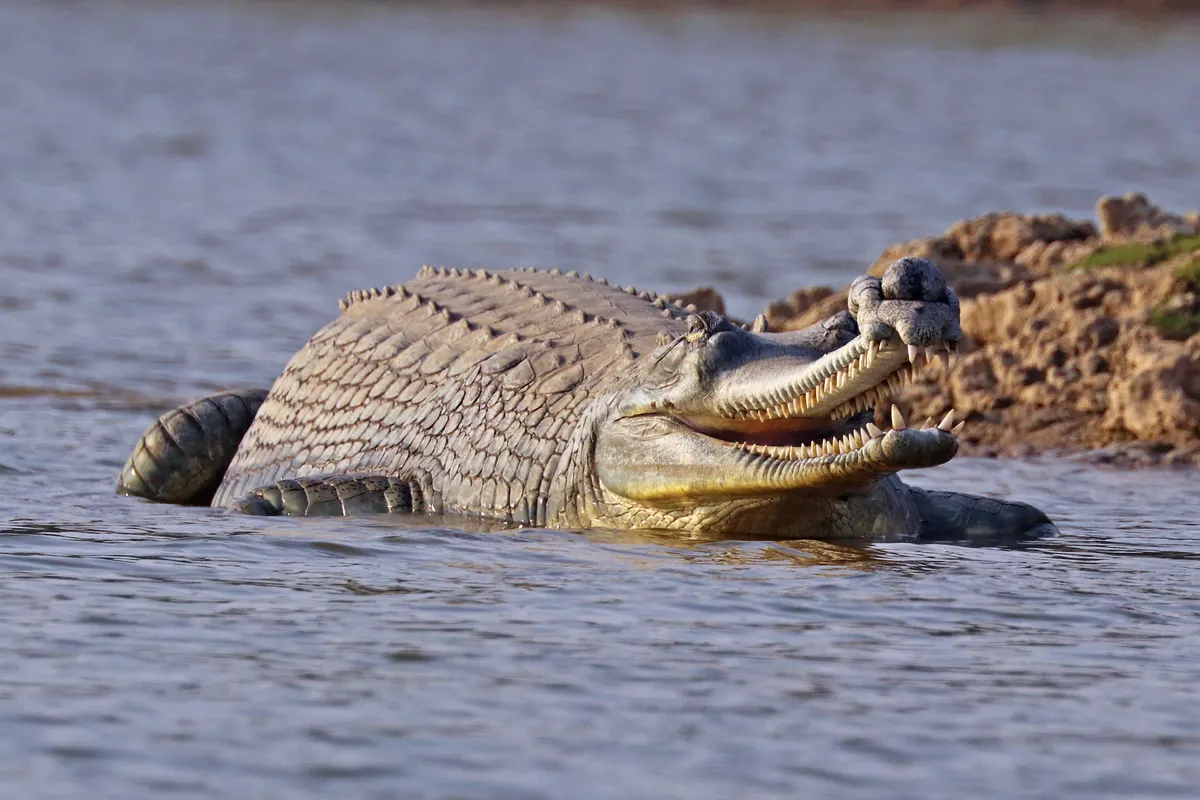
- GharialExtremely long, narrow snout that meets little water resistance, Over 100 needle-like interlocking teeth that form a fish trap, Ghara, a bulbous nasal growth on adult males used as a vocal resonator and visual signal
- Nile CrocodilePowerful jaws, Armored scales, Nostrils on snout top
- Conservation
- GharialCritically Endangered · Increasing
- Nile CrocodileLeast Concern · Stable
- Reproduction
- GharialAbout 70 to 90 days of egg incubation; 20 to 95 eggs
- Nile CrocodileEggs incubate about 3 months in nests; Usually 25 to 80 eggs
A snout built for fish, not for large prey
The gharial, Gavialis gangeticus, has an extremely long, thin snout lined with more than a hundred interlocking needle-like teeth. It works as a fish trap: the narrow profile meets little water resistance, so the animal can sweep its head sideways fast enough to snap up a moving fish.
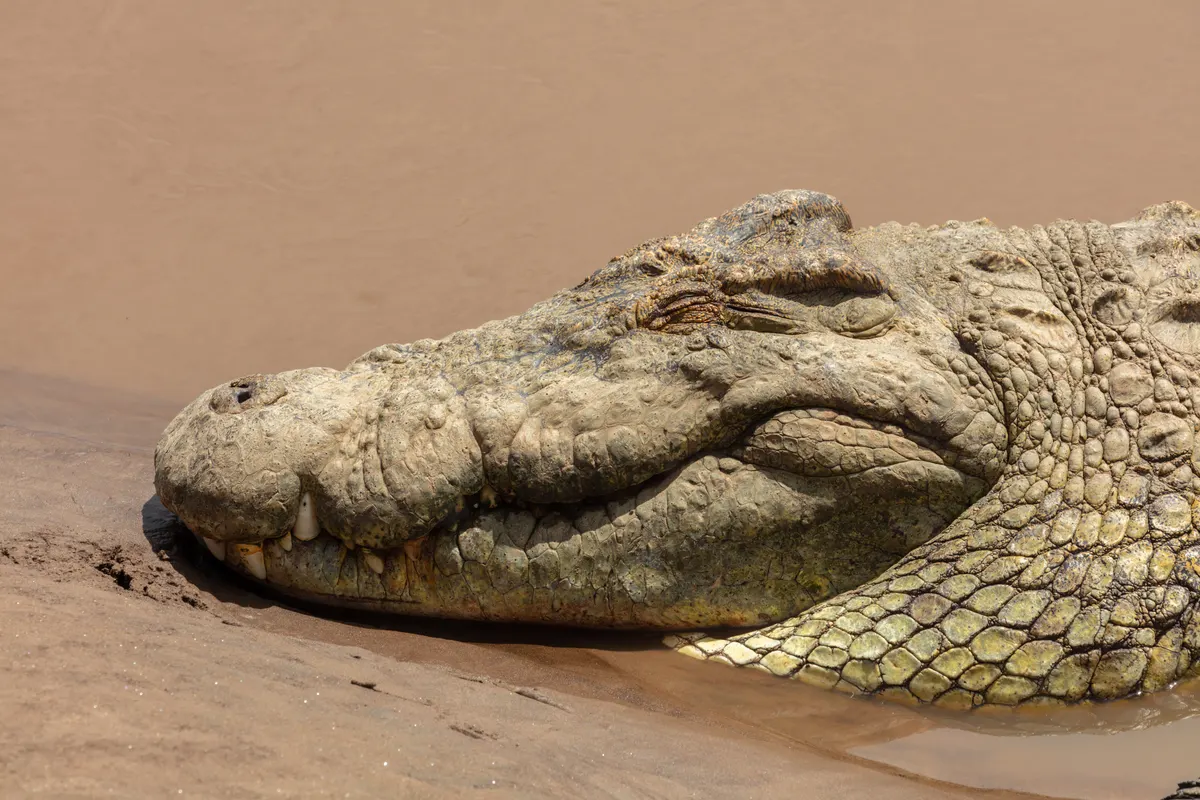
The Nile crocodile, Crocodylus niloticus, has a broad, heavily muscled snout and stout teeth for seizing and holding large struggling prey. Both belong to the order Crocodilia but to different families — Gavialidae and Crocodylidae — and the snout is where that split shows most clearly.
The ghara on the male's nose
Adult male gharials grow a bulbous, pot-shaped growth of tissue on the snout tip. The name of the species comes from it: ghara is an Indian earthenware vessel. No crocodile has anything comparable.
The ghara is not ornamental. It acts as a resonator, giving males a distinctive buzzing hiss during courtship, and it also functions as a visual signal. A crocodilian with a knob on the end of its nose is a mature male gharial and nothing else.
Longer, yet far lighter
Gharials measure about 2.6 to 6 metres, and large old males are among the longest of all living crocodilians. Nile crocodiles are shorter on average, roughly 3.5 to 5 metres.
Length is misleading here. The gharial is slender-bodied, while the Nile crocodile carries 500 to 1,650 pounds on a shorter frame and is built for bulk, bite force, and power. The gharial can match or exceed the crocodile in length and still be the far lighter animal — which is why a length-only comparison gets this pair backwards.
Is a gharial dangerous to people?
No. The gharial's jaws are built for fish, not for prey the size of a person, and it is regarded as essentially harmless to humans. Its diet is fish, crustaceans, frogs, insects, and tadpoles, with juveniles taking the smaller items.
The Nile crocodile is a different matter: a powerful ambush predator that eats fish, birds, mammals, reptiles, and carrion, takes animals that come to drink, and is responsible for attacks on people. It cannot chew — it grips prey and rolls or swallows pieces. Treating all crocodilians as equally dangerous misstates the risk in both directions.
Almost helpless on land
The gharial is among the most aquatic of all crocodilians. Weak, splayed legs can barely support its weight, so it moves on land by belly-sliding and normally hauls out only to bask on sandbanks or to nest. A laterally flattened tail and webbed hind feet make it powerful in water and awkward out of it.
The Nile crocodile is considerably more mobile ashore and can launch fast lunges from the water's edge. Both bask to control body temperature, and both have eyes, nostrils, and ears set high on the head for breathing while submerged. Gharials also gather for communal basking in the cold season, and females guard nests and hatchlings — as Nile crocodile females do.
Clean Indian rivers against African wetlands
Both live in fresh water, on different continents. The gharial survives in a few clean, fast-flowing rivers of India and Nepal, needing deep pools for feeding and sandbanks for nesting — a narrow set of wetland conditions that is easily lost to dams, sand mining, and fishing nets.
The Nile crocodile occupies rivers, lakes, and wetlands across much of sub-Saharan Africa and into Egypt and Madagascar, a far broader and more forgiving range.
Critically Endangered against Least Concern
This is the gap that matters most. The gharial is Critically Endangered: its population fell by roughly 96 to 98 percent between the 1940s and 2006 before conservation breeding began to reverse the decline, and the current trend is increasing from a very low base. It survives largely because of river sanctuaries and captive breeding.
The Nile crocodile is Least Concern with a stable trend and remains widespread. Two animals in the same order, in the same broad habitat type, can sit at opposite ends of the extinction risk scale.