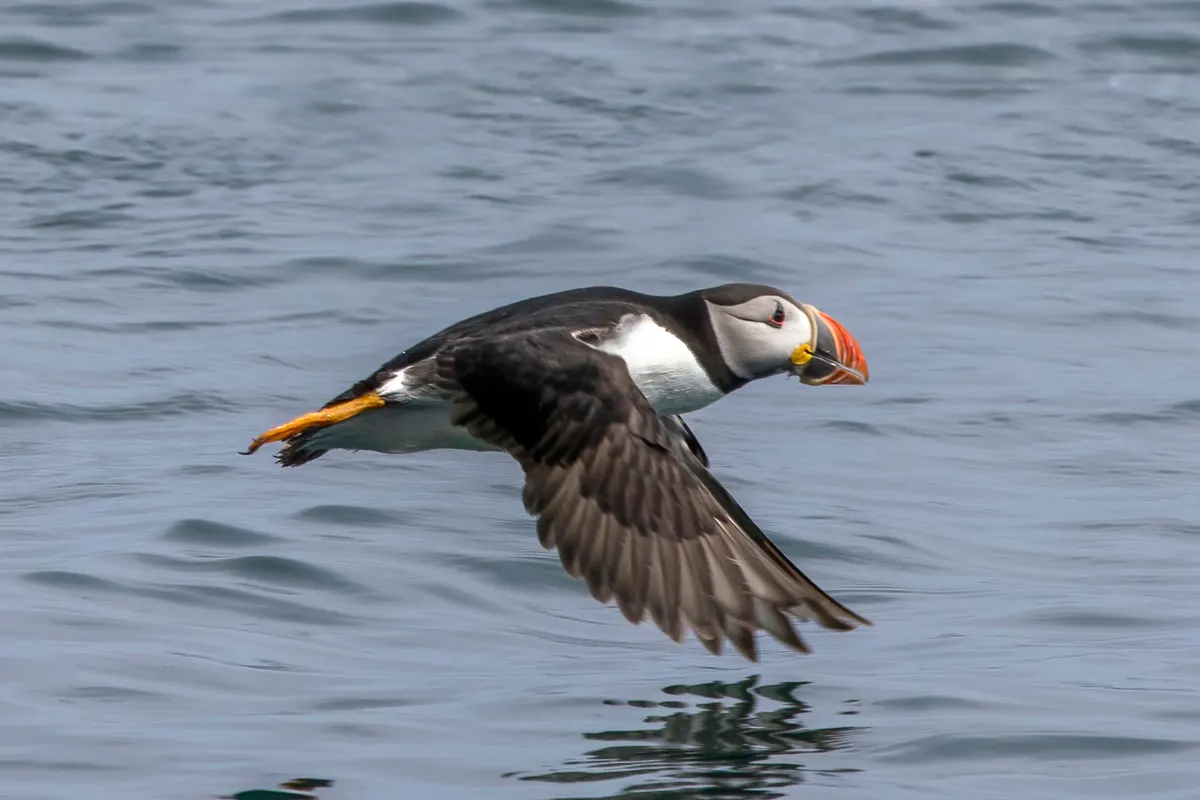

The Atlantic puffin is a small but dense, solidly built bird. Adults measure roughly 26 to 29 centimeters in length—standing about 20 centimeters tall when upright—and weigh between 380 and 480 grams. Their plumage is classic countershading: pitch-black on their dorsal (back and head) surfaces to blend in with the dark ocean depths from above, and brilliant white on their ventral (belly) surfaces to blend with the bright sky when viewed from below.
The most iconic anatomical feature of the Atlantic puffin is, undoubtedly, its massive, laterally flattened beak. During the spring breeding season, the bill transforms into a vibrant canvas of deep orange, bright yellow, and slate blue, bordered by a fleshy yellow rosette at the base. This striking coloration is strictly an ornamental trait driven by sexual selection to attract mates. After the breeding season, in a process known as catastrophic molt, the puffin sheds the colorful outer plates of its beak, leaving it noticeably smaller and dull gray for the harsh winter months.
A puffin's beak is an engineering fascinating example designed for bulk transport. The upper mandible possesses a series of backward-pointing serrations, and they have a specialized, raspy tongue. They use their tongue to pin captured fish against the serrated roof of their mouth, allowing them to open their beak underwater to catch more prey without losing their existing catch. A puffin can routinely hold a dozen small fish at once, with extreme records documenting over 60 fish dangling from a single beak.
Their short, stubby wings are heavily adapted for swimming. To maintain flight in the air, a puffin must flap its wings frantically—up to 400 beats per minute—allowing it to reach flight speeds of 55 mph (88 km/h). However, underwater, these short wings act as powerful, highly efficient flippers, while their webbed feet serve as rudders, enabling them to dive to depths of 200 feet (60 meters) in pursuit of agile fish.