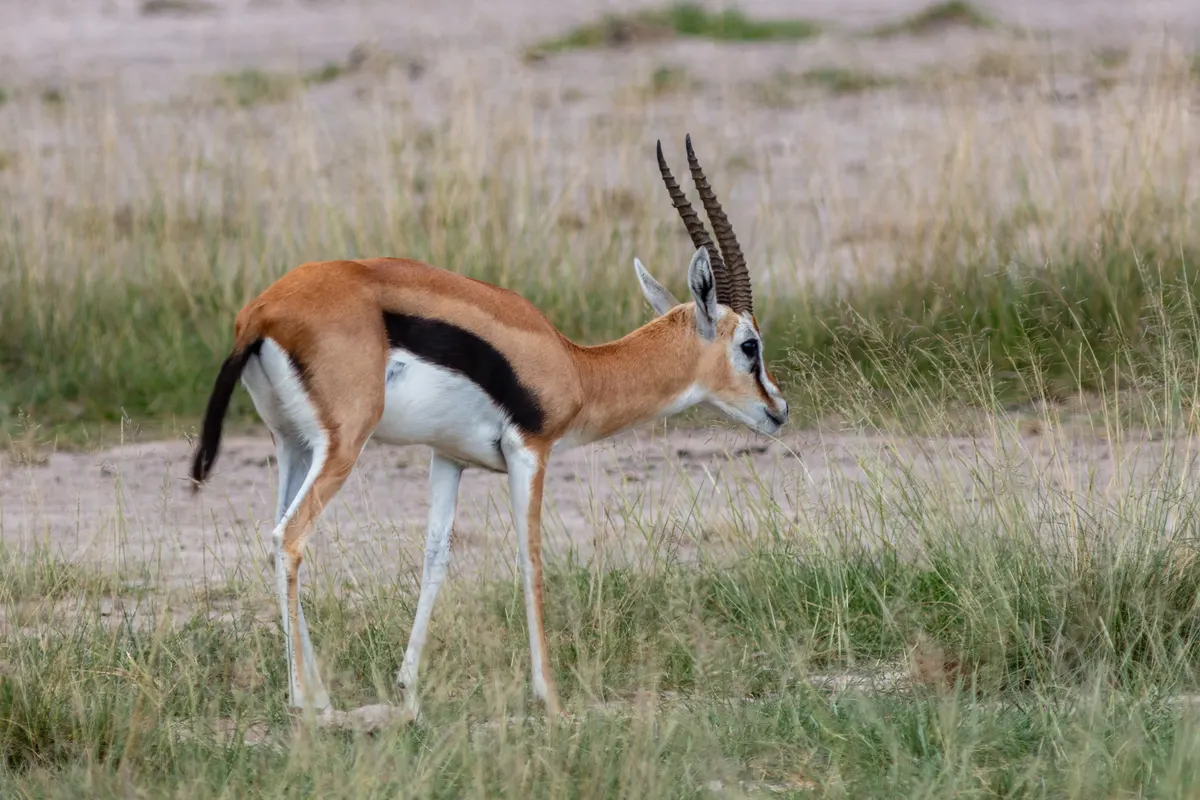
Wild saiga antelope standing at a waterhole with its enlarged nose visible
The saiga's flexible nose filters summer dust and warms freezing winter air.
MammaliaNear Threatened

Saiga Antelope

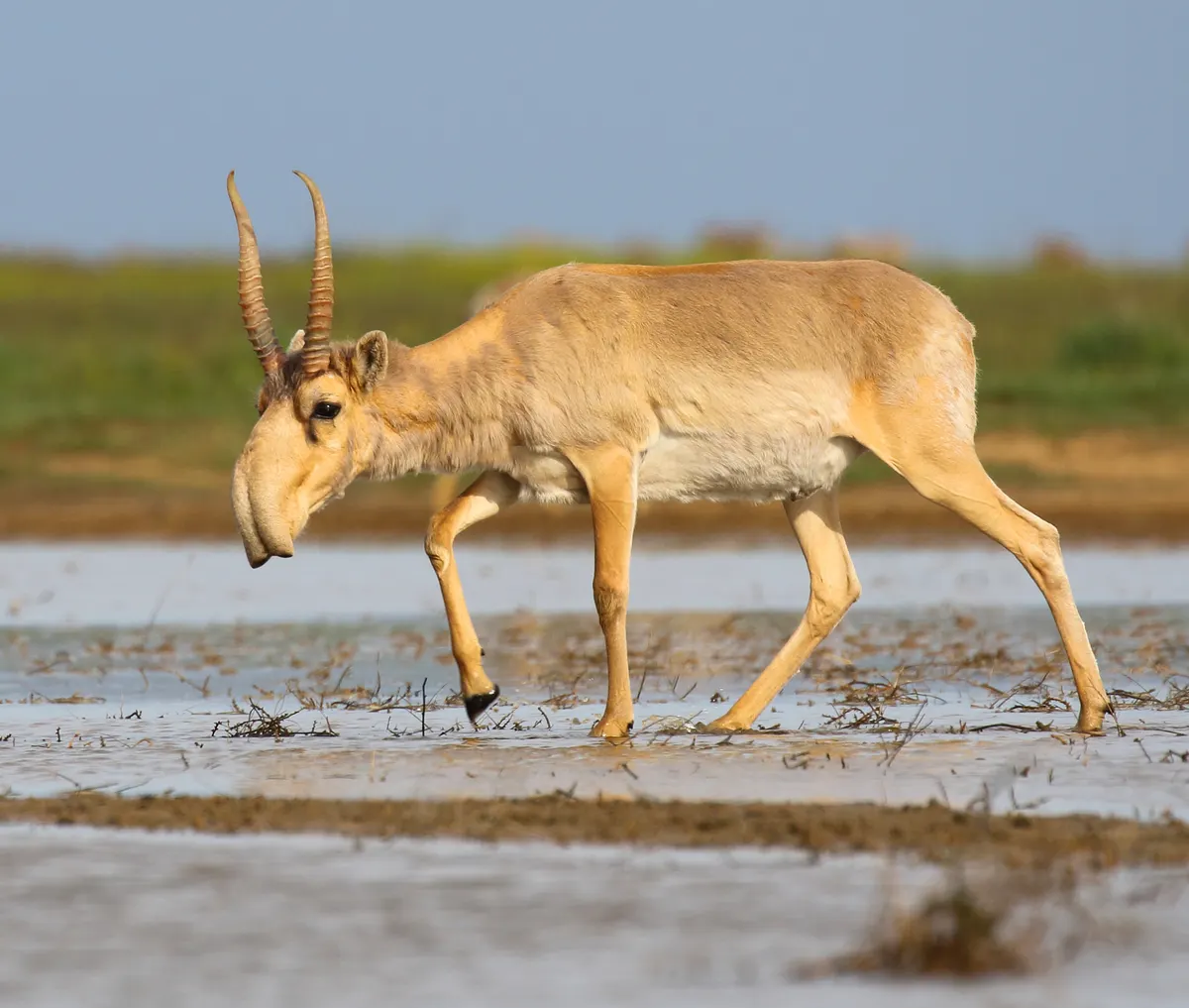
The saiga's nose hangs over the mouth like a short, flexible trunk.

The saiga antelope is a migratory grazer of Central Asia's open steppe and semi-desert. Its enlarged, flexible nose filters summer dust and warms freezing winter air before it reaches the lungs. After catastrophic declines caused by poaching and disease, strong recovery in Kazakhstan led the IUCN to reclassify the species from Critically Endangered to Near Threatened in 2023.

By · Updated

Quick Facts

Saiga Antelope at a glance

Saiga tataricaArtiodactylaBovidae

About their home

Kind of animal

Mammalia

Where they live

What they eat

How safe?

Near Threatened

Size and speed

How heavy

30 kg – 45 kg

How long

100 cm – 150 cm

How fast

Lifespan

About 10 to 12 years

Core article

Saiga Antelope: ecology and life history

A closer look at habitat, diet, behavior, reproduction, and conservation.

Start here

Saiga Antelope

The saiga antelope is built for a landscape with little shelter. It crosses the steppe in large herds, following rain, fresh plant growth and snow conditions over hundreds of kilometers. Its most conspicuous feature—a swollen nose hanging over the mouth—is not ornamental. The internal passages help filter dust in summer and warm dry, freezing air in winter.

Saiga tatarica also has one of conservation's most dramatic recent histories. Poaching and the collapse of management after the Soviet era reduced numbers by about 95 percent. A mass disease event then killed roughly 200,000 animals in Kazakhstan in 2015. Strong protection allowed an equally striking rebound, and in December 2023 the IUCN changed the species from Critically Endangered to Near Threatened. Recovery has been real, but it has not removed the risks.

The Saiga's Flexible Nose

The saiga's nostrils open at the end of a soft, downward-pointing structure sometimes compared with a short trunk. Inside, the nasal cavity is large and folded. During dry migrations, moving hooves can raise clouds of fine steppe dust; hairs and moist surfaces in the nose trap particles before they enter the lungs. In winter, the same long passage warms and humidifies air that may be far below freezing.

Both sexes carry the enlarged nose. Adult males also grow a pair of pale, translucent horns marked by dark rings. The horns rise almost vertically and curve slightly backward. Females normally lack horns.

Coat and body change with the season. Summer fur is short and sandy yellow to reddish tan. Before winter it becomes much longer, thicker and paler, insulating the animal and blending into snow-dusted grassland. Long legs, a compact body and splayed hooves suit fast travel over flat ground.

Habitat and Range

Saiga herd spread across flat dry grassland in Kazakhstan
Fences, roads and railways can block the flexible routes saigas use to reach seasonal pasture.

Saigas live in open grassland, dry steppe and semi-desert across Central Asia. Most occur in Kazakhstan, with populations in Russia and smaller numbers in Uzbekistan. The Mongolian form is restricted to western Mongolia and is sometimes treated as a subspecies of S. tatarica and sometimes as a separate species, Saiga borealis, depending on the authority.

The landscape must remain permeable. Saigas do not defend fixed territories or follow one narrow route every year. Some movements are directed seasonal migrations between winter and summer areas; others are nomadic responses to local rainfall and vegetation green-up. A herd may shift its path when drought, deep snow or forage conditions change.

Roads, railways, border fences, pipelines and agricultural development can turn that flexible movement into a trap. A barrier that seems small on a map can block access to calving grounds, winter pasture or emergency routes around severe weather.

Diet and Seasonal Movement

Saiga antelopes feeding among sparse steppe plants
A broad plant diet allows herds to use dry and salty vegetation across semi-desert ranges.

The saiga is a herbivore recorded eating more than 100 plant species. Grasses, forbs, saltworts, sagebrush, summer cypress and steppe lichens all enter the diet. The mix changes with season and location, allowing the animals to use dry, salty vegetation that many livestock avoid.

Herds track new growth after rain and visit scattered water sources. In summer they may wander broadly across productive patches. Autumn movement leads toward rutting and winter areas; snow depth then influences how far south the animals travel. Some populations cover several hundred kilometers between seasonal ranges.

Saigas graze during the day and may dig shallow depressions before resting. Their movement redistributes nutrients through dung and creates grazing patterns across vast steppe systems. Dense herds also compete locally with livestock for pasture and water, making conservation a question of coexistence as well as protection.

Herd Behavior and Migration

Multiple saiga antelopes traveling together across the steppe
Herd membership changes as animals respond to forage, weather, calving and the winter rut.

Outside the rut, saigas form fluid groups that can join into herds numbering thousands. The largest concentrations occur in May, when pregnant females gather on calving grounds. Births are synchronized into a short period, often one or two weeks, so many calves appear at once.

The winter rut is more violent. Adult males defend groups of females and fight with their horns. They eat little while guarding a harem, and exhaustion, injury and severe weather can produce high male mortality. Heavy poaching of horned males in the 1990s distorted sex ratios so severely that too few adult males remained to mate with available females in some populations.

Migration links every part of the annual cycle. Calving grounds, summer grazing, rut areas and winter shelter may lie far apart. Protecting one reserve cannot secure a herd if the corridors between those places are blocked.

Calves and Rapid Reproduction

Newborn saiga calf lying concealed in spring grass
Young females can reproduce during their first year, and mature females commonly bear twins.

Mating occurs mainly in late November and December. After a gestation of about five months, females give birth in May. Young first-time mothers often have one calf, while mature females commonly produce twins and occasionally triplets.

Calves lie concealed for their first days, then begin following their mothers and nibbling vegetation within the first week. They grow quickly and may be weaned at roughly three to four months. Females can mature during their first year, giving the species a high capacity for population growth when adult survival and habitat conditions are favorable.

That reproductive speed explains part of the recent recovery, but concentrated calving also creates vulnerability. Thousands of animals sharing a small area can enable pathogens to spread rapidly when weather conditions favor disease.

Conservation, Collapse and Recovery

Mongolian saiga standing in arid desert-steppe
The recovering global population remains vulnerable to disease, poaching and loss of migration corridors.

Saiga numbers crashed after the early 1990s as governance and anti-poaching systems weakened across their range. Males were targeted for horns used in traditional medicine, while meat hunting affected both sexes. The global population fell from more than 1.5 million to around 50,000.

Protection, enforcement, customs work and cooperation with steppe communities reversed much of that decline. Kazakhstan, which holds nearly all of the nominate population, recorded an increase of about 1,100 percent between 2015 and 2022. Recent surveys put the Ural population alone above 1.6 million in 2025. These gains led the IUCN to assess the global species as Near Threatened rather than Critically Endangered.

The change does not mean conservation work is finished. Illegal horn trade persists. Fences and transport corridors constrain migration. Conflict has increased where recovering herds share pasture with livestock. Most importantly, saigas remain susceptible to sudden mass mortality. In May 2015, warm and humid conditions helped normally harmless Pasteurella multocida bacteria invade the bloodstream, killing about 200,000 animals in the Betpak-Dala population within weeks.

Recovery has therefore created a new management problem: maintain protection while reducing conflict and preserving movement for an animal whose numbers can rise or fall extraordinarily fast.

Taxonomy

The saiga belongs to Bovidae, the family that includes cattle, sheep, goats, gazelles and many antelopes. It is the only living species in its distinctive genus under the most common treatment.

Taxonomy differs for the Mongolian population. The IUCN has generally treated it as Saiga tatarica mongolica, while some conservation agreements recognize Saiga borealis. Because legal and population reports may follow different systems, a number should always be read together with the taxonomic definition used.

References and Authoritative Sources

Saiga Antelope: classification and fun facts

Classification

Scientific Taxonomy
  1. Kingdom

    Animalia

  2. Phylum

    Chordata

  3. Class

    Mammalia

  4. Order

    Artiodactyla

  5. Family

    Bovidae

  6. Genus

    Saiga

  7. Species

    S. tatarica

Did You Know?

Fun Facts

1

The saiga's nose hangs over the mouth like a short, flexible trunk.

2

Its nasal passages filter airborne dust in summer and warm cold air in winter.

3

Some populations move several hundred kilometers between seasonal ranges.

4

Large numbers of females give birth within a concentrated one- to two-week period in May.

5

The species improved from Critically Endangered to Near Threatened on the IUCN Red List in 2023.

6

Kazakhstan's saiga population increased by roughly 1,100 percent between 2015 and 2022.

Common Questions

FAQ about Saiga Antelope

Select a question to reveal the answer.

What is a saiga antelope?

The saiga (*Saiga tatarica*) is a small migratory antelope of Central Asian steppe and semi-desert. Males carry pale ringed horns, and both sexes have an enlarged, downward-pointing nose.

Why does the saiga have such a large nose?

The nose contains a large chamber lined with moist tissues and hairs. It helps trap dust kicked up by moving herds during dry summers and warms and humidifies frigid air before it reaches the lungs in winter.

Where do saiga antelopes live?

Most saigas live in Kazakhstan, with additional populations in Russia, Mongolia and Uzbekistan. They require broad, open steppe and semi-desert where they can move freely between seasonal grazing and calving areas.

What do saiga antelopes eat?

Saigas graze and browse on more than 100 plant species, including grasses, forbs, saltworts, sagebrush, summer cypress and steppe lichens.

Are saiga antelopes still critically endangered?

No. The IUCN changed the global species from Critically Endangered to Near Threatened in December 2023 after a major recovery, especially in Kazakhstan. Disease outbreaks, illegal horn trade and barriers across migration routes remain serious risks.

Why can saiga numbers change so quickly?

Females mature early and often produce twins, allowing rapid growth under good conditions. The same dense calving herds are vulnerable to disease: in 2015 a bacterial outbreak killed about 200,000 animals in the Betpak-Dala population within weeks.