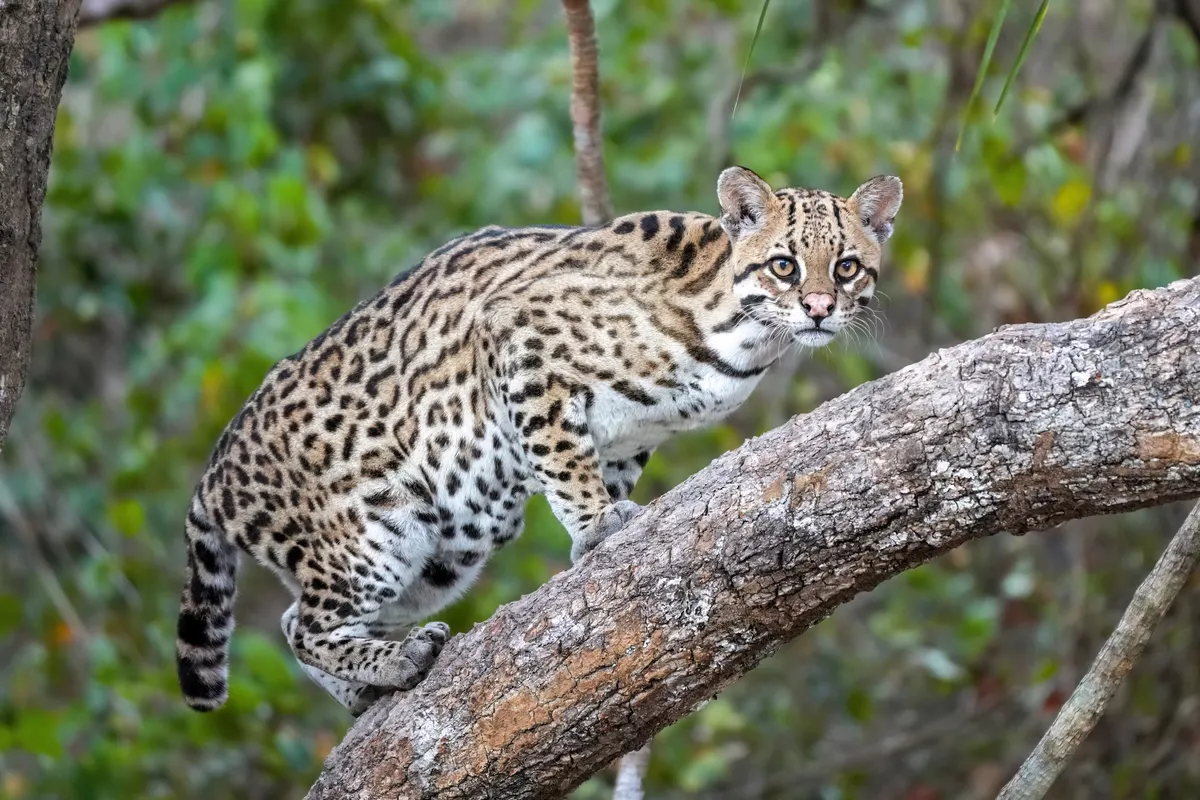
Wild ocelot walking through dense vegetation in Brazil's Pantanal
Ocelots are medium-sized American cats whose rosettes and stripes form a unique pattern on every individual.
MammaliaLeast Concern

Ocelot

No two ocelots have exactly the same arrangement of spots and rosettes.

The ocelot is a medium-sized spotted cat of the Americas, ranging from southern Texas and Mexico through Central America to northern Argentina. Its chain-like rosettes are unique to each animal. Ocelots are mostly nocturnal, hunt a broad range of vertebrate prey and depend strongly on dense vegetation for cover.

By · Updated

Quick Facts

Ocelot at a glance

Leopardus pardalisCarnivoraFelidae

About their home

Kind of animal

Mammalia

Where they live

What they eat

How safe?

Least Concern

Size and speed

How heavy

8 kg – 15.1 kg

How long

50 cm head and body – 101 cm head and body, plus a 30 to 50 cm tail

How fast

Lifespan

Up to about 10 years

Core article

Ocelot: ecology and life history

A closer look at habitat, diet, behavior, reproduction, and conservation.

Start here

Ocelot

The ocelot is a cat of cover. Across a range that stretches from southern Texas to northern Argentina, it appears in rainforests, thornscrub, mangroves and seasonally flooded grasslands, but the common requirement is usually vegetation dense enough to hide a stalking predator. Its coat does the rest. Black-edged rosettes merge into chains and stripes along the flanks, breaking up the animal's outline among leaves, stems and shifting light.

At 8 to 15 kg, Leopardus pardalis occupies the middle ground between a house cat and the much larger jaguar. It is widespread enough to be classified globally as Least Concern, yet that broad label hides severe regional losses. In the United States, only a small isolated population survives in southern Texas.

A Coat Unique to Each Cat

Ocelot fur varies from pale gray or cream in dry country to richer yellow, brown or reddish tones in humid forest. Dark spots and open rosettes form elongated chains across the sides. Two black lines mark each cheek, the tail carries bars or rings and the back of each rounded ear is black with a central pale spot.

The arrangement is individual, allowing researchers to identify cats in camera-trap photographs without handling them. Facial marks, flank rosettes and scars can turn a sequence of night images into records of survival, movement and reproduction.

An ocelot has a long, low body, stout legs and unusually broad paws. The forepaws are slightly larger than the hind paws, a feature behind the regional name manigordo, or “big hands.” Males are generally heavier than females. The species differs sharply from the leopard, Panthera pardus: leopards live in Africa and Asia, belong to a different genus and can weigh several times more.

Habitat and Range

Wild ocelot photographed in Rio Doce State Park, Brazil
Connected native vegetation allows ocelots to rest, hunt and disperse without crossing broad cleared areas.

The ocelot ranges through the Americas from southern Texas and occasionally Arizona, across Mexico and Central America, then through much of South America east of the Andes to northern Argentina. It occupies tropical evergreen forest, dry forest, thornscrub, mangrove, savanna edges and wetlands. Records extend from sea level to roughly 3,800 m, although most occur below 1,200 m.

Dense cover is more important than any single forest type. In south Texas, breeding habitat is closely associated with thick thornscrub. In the Amazon and Pantanal, ocelots use humid forest, river margins and seasonally flooded ground. They may enter plantations or cross open areas when prey is abundant and native cover remains nearby, but roads and wide cleared fields can divide populations.

The cat can swim and climb, yet most hunting and travel occurs on the ground. By day it rests in vegetation, a hollow tree or a sheltered branch. At night it follows game trails, stream edges and other routes where prey is likely to pass.

Diet and Hunting

Ocelot crouching low with its attention directed toward the ground
Most ocelot prey items are small, but armadillos, agoutis and other medium-sized animals add substantial food.

Ocelots are carnivores with a broad menu. Rodents, opossums and other small mammals are frequent prey, along with rabbits, birds, lizards, snakes, frogs and insects. In wetlands and flooded forest they also catch fish and crabs. Larger items such as armadillos, agoutis, pacas, monkeys and young deer contribute substantial food even though they are caught less often.

Research once encouraged the simple rule that an ocelot mainly takes animals under 1 kg. Most prey items do fall below that mass, but biomass tells a more useful story: occasional medium-sized mammals can provide a large share of the calories consumed.

The cat hunts by moving slowly, stopping to listen and waiting near promising cover. A short rush ends the stalk. Ocelots can also sit at one location for an extended period, a strategy suited to nocturnal rodents using regular paths. Strong forelimbs and broad paws pin prey, while sharp carnassial teeth cut flesh.

Solitary Behavior and Communication

Ocelot resting alone in shaded vegetation
Scent marks and scrapes communicate occupancy between solitary cats whose home ranges overlap.

Adult ocelots are mostly solitary. A male home range commonly overlaps those of two or three females and is usually larger than a female's range, but size varies enormously with habitat, prey and population density. Reported ranges span less than 1 km² in productive forest to tens of square kilometers in drier or fragmented landscapes.

Scent marks, urine, scrapes and feces communicate occupancy and reproductive condition. The cats are active mainly from sunset to sunrise and often avoid periods or places with heavy human activity. Moonlight can also influence how willing they are to cross exposed ground.

Ocelots share habitat with larger predators such as the cougar and jaguar. Those cats can kill them, while competition with other small felids shapes where and when each species hunts. High ocelot density may suppress smaller cats, an ecological effect sometimes called the “ocelot effect.”

Babies: Kittens and Maternal Care

Very young ocelot kitten resting on a blanket
Kittens open their eyes after about two weeks and begin exploring outside the den at four to six weeks.

Breeding can occur year-round, with local peaks tied to climate and prey. Gestation lasts about 66 to 83 days, averaging close to 72 days. A litter contains one to four kittens, but one or two is usual and litters of three or four are uncommon.

The mother chooses a concealed den in dense vegetation, a tree hollow or another sheltered site. Newborn kittens weigh roughly 200 to 300 g, open their eyes after about two weeks and begin leaving the den at four to six weeks. Their eyes start blue and darken during the first months.

Development is slow for a cat of this size. Young may remain with their mother for well over a year and disperse around 18 to 24 months. A female may therefore raise a litter only once every two years, limiting the speed at which a small population can recover.

Conservation Across a Large Range

Radio-collared ocelot in dense thornscrub in southern Texas
Road mortality, habitat isolation and low genetic diversity threaten the small endangered ocelot population in Texas.

The IUCN lists the ocelot as Least Concern because it retains a broad distribution and is still relatively numerous in parts of South America. The overall trend is nevertheless considered decreasing. Forest clearing, agricultural expansion, roads and loss of dense understory reduce habitat and separate populations.

Commercial demand for spotted-cat fur drove enormous mortality during the twentieth century. More than half a million ocelot skins were officially traded from the 1960s through the 1980s. International restrictions and national protection sharply reduced that market, and the species is now listed on CITES Appendix I. Illegal pet and souvenir trade has not disappeared.

Regional status can be much worse than the global category suggests. The United States population is federally endangered and concentrated in southern Texas, where vehicle collisions and genetic isolation are major threats. Wildlife crossings, roadside fencing and restored thornscrub corridors can reconnect habitat and reduce deaths. Similar corridor work matters throughout the range because a narrow strip of vegetation may determine whether a dispersing young cat can reach another breeding population.

Taxonomy

The ocelot belongs to Leopardus, the lineage of small spotted cats native to the Americas. Its closest relatives include the margay and several tiger-cat species. Recent genetic work provisionally supports two broad subspecies groups—L. p. pardalis from the northern part of the range and L. p. mitis in South America—but the boundaries remain under study.

The scientific name can create confusion with the leopard, Panthera pardus. The animals are not close counterparts: “pardalis” reflects the long history of names applied to spotted cats, not membership in the leopard genus.

References and Authoritative Sources

Ocelot: classification and fun facts

Classification

Scientific Taxonomy
  1. Kingdom

    Animalia

  2. Phylum

    Chordata

  3. Class

    Mammalia

  4. Order

    Carnivora

  5. Family

    Felidae

  6. Genus

    Leopardus

  7. Species

    L. pardalis

Did You Know?

Fun Facts

1

No two ocelots have exactly the same arrangement of spots and rosettes.

2

The name manigordo, used in parts of Central America, means 'big hands' and refers to the cat's broad paws.

3

Around 90 percent of individual prey items weigh less than 1 kg, but larger prey contributes substantially to the total food consumed.

4

Ocelots can occur from sea level to roughly 3,800 m, although most live below 1,200 m.

5

International commercial trade once involved hundreds of thousands of ocelot skins before stronger protection took effect.

6

The global species is Least Concern, but the small, isolated United States population is federally endangered.

Common Questions

FAQ about Ocelot

Select a question to reveal the answer.

What is an ocelot?

The ocelot (*Leopardus pardalis*) is a medium-sized wild cat native to the Americas. It is larger than a typical house cat but much smaller than a jaguar, with chain-like rosettes and stripes across its coat.

Where do ocelots live?

Ocelots range from southern Texas and Mexico through Central America and much of South America to northern Argentina. They use rainforests, dry forests, thornscrub, mangroves and flooded savannas, usually where dense cover is available.

What do ocelots eat?

Ocelots are opportunistic carnivores. Rodents and other small mammals are frequent prey, but they also take rabbits, armadillos, birds, lizards, snakes, fish, crabs and occasionally larger mammals.

How can you tell an ocelot from a leopard?

Ocelots live only in the Americas and usually weigh 8 to 15 kg. Leopards belong to a different genus, live in Africa and Asia and are several times heavier. Ocelot markings often form elongated chains and stripes along the body.

Are ocelots endangered?

The ocelot is globally listed as Least Concern, but its overall trend is decreasing and some regional populations are severely threatened. In the United States, only a small isolated population remains in southern Texas and the species is federally endangered.

Why do ocelots need dense cover?

Dense vegetation conceals ocelots while they rest and stalk prey. Fragmentation removes that cover, separates breeding populations and forces the cats to cross roads, where vehicle collisions are a major source of mortality.