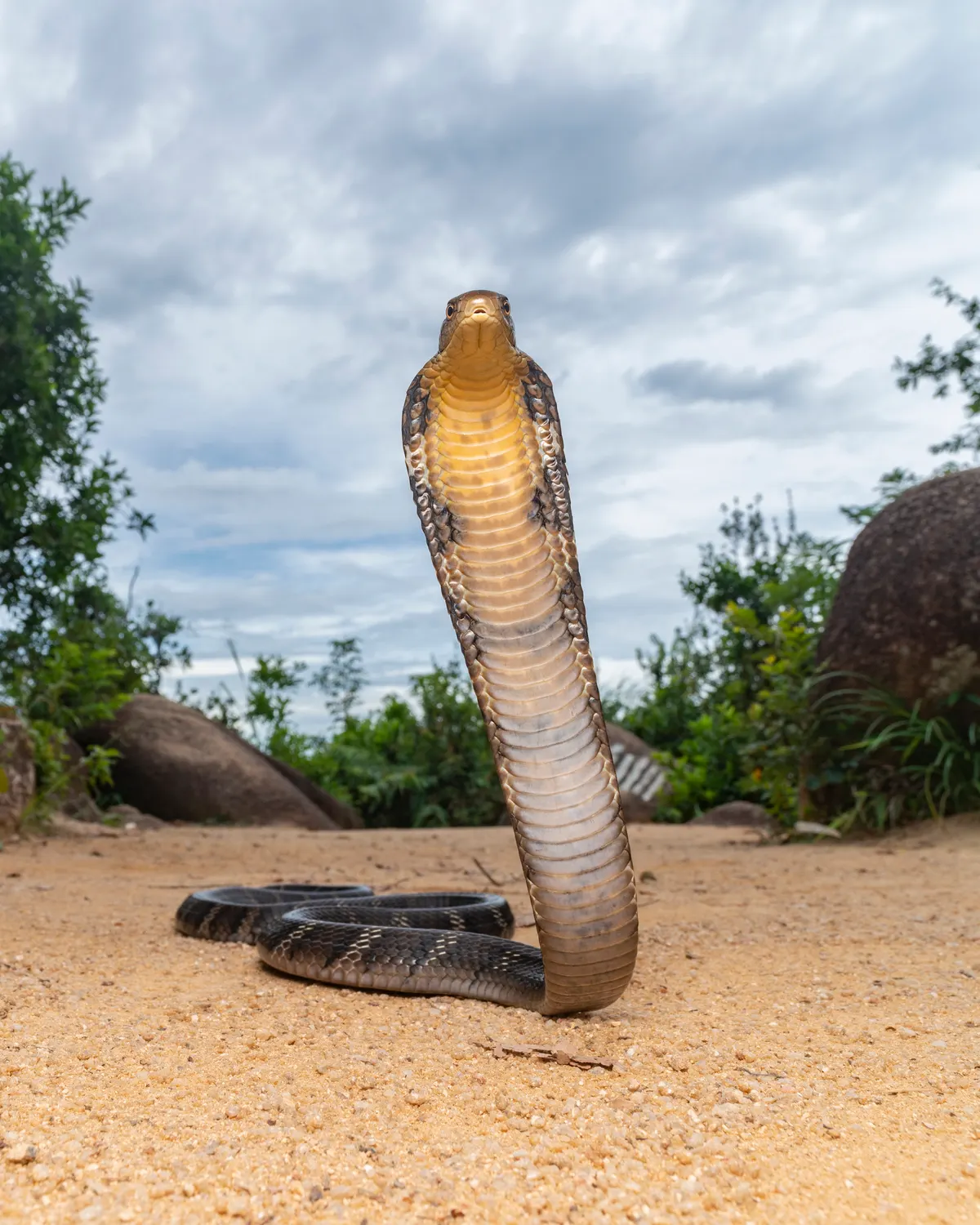
Wild king cobra rearing up with its hood raised in Hong Kong
The king cobra is the world's longest venomous snake, reaching lengths of over 5 meters (16 feet).
ReptiliaVulnerable

King Cobra Facts

The king cobra is the only snake species known to build a nest for its eggs, using coils of dead leaves and other vegetation.

The king cobra is the world's longest venomous snake, reaching lengths of 10 to 13 feet and occasionally more. It primarily eats other snakes, including venomous species, and is the only snake known to build a nest for its eggs.

By · Updated

Quick Facts

King Cobra at a glance

Ophiophagus hannahSquamataElapidae

About their home

Kind of animal

Reptilia

Where they live

What they eat

How safe?

Vulnerable

Size and speed

How heavy

6 pounds (3 kg) – 20 pounds (9 kg), with the largest individuals weighing more

How long

10 feet (3 m) – 13 feet (4 m), with a maximum verified record near 18.5 to 19 feet (5.6 to 5.85 m)

How fast

Fast-moving on the ground for a snake; also a strong, capable swimmer

Lifespan

About 20 years

Core article

King Cobra: ecology and life history

A closer look at habitat, diet, behavior, reproduction, and conservation.

Start here

King Cobra

The king cobra (Ophiophagus hannah) is the world's longest venomous snake, native to the forests of South and Southeast Asia. This carnivore is best known for a trait rare among reptiles and unique among snakes: it primarily hunts and eats other snakes, and the female builds and guards a nest for her eggs.

Taxonomy and Evolution

The king cobra belongs to the family Elapidae, the same family as true cobras, mambas, and coral snakes, but it sits in its own genus, Ophiophagus, meaning "snake-eater." Despite its common name, it is not a true cobra of the genus Naja. Genetic and morphological studies place it as a distinct lineage that diverged early from other elapids, likely as a specialization tied to its snake-eating diet.

Anatomy and Physical Characteristics

Adult king cobras typically measure 10 to 13 feet (3 to 4 m) long, with the longest verified individuals reaching close to 19 feet (5.85 m). Body weight ranges from about 6 to 20 pounds (3 to 9 kg), with the largest snakes weighing considerably more. The body is olive, brown, or black, often with faint crossbands, and the head is broad with smooth scales.

Like other elapids, king cobras deliver venom through fixed front fangs. A single bite can inject a large volume of neurotoxic venom, enough to affect the nervous system of large prey, including other snakes. When threatened, a king cobra rears the front third of its body upright, spreads a hood, and hisses or produces a low growl-like sound — a display that can bring its head to roughly eye level with an adult human.

Habitat and Distribution

Wild king cobra rearing up on the floor of a palm forest
King cobras live in forests, mangroves, and farmland across South and Southeast Asia, usually near water.

King cobras occupy dense forest across India, Nepal, Bhutan, Bangladesh, Myanmar, Thailand, China, Vietnam, Malaysia, Indonesia, the Philippines, and Hong Kong. They favor tropical and subtropical forest, often near streams, rivers, and other water sources, and also use mangroves and forest edges bordering agricultural land.

Their range spans lowland and hill forest, and they are capable swimmers, sometimes crossing rivers or entering flooded areas in search of prey or during seasonal movement.

Diet and Feeding Strategies

King cobra head raised and alert among low green vegetation
King cobras track prey by scent and hunt mainly other snakes, using potent venom to subdue them.

King cobras are ophiophagous, meaning their diet is dominated by other snakes. Prey includes venomous species such as kraits and other cobras, nonvenomous snakes, and pythons — including specimens considerably larger in girth than the king cobra itself. They also eat monitor lizards and, less often, small mammals and birds.

Hunting relies heavily on scent. A king cobra uses its forked tongue to collect chemical particles and its Jacobson's organ to detect and follow the specific scent trail of a prey snake, sometimes over long distances. Prey is subdued with a venomous bite and swallowed whole, and a large meal can sustain a king cobra for weeks between feedings.

Social Structure and Behavior

King cobra raising its head and neck off the ground in dense grass
King cobras are generally solitary and shy, raising the head and spreading a narrow hood only when threatened.

King cobras are solitary outside of breeding and nesting. They are primarily diurnal, active by day, though they may move at dusk in warmer conditions. They generally avoid contact with humans and are not aggressive by nature; most defensive encounters happen when a king cobra is cornered, startled, or protecting eggs.

Beyond climbing trees and swimming well, their most distinctive behavior is nest-building. No other snake species is known to construct a nest for its eggs — a trait that sets king cobra reproduction apart from every other snake.

Life Cycle and Reproduction

Juvenile king cobra showing bold black and yellow banding on its neck
Hatchlings are boldly banded in black and yellow and are venomous from the moment they emerge from the egg.

Breeding season generally falls between January and April, depending on region. The female builds a nest mound of leaf litter and other plant debris, then lays a clutch of typically 20 to 40 eggs inside it. She remains near the nest and guards it against predators for the roughly 60 to 90 days it takes the eggs to incubate.

Hatchlings emerge fully independent, already equipped with functional venom, and receive no further parental care after hatching. In the wild, king cobras live around 20 years.

Conservation Status and Threats

King cobra being relocated with a hook and bag near a rural home
Habitat loss and encounters near homes and farmland are among the main threats to king cobras across their range.

(Population and conservation trend data sourced from the IUCN Red List of Threatened Species)

The king cobra is classified as Vulnerable, with a decreasing population trend across its range.

Deforestation and conversion of forest to agriculture are the primary drivers of decline, reducing both habitat and the populations of prey snakes the species depends on. King cobras are also killed out of fear or in retaliation for livestock and poultry losses, and are collected for the wildlife trade in some regions. Because of their large size and specialized diet, they are more sensitive to habitat fragmentation than many smaller, more generalist snake species.

References and Authoritative Sources

King Cobra: classification and fun facts

Classification

Scientific Taxonomy
  1. Kingdom

    Animalia

  2. Phylum

    Chordata

  3. Class

    Reptilia

  4. Order

    Squamata

  5. Family

    Elapidae

  6. Genus

    Ophiophagus

  7. Species

    O. hannah

Did You Know?

Fun Facts

1

The king cobra is the only snake species known to build a nest for its eggs, using coils of dead leaves and other vegetation.

2

It is primarily ophiophagous, meaning it mainly eats other snakes, including venomous species and occasionally other king cobras.

3

It is the world's longest venomous snake, with confirmed lengths exceeding 18 feet.

4

Although its venom is not the most toxic drop-for-drop among snakes, a single bite can deliver a very large volume of venom.

5

When threatened, a king cobra can raise the front third of its body off the ground, bringing its head roughly to the eye level of an adult human.

6

Despite the genus name Ophiophagus meaning 'snake-eater,' the king cobra is not classified in the true cobra genus Naja.

Common Questions

FAQ about King Cobra

Select a question to reveal the answer.

What is a king cobra?

The king cobra (Ophiophagus hannah) is a large venomous snake native to South and Southeast Asia. It is the world's longest venomous snake and lives in dense forest habitats, often near water.

How big do king cobras get?

Adult king cobras typically measure 10 to 13 feet (3 to 4 m) long. The longest verified individuals have reached close to 19 feet (5.85 m), making it the longest venomous snake in the world.

Is the king cobra the most venomous snake?

No. Its venom is not the most toxic drop-for-drop compared with many other venomous snakes. What makes a king cobra bite dangerous is the large volume of venom it can inject in a single strike, combined with its size and reach.

What do king cobras eat?

King cobras are carnivores that primarily eat other snakes, including venomous species such as kraits and other cobras, as well as pythons. They occasionally eat monitor lizards, small mammals, and birds.

Do king cobras really build nests?

Yes. The king cobra is the only snake species known to build a nest for its eggs. The female gathers leaf litter and vegetation into a mound, lays her eggs inside, and guards the nest until the eggs hatch.

Where do king cobras live?

King cobras live across South and Southeast Asia, including India, Thailand, Vietnam, Indonesia, Malaysia, Myanmar, and the Philippines. They favor dense forest, often near streams and rivers, but also occur in mangroves and agricultural edges.

Show 2 more questionsExpand
Are king cobras aggressive toward humans?

King cobras generally avoid humans and are not naturally aggressive. Most defensive displays and bites occur when a king cobra is cornered, surprised, or guarding a nest.

Are king cobras endangered?

King cobras are listed as Vulnerable by the IUCN, with a decreasing population trend driven mainly by habitat loss, deforestation, and conflict with humans.