Ball Python Facts
"Ball pythons are also called royal pythons."
Ball pythons are calm African snakes with beautiful patterns. When frightened, they curl into a tight ball—and mothers coil around eggs to keep them warm.
Loading page content

"Ball pythons are also called royal pythons."
Ball pythons are calm African snakes with beautiful patterns. When frightened, they curl into a tight ball—and mothers coil around eggs to keep them warm.
Python regiusSquamataPythonidae
Explore ball python photos organized for learning and classroom observation.
Click any photo to view it larger. 8 images available.
Core article
Habitat, diet, behavior, and more — everything on one page.
The ball python (Python regius), often referred to as the royal python, is a robust, beautifully patterned constrictor endemic to the savannas and forest edges of West and Central Africa. Known for its docile temperament and highly specialized defensive posture, this moderately sized snake is a master of terrestrial and semi-arboreal ambush hunting. Operating under the cover of darkness, it relies on advanced thermal imaging and chemosensory organs to track warm-blooded prey through the dense African undergrowth.
Classified within the kingdom Animalia, phylum Chordata, and class Reptilia, the ball python belongs to the order Squamata, which encompasses all scaled reptiles (snakes and lizards). Within the family Pythonidae, it is designated under the genus Python as Python regius. The specific epithet regius translates to "royal." Historically, African royalty—most notably purportedly Cleopatra—were said to wear these small, docile pythons around their wrists as living jewelry. The common name "ball python" stems from its primary defensive behavior of coiling tightly into a spherical shape when threatened.
Evolutionarily, pythons are considered relatively basal (primitive) snakes. Unlike more highly derived snakes (such as vipers or colubrids), pythons still retain vestigial remnants of their evolutionary past. Just near their cloaca, ball pythons possess two small "pelvic spurs," which are the reduced, vestigial remnants of the hind legs their lizard-like ancestors possessed millions of years ago.
The ball python is one of the smallest species of African pythons. They exhibit sexual dimorphism in size; mature females are generally larger and heavier, measuring between 4 and 5 feet in length, while males typically max out around 3 to 4 feet. Their bodies are remarkably stocky and muscular, built for immense constriction pressure rather than speed, weighing between 3 and 5 pounds.
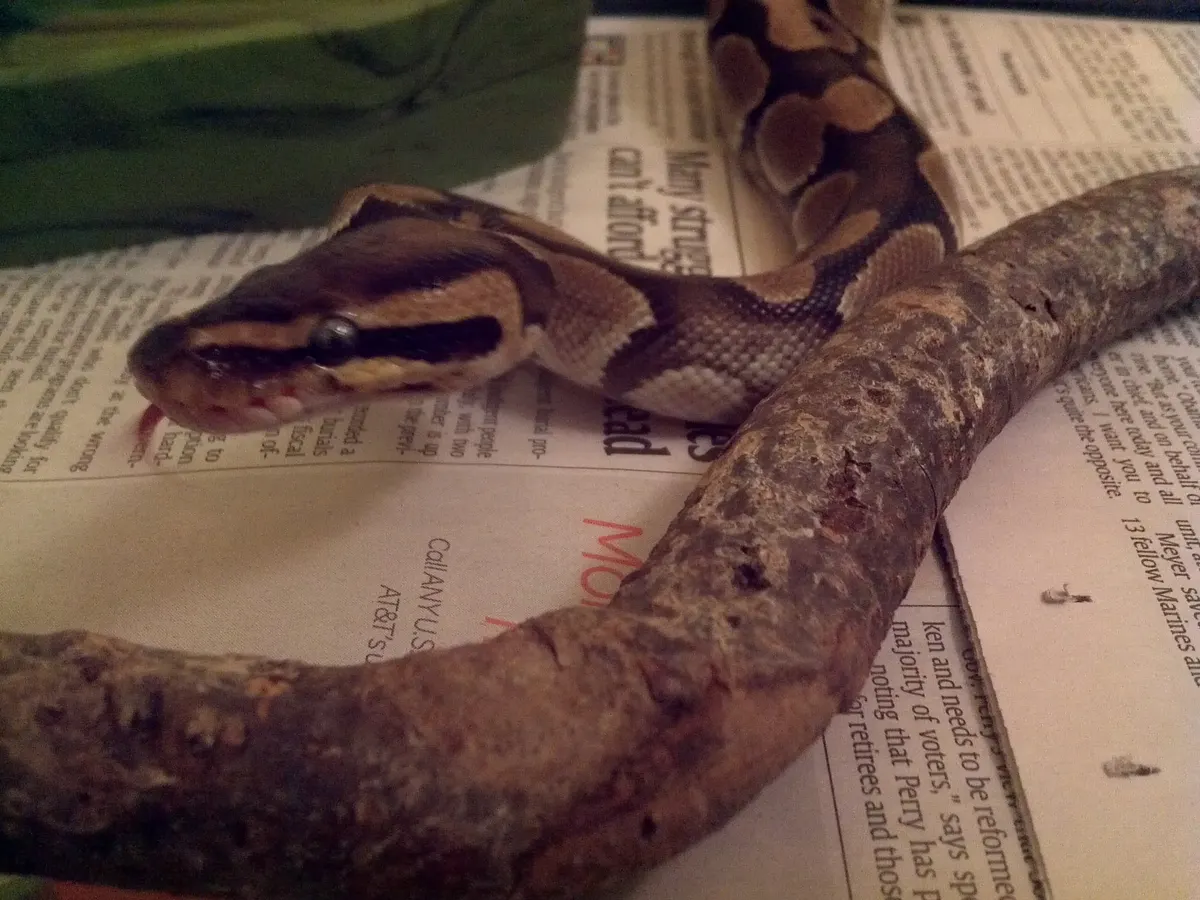
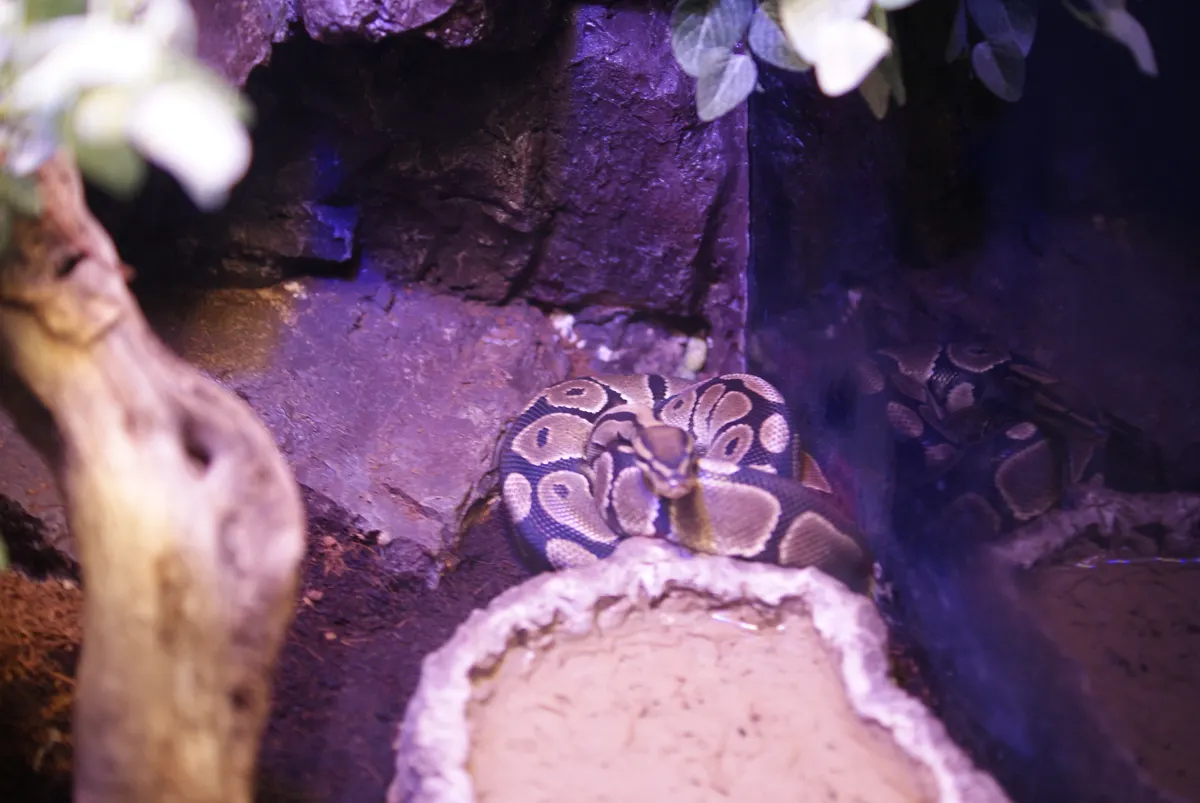
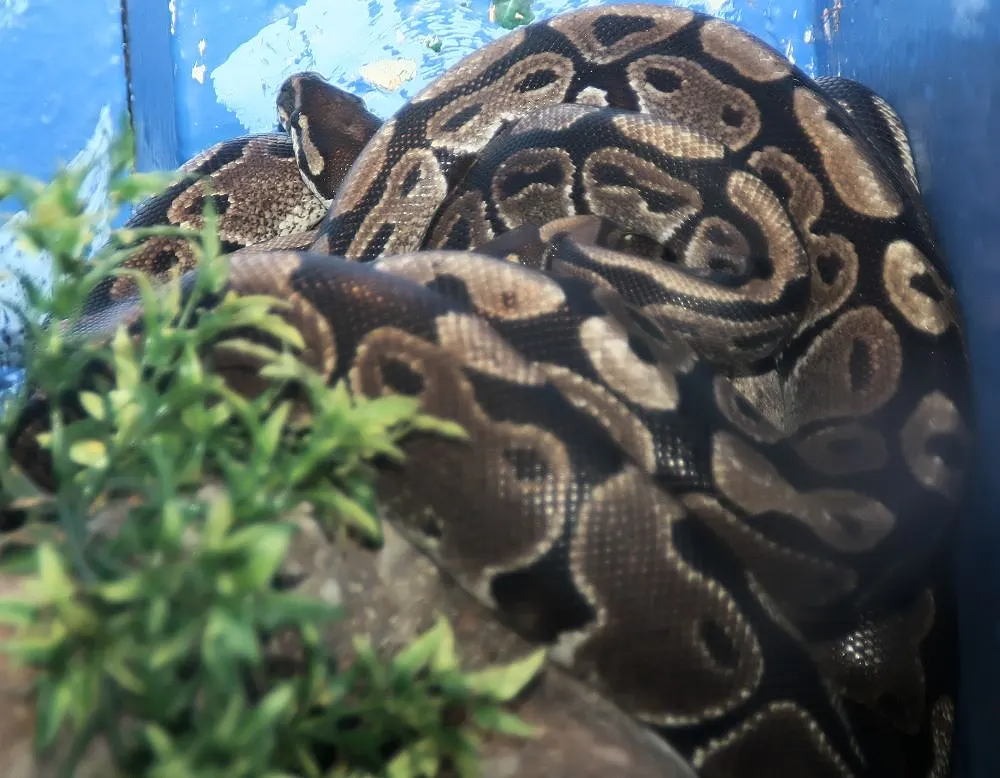
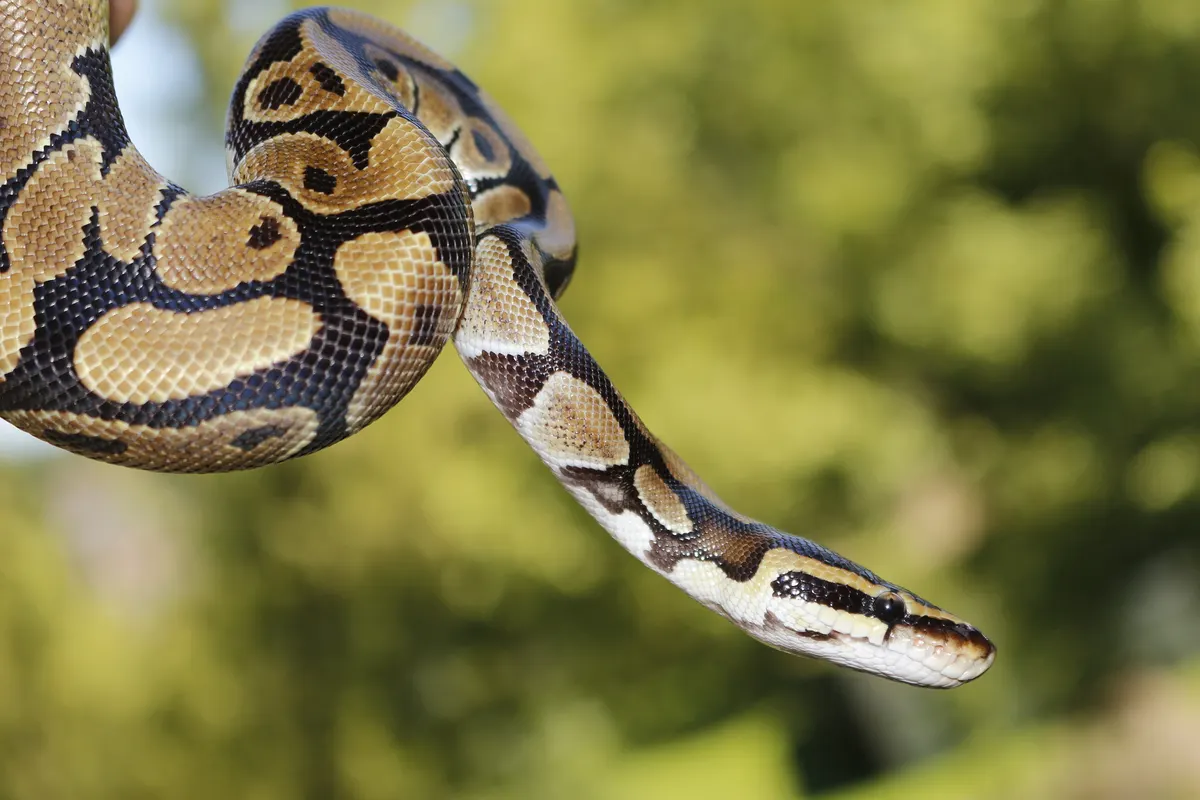
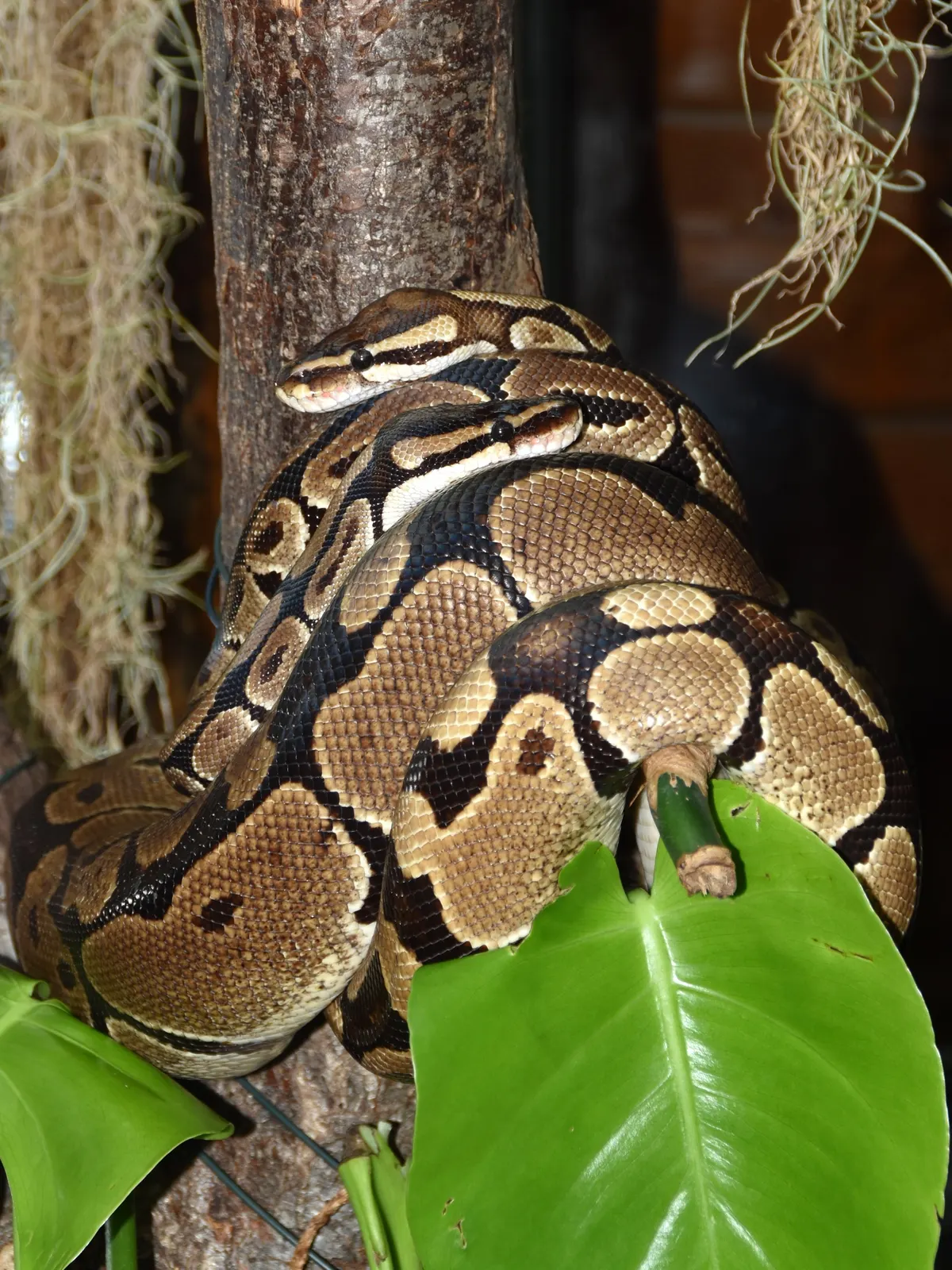
Their natural (wild-type) coloration is a highly effective camouflage mechanism. The dorsum features a dark brown to black base adorned with asymmetrical, light brown or golden blotches, while the ventral surface is typically pale white. This disruptive coloration allows them to vanish seamlessly into the dappled light of the forest floor or dried savanna grasses.
A defining anatomical feature is their array of heat-sensing labial pits. Located along their upper lip (maxilla), these pits are densely packed with thermoreceptors capable of detecting the infrared radiation (body heat) emitted by mammalian prey, allowing them to construct a "thermal image" of their surroundings in absolute darkness. Additionally, they rely heavily on their vomeronasal organ (Jacobson's organ). By constantly flicking their forked tongues, they collect chemical scent particles from the air and deliver them to this organ on the roof of their mouth, effectively "tasting" the presence of prey or predators.

The ball python is distributed extensively across sub-Saharan West and Central Africa. Their geographic range spans from Senegal, Mali, and Guinea in the west, through Ivory Coast, Ghana, Togo, Benin, and Nigeria, extending east into Cameroon, the Central African Republic, Uganda, and Sudan.
They are highly adaptable but show a strong preference for open savannas, dry scrublands, grasslands, and the ecotones where open plains transition into dense gallery forests. They generally avoid deep, closed-canopy rainforests. They are largely terrestrial but exhibit semi-arboreal tendencies, frequently climbing low bushes and trees to hunt avian prey or escape ground predators. During the intense heat of the African day, they shelter in subterranean rodent burrows, hollow logs, or large termite mounds to maintain thermoregulation and avoid desiccation.

As strict carnivores, ball pythons are nocturnal ambush predators. Their diet in the wild consists predominantly of small mammals, including African soft-furred rats, gerbils, shrews, and jerboas. However, male ball pythons, being smaller and more arboreally inclined, often consume a higher percentage of small birds and nestlings.
The hunting sequence of a ball python is a fascinating example of evolutionary engineering. Lying perfectly still in the underbrush, the python uses its thermal pits and Jacobson's organ to detect approaching prey. When a rodent moves within striking distance, the snake launches a high-velocity strike, sinking its numerous rows of sharp, rear-facing recurved teeth into the prey.
Ball pythons are non-venomous constrictors. Immediately after the strike, they throw powerful coils of their muscular body around the prey. Contrary to popular belief, they do not crush the prey's bones or suffocate it by preventing breathing. Instead, the immense constriction pressure rapidly overwhelms the prey's circulatory system, stopping the heart and inducing immediate cardiac arrest. Once the prey is dead, the snake utilizes its highly kinetic skull—featuring lower jaws that are not fused at the chin and highly elastic ligaments—to stretch its mouth open incredibly wide and swallow the prey whole, usually head-first.

Ball pythons are solitary reptiles, interacting with conspecifics only during the breeding season. They are notoriously shy and retiring.
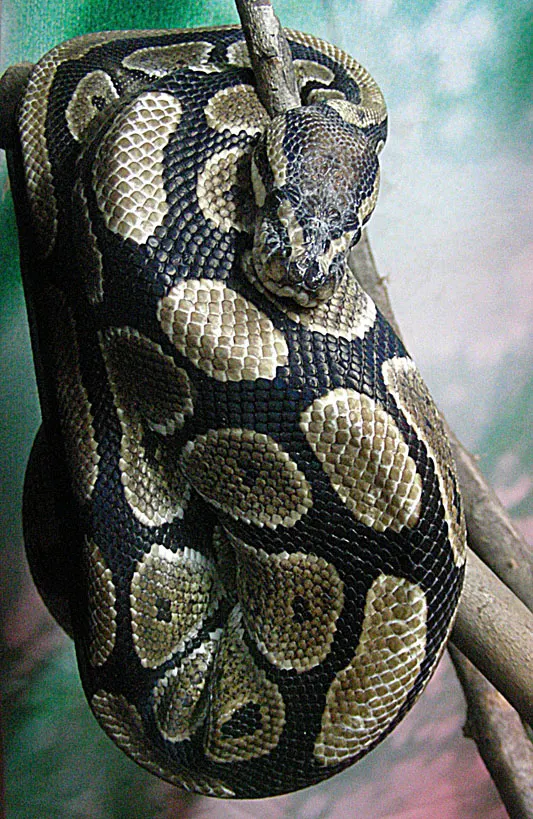
Their most famous behavior is their defensive strategy. When confronted by a predator—such as a large raptor, a monitor lizard, or a mammal—the ball python rarely attempts to bite. Instead, it tightly coils its body into a compact, impregnable sphere, tucking its vulnerable head securely in the center of the coils. In this state, it can literally be rolled across the ground like a ball.
Like all snakes, the ball python undergoes ecdysis (shedding). As they grow, their rigid outer layer of keratinized skin does not expand. To accommodate growth and remove external parasites, the snake secretes a fluid between the old and new skin layers, causing its eyes to temporarily cloud over (turn "blue"). It then rubs its snout against a rough surface to split the old skin and crawls completely out of it, leaving behind a continuous, inside-out shed.

Reproduction is closely tied to the African wet and dry seasons. Following successful copulation, the female undergoes a significant physiological change, seeking out a secure, humid subterranean burrow to lay her eggs.
The female ball python lays a relatively small clutch of 4 to 10 large, leathery eggs. Unlike the vast majority of reptiles, which deposit their eggs and abandon them, the female ball python exhibits intense maternal brooding. She coils her body tightly around the clutch for the entire two-month incubation period. By aggressively protecting them from predators and utilizing maternal thermogenesis—rhythmically shivering her muscles to generate body heat—she carefully regulates the incubation temperature.
She does not eat during this entire period, losing a significant portion of her body weight. Once the eggs hatch, her maternal duties conclude, and the 10-to-16-inch neonate hatchlings are entirely independent, equipped with venomless fangs and the instinct to hunt immediately. Wild ball pythons typically live 10 to 15 years, while captive specimens can exceed 30 years.
(Population and conservation trend data sourced from the IUCN Red List of Threatened Species)
The ball python is currently listed as Near Threatened on the IUCN Red List, with wild populations in a state of continuous decline.
The greatest threat facing Python regius is extreme overexploitation for the international pet trade. For decades, hundreds of thousands of wild-caught ball pythons have been exported annually from West Africa. While captive breeding has become common, massive numbers of wild individuals are still extracted from their habitats.
Additionally, they face severe habitat degradation as vast tracts of African savanna are converted into agricultural fields for cash crops. In some local regions, they are hunted for their meat or killed out of an irrational fear of snakes. However, in certain cultures, notably among the Igbo people of southeastern Nigeria, the ball python is deeply revered as a sacred animal and symbol of the earth, where it is strictly protected by local taboos against harming them.
Ball pythons are also called royal pythons.
They are non-venomous constrictors.
When scared, they curl into a ball with the head tucked inside.
Females coil around eggs and shiver to warm them.
Snakes smell with their tongue flicking in the air.
Ball pythons shed their skin as they grow.
Select a question to reveal the answer.
A ball python is a non-venomous snake from Africa known for curling into a ball when frightened.
Ball pythons live in grasslands, savannas, and forest edges in West and Central Africa.
Ball pythons eat rodents, small birds, and other small mammals. They swallow prey whole.
No. Ball pythons are constrictors and do not have venom.
It curls its body into a tight ball when threatened, hiding its head in the center.
Yes. Snakes are reptiles with scaly skin and they lay eggs or give birth to live young depending on the species.
Ball pythons are listed as Near Threatened because of habitat loss and collection for the pet trade.