Quokka sitting alert among shrubs on Rottnest Island
Quokkas are small macropods famous for their calm, rounded faces on Rottnest Island.
MammaliaVulnerable

Quokka Facts

Quokkas are the only living species in the genus Setonix.

The quokka is a small herbivorous marsupial endemic to southwestern Australia. About the size of a house cat, it browses dense forest and island scrub and raises joeys in a pouch.

By · Updated

Quick Facts

Quokka at a glance

Setonix brachyurusDiprotodontiaMacropodidae

About their home

Kind of animal

Mammalia

Where they live

What they eat

How safe?

Vulnerable

Size and speed

How heavy

5.5 pounds – 11 pounds

How long

16 inches – 21 inches

How fast

Short hops through dense cover; not built for open-plains speed

Lifespan

About 10 years

Core article

Quokka: ecology and life history

A closer look at habitat, diet, behavior, reproduction, and conservation.

Start here

Quokka

The quokka (Setonix brachyurus) is a compact marsupial about the size of a house cat, endemic to southwestern Australia. It browses dense forest undergrowth and island scrub, hides by day, and raises a single joey in a forward-opening pouch. Tourists know its rounded, "smiling" face from Rottnest Island photos; biologists know it as a Vulnerable specialist of thick cover.

A Small Wallaby, Not a Miniature Kangaroo

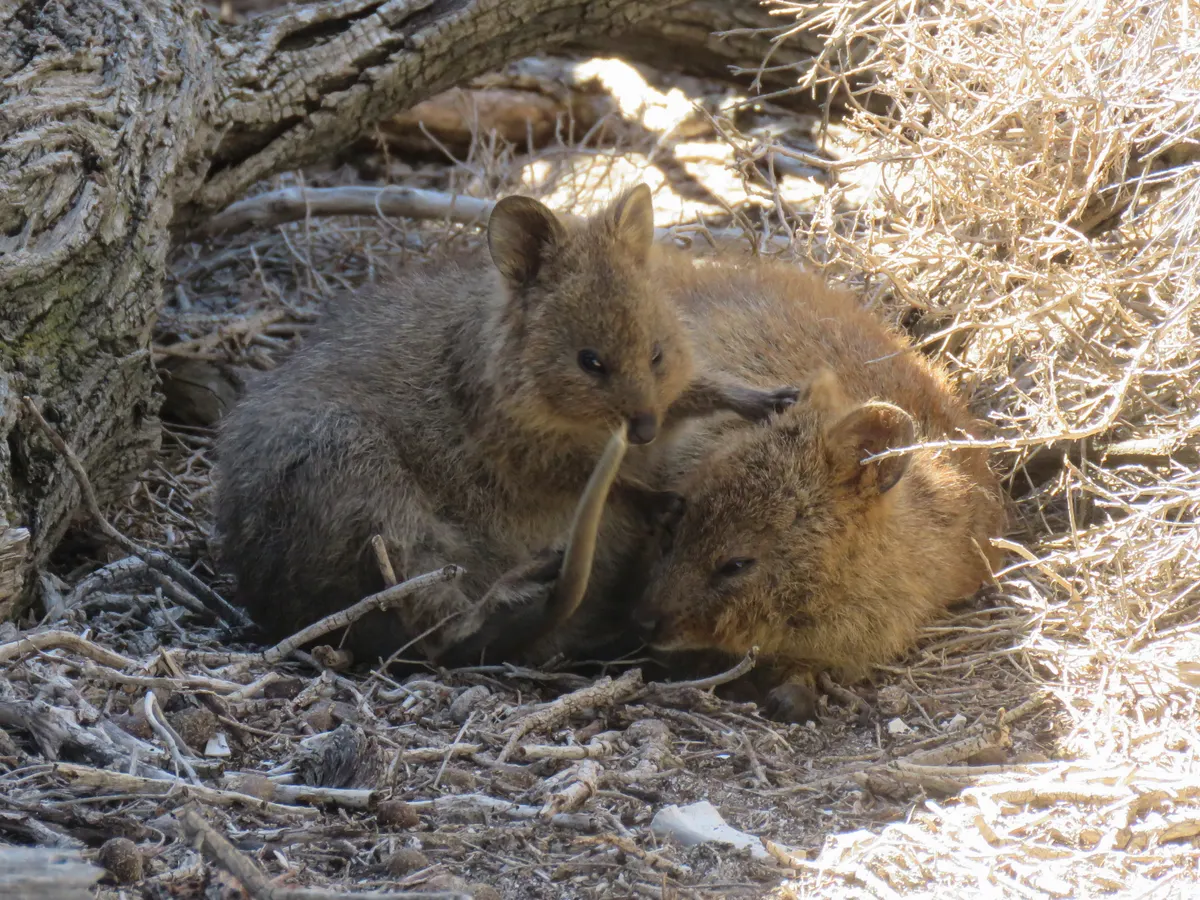
Adults are 16 to 21 inches in body length with a short tail and weigh about 5.5 to 11 pounds, in coarse brown-gray fur that blends into leaf litter and coastal scrub. Powerful hind legs provide the hop while the forepaws grasp stems, and small rounded ears and a blunt muzzle create the famous "smile" — a resting posture, not an emotion, and no reliable sign that a crowded or cornered animal is relaxed. Females carry a pouch that cradles the joey until it can hop alongside. Quokkas belong to the kangaroo family Macropodidae and are the only species in the genus Setonix; better understood as a small, specialized wallaby relative than a mini kangaroo, they evolved short proportions and brief hops for tangled vegetation rather than the long-striding, tail-propped travel of big kangaroos across open plains. A large forestomach ferments low-quality browse with microbes, and they can even climb low shrubs to reach leaves.

Where Quokkas Live

Quokka moving through coastal scrub habitat on Rottnest Island
Dense shrubs give shade, shelter, and plant food on predator-free islands.

Quokkas are restricted to the southwestern corner of Australia. Mainland animals keep to jarrah forest, heath, and dense thickets — especially moist riparian vegetation, swamps, and gullies that hold water through summer — while island populations on Rottnest and Bald Island use coastal scrub and dune vegetation. By day they rest in nests of flattened plants, emerging at dusk to forage along the edges of cover. Islands without foxes support unusually high numbers, a reminder that habitat structure and predator pressure decide where quokkas persist; intense fire is especially damaging when it strips both forage and the dense refuge they need to escape foxes and cats, and recovery is hard where roads and farmland separate surviving pockets.

What Quokkas Eat

Quokka standing near low vegetation suitable for browsing
Leaves, grasses, and succulent stems supply water as well as calories.

Quokkas are herbivores that eat grasses, herbs, leaves, stems, succulent shrubs, and occasional bark, browsing selectively to follow the fresh flush after rain and turning to tougher perennials and leaves in drier periods. They chew thoroughly and feed close to escape cover, and because much of their water comes from foliage, healthy plant communities matter as much as standing pools. Human food is not a harmless supplement: bread, chips, and sweets don't match the high-fiber plants their gut is built for, and hand-feeding draws animals toward roads and crowds — keeping food sealed and letting quokkas choose their own forage protects both their digestion and their normal movement.

Behavior: Solitary Browsers of Thick Cover

Quokka mother with pouch joey showing macropod family care
Outside mating and pouch care, adults often forage alone or in loose groups.

Quokkas are mostly solitary or loosely aggregated where food is rich, several sharing a feeding area without forming stable herds, and they hold overlapping activity ranges organized by scent marks and well-used runways rather than defended territories. Alarmed, a quokka hops into thick vegetation rather than sprinting across the open, and it is chiefly nocturnal and crepuscular to dodge daytime heat. On predator-free islands they can seem unusually tame — an artifact of safety and habituation, not an invitation to approach mainland animals. Communication runs to soft calls between mothers and young and harsher sounds in conflict, with males competing briefly for females.

Life Cycle: One Joey and Embryonic Diapause

Young quokka joey visible beside its mother on Rottnest
Joeys graduate from permanent pouch life to short ground trips, then full independence.

After about a month of pregnancy a tiny joey crawls into the pouch and attaches to a teat, developing there for months before it starts leaving and re-entering while learning to browse; usually just one is raised at a time. As in many macropods, a female can mate soon after giving birth and hold the new embryo in a paused state — embryonic diapause — while the older joey occupies the pouch, timing the next young to her capacity to support it. Females on Rottnest may breed through much of the year, while mainland births track seasons with better forage. Wild lifespan is often around a decade, but low reproductive output means populations recover slowly after fire, drought, or predation spikes.

Conservation: Vulnerable Beyond the Tourist Island

Map highlighting remaining quokka populations in southwestern Australia
Mainland numbers are patchy; islands hold some of the best-known populations.

The quokka is Vulnerable with a decreasing trend across much of the mainland. Introduced foxes and cats, hot wildfires, habitat clearing, and disease all shrink and isolate groups, and the large, visible Rottnest population makes the species look more secure than it is: mainland groups are smaller and fragmented, while concentrating so many animals on one island carries its own risk from disease, drought, or a single major fire. Climate change is expected to intensify drying and extreme fire weather in southwestern Australia, eroding the moist refuges mainland animals depend on. Conservation combines fox and cat control, camera and genetic surveys, mosaic-retaining prescribed fire, and enforcement of no-feeding rules and waste management on visitor islands.

References and Authoritative Sources

Quokka: classification and fun facts

Classification

Scientific Taxonomy
  1. Kingdom

    Animalia

  2. Phylum

    Chordata

  3. Class

    Mammalia

  4. Order

    Diprotodontia

  5. Family

    Macropodidae

  6. Genus

    Setonix

  7. Species

    S. brachyurus

Did You Know?

Fun Facts

1

Quokkas are the only living species in the genus Setonix.

2

Their resting face muscles can look like a smile in photos.

3

Rottnest Island holds one of the densest wild populations.

4

Mainland quokkas hide in thick forest undergrowth by day.

5

A joey may leave and re-enter the pouch for weeks during weaning.

6

They get much of their water from the plants they eat.

Common Questions

FAQ about Quokka

Select a question to reveal the answer.

What is a quokka?

A quokka is a small marsupial in the kangaroo family (Macropodidae). It lives only in southwestern Australia and is about the size of a domestic cat.

Where do quokkas live?

They live in dense forest, coastal scrub, and island thickets in Western Australia, including Rottnest Island and nearby mainland patches.

What do quokkas eat?

Quokkas are herbivores. They browse grasses, leaves, stems, herbs, and succulent shrubs, often feeding at dusk and night.

Why do quokkas look like they smile?

Quokkas do not smile for cameras. The shape of their snout and cheek muscles simply looks grin-like when they rest or chew.

What is a baby quokka called?

A baby quokka is a joey. After a short pregnancy, the tiny joey climbs into the mother’s pouch and stays there for months.

Are quokkas endangered?

The species is listed as Vulnerable. Predators, fire, and habitat loss reduce many mainland populations.

Show 2 more questionsExpand
Are quokkas related to kangaroos?

Yes. Quokkas are macropods, the same family as kangaroos. Other Australian marsupials on this site include koalas and wombats.

Can you touch or feed quokkas?

On Rottnest Island, touching or feeding wildlife is illegal and harmful. Photos from a respectful distance keep animals wild and safe.