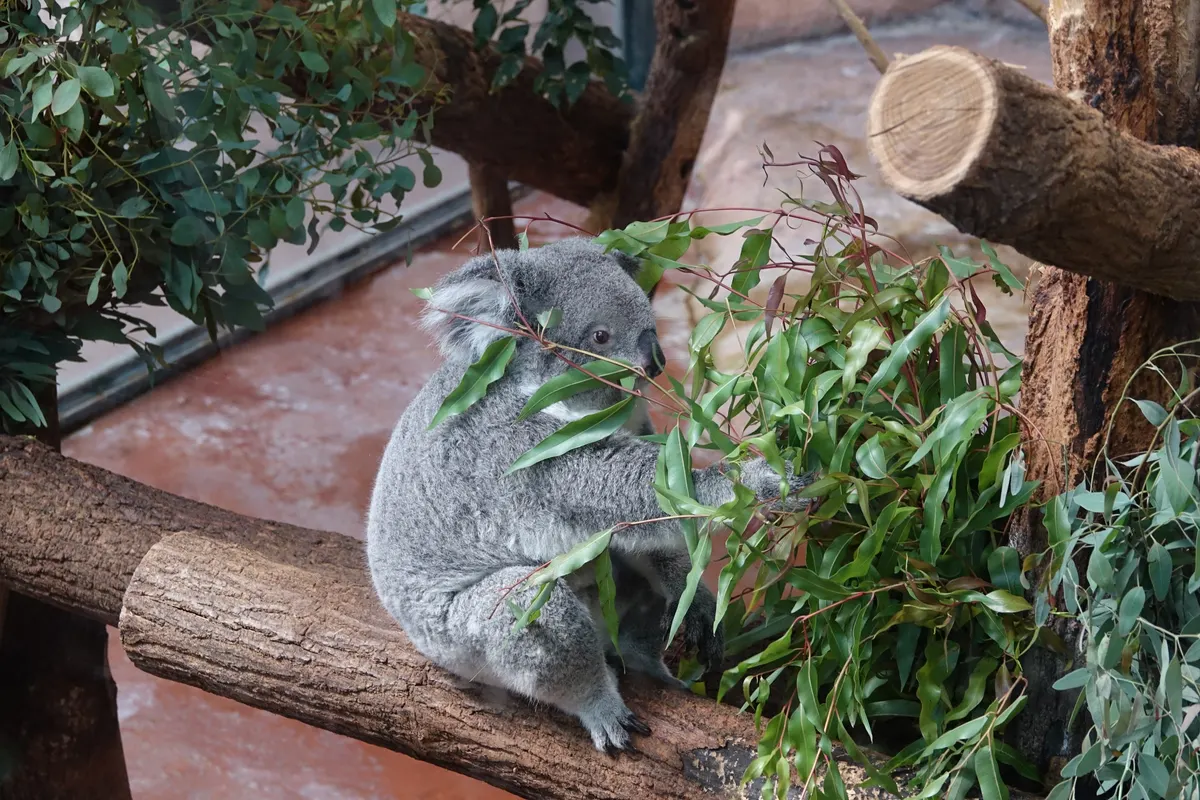
Koala resting on a tree branch
Koalas are tree-dwelling marsupials famous for their fluffy ears and sleepy lifestyle.
MammaliaVulnerable

Koala Facts

Koalas are marsupials, not bears, even though people sometimes call them koala bears.

Koalas are sleepy tree-dwelling marsupials from Australia. They eat eucalyptus leaves, carry joeys in a pouch, and spend most of the day resting in branches.

By · Published · Updated

Quick Facts

Koala at a glance

Phascolarctos cinereusDiprotodontiaPhascolarctidae

About their home

Kind of animal

Mammalia

Where they live

What they eat

How safe?

Vulnerable

Size and speed

How heavy

9 pounds – 30 pounds

How long

2 feet – 3 feet

How fast

Slow on ground; agile climber in trees

Lifespan

10 to 14 years

Core article

Koala: ecology and life history

A closer look at habitat, diet, behavior, reproduction, and conservation.

Start here

Koala Facts: The Iconic Marsupial of the Eucalyptus Canopy

The koala (Phascolarctos cinereus) is a tree-dwelling marsupial of eastern and southern Australia, known for its stout, tailless body, big ears, and spoon-shaped nose. Despite the nickname "koala bear," it is not a bear at all — its closest relative is the wombat — and almost everything about it is built around one demanding job: living on eucalyptus leaves, which are tough, low in energy, and laced with toxins. That diet explains its slow metabolism, its long sleeps, and even the strange way it raises its young.

A Body Built to Live on Toxic Leaves

The koala's body is tuned for the eucalyptus canopy. Strong, muscular forelimbs and long curved claws grip branches, and the front paws have two opposable digits that work like a second thumb for a secure hold. Thick ashy-grey fur insulates against heat and cold, and an especially dense pad of fur on the rump cushions the animal through the many hours it sits wedged in a branch fork. Its eyesight is poor, so it leans on a large, leathery nose to sort palatable leaves from dangerously toxic ones. Internally, the defining feature is a huge caecum — a fermentation chamber up to two metres long where symbiotic microbes break down fibre and neutralise the leaves' oils and toxins.

Where Koalas Live

Koala resting among eucalyptus branches
Eucalyptus trees provide food, shade, and safe perches high above the ground.

Koalas are found only in Australia, across Queensland, New South Wales, Victoria, and South Australia, in eucalyptus forests and woodlands from tall coastal forest to inland and semi-arid country, often near watercourses where the foliage holds more moisture. They are famously fussy: of more than 700 eucalyptus species, koalas rely on fewer than 50, with strong regional preferences for just a handful of trees.

A Diet of Poison: Why Koalas Sleep 20 Hours a Day

Wild koala feeding on eucalyptus leaves in a tree
Koalas have special bacteria in their gut that help digest tough eucalyptus leaves.

A koala is a folivore with one of the most challenging diets of any mammal, eating about 1 to 1.5 pounds of eucalyptus leaves a day. Those leaves are high in indigestible fibre, low in calories, and full of toxic compounds, so the koala extracts very little usable energy from them. Its response is rigorous energy conservation: an exceptionally low metabolic rate and 18 to 22 hours a day spent sleeping or resting motionless. It also gets most of its water straight from the leaves — the name "koala" comes from a Dharug word meaning "no drink" — and rarely needs to come down to find water.

Behavior: Solitary, Territorial, and Loud

Koala mother with joey peeking from her fur
Joeys are born tiny and finish growing inside the mother's backward-opening pouch.

Koalas are mostly solitary and territorial, each holding a home range sized to the local food trees, and they avoid contact outside the breeding season even where ranges overlap. Communication is by scent and sound: males rub a large scent gland on the chest against tree trunks to mark territory, and in the breeding season give a surprisingly deep, resonant bellow — amplified by an extra set of vocal folds outside the larynx — to assert dominance and attract females.

Life Cycle: Pouch Life and "Pap" Feeding

Young koala joey riding on its mother's back
After leaving the pouch, joeys cling to their mother's back while learning to climb.

After a gestation of only about 35 days, a single joey is born weighing under a gram — blind, hairless, and jellybean-sized — and climbs unaided into the mother's backward-opening pouch, where it latches to a teat for roughly six months on milk alone. Before it can handle toxic leaves, the mother produces a special soft faeces called "pap," which the joey eats directly from her — a crucial step that seeds its gut with the microbes needed to ferment and detoxify eucalyptus. The joey then rides on her back until about a year old. Wild koalas live 10 to 14 years.

Conservation: Now Endangered in Much of Its Range

Koala resting in a eucalyptus tree canopy
Koalas are listed as Vulnerable because of habitat loss, disease, and bushfires.

The koala's status has worsened fast. The IUCN now lists it as Vulnerable, and Australia has declared the Queensland, New South Wales, and ACT populations Endangered, with numbers falling steeply. Land clearing for agriculture and cities fragments habitat and cuts off food; drought dries out the leaves koalas drink from; and the 2019–2020 "Black Summer" bushfires killed an estimated 60,000 koalas. Disease compounds it all — chlamydia causes blindness and infertility, and the koala retrovirus (KoRV) suppresses the immune system — while shrinking habitat forces koalas across roads and into dogs.

References and Authoritative Sources

Koala: classification and fun facts

Classification

Scientific Taxonomy
  1. Kingdom

    Animalia

  2. Phylum

    Chordata

  3. Class

    Mammalia

  4. Order

    Diprotodontia

  5. Family

    Phascolarctidae

  6. Genus

    Phascolarctos

  7. Species

    P. cinereus

Did You Know?

Fun Facts

1

Koalas are marsupials, not bears, even though people sometimes call them koala bears.

2

A koala's diet is almost all eucalyptus leaves, which are tough and low in calories.

3

Koalas sleep up to 20 hours a day to save energy.

4

Joeys are born tiny and finish growing inside the mother's pouch.

5

A koala's big nose helps it sniff out the freshest eucalyptus leaves.

6

Each koala often prefers certain eucalyptus tree species in its home range.

Common Questions

FAQ about Koala

Select a question to reveal the answer.

What is a koala?

A koala is a tree-dwelling marsupial from Australia that eats eucalyptus leaves and raises its young in a pouch.

Are koalas bears?

No. Koalas are marsupial mammals, not bears. People sometimes use the nickname koala bear, but they are not related to bears.

Where do koalas live?

Wild koalas live in eucalyptus forests and woodlands along the eastern and southeastern coast of Australia.

What do koalas eat?

Koalas are herbivores that eat mainly eucalyptus leaves. They rarely drink much water because leaves provide moisture.

What is a baby koala called?

A baby koala is called a joey. Joeys grow in the mother's pouch before riding on her back.

Why do koalas sleep so much?

Eucalyptus leaves are hard to digest and low in energy, so koalas rest for many hours to save strength.

Show 1 more questionsExpand
Are koalas endangered?

Koalas are listed as Vulnerable. Habitat loss, disease, dog attacks, and bushfires threaten wild populations.