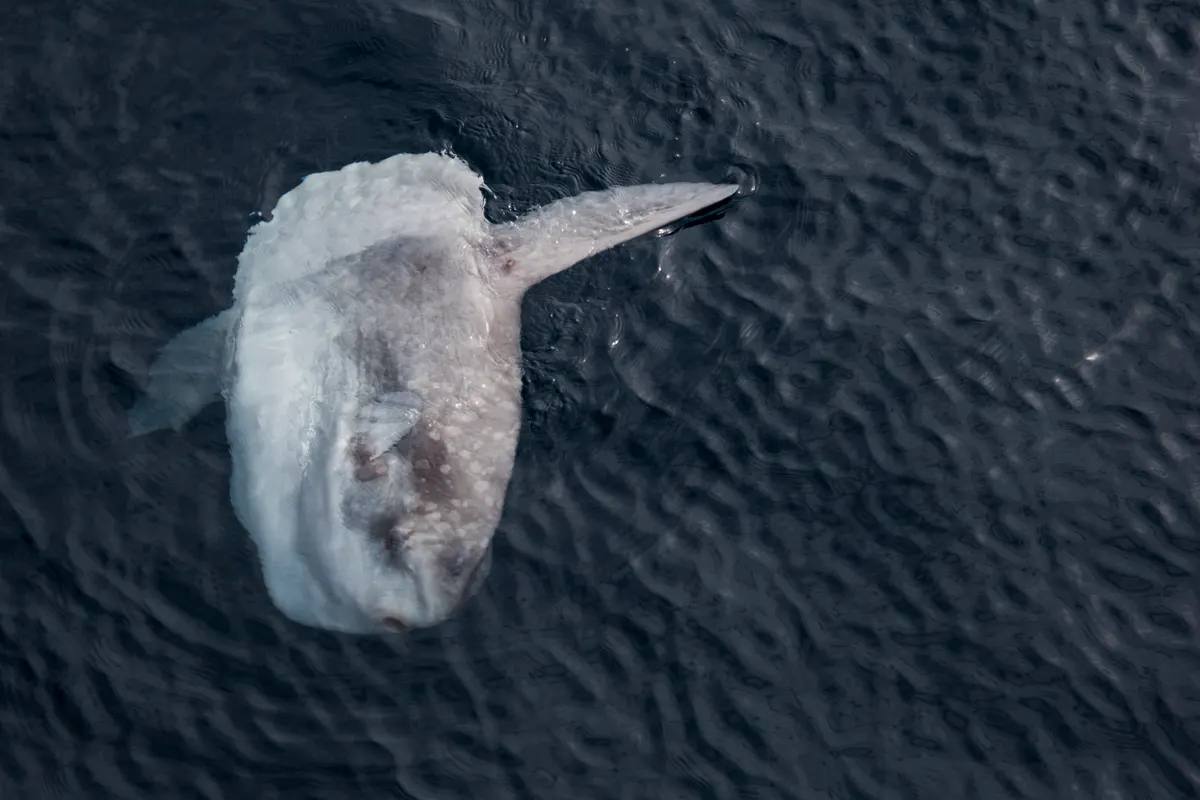
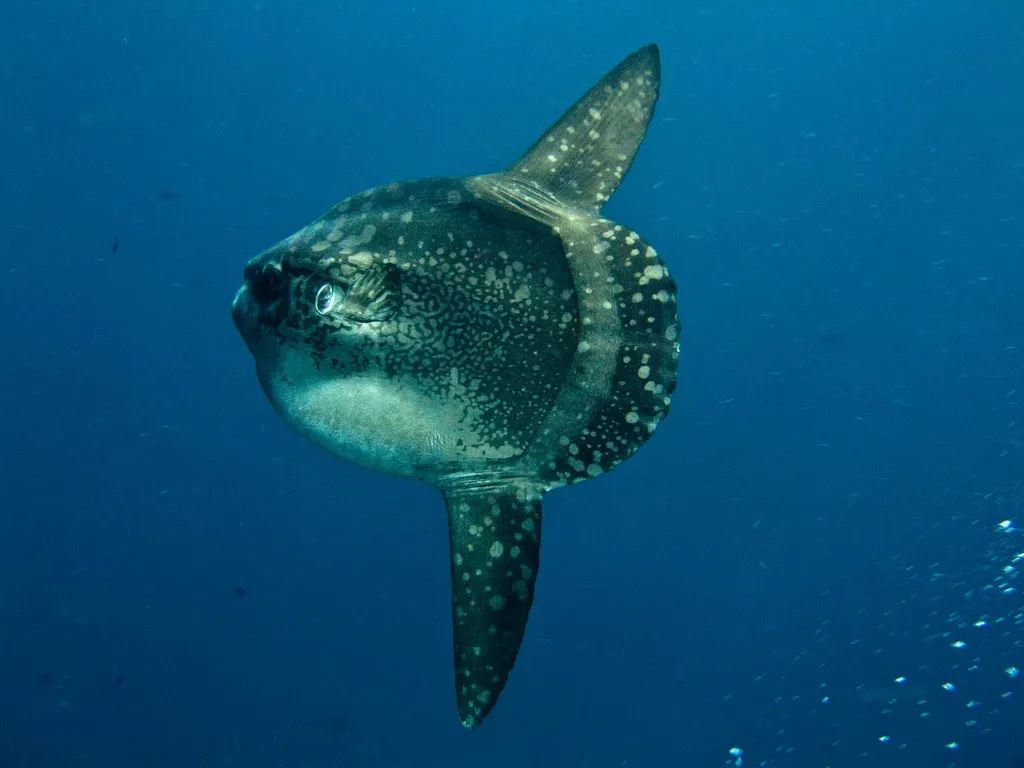
The sunfish's most obvious feature is what it lacks — a proper tail fin. Over evolutionary time its ancestors lost the rear vertebrae and caudal fin, and the back edge of the body became a stiff, scalloped rudder called the clavus, formed from modified dorsal and anal fin rays. Thrust comes almost entirely from beating the tall dorsal and anal fins together, top and bottom.
Other oddities follow from its lifestyle. It has no functional swim bladder, unusual for a bony fish that dives through great changes in depth. It has no scales; instead a thick, leathery, elastic skin — up to three inches deep and coated in mucus — covers the body. And like its pufferfish relatives (both are in the order Tetraodontiformes), its teeth are fused into a rigid, beak-like plate it cannot fully close, suited to shredding soft prey. Large individuals reach roughly 6 to 10 feet across and can weigh well over 2,000 pounds, though the biggest records are exceptional rather than typical.