
Ocean life
Why Do Ocean Sunfish Look So Strange?
An ocean sunfish looks unfinished only if you expect every fish to have a long tail.
By An Nguyen · Published · Updated
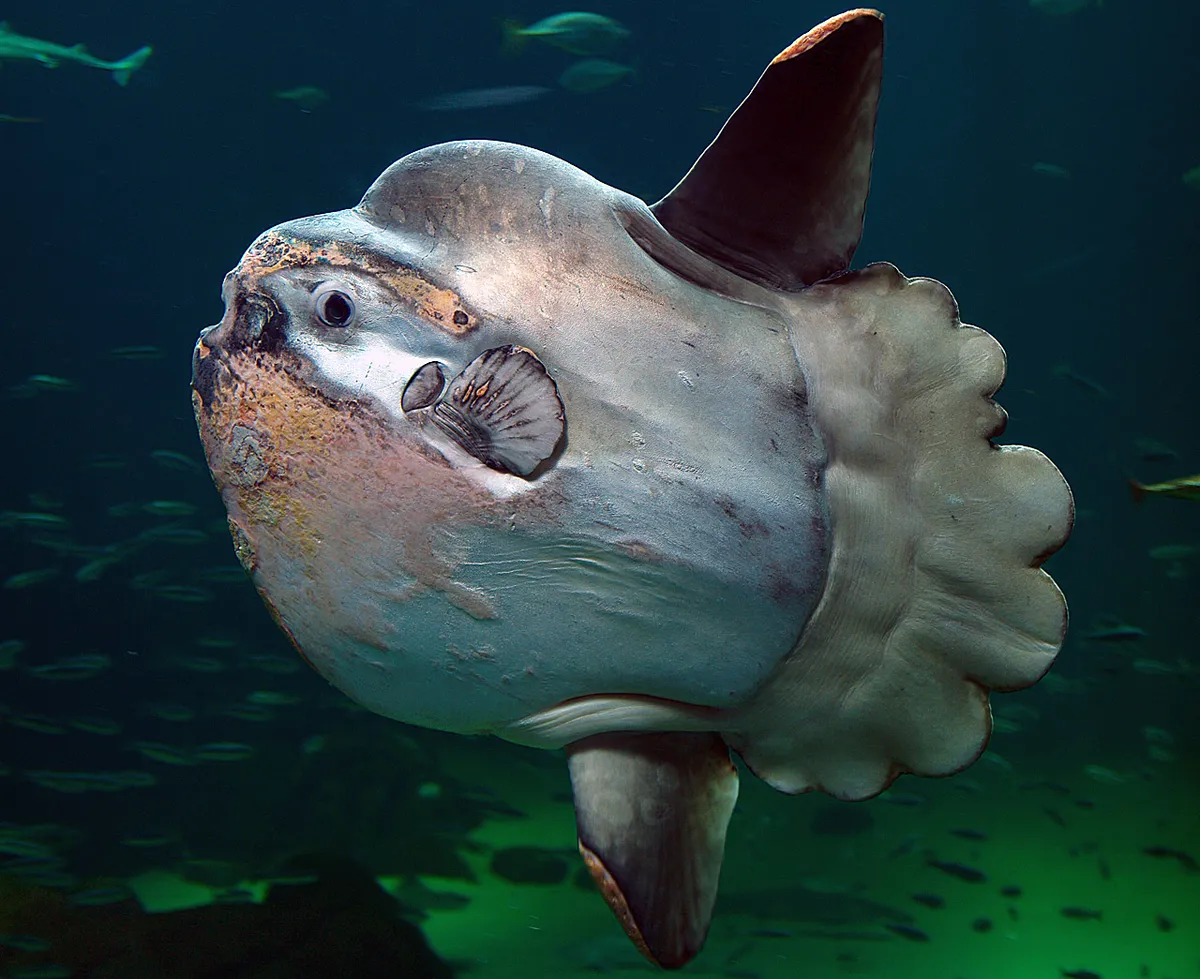
Ocean sunfish look strange because they do not follow the familiar shape of a fast, streamlined fish. Instead of a long body with a clear tail fin, they have a tall, flattened body and a blunt rear edge. From the side, the fish can look almost like a swimming head with fins.
That appearance is unusual, but it is not a mistake. Ocean sunfish, also called mola, belong to a group with a very specialized body plan. Their shape, fins, and thick skin all support a life spent moving through open ocean rather than chasing prey like a tuna or a shark.
The "missing tail" is not really missing
The most obvious feature is the back end of the body. Ocean sunfish do not have a conventional tail fin. The rear structure is called a clavus, a shortened, stiff edge that works more like a rudder than a propeller.
Most people expect a fish to move forward by sweeping a tail side to side. Ocean sunfish use a different system. Their tall dorsal fin on top and anal fin below provide much of the movement. The clavus helps with direction and stability.
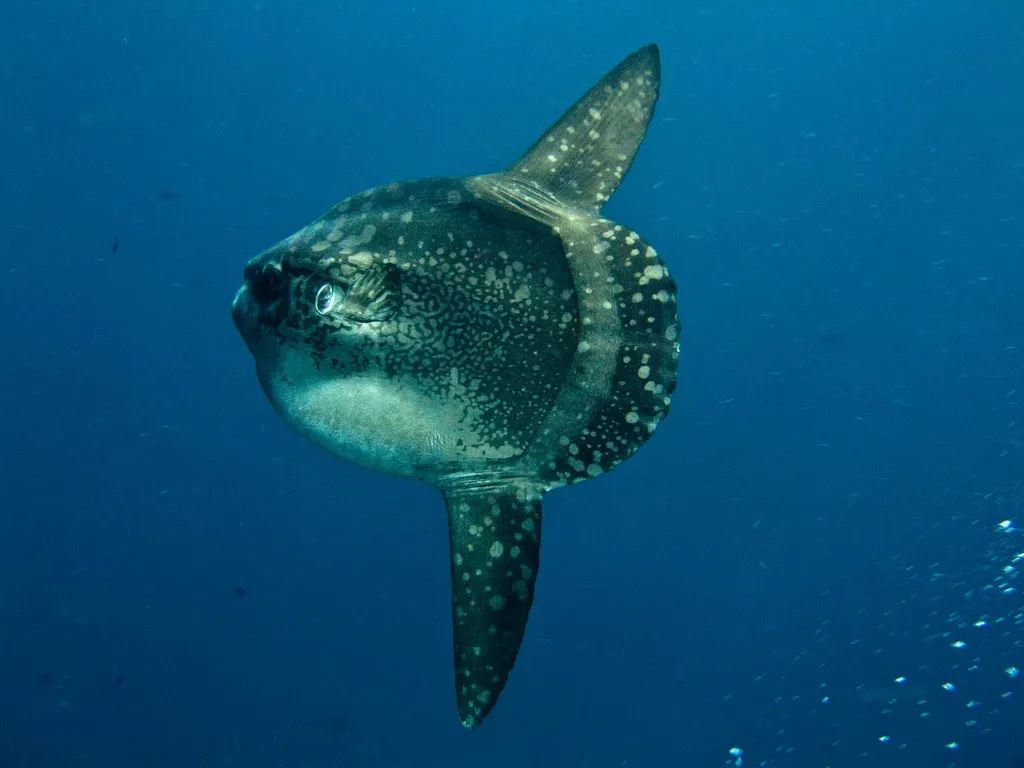
Photo by Ilse Reijs and Jan-Noud Hutten via Wikimedia Commons, CC BY 2.0.

A body for open water
The deep, flattened body may look awkward, especially near the surface, but ocean sunfish are not helpless drifters. They can move through the water column, dive, and return toward the surface. Their dorsal fin can break the surface, which is one reason they are sometimes mistaken for sharks from a distance.
The fish's diet also helps explain the body plan. Ocean sunfish are often associated with soft-bodied prey such as jellyfish and other gelatinous animals, although their diet can be broader. They are not built for the same kind of high-speed pursuit as predatory fish that chase schooling prey.
Large size is another part of the surprise. Ocean sunfish are among the heaviest bony fish, so their odd outline can look even more dramatic when a diver or boat gives scale. A shape that seems cartoonish in a photograph is a real open-ocean design.
Strange does not mean primitive
It is easy to describe ocean sunfish as if they are incomplete fish, but that is misleading. They are highly specialized. The clavus, tall fins, and flattened body are traits of a distinct evolutionary path, not signs that the animal failed to grow a proper tail.
Their life is still not fully understood. Researchers continue to study their movements, diving behavior, diet, and population status. For a fish that is easy to recognize, there is still a lot left to learn.
Surface basking is only one chapter
People often meet ocean sunfish when one is lying near the surface, sometimes with birds or cleaner fish nearby. That scene is memorable, but it is not the whole ecology. Tracking work shows these fish also move through deeper water and travel across broad ocean regions.
The thick skin and large body can make the animal look clumsy in still photos. In water, the same mass is supported, and the tall fins can drive surprisingly effective locomotion. Oddness is mostly a land-animal bias about what a "proper" fish should look like.
The short answer
Ocean sunfish look unusual because their body plan is highly specialized. They are not simply missing a tail. They use a shortened rear structure called a clavus, tall vertical fins, and a flattened body suited to open-ocean movement.
For size, diet, range, and conservation context, see the full ocean sunfish profile.