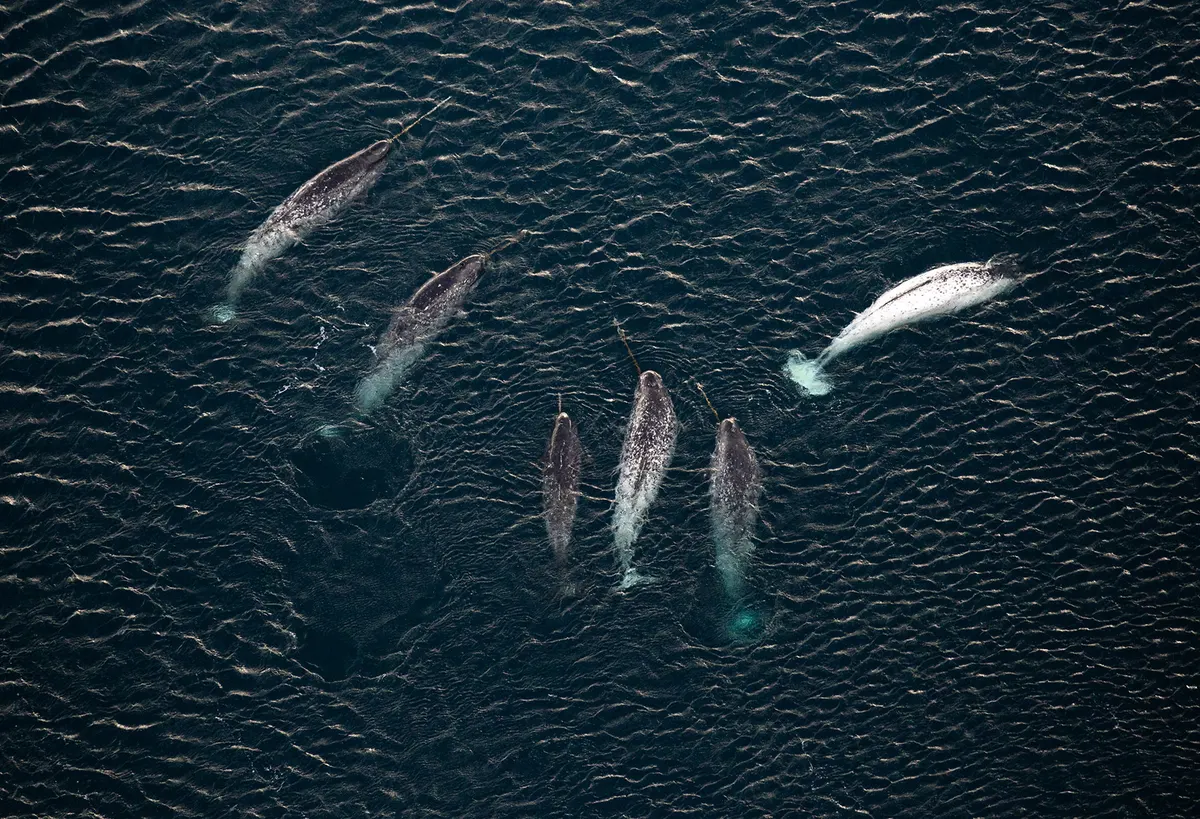
Narwhals are robust cetaceans with a mottled black, white, and gray pigmentation that lightens significantly with age; older individuals may appear almost entirely white. Adult narwhals exhibit pronounced sexual dimorphism, primarily concerning body size and dentition. They range in length from 13 to 20 feet (excluding the tusk) and carry an impressive mass, weighing between 1,760 and 3,500 pounds.
To survive in waters that frequently hover near the freezing point of seawater (-1.8°C), narwhals possess an incredibly thick layer of highly vascularized blubber that can constitute up to 40% of their total body mass. They lack a dorsal fin—a crucial morphological adaptation that reduces surface area for heat loss and allows them to navigate seamlessly immediately beneath dense sheets of pack ice without obstruction. Their cervical vertebrae remain unfused, granting them a highly flexible neck, a trait they share with their beluga relatives, facilitating rapid multi-directional scanning in cluttered acoustic environments.
The most unique anatomical feature is undoubtedly the tusk. Present in nearly all males and roughly 15% of females, the tusk is actually an elongated, spiraled upper left canine tooth that continuously erupts through the lip. Reaching lengths of up to 10 feet, the tusk defies standard mammalian dental paradigms; it is oriented inside-out, with a highly porous cementum layer on the outside and millions of patent dentinal tubules connecting directly to the central pulp. This complex neuroanatomy renders the tusk a hyper-sensitive hydrodynamic sensor, capable of detecting minute fluctuations in salinity, temperature, and barometric pressure, aiding in navigation and prey detection.