
Animal guides
Is a Narwhal's Tusk Really a Horn?
The Arctic's so-called unicorn does not carry a horn: its famous spiral is a tooth with social and sensory roles.
By An Nguyen · Published · Updated
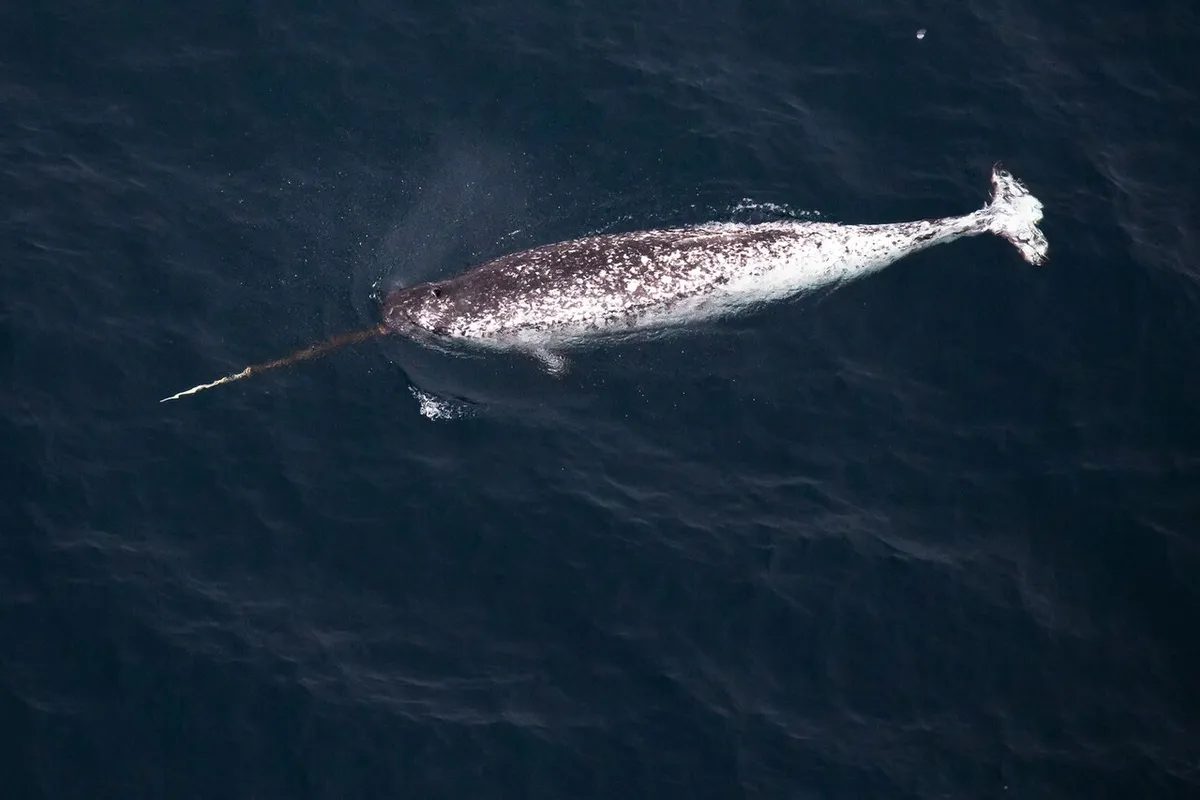
A narwhal can look like a whale with a unicorn horn, but the famous spiral is not a horn at all. It is a tooth. In most adult males, the left tooth grows out through the upper jaw and can become several metres long.
That single fact corrects the legend without ending the biology. A tooth that long still needs an explanation: how it grows, why males usually have it, and what sensory or social work it may do in cold Arctic water.
One very long tooth
Narwhals have teeth in the upper jaw, but they usually remain embedded. In males, the left tooth commonly grows forward into the tusk. Females rarely have one, although exceptions occur. NOAA describes the tusk as a spiralled tooth, not a separate bone or a horn.
The spiral is part of the tooth's growth pattern. Enamel is limited, and the outer surface includes cementum that can feel rough rather than polished like a carved ornament. Inside, the pulp and nerves make the structure biologically active, not a dead spike bolted onto the skull.

Photo by Kristin Laidre via Wikimedia Commons, public domain.

What is it used for?
The tusk is linked to male social status and may help with nonviolent assessment between males. Researchers also think it can act as a sensory tool, detecting changes in the surrounding water. It is not best understood as a weapon used all the time.
Laboratory and field studies have reported nerve-rich tissue and responses consistent with sensing salt concentration and other water properties. That does not mean every movement of the tusk is a deliberate measurement. It means the structure is wired in a way that can gather information as the whale moves through different layers of Arctic water.
Social use and sensory use are not mutually exclusive. A conspicuous, sensitive tooth can signal condition while also collecting environmental cues. What researchers avoid is the cartoon version of the story: a unicorn spear used mainly for fencing or ice-breaking.
Why are tusks so uneven between sexes?
Male-biased tusks suggest sexual selection has shaped the trait, even if the exact display rules are still being worked out. A large, intact tusk may advertise age or condition. Broken or worn tusks appear in real animals, which is another reminder that the structure lives a hard working life, not a museum life.
Females without tusks still survive and raise calves, so the tooth is not required for basic feeding the way a whale's baleen or a dolphin's teeth are. Narwhals feed mainly by suction on fish, squid, and shrimp-like prey. The tusk is therefore an add-on with social and sensory value, not the animal's primary eating tool.
Why are narwhals hard to study?
Narwhals live in Arctic waters that can be dark, remote, and covered by sea ice. They dive deeply and move with seasonal ice, so even basic observations are difficult. That means some questions about tusk use still need careful study rather than a simple answer.
Tracking, aerial surveys, and rare close encounters have improved the picture, but many behaviours happen below the surface where cameras and people rarely follow. Claims that sound definitive often turn out to be incomplete once new dive data or genetic work arrives.

Photo by Gazprom neft via Wikimedia Commons, CC BY-SA 4.0.

Horn, antler, or tooth?
Everyday language blurs the categories. A true horn has a bony core covered by keratin and usually stays with the animal for life. Antlers are bone grown and shed on a seasonal schedule by deer. A narwhal tusk fails both definitions: it is a modified tooth erupting through the jaw.
The unicorn comparison survives because the silhouette is memorable. Biologically, the better neighbours are other toothed whales. The beluga is the narwhal's closest living relative, and both belong to the family Monodontidae. For a broader Arctic pairing, see beluga vs narwhal.
The short answer
A narwhal tusk is a long, spiralled tooth, usually found on a male. It helps explain the unicorn legend, but it also has real biological roles in the social and sensory life of an Arctic whale. It is not a horn, and it is not required for everyday feeding.
For diving behaviour, diet, range, and conservation context, see the full narwhal profile.