
Delphinapterus leucas / Monodon monoceros
Beluga vs Narwhal
The Arctic's two monodontid whales share an ice-shaped body plan, yet differ sharply in appearance, seasonal habitat use, communication, and diving behavior.
By An Nguyen · Updated
At a glance
Published species data from both WildlifeDB profiles, aligned trait by trait. Size metrics highlight the larger value with a relative bar.
- Scientific name
- Beluga WhaleDelphinapterus leucas
- NarwhalMonodon monoceros
- Classification
- Beluga WhaleMammalia · Monodontidae
- NarwhalMammalia · Monodontidae
- Native range
- Beluga WhaleNorth America, Europe, Asia
- NarwhalNorth America, Europe, Asia
- Primary habitat
- Beluga WhalePolar
- NarwhalPolar
- Diet
- Beluga WhaleCarnivore
- NarwhalCarnivore
- Typical food
- Beluga WhaleArctic fish, Salmon, Cod, Shrimp, Crabs
- NarwhalArctic cod, Greenland halibut, Squid, Shrimp
- Body length
- Beluga Whale11 feet – 18 feet
- Narwhal13 feet – 20 feet
- Shoulder height
- Beluga Whale—
- NarwhalN/A
- Weight
- Beluga Whale1,200 pounds – 3,500 pounds
- Narwhal1,760 pounds – 3,500 pounds
- Top speed
- Beluga WhaleUp to about 14 mph in short bursts
- NarwhalUp to 17 mph in short bursts
- Wild lifespan
- Beluga Whale35 to 50 years
- NarwhalUp to 50 years
- Social pattern
- Beluga WhalePod living, Echolocation, Estuary gatherings
- NarwhalDeep diving, Seasonal migration, Pod living
- Key adaptations
- Beluga WhaleWhite adult coloration, Flexible neck vertebrae, Thick blubber
- NarwhalThick blubber layer, Flexible spine, No dorsal fin
- Conservation
- Beluga WhaleLeast Concern · Varies By Stock
- NarwhalNear Threatened · Unknown
- Reproduction
- Beluga WhaleAbout 14 to 15 months; Usually 1 calf
- NarwhalAbout 14 months; 1 calf
Only one of them grows a tusk
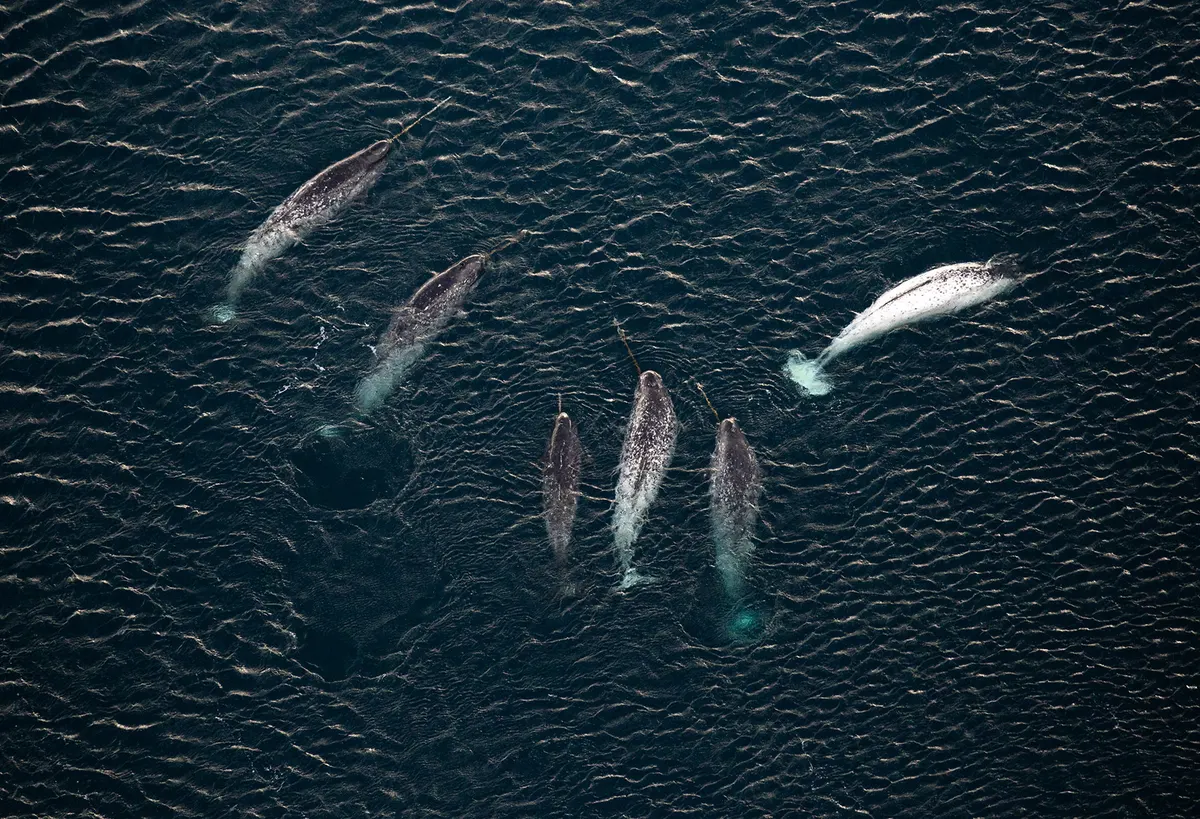
The narwhal grows the spiral tusk; the beluga never does. That single fact answers most questions about this pair, and it holds in both directions — an Arctic whale with a long forward-pointing spiral is a narwhal, and a plain white one is a beluga.
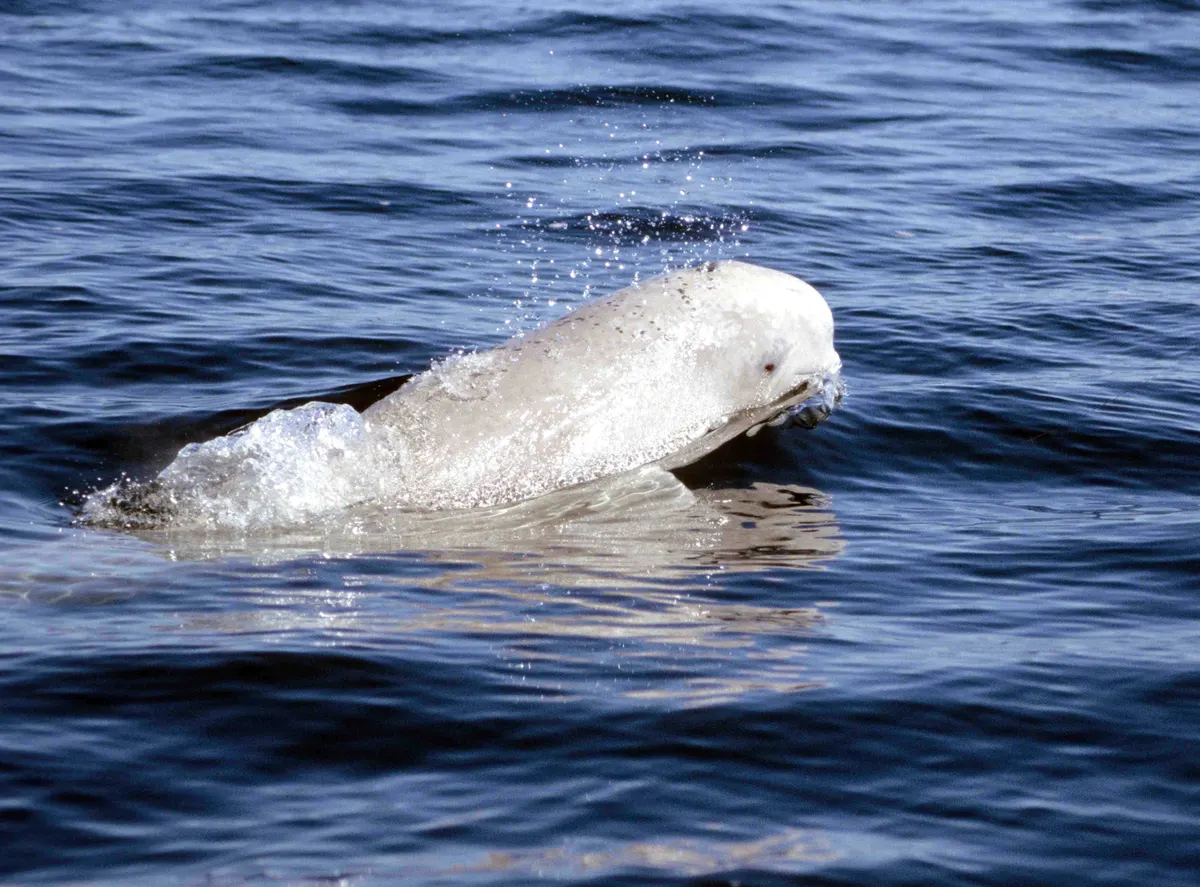
Colour is the second check. A healthy adult beluga is white all over, with a rounded forehead called a melon and a visibly flexible neck. A narwhal is mottled grey to dark brown and often pales with age, with no prominent melon.
The tusk is a tooth, not a horn
The tusk is an enlarged upper left canine, present in most males and some females. It can pass 10 feet in length and contains up to about 10 million nerve endings, which is why it is treated as sensory tissue as well as a social feature. Males sometimes cross or rub tusks, but reducing that to fighting ignores its use in display and investigation. The full explanation of tusk anatomy goes further into why "horn" is the wrong word.
Nearly the same weight, different silhouette
Belugas span about 11–18 feet and 1,200–3,500 pounds. Narwhals reach roughly 13–20 feet and 1,760–3,500 pounds. The weight ranges nearly coincide; sex, age, population, and seasonal condition matter more than species when judging an individual.
A male narwhal's tusk adds apparent length without changing body length. Belugas look rounder through the head and trunk; narwhals are more tapered. Both belong to the small whale family Monodontidae and neither has a dorsal fin — a low ridge instead reduces exposed surface under ice and makes it easier to travel beneath a low ice ceiling.
The talkative whale and the deep diver
Belugas are conspicuously vocal, producing whistles, chirps, clicks, and pulses that earned them the nickname "canaries of the sea." Their neck vertebrae are not fused, so the head turns more freely than in most whales — useful in shallow water and among ice. Pods are fluid and can gather in the hundreds or thousands at summer estuaries.
Narwhals are quieter at the surface and spend much of the year in remote ice-covered water. They are exceptional deep divers, recorded below 5,000 feet, and navigate winter pack ice through a limited number of breathing openings. Both species echolocate to find food in dark or turbid water.
The same prey list, at different depths
Both are carnivores that swallow prey whole rather than chewing. Belugas eat Arctic fish, salmon, cod, squid, shrimp, and crabs, moving from seafloor prey to schooling fish and into productive estuaries as the season changes. Narwhals feed on Arctic cod, Greenland halibut, squid, and shrimp, with important feeding occurring on deep winter dives beneath pack ice.
Sharing a prey list is not sharing a feeding ground. The beluga takes much of its food in shallow, seasonally accessible water; the narwhal takes much of its food far below the ice.
Summer estuaries against winter pack ice
Belugas range across Arctic and sub-Arctic North America, Europe, and Asia, with many populations moving between offshore winter habitat and shallow summer bays, river mouths, and estuaries, often returning to the same places each year.
Narwhals have a more concentrated High Arctic distribution, migrating between summer fjords and wintering grounds under dense pack ice, especially around Canada and Greenland. That dependence on predictable ice and reliable breathing openings is what makes changing polar conditions a direct problem rather than an abstract one.
Both give birth to a single calf after roughly 14–15 months of gestation, and calves rely on their mothers for milk, protection, and knowledge of migration routes.
Least Concern and Near Threatened, stock by stock
The beluga is Least Concern globally while individual stocks vary widely and some are depleted. The narwhal is Near Threatened with an unknown overall trend. Neither label works at the population level: harvest pressure, vessel noise, shipping, contaminants, and rapid Arctic change do not fall equally on every stock.