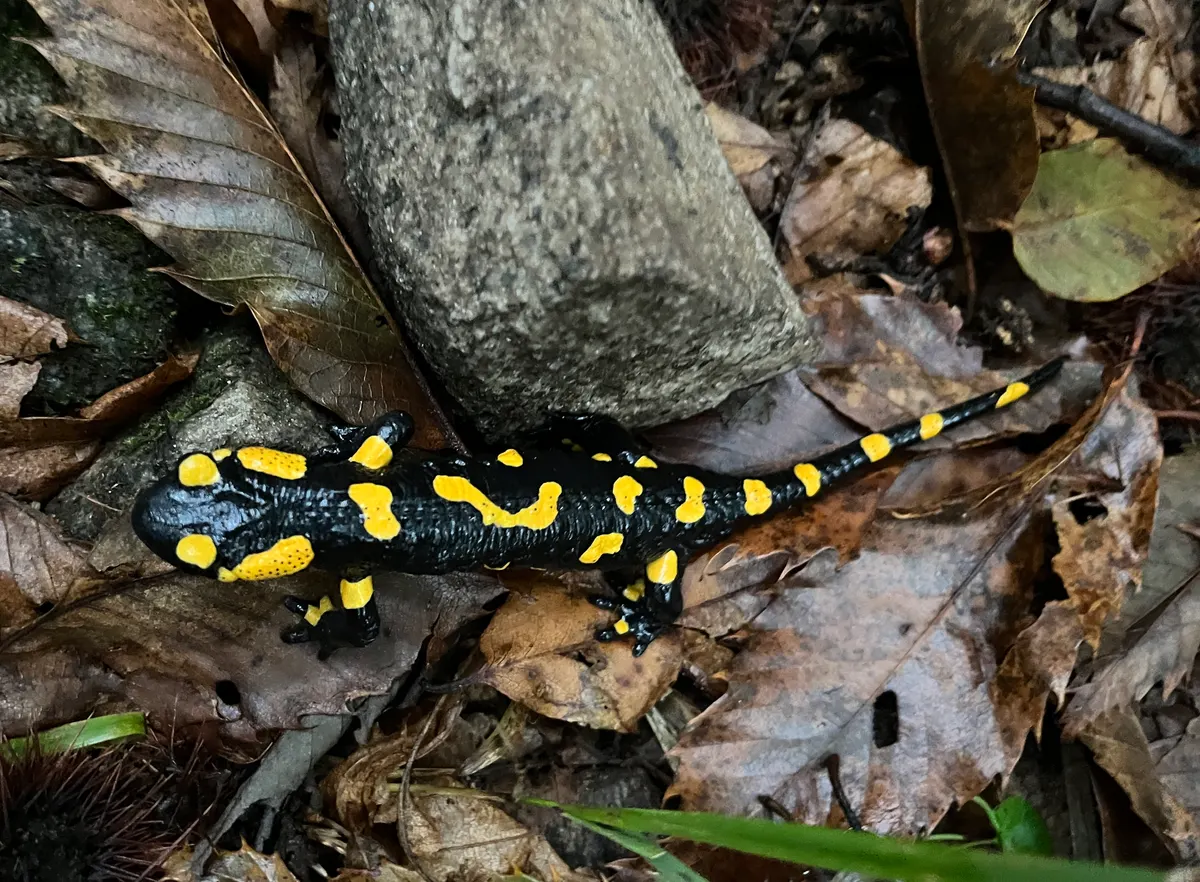
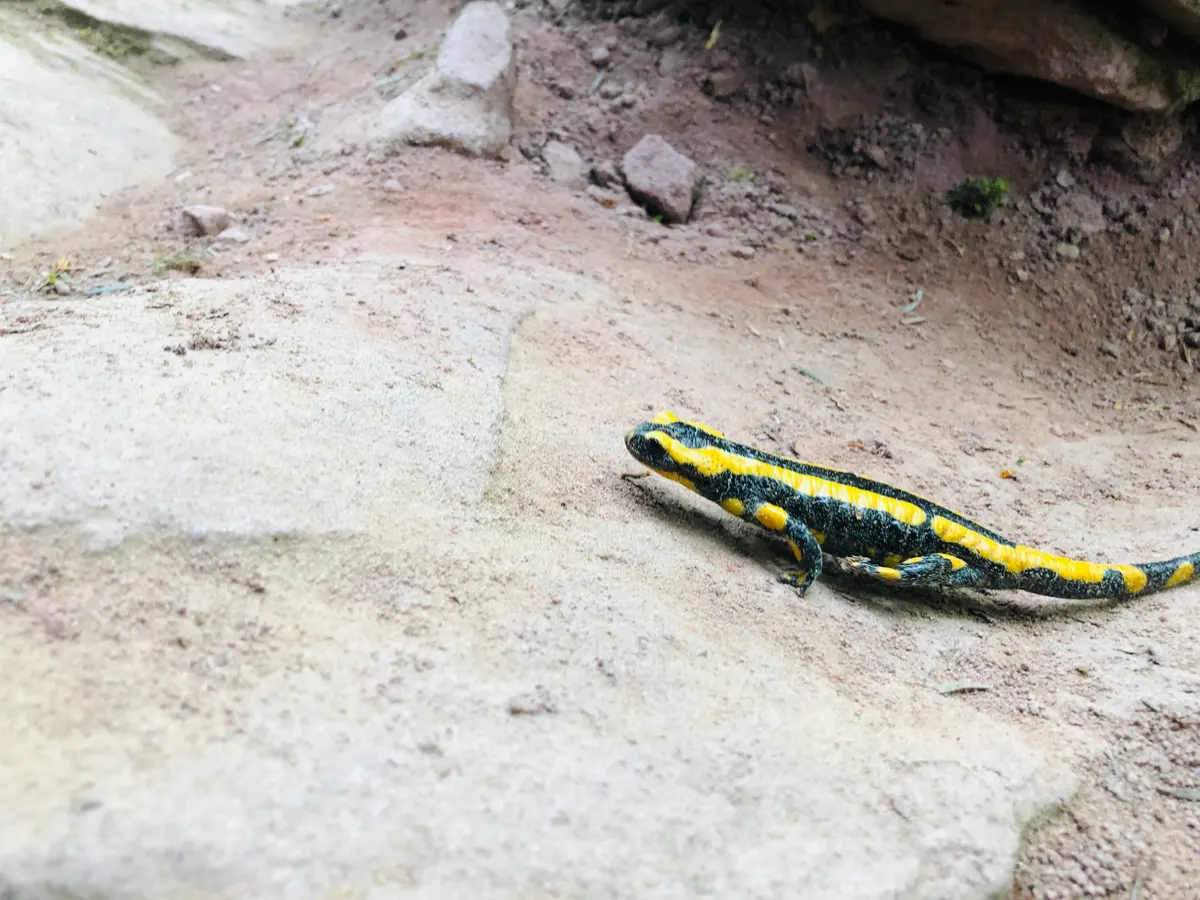
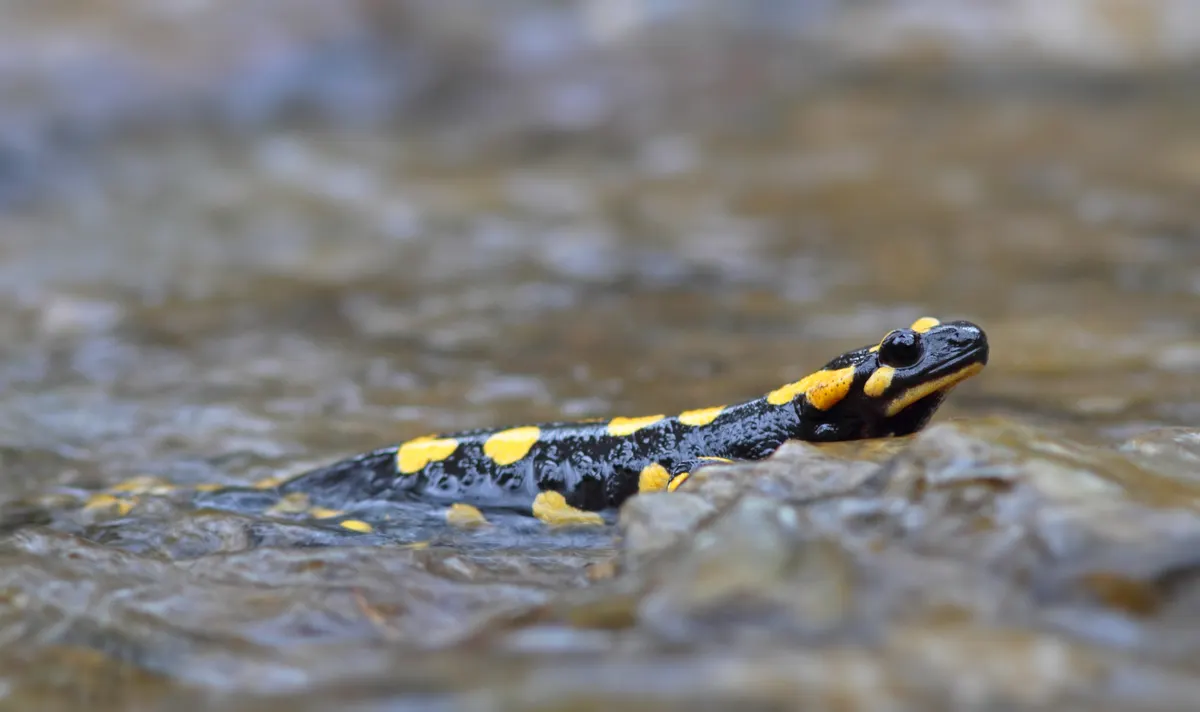
Fire salamander with black and yellow banding on rocky ground near a waterfall
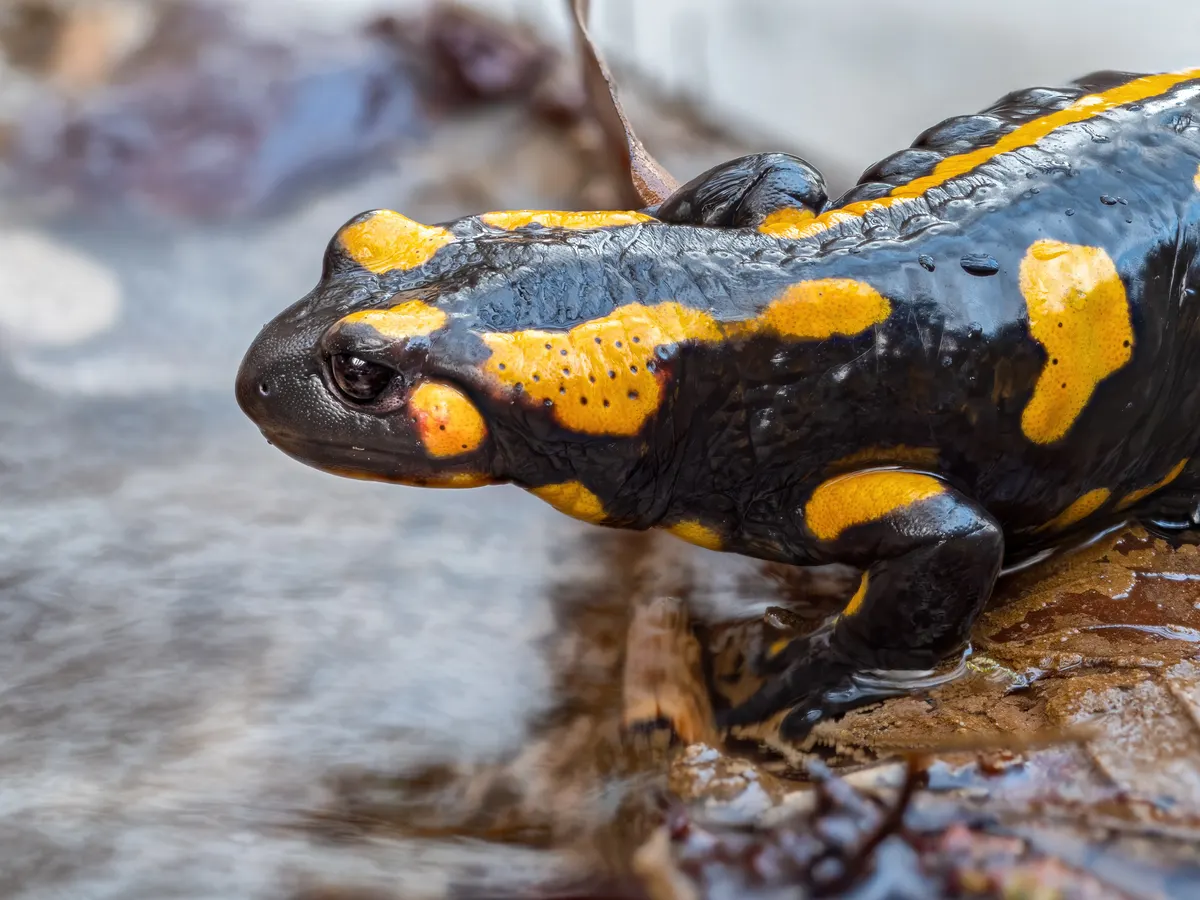
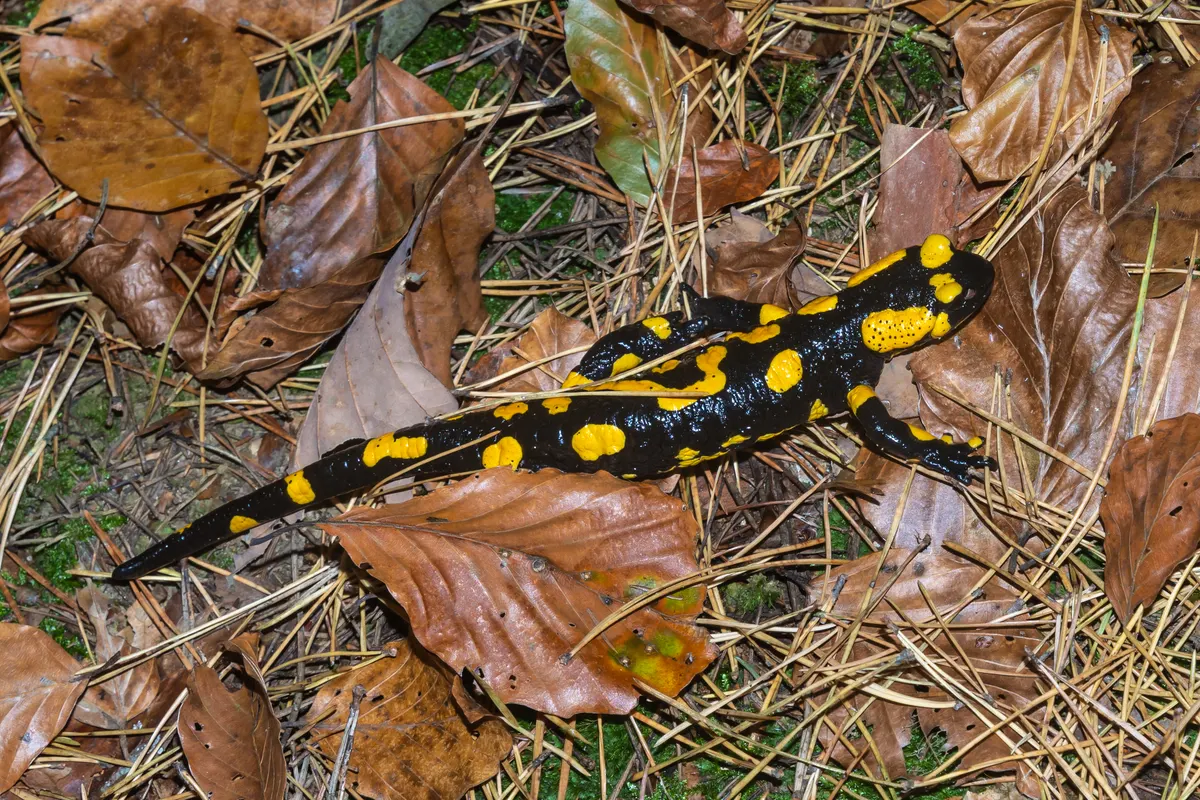
The fire salamander's black skin with bold yellow bands is a warning pattern known as aposematism.
AmphibiaVulnerable

Fire Salamander Facts

Fire salamanders secrete a neurotoxic alkaloid called samandarin from skin glands, which can irritate skin and mucous membranes.

The fire salamander is a black amphibian with yellow or orange spots and blotches, found in the moist forests of Europe. It stores toxic alkaloids in skin glands and, in most populations, gives birth to live aquatic larvae rather than laying eggs on land.
By · Updated

Quick Facts

Fire Salamander at a glance

Salamandra salamandraCaudataSalamandridae

About their home

Kind of animal

Amphibia

Where they live

What they eat

How safe?

Vulnerable

Size and speed

How heavy

1 ounce – 1.4 ounces

How long

6 inches – 10 inches

How fast

Slow-moving and ground-dwelling, relying on concealment rather than flight

Lifespan

About 10 to 20 years

Core article

Fire Salamander: ecology and life history

A closer look at habitat, diet, behavior, reproduction, and conservation.

Start here

Fire Salamander

The fire salamander (Salamandra salamandra) is a black amphibian marked with yellow or orange spots and blotches, a warning pattern known as aposematism. It lives on the floor of moist forest habitats across central and southern Europe, where it hunts small invertebrates at night and secretes a toxic alkaloid from its skin when disturbed. Unlike most amphibians, most populations give birth to live aquatic larvae rather than laying eggs on land.
Taxonomy and Evolution

The fire salamander belongs to the family Salamandridae, in the order Caudata, which comprises salamanders and newts rather than frogs and toads. The genus Salamandra includes several closely related species distributed across Europe, North Africa, and the Middle East, of which S. salamandra is the most widespread.

Numerous subspecies are recognized across the range, differing in size, color pattern, and reproductive mode. Some populations retain the ancestral trait of laying eggs in water, while most western and central European populations have evolved toward giving birth to live larvae, an adaptation that reduces the vulnerability of eggs during early development.

Anatomy and Physical Characteristics

Adult fire salamanders typically measure 6 to 10 inches (15 to 25 cm) in total length, including the tail, and weigh roughly 1 to 1.4 ounces (25 to 40 grams), with size varying by subspecies. The body is stocky, the head broad, and the tail rounded rather than laterally compressed as in many aquatic salamanders.

The skin is smooth and kept moist by mucus glands, supporting cutaneous respiration — gas exchange through the skin that supplements lung function. Prominent parotoid glands behind the eyes and a row of glands along the back produce samandarin, a toxic alkaloid that deters predators. The black base color with yellow or orange spots and stripes varies considerably by population, from bold longitudinal stripes to scattered irregular blotches.

Like other salamanders, fire salamanders can regenerate lost limbs and portions of the tail, a trait tied to their retained capacity for tissue regrowth into adulthood.

Habitat and Distribution

Fire salamander beside a forest stream in Germany
Moist deciduous forests with clean streams support both adult salamanders and their aquatic larvae.

Fire salamanders inhabit moist deciduous and mixed forest across a range that includes France, Germany, Spain, Portugal, Italy, Switzerland, Austria, Belgium, Poland, Czechia, Slovenia, and Ukraine, among other European countries. They favor hilly and montane woodland with abundant leaf litter, fallen logs, and rocky cover near streams or ponds.

Access to clean, slow-flowing or standing water is essential, since larvae develop in aquatic habitats even though adults are almost entirely terrestrial. Fire salamanders avoid open, dry ground and are rarely found far from forest cover.

Diet and Feeding Strategies

Fire salamander moving through leaf litter at night
Fire salamanders forage slowly through damp leaf litter for worms, slugs, insects, and woodlice.

Fire salamanders are carnivores that feed on insects, earthworms, slugs, spiders, woodlice, and millipedes found in leaf litter and under logs. They forage at night or during humid, overcast periods, using scent and vision to locate slow-moving invertebrate prey.

Prey is captured with a rapid tongue projection or direct bite and swallowed whole. Larvae, which live in water, feed on small aquatic invertebrates and can also prey on other amphibian larvae, including smaller fire salamander larvae, when food is scarce.

Social Structure and Behavior

Female fire salamander depositing larvae in a stream
Many populations give birth to live larvae directly into shallow forest streams.

Fire salamanders are largely solitary outside of breeding encounters and do not defend territories in the way many vertebrates do, though individuals often return to the same shelter sites. They are nocturnal or crepuscular, spending daylight hours hidden under bark, rocks, or leaf litter to avoid predators and desiccation.

When threatened, a fire salamander may arch its back, raise its tail, and release samandarin from its skin glands, a defense that discourages many predators after a single unpleasant encounter. In colder parts of their range, they hibernate through winter in burrows, rock crevices, or other sheltered sites, becoming active again in spring.

Life Cycle and Reproduction

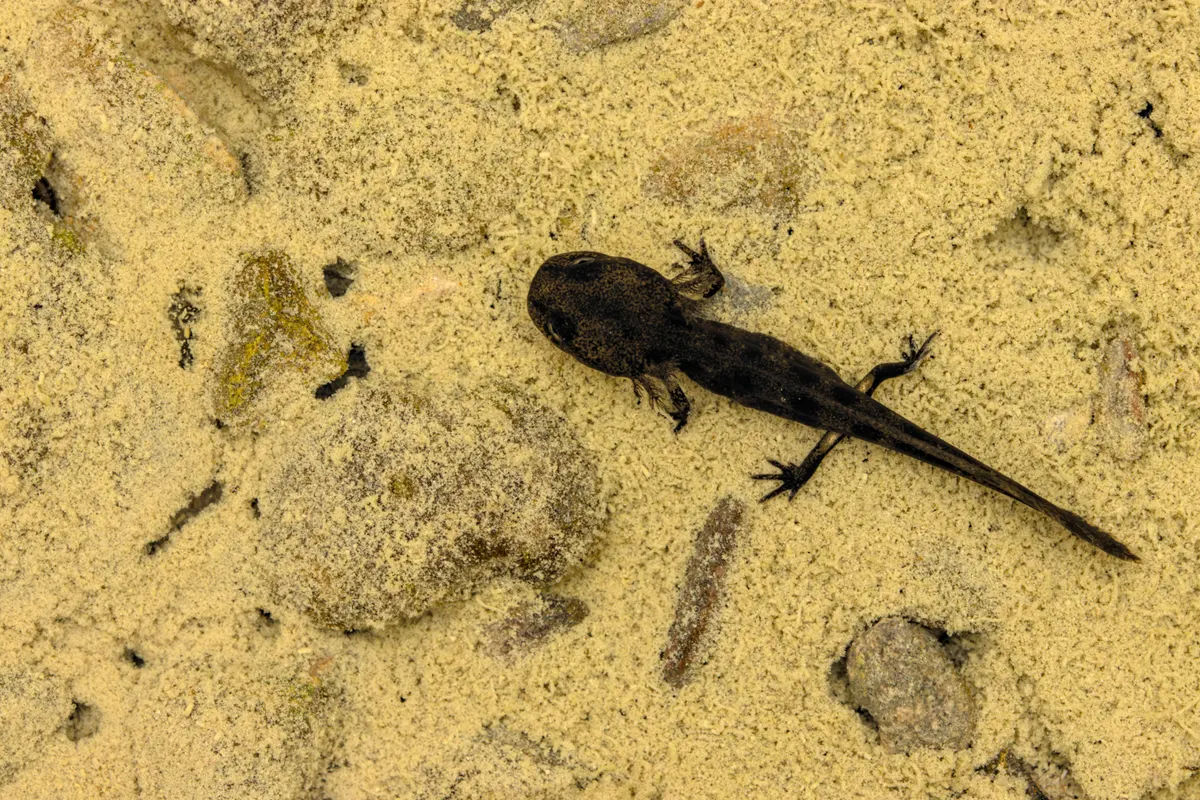
Fire salamander larva in shallow water
Larvae live in pools and streams before they develop legs, lungs, and adult colors.

Fire salamander reproduction differs from that of most amphibians. In most populations, females do not lay externally fertilized eggs; instead, males deposit a packet of sperm (spermatophore) that the female takes up internally, and eggs are fertilized and retained inside her body for several months. Rather than depositing eggs, she then gives birth directly to fully formed aquatic larvae in a stream or pool — a strategy termed ovoviviparity. A birth typically produces 20 to 40 larvae, though some populations instead lay eggs in water that hatch within about two weeks.

Larvae are aquatic, breathing through gills and developing legs before undergoing metamorphosis into terrestrial juveniles over the course of a few months. Sexual maturity is reached after two to five years, depending on climate and subspecies. In the wild, fire salamanders commonly live 10 to 20 years, and captive individuals have been recorded living close to 50 years, making them notably long-lived among amphibians.

Conservation Status and Threats

Fire salamander in Swiss forest within its European range
The species occurs across much of central and southern Europe in cool, damp woodland.

(Population and conservation trend data sourced from the IUCN Red List of Threatened Species)

The fire salamander is classified as Vulnerable, a status raised from Least Concern as declines driven by an emerging fungal disease became clearer across parts of its European range.

Habitat loss and fragmentation from logging, agriculture, and development reduce suitable forest and breeding sites. Water pollution and stream modification degrade the aquatic habitat larvae depend on. A more recent and specific threat is the chytrid fungus Batrachochytrium salamandrivorans (Bsal), which causes severe skin lesions and mortality in salamanders and newts and has caused sharp local population crashes in parts of the Netherlands, Belgium, and Germany. Road mortality during seasonal movements to breeding streams also affects local populations.

References and Authoritative Sources

Fire Salamander: classification and fun facts

Classification

Scientific Taxonomy
  1. Kingdom

    Animalia

  2. Phylum

    Chordata

  3. Class

    Amphibia

  4. Order

    Caudata

  5. Family

    Salamandridae

  6. Genus

    Salamandra

  7. Species

    S. salamandra

Did You Know?

Fun Facts

1

Fire salamanders secrete a neurotoxic alkaloid called samandarin from skin glands, which can irritate skin and mucous membranes.

2

Their name comes from an old European belief that they lived inside logs and emerged when the wood was thrown on a fire, giving rise to myths about fire resistance.

3

Most populations are ovoviviparous: females give birth to live larvae in streams rather than laying eggs on land.
4

Individuals can live for decades, with some captive records approaching 50 years.

5

Like other salamanders, they can regenerate lost limbs and parts of the tail.

6

The black-and-yellow pattern varies widely between populations, from bold stripes to scattered spots.

Common Questions

FAQ about Fire Salamander

Select a question to reveal the answer.

What is a fire salamander?

The fire salamander (*Salamandra salamandra*) is a black amphibian with yellow or orange markings, native to the forests and hills of Europe. It belongs to the order Caudata, which includes salamanders and newts.

Is a fire salamander poisonous or dangerous to touch?

It secretes a toxin called samandarin from skin glands that can irritate skin, eyes, and mucous membranes if handled. It is not dangerous to touch briefly, but hands should be washed afterward and the toxin should not reach the mouth or eyes.

Where does the fire salamander live?

It lives in moist forest habitats across much of central and southern Europe, favoring deciduous and mixed woodland near streams where its larvae develop.

What does a fire salamander eat?

It is a carnivore that hunts insects, earthworms, slugs, spiders, and woodlice on the forest floor at night.

Why is it called a fire salamander?

The name comes from a historical European belief that the animal was born from fire or could survive it, likely because salamanders sheltering in damp log piles would flee when the wood was burned.

How long do fire salamanders live?

In the wild they typically live 10 to 20 years. In captivity, well-kept individuals have been recorded living up to about 50 years.

Show 2 more questionsExpand
Do fire salamanders lay eggs or give birth?

Most populations are ovoviviparous: females retain fertilized eggs internally and give birth to live aquatic larvae directly into streams. Some populations instead lay eggs in water that hatch quickly.

Are fire salamanders endangered?

The species is listed as Vulnerable, a status raised from Least Concern as population declines linked to disease pressure, including the chytrid fungus Batrachochytrium salamandrivorans (Bsal), became clearer.