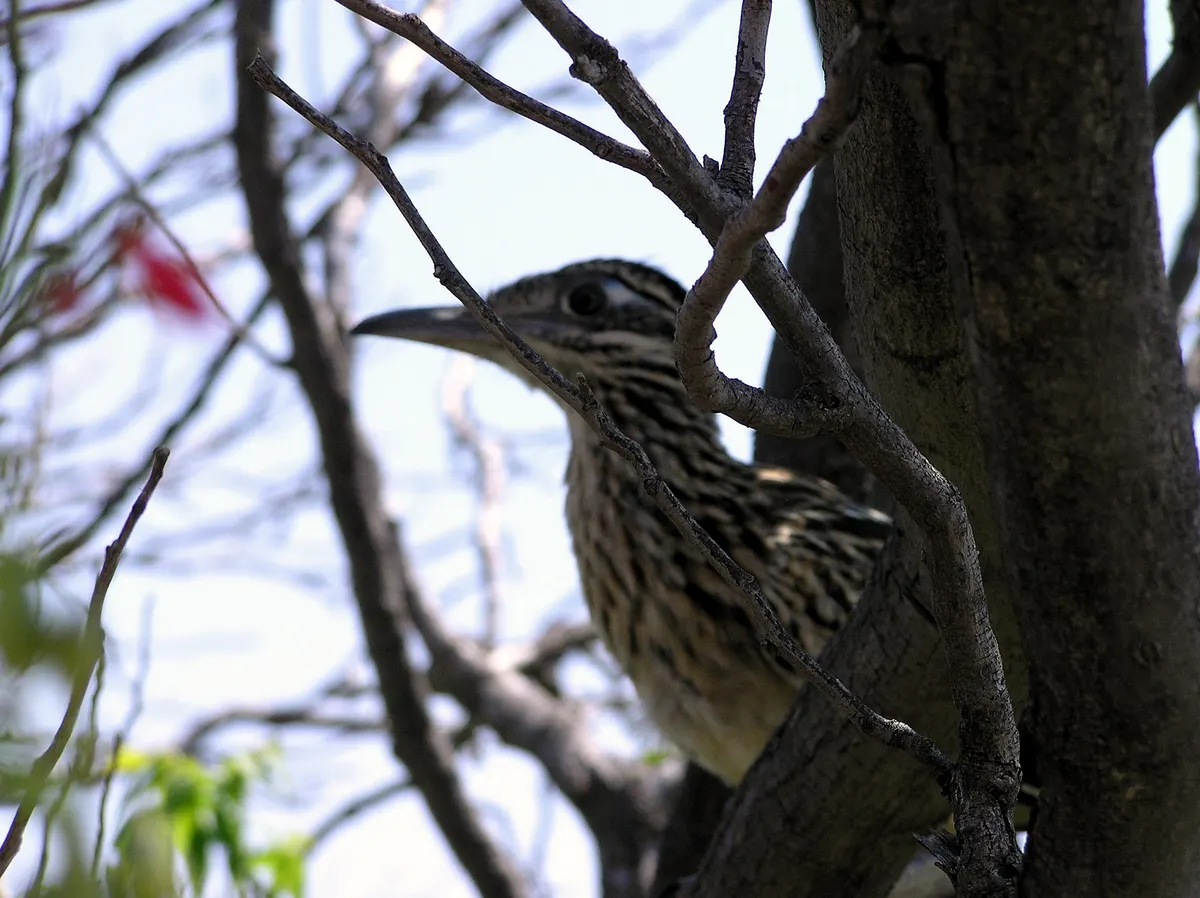
Greater roadrunner perched among desert branches
A greater roadrunner (Geococcyx californianus) in desert scrub; these ground birds sprint after lizards and insects.
AvesLeast Concern

Roadrunner Facts

Roadrunners can run up to 20 miles per hour but rarely fly for long distances.

The greater roadrunner is a fast-running desert bird of the American Southwest. It sprints on the ground to catch lizards, snakes, and insects in arid scrubland.

By · Updated

Quick Facts

Roadrunner at a glance

Geococcyx californianusCuculiformesCuculidae

About their home

Kind of animal

Aves

Where they live

What they eat

How safe?

Least Concern

Size and speed

How heavy

8 ounces – 15 ounces

How long

20 inches – 24 inches

How fast

Up to 20 mph running on the ground

Lifespan

7 to 8 years

Core article

Roadrunner: ecology and life history

A closer look at habitat, diet, behavior, reproduction, and conservation.

Start here

Roadrunner

Sprinting across desert roads with a shaggy crest bouncing above its beak, the greater roadrunner (Geococcyx californianus) is one of the most recognizable birds of the American Southwest. This ground-running carnivore chases lizards, snakes, and scorpions through cactus scrub — a formidable desert predator, not the comic sidekick of cartoon fame.

A Ground-Running Cuckoo, Not a Cartoon

Greater roadrunners are 20 to 24 inches from beak to tail (the tail nearly half of that) and 8 to 15 ounces, streaked brown, white, and black for camouflage against desert gravel. Strong legs and zygodactyl feet — two toes forward, two back — grip the ground for sprints reaching about 20 mph, the long tail acting as a rudder in sharp turns and the shaggy blue-black crest rising and falling with mood. It is built for acceleration on the ground rather than flight: short rounded wings can lift it into a shrub or across a gap, but the cartoon's endless highway pace is fiction — that 20 mph is a short burst, and coyotes run considerably faster. Roadrunners even lower their body temperature on cold nights to save energy, then "dorsal sun" in the morning with back feathers spread to soak up heat. They are true cuckoos (family Cuculidae), but unlike some cuckoos they build nests, incubate their own eggs, and raise their own chicks.

Where Roadrunners Live

Greater roadrunner standing in arid scrubland habitat
Roadrunners live in desert scrub, grassland, and open woodland of the American Southwest.

Roadrunners inhabit desert scrub, open grassland, and dry woodland across the southwestern U.S. and Mexico, from California and Utah east to Texas, Oklahoma, and Missouri and south through central Mexico, in mesquite, creosote, and cholla country. They do best in a patchwork of low vegetation, exposed soil, and elevated lookout or nest sites — thorn scrub for shade and cover, roadsides and dry washes as open hunting lanes — and at cooler northern and eastern edges they also use juniper woodland and brushy ranchland. Pairs hold territories year-round rather than migrating, learning where prey, shade, roosts, and water lie.

What Roadrunners Eat

Greater roadrunner holding a lizard prey in its beak
They hunt lizards, snakes, insects, and small rodents on the ground.

Roadrunners are opportunistic carnivores, taking lizards, snakes (including small rattlesnakes), insects, scorpions, spiders, rodents, and small birds, plus fruit and seeds when prey is scarce. They stalk on foot and lunge with the heavy bill, and against a venomous snake they strike repeatedly at the head, pin it, and bash it on rocks — cautiously, keeping beyond striking range, since a large rattlesnake can still kill them. Prey too long to swallow at once may hang from the bill while the first part digests. Insects dominate in warm months, while moisture-rich rodents and reptiles are especially valuable in dry periods; pairs sometimes cooperate on large prey.

Behavior: Territorial Pairs on Foot

Pair of greater roadrunners together in open desert habitat
Mated pairs may stay together and defend a territory year-round.

Roadrunners are usually seen alone or in breeding pairs, males defending territory with low, cooing calls from a fence post, boulder, or branch. Curious birds, they sometimes approach human activity, and though they can make short flights to escape danger or reach a roost, they run from most threats, leaving distinctive X-shaped tracks (from the two-forward, two-back toes) that don't reveal travel direction. A pair keeps contact through descending coos, bill clacks, and displays, and at night both roost in shrubs or small trees, where height offers more protection from coyotes and other ground predators than an exposed perch.

Life Cycle: Stick Nests and Fast-Growing Chicks

Young greater roadrunner chick with developing feathers
Chicks hatch from eggs in low nests hidden in cactus or shrubs.

Breeding is in spring. A pair builds a low stick nest in a cactus, shrub, or small tree — the male often bringing sticks while the female arranges a shallow platform lined with grasses, feathers, or shed snakeskin — and she lays two to six eggs that both parents incubate for about 20 days. Laying may be staggered, so chicks in one brood differ in size. The young hatch downy, leave the nest around 18 days, and are fed for several more weeks, developing fast from clambering around branches to chasing prey on the ground. In good conditions roadrunners raise two broods a year, a second attempt hinging on rain that boosts insects and prey. They live seven to eight years in the wild.

Conservation: Least Concern in Native Scrub

Greater roadrunner in open Texas landscape within its southwestern range
Greater roadrunners range from California to Missouri and south into Mexico.

The greater roadrunner is Least Concern with a stable population across most of its range. Habitat loss to urban sprawl and agriculture is the main long-term threat, while desert-highway collisions kill many birds, pesticides cut their insect and lizard prey, outdoor cats take eggs, chicks, and adults near homes, and rodenticides risk secondary poisoning. Long droughts can lower nesting success even where habitat still looks suitable. Local conservation centers on keeping connected native scrub, limiting broad pesticide use, and reducing traffic hazards near wildlife corridors.

References and Authoritative Sources

Roadrunner: classification and fun facts

Classification

Scientific Taxonomy
  1. Kingdom

    Animalia

  2. Phylum

    Chordata

  3. Class

    Aves

  4. Order

    Cuculiformes

  5. Family

    Cuculidae

  6. Genus

    Geococcyx

  7. Species

    G. californianus

Did You Know?

Fun Facts

1

Roadrunners can run up to 20 miles per hour but rarely fly for long distances.

2

They are one of the few birds that hunt venomous rattlesnakes.

3

Roadrunners sunbathe in the morning, lowering their back feathers to warm up.

4

They have a shaggy crest and a long tail that helps with balance while running.

5

Roadrunners make a series of low cooing calls across the desert.

6

They are the largest cuckoo species in North America.

Common Questions

FAQ about Roadrunner

Select a question to reveal the answer.

What is a roadrunner?

A roadrunner is a ground-dwelling bird of the American Southwest and Mexico. The greater roadrunner is known for running fast across desert roads and trails.

Where do roadrunners live?

Roadrunners live in desert scrub, grassland, and open woodland from California and Missouri south into Mexico.

How fast can a roadrunner run?

Roadrunners can sprint at about 20 miles per hour on the ground, using their long tail for balance.

What do roadrunners eat?

Roadrunners are carnivores that eat lizards, snakes, insects, scorpions, rodents, and sometimes fruit.

Can roadrunners fly?

Roadrunners can fly short distances to escape danger or reach a perch, but they spend most of their time running on the ground.

Are roadrunners endangered?

Greater roadrunners are listed as Least Concern, though habitat loss and traffic can harm local populations.