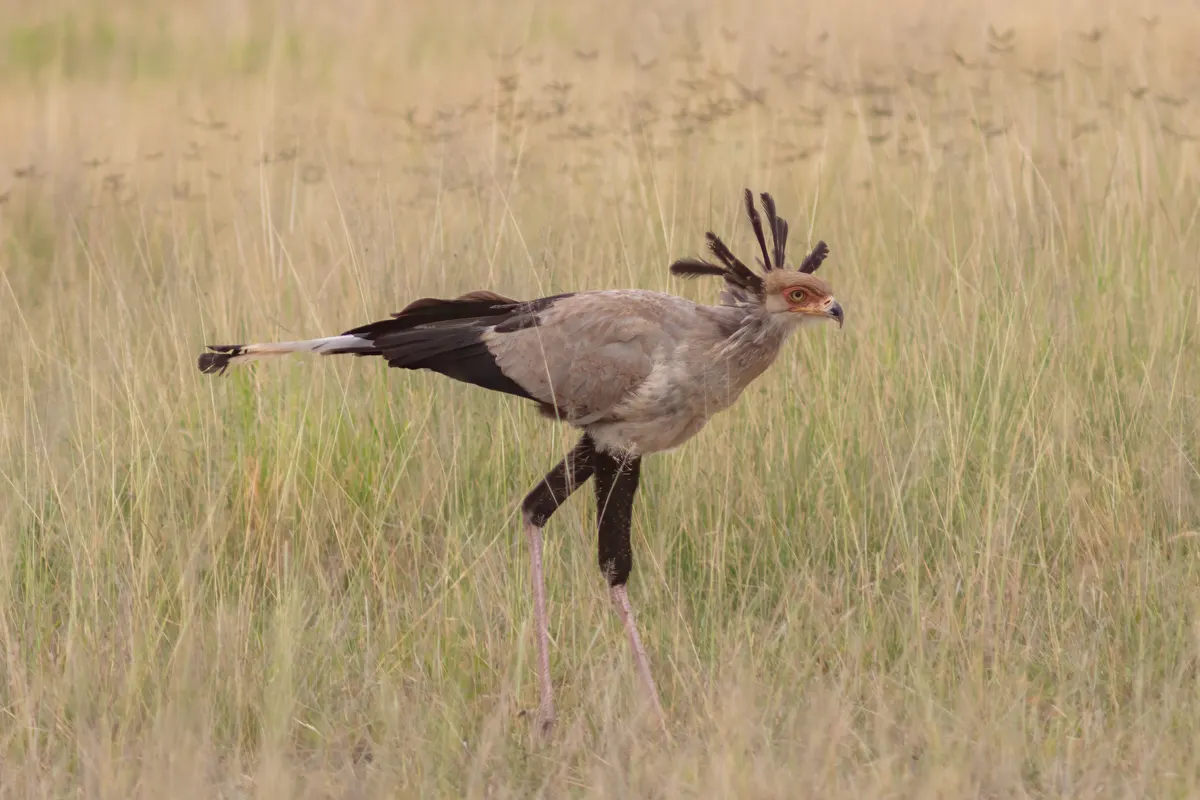
Stately adult secretarybird standing alert with its distinctive black head crest feathers and orange facial skin
The secretarybird is an instantly recognizable, long-legged terrestrial bird of prey endemic to Africa.
AvesEndangered

Secretarybird Facts

A secretarybird can deliver a blindingly fast kick with a force equivalent to five times its own bodyweight, making contact in just 15 milliseconds—faster than the blink of an eye.

Secretarybirds are long-legged African raptors that spend much of the day walking through open grassland. They kill insects, lizards, rodents, and snakes with rapid downward kicks, then return to large stick nests built in low trees.
By · Updated

Quick Facts

Secretarybird at a glance

Sagittarius serpentariusAccipitriformesSagittariidae

About their home

Kind of animal

Aves

Where they live

What they eat

How safe?

Endangered

Size and speed

How heavy

7 pounds – 10 pounds

How long

4.1 feet – 4.9 feet

How fast

Fast terrestrial walker (can walk 20+ miles a day) and powerful soarer in flight

Lifespan

12 to 18 years

Core article

Secretarybird: ecology and life history

A closer look at habitat, diet, behavior, reproduction, and conservation.

Start here

Secretarybird

Striding imposingly across the sun-scorched savannas of sub-Saharan Africa, the secretarybird (Sagittarius serpentarius) is a raptor unlike any other. While possessing the hooked beak, large wingspan, and keen binocular vision characteristic of eagles and hawks, it has completely abandoned an aerial hunting strategy in favor of a strictly terrestrial lifestyle. Best known for its incredibly long, crane-like legs and its ability to dispatch highly venomous snakes with blindingly fast, bone-crushing kicks, the secretarybird is a highly specialized apex predator of the African grasslands.

Taxonomy and Evolution

The secretarybird belongs to the kingdom Animalia, phylum Chordata, and the avian class Aves. Taxonomically, it sits within the order Accipitriformes, an order it shares with hawks, eagles, vultures, and kites. However, its evolutionary path diverged so significantly from other birds of prey that it is placed in its own exclusive, monotypic family: Sagittariidae. The genus Sagittarius translates from Latin as "archer," likely referring to its striding gait, while the specific epithet serpentarius translates directly to "hunter of serpents."

Fossil evidence suggests that the ancestors of the secretarybird diverged from other accipitrids during the Oligocene or Miocene epochs. The evolutionary shift to long legs and a cursorial (running/walking) lifestyle was an adaptation to the expansion of open grassland biomes in Africa, allowing the bird to survey over tall grass and strike ground-dwelling prey with immense mechanical leverage.

Anatomy and Physical Characteristics

A visually striking animal, the secretarybird is a large raptor standing between 4.1 and 4.9 feet tall, yet it maintains a relatively light weight of 7 to 10 pounds. Its plumage is predominantly ash-gray across the back and breast, with black flight feathers and stark black thighs. The face features bare, highly vascularized skin that ranges from bright orange to deep red.

Its most iconic features are the elongated, black quill-like crest feathers protruding from the back of its head. According to popular lore, its common name derives from these feathers, which allegedly resemble the quill pens that 19th-century bank clerks or secretaries tucked behind their ears.

However, the defining anatomical adaptation of the secretarybird is its elongated legs. The lower legs (tarsi) are heavily protected by thick, modified keratinous scales. This armor acts as a highly effective defense mechanism against the fangs of venomous snakes during combat. Their toes are robust, relatively short for a raptor, and armed with blunt talons optimized for running and blunt-force trauma rather than grasping. Despite its terrestrial nature, it is far from flightless; it possesses a broad wingspan of over 6.5 feet, making it a powerful flier capable of soaring to great heights on thermal updrafts.

Habitat and Distribution

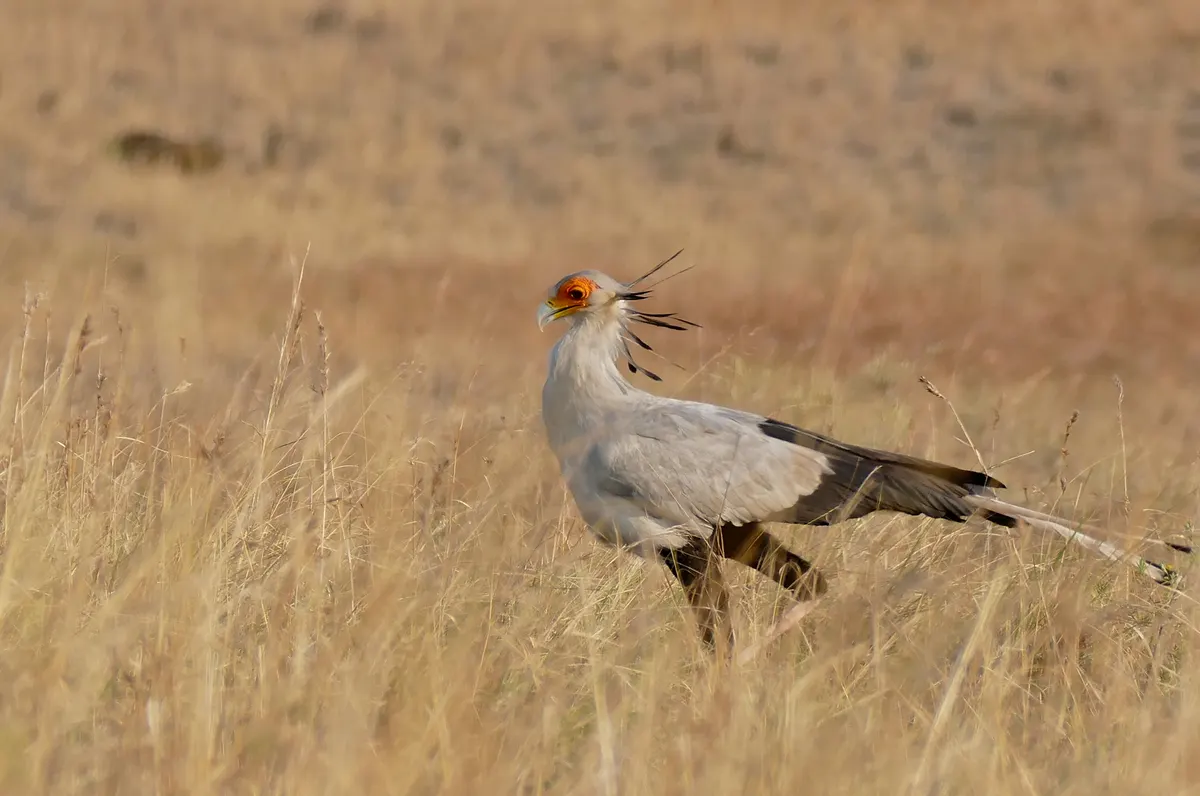
Beautiful secretarybird striding through tall green savanna grasses
Healthy, intact savanna grasslands are vital to support the vast terrestrial home ranges required by foraging secretarybirds.

The secretarybird is strictly endemic to the African continent. Its expansive range stretches across sub-Saharan Africa, from Senegal in the west to Somalia in the east, and extends southward down to the Western Cape of South Africa.

Its primary habitat consists of open, semi-arid landscapes. They heavily favor vast savanna grasslands, open scrublands, and plains punctuated by scattered acacia trees. They generally avoid densely forested regions, true deserts, and dense brush where their long legs would impede movement and visual hunting would be compromised. The presence of isolated, thorny trees is a critical habitat requirement, as they rely on them entirely for safe roosting and nesting.

Diet and Feeding Strategies

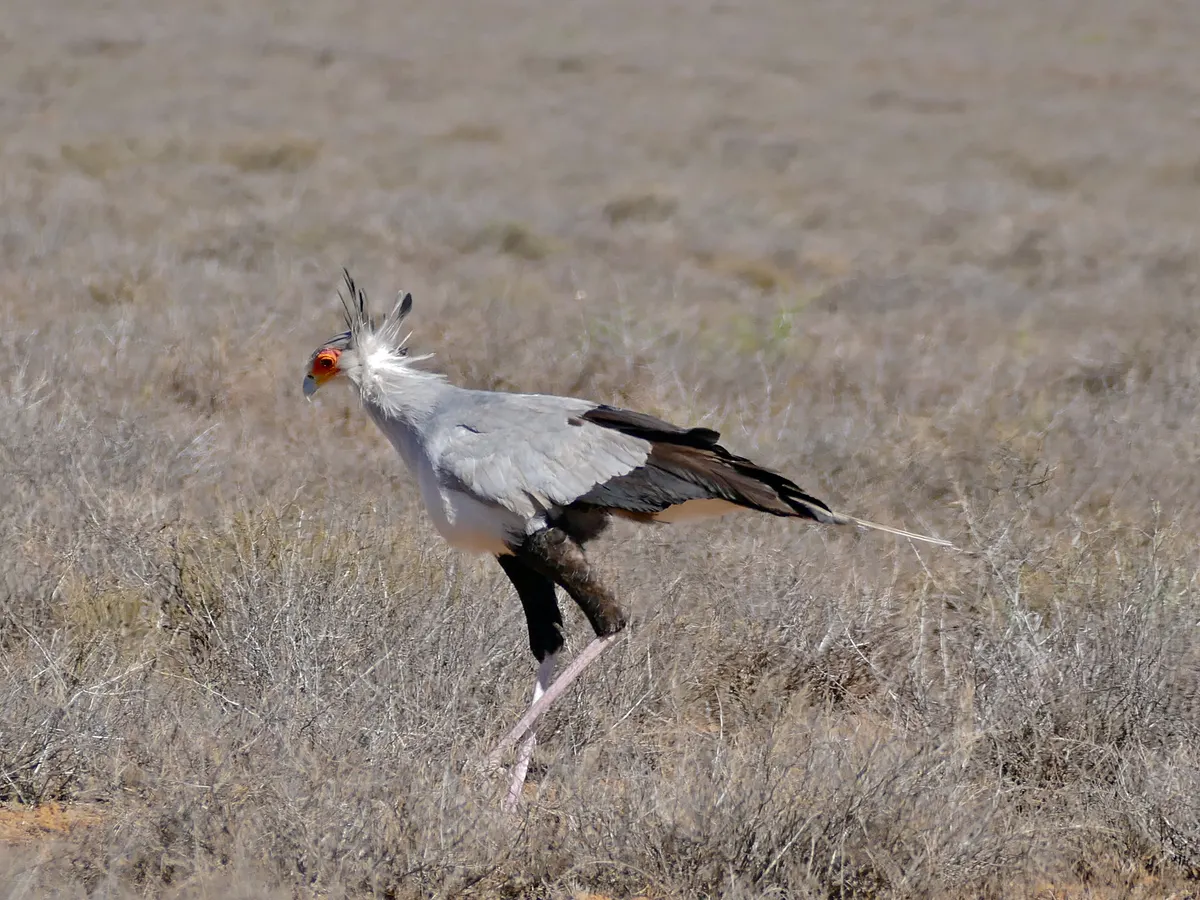
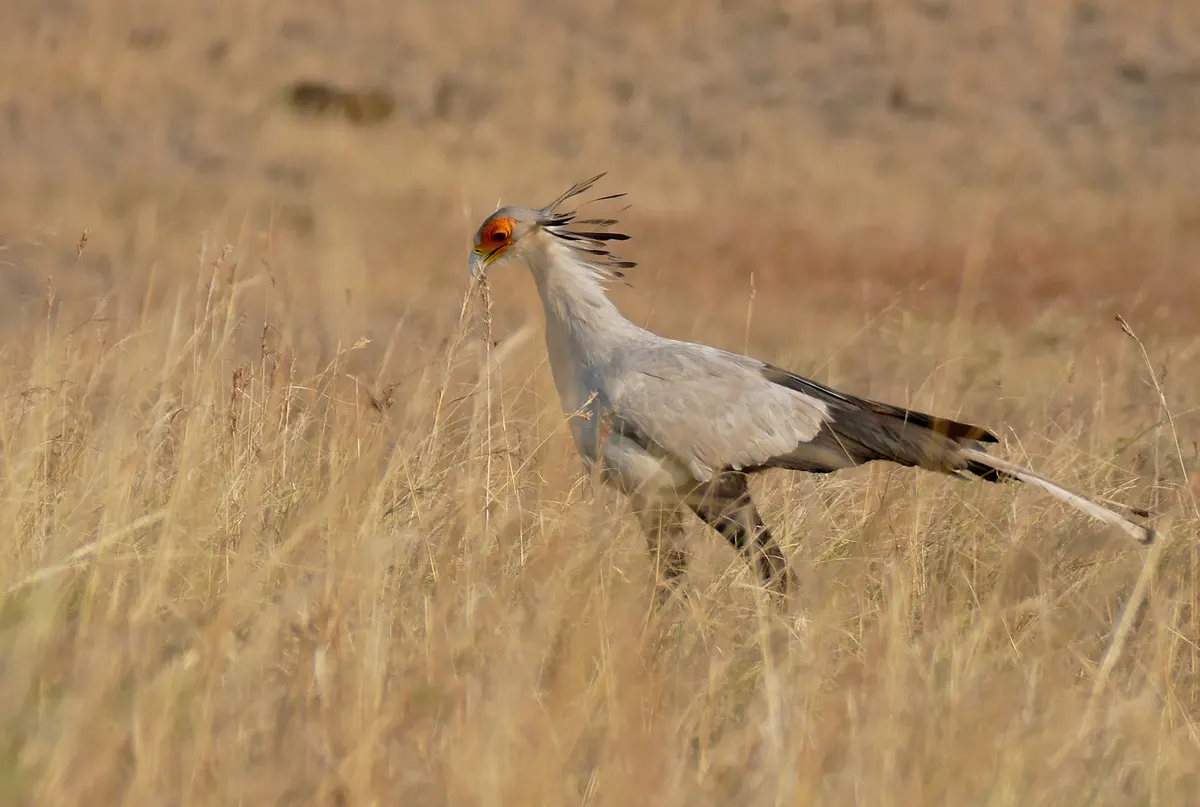
Secretarybird actively hunting across the terrain of Camdeboo National Park
They can walk over 30 kilometers in a single day, constantly scanning the grass for fleeing reptiles and insects.

As an obligate carnivore, the secretarybird is a highly active, opportunistic predator. It spends the vast majority of its day walking—frequently covering 12 to 18 miles daily—while scanning the grass with highly acute binocular vision.

Their diet is highly varied. They consume massive quantities of large insects (such as locusts, beetles, and grasshoppers), small rodents, amphibians, lizards, bird eggs, and even young ground-nesting birds. However, they are most famous for their prowess as ophiophages (snake-eaters). They routinely hunt highly venomous species, including puff adders and cobras.

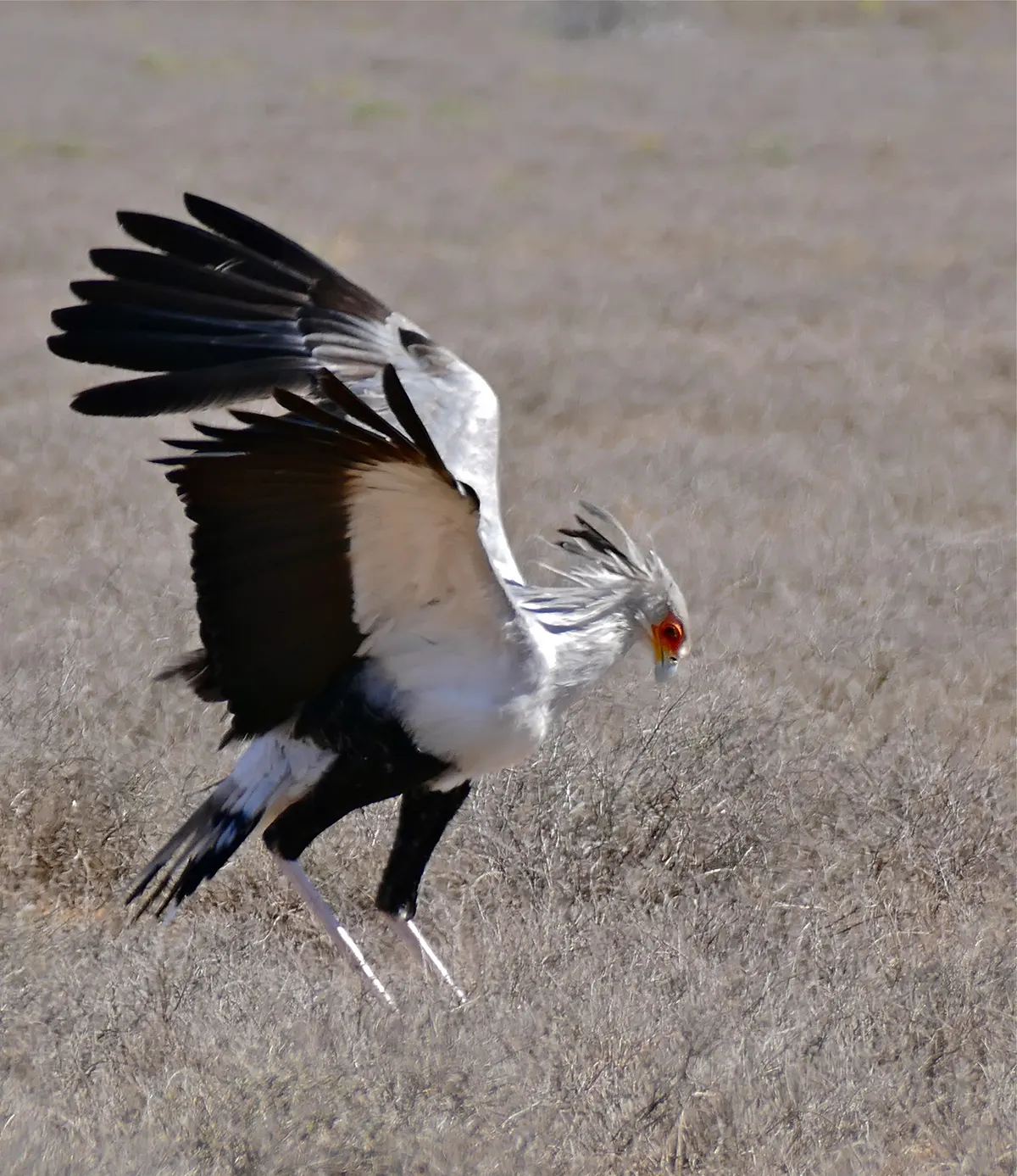
The secretarybird hunts snakes and other small animals mainly with its legs. It approaches with its wings spread for balance, then delivers rapid downward kicks. Biomechanical studies indicate that a kick can carry force equivalent to about five times the bird's bodyweight and land in roughly 15 milliseconds, allowing it to immobilize prey quickly before swallowing it.

Social Structure and Behavior

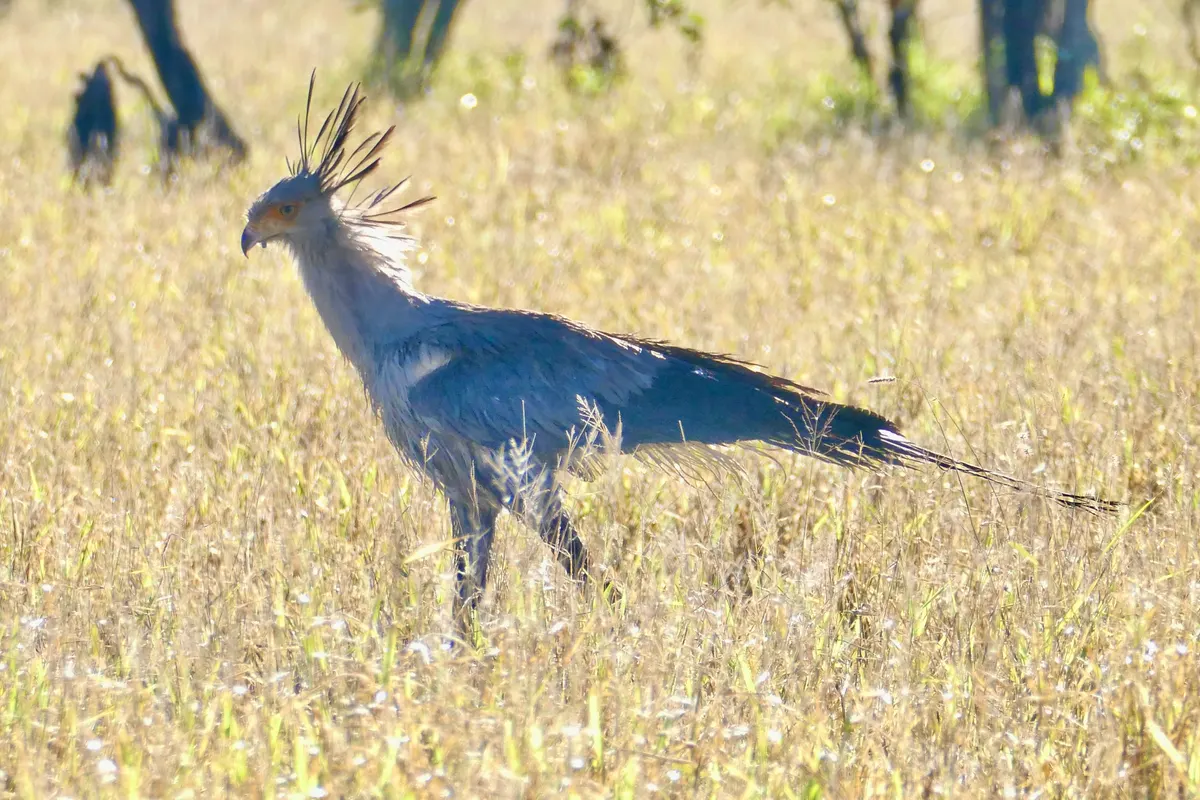
An elegant secretarybird keeping watch over its savanna territory
Both parents diligently share the responsibilities of incubating the eggs and regurgitating food for the growing chicks.

Secretarybirds are generally solitary hunters, though they are frequently seen in pairs. They are highly monogamous, forming lifelong pair bonds. Even when foraging independently during the day, the paired birds often remain in visual contact and roost together in the same tree at night.

Their territorial behavior is robust. Both the male and female actively defend massive territories that can span up to 50 square kilometers. Intruding secretarybirds are met with aggressive displays and, if necessary, aerial chases or physical combat on the ground.

Courtship displays are highly visual and occur both in the air and on the ground. Aerial displays involve the pair soaring high on thermals and executing dramatic, undulating flight patterns, sometimes locking talons and spiraling toward the ground. On land, they perform a synchronized "dance" with wings outstretched, chasing one another in a ritualized display of fitness.

Life Cycle and Reproduction

A robust secretarybird standing tall near its nesting territory
Chicks develop slowly on the treetop nest, exercising their long legs for many weeks before taking their first ambitious flights.

Unlike ground-dwelling birds like ostriches or bustards, the secretarybird insists on aerial safety for its offspring. The pair constructs a massive, flat platform nest made of sticks and thorny branches, positioned directly on the canopy of a large acacia or other thorny tree, often 15 to 20 feet off the ground. The nest is reused and added to year after year, eventually reaching up to 8 feet in diameter.

Reproduction can occur year-round, loosely tied to local food abundance. The female lays a small clutch of 1 to 3 chalky white eggs, which she and the male take turns incubating for 42 to 46 days. The chicks are highly altricial, hatching covered in white down but completely helpless.

Both parents exhibit intense brood care, returning to the nest frequently to regurgitate a slurry of semi-digested insects and small vertebrates for the chicks. The chicks grow rapidly but require extensive development time; they do not fledge (leave the nest) until they are 65 to 105 days old. Even after fledging, they remain reliant on their parents for hunting instruction for several more weeks. In the wild, secretarybirds live roughly 12 to 18 years, with captive individuals surviving up to 19 years.

Conservation Status and Threats

Secretarybird standing proudly on the African plains
Rapid habitat loss and severe degradation across African savannas have led to their listing as Endangered on the IUCN Red List.

(Population and conservation trend data sourced from the IUCN Red List of Threatened Species)

The secretarybird is currently classified as Endangered on the IUCN Red List. Recent comprehensive surveys have revealed a precipitous and deeply alarming population decline across almost their entire African range over the last three decades.

The primary driver of this collapse is anthropogenic habitat degradation. The conversion of pristine savanna into intensive agricultural land, combined with severe overgrazing by domestic livestock, completely decimates the tall grasses required for insect and rodent populations, effectively starving the birds. Furthermore, the encroachment of human settlements leads to increased disturbance, causing these highly sensitive birds to abandon their nests.

Direct anthropogenic mortality is also a significant factor. Secretarybirds frequently suffer fatal collisions with expanding rural power line networks. Additionally, the widespread use of unregulated agricultural pesticides poisons their insect prey, which biomagnifies within the birds, causing severe physiological damage or death.

References and Authoritative Sources

Secretarybird: classification and fun facts

Classification

Scientific Taxonomy
  1. Kingdom

    Animalia

  2. Phylum

    Chordata

  3. Class

    Aves

  4. Order

    Accipitriformes

  5. Family

    Sagittariidae

  6. Genus

    Sagittarius

  7. Species

    S. serpentarius

Did You Know?

Fun Facts

1

A secretarybird can deliver a blindingly fast kick with a force equivalent to five times its own bodyweight, making contact in just 15 milliseconds—faster than the blink of an eye.

2

Their common name is widely believed to originate from the long black crest feathers, which resemble the quill pens 19th-century bank clerks tucked behind their ears.

3

Unlike almost all other ground-dwelling birds, secretarybirds construct massive stick nests high up in the thorny crowns of acacia trees to keep their eggs and chicks perfectly safe from ground predators.

4

They are exceptionally active terrestrial hunters, frequently walking over 20 to 30 kilometers (12 to 18 miles) across the savanna in a single day.

5

Their lower legs are covered in thick, heavily modified scales that act as natural armor plates, protecting them from the venomous fangs of cobras and adders during battle.

6

The secretarybird is a revered cultural symbol in Africa, appearing prominently on the national coats of arms of both South Africa and Sudan.

Common Questions

FAQ about Secretarybird

Select a question to reveal the answer.

What is a secretarybird?

The secretarybird is a large, instantly recognizable terrestrial bird of prey endemic to Africa, distinguished by its eagle-like body, crane-like legs, and elegant black crest.

Where do secretarybirds live?

They inhabit the open grasslands, savannas, and scrublands of sub-Saharan Africa, ranging from Senegal to Somalia and south to South Africa.

What do secretarybirds eat?

They are active carnivores whose diet includes large insects like locusts and grasshoppers, lizards, small mammals, and famously, venomous snakes such as cobras and puff adders.

How hard can a secretarybird kick?

Incredibly hard; their legs can snap down with over five times their bodyweight in physical force, instantly breaking the spine or crushing the skull of tough reptilian prey.

Can secretarybirds fly?

Yes, despite spending almost their entire day walking and hunting on the ground, secretarybirds are powerful fliers and frequently soar on thermal currents with their long legs trailing behind.

Why are secretarybirds endangered?

They are currently listed as Endangered due to widespread habitat loss, the conversion of pristine savannas into farmland, severe overgrazing, and direct collisions with power lines.