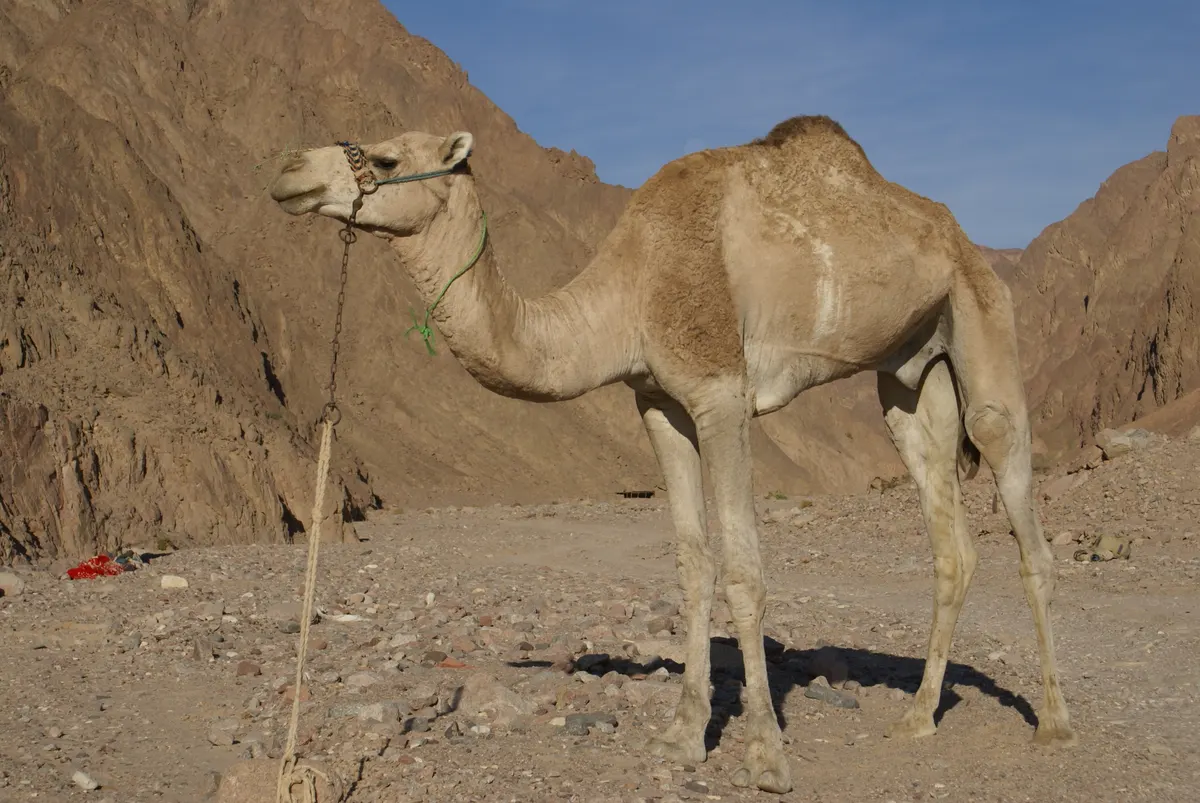
Dromedary camel standing in a rocky desert
A dromedary (Camelus dromedarius), the one-humped camel of hot deserts, stands in the Sinai.
MammaliaLeast Concern

Dromedary Camel Facts

Dromedary camels have one hump; Bactrian camels have two.

The dromedary camel is a desert mammal with one hump, built to survive extreme heat and scarce water. It has carried people and goods across deserts for thousands of years.

By · Updated

Quick Facts

Dromedary Camel at a glance

Camelus dromedariusArtiodactylaCamelidae

About their home

Kind of animal

Mammalia

Where they live

What they eat

How safe?

Least Concern

Size and speed

How heavy

660 pounds – 1500 pounds

How long

7 feet – 11 feet

How fast

Up to 40 mph in short bursts

Lifespan

40 to 50 years

Core article

Dromedary Camel: ecology and life history

A closer look at habitat, diet, behavior, reproduction, and conservation.

Start here

Dromedary Camel

For thousands of years the dromedary camel (Camelus dromedarius) has crossed deserts where almost no other large animal can survive. This one-humped herbivore is engineered for heat, sand, and long journeys on little water — and from the Sahara to Arabia it remains a working transport animal and an emblem of desert life. Nearly all camels alive today are dromedaries, and almost all are domestic or feral rather than wild.

Built for Heat: The Hump, the Feet, and Water-Saving Tricks

Dromedary camel grazing on sparse coastal vegetation
Camels eat tough desert plants, dry grasses, and thorny shrubs other grazers avoid.

Adults stand 6 to 7 feet at the hump and weigh 660 to 1,500 pounds. The single hump stores up to 80 pounds of fat, not water — a myth worth correcting; concentrating fat in one place also leaves the rest of the body less insulated, so heat escapes more easily, and the hump shrinks and flops once the reserve is spent. The real savings come from physiology and behavior: the camel lets its body temperature swing through the day so it sweats less, its kidneys make concentrated urine, and its gut reclaims so much water that the dung comes out dry. Oval red blood cells keep flowing through thickened blood when the animal is severely dehydrated and tolerate rapid dilution when it finally drinks. Long lashes, bushy brows, and closable nostrils keep sand out, and broad two-toed feet over an elastic pad spread the load on soft ground. It belongs to the family Camelidae; one hump separates it at a glance from the two-humped Bactrian camel and the wild Camelus ferus.

Where Dromedary Camels Live

Dromedary camel with rider crossing desert near the Giza pyramids
Dromedaries have been used for desert travel across North Africa and Arabia for thousands of years.

Dromedaries occupy desert and semi-desert across North Africa, the Middle East, and Arabia — from Morocco and Mauritania through Egypt, Sudan, and the Horn of Africa into Saudi Arabia, the UAE, Oman, Yemen, and parts of India. Because they are domestic or feral almost everywhere, "where camels live" is partly a question of human land use: pastoral herds move between seasonal grazing and water points, occupying gravel plains, dry steppe, and thorn scrub as much as dune seas. Australia also holds large feral herds descended from 19th-century imports, self-sustaining in the arid interior — proof of the species' tolerance, though big groups can foul waterholes and strip vegetation native animals need.

What Dromedary Camels Eat

Dromedaries are flexible herbivores, eating dry grasses, leaves, thorny shrubs, seeds, and salt-tolerant plants most animals avoid. A mobile, split upper lip picks leaves from between thorns, and a tough mouth lining resists the abrasive stems. As ruminants they regurgitate and re-chew the cud, fermenting fibre in a foregut full of microbes to wring energy from low-grade forage. They can go weeks without drinking when plants hold enough moisture, and then a dehydrated camel can gulp around 30 gallons in minutes. Claims of a fixed number of waterless days are misleading — temperature, workload, diet, and starting condition all change the answer.

Behavior: Herds, Spitting, and the Rut

Caravan of dromedary camels traveling together across Libyan desert
Herds often travel in groups led by a dominant male along established desert routes.

Wild and feral dromedaries form herds of up to 20, usually led by a dominant male, while domestic camels are managed in larger groups. They recognize familiar companions and keep spacing through posture, neck movements, calls, and scent, resting through peak heat and moving in cooler hours to save water. The famous "spitting" is really saliva mixed with regurgitated foregut contents, aimed at a threat or rival rather than used in routine contact. During the rut, males turn dangerous — inflating a soft-palate sac called the dulaa, giving off strong odors, and fighting by biting and shoving with the neck.

Life Cycle: A Single Desert-Born Calf

Young dromedary camel calf standing beside an adult
Calves can walk within hours of birth and nurse for up to a year.

After about 13 months' gestation a female bears a single calf, born with a small hump and able to stand and walk within hours — essential in open desert. The hump is not a fat store at birth; it fills out as the calf grows and begins banking surplus energy. Calves nurse for 10 to 18 months and stay close for protection, and females usually calve only every two to three years. That slow turnover, with long gestation and single births, means herds recover slowly from heavy losses. Dromedaries live 40 to 50 years, among the longest-lived hoofed mammals.

Conservation: Abundant, but a Feral Problem in Australia

Dromedary camel in an arid landscape
Dromedaries are found across North Africa, the Middle East, and South Asia, with large feral herds in the Australian outback.

The dromedary is Least Concern, with an estimated 15 million worldwide, almost all domesticated. There is no recognized surviving wild population — Australia's free-ranging animals are feral descendants of domestic stock, and the rare camels of the Gobi are the distinct two-humped Camelus ferus, not wild dromedaries. Domestic herds are numerous, but particular breeds and pastoral systems remain vulnerable to prolonged drought, disease, lost grazing access, and shrinking genetic diversity. In Australia the aim flips: feral camels crowd water sources and damage native plants, so control programs and commercial harvest are used in places — a reminder that global conservation status and local ecological impact are separate questions.

References and Authoritative Sources

Dromedary Camel: classification and fun facts

Classification

Scientific Taxonomy
  1. Kingdom

    Animalia

  2. Phylum

    Chordata

  3. Class

    Mammalia

  4. Order

    Artiodactyla

  5. Family

    Camelidae

  6. Genus

    Camelus

  7. Species

    C. dromedarius

Did You Know?

Fun Facts

1

Dromedary camels have one hump; Bactrian camels have two.

2

A camel's hump stores fat, not water — the fat provides energy when food is scarce.

3

Camels can drink up to 30 gallons of water in one session after a long dry period.

4

They have three eyelids and two rows of eyelashes to keep sand out.

5

Dromedary camels are the tallest camels and are sometimes called ships of the desert.

6

Their red blood cells are oval-shaped, so they keep flowing even when dehydrated.

Common Questions

FAQ about Dromedary Camel

Select a question to reveal the answer.

What is a dromedary camel?

A dromedary camel is a large desert mammal with a single hump. It is the most common camel species and lives in hot deserts of Africa and the Middle East.

Where do dromedary camels live?

They live in desert habitats across North Africa, the Arabian Peninsula, the Middle East, and parts of South Asia. Feral populations also exist in Australia.

Why do camels have humps?

The hump stores fat that camels can burn for energy when food and water are hard to find. It is not a water tank.

What do camels eat?

Dromedary camels are herbivores that eat dry grasses, leaves, thorny plants, and desert shrubs that many animals cannot digest.

How do camels survive in the desert?

They conserve water with efficient kidneys, tolerate high body heat, store fat in their hump, and have padded feet and protective eyelashes for sandy conditions.

What is a baby camel called?

A baby camel is called a calf. Calves can stand and walk within hours of birth.

Show 1 more questionsExpand
Are dromedary camels endangered?

Dromedary camels are listed as Least Concern. Millions are kept as domestic animals, though wild populations are rare.