
Mobula birostris / Rhincodon typus
Manta Ray vs Whale Shark
Both animals are immense filter feeders in warm seas, but one is a ray with wing-like fins and the other is the world's largest fish.
By An Nguyen · Updated
At a glance
Published species data from both WildlifeDB profiles, aligned trait by trait. Size metrics highlight the larger value with a relative bar.
- Scientific name
- Giant Oceanic Manta RayMobula birostris
- Whale SharkRhincodon typus
- Classification
- Giant Oceanic Manta RayChondrichthyes · Mobulidae
- Whale SharkChondrichthyes · Rhincodontidae
- Native range
- Giant Oceanic Manta RayWorldwide
- Whale SharkWorldwide
- Primary habitat
- Giant Oceanic Manta RayOcean
- Whale SharkOcean
- Diet
- Giant Oceanic Manta RayCarnivore
- Whale SharkCarnivore
- Typical food
- Giant Oceanic Manta RayZooplankton, Krill, Small shrimp, Tiny fish
- Whale SharkPlankton, Krill, Fish eggs, Small fish, Shrimp
- Body length
- Giant Oceanic Manta Ray11 feet – 23 feet
- Whale Shark18 feet – 40 feet
- Shoulder height
- Giant Oceanic Manta Ray—
- Whale Shark—
- Weight
- Giant Oceanic Manta Ray1,500 pounds – 4,000 pounds
- Whale Shark15,000 pounds – 40,000 pounds
- Top speed
- Giant Oceanic Manta RayPowerful gliding swimmer in open water
- Whale SharkAbout 3 mph on long ocean cruises
- Wild lifespan
- Giant Oceanic Manta Ray40 years or more
- Whale Shark70 to 100 years
- Social pattern
- Giant Oceanic Manta RayLong-distance migration, Filter feeding, Barrel rolling while feeding
- Whale SharkSlow ocean cruising, Filter feeding, Surface feeding
- Key adaptations
- Giant Oceanic Manta RayCephalic lobes for funneling food, Gill filter plates, Cartilage skeleton
- Whale SharkVery wide mouth, Gill filters for trapping food, Thick spotted skin
- Conservation
- Giant Oceanic Manta RayEndangered · Decreasing
- Whale SharkEndangered · Decreasing
- Reproduction
- Giant Oceanic Manta RayAbout 12 to 13 months; Usually 1 pup
- Whale SharkProbably more than 12 months; Many pups may develop in one mother
A flattened ray against a torpedo-shaped shark
The giant oceanic manta ray, Mobula birostris, is flattened top to bottom and swims by flapping broad pectoral fins like underwater wings. The whale shark, Rhincodon typus, has the familiar torpedo-shaped shark profile and swims with its tail.
Both are cartilaginous fish, but from different branches of that group — the manta is a ray in the family Mobulidae, the whale shark a shark in Rhincodontidae. Despite the name, a whale shark is a fish that breathes with gills, not a whale.
Cephalic lobes beside the mouth
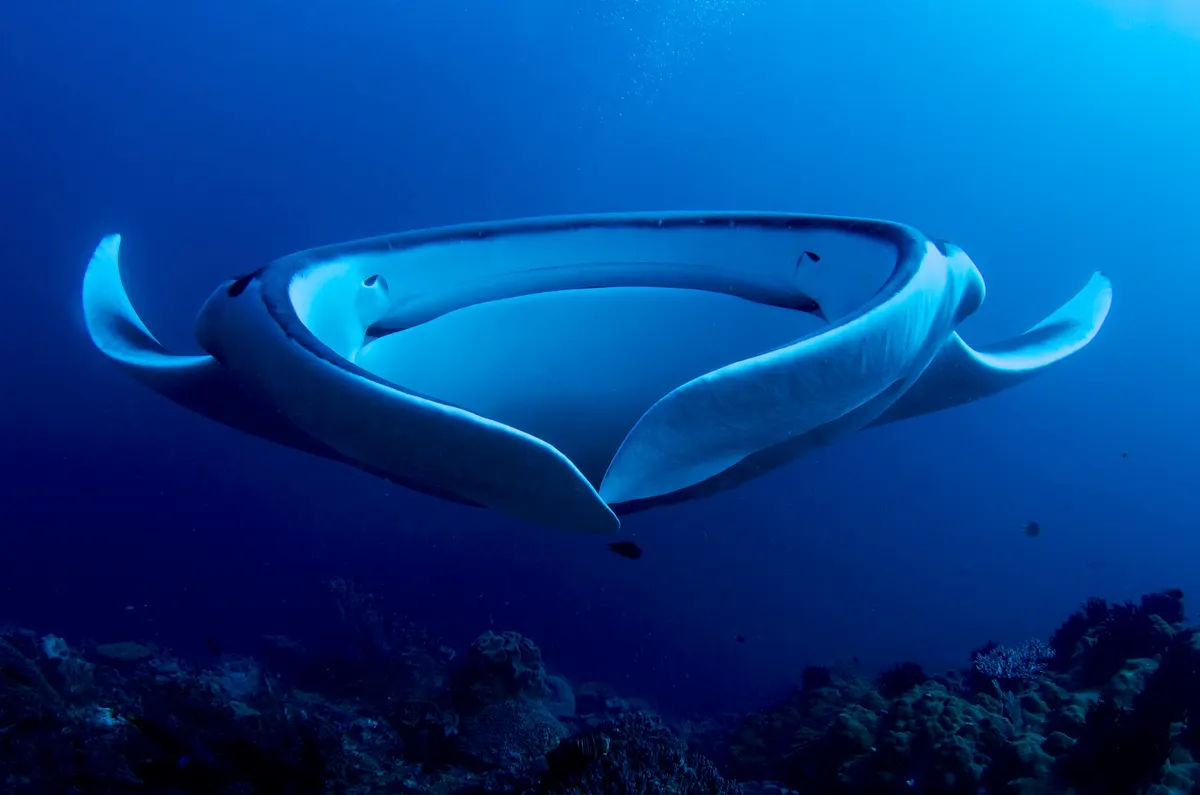
The manta's clearest anatomical signature is a pair of fins beside the mouth called cephalic lobes, which funnel food-rich water inward while feeding. No shark has them.
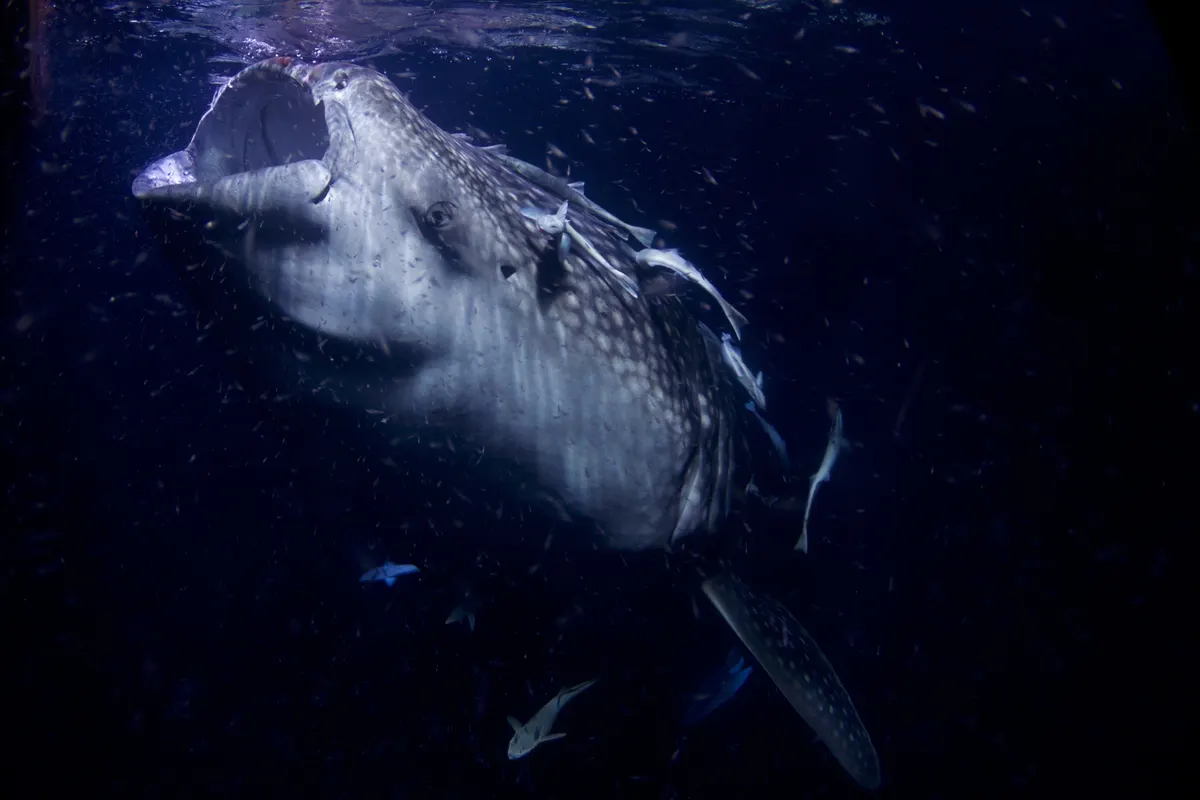
The whale shark's signature is the mouth itself: exceptionally wide and set at the front of the head, rather than underslung as in most sharks. Between the lobes and the mouth position, a single photograph of the head resolves this pair.
Wingspan is not body length
Giant manta rays reach about 11–23 feet and 1,500–4,000 pounds in these records. Whale sharks run roughly 18–40 feet and 15,000–40,000 pounds — around ten times the mass.
The trap is measuring the wrong dimension. A manta's visual span is dominated by the width of its pectoral fins, so it can look enormous passing overhead while its body remains far smaller than a large whale shark's. Wingspan and body length are not the same metric and should not be compared directly.
Movement style separates them even from a brief look at the surface: a manta glides and flaps, a whale shark cruises at about 3 mph on long ocean crossings.
Both strain plankton, neither chases
Both are recorded as carnivores, which describes animal prey rather than predatory hunting. Zooplankton, krill, small shrimp, and tiny fish pass through the manta's system, funnelled by the cephalic lobes toward specialised gill plates that strain them out. Whale sharks take plankton, krill, fish eggs, small fish, and shrimp, drawing in large volumes of water and retaining food with filtering structures around the gills.
Filter feeding is not passive drifting. Both animals have to find dense, patchy food and travel efficiently between those patches, which is why both make long migrations and both aggregate predictably where seasonal blooms or spawning events concentrate prey.
Individual markings that researchers can read
Each whale shark has a unique pattern of white spots and stripes, and each manta has individual markings, so both species support photo-identification. That is how much of what is known about their movements was established without tagging every animal.
Mantas also visit reef cleaning stations where smaller fish remove parasites, barrel-roll while feeding, and sometimes breach clear of the surface. Their dark upper surface and pale underside create countershading that breaks up the outline in open water. Manta rays have the largest brain-to-body ratio of any fish, and unlike many rays they have no stinging tail.
Slow to mature, slow to recover
Both species mature slowly and produce few young relative to most fish. A manta usually bears a single pup after 12 to 13 months, already 4 to 5 feet across at birth. Whale shark reproduction is less well documented — many pups may develop in one mother, over a gestation probably exceeding 12 months — and juveniles are rarely seen, so where they grow up remains largely unknown.
That life history is the reason population recovery is slow whenever adult survival drops. Neither animal's size protects it.
Two Endangered species in shared water
Warm oceans worldwide provide the setting for both, especially tropical to warm-temperate water. Mantas often use offshore waters, seamounts, reef edges, and coastal cleaning stations. Whale sharks occur offshore and near coasts, gathering where plankton blooms create concentrated food. They can share a bay on one day and use different depths on the next, so a sighting location identifies neither.
Both are Endangered with decreasing trends. Their ocean range is wide enough that neither can be protected by a single country: targeted fishing, bycatch, vessel strikes, and disturbance at aggregation sites all need international management, and tourism at predictable gathering sites makes local operating rules matter.