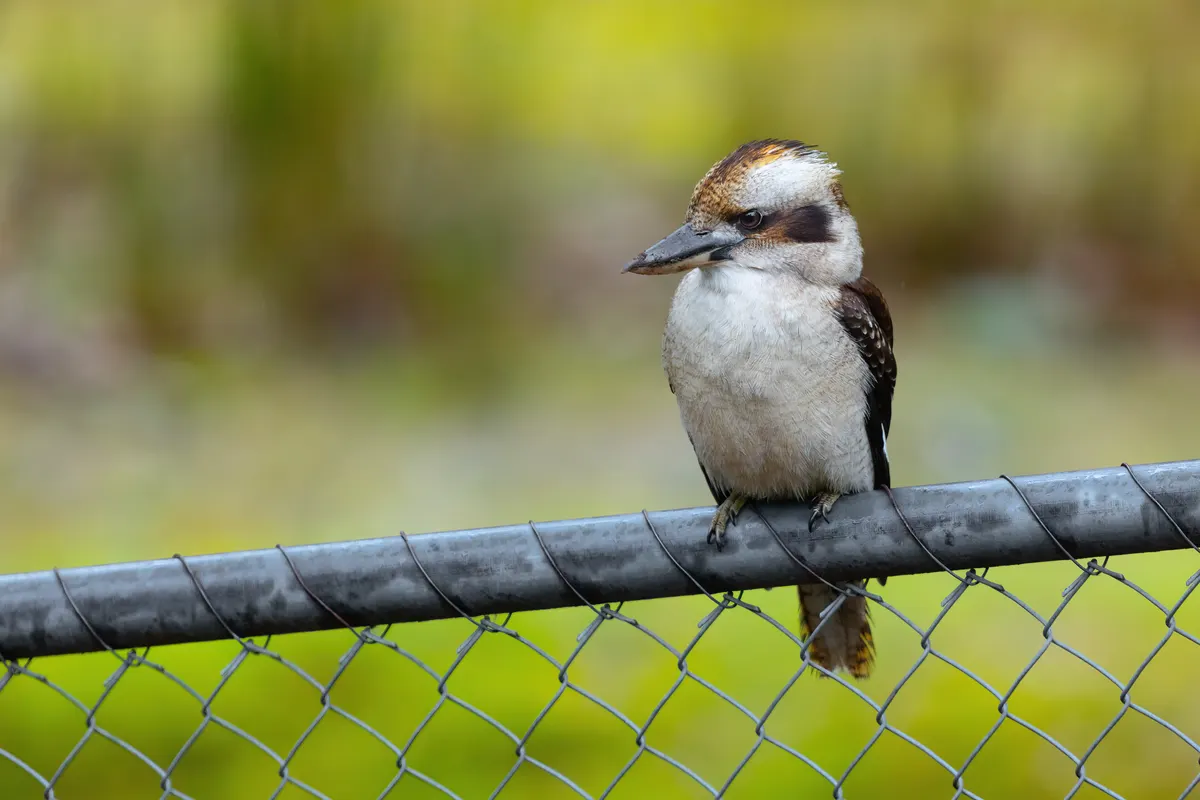
Laughing kookaburra perched on a branch with its heavy bill in profile
The laughing kookaburra is a large terrestrial kingfisher native to eastern Australia.
AvesLeast Concern

Laughing Kookaburra

The laughing call is a territorial warning delivered by several family members together.

The laughing kookaburra is a large terrestrial kingfisher native to eastern Australia. Its famous cackle is a territorial chorus, not laughter. Family groups defend the same area year-round, watch for prey from exposed perches and cooperate to raise chicks in tree hollows or arboreal termite nests.

By · Updated

Quick Facts

Laughing Kookaburra at a glance

Dacelo novaeguineaeCoraciiformesAlcedinidae

About their home

Kind of animal

Aves

Where they live

What they eat

How safe?

Least Concern

Size and speed

How heavy

300 g – 450 g

How long

40 cm – 45 cm

How fast

Lifespan

Often more than 15 years

Core article

Laughing Kookaburra: ecology and life history

A closer look at habitat, diet, behavior, reproduction, and conservation.

Start here

Laughing Kookaburra

The sound that gives the laughing kookaburra its name is not casual noise. A low chuckle builds into a rolling cackle, other birds join, and a family announces that its territory is occupied. The chorus is one of eastern Australia's most familiar natural sounds, but it belongs to a practical predator: a large kingfisher that watches the ground from a branch and drops onto insects, reptiles and small mammals.

Dacelo novaeguineae is native to eastern Australia and has adapted readily to parks and suburbs where old trees, prey and nesting hollows remain. It belongs to the kingfisher family, yet it catches relatively little fish. Its bill and hunting style are directed mainly at life on land.

A Terrestrial Kingfisher

At 40 to 45 cm long, the laughing kookaburra is one of the largest kingfishers. It has a heavy head, a long powerful bill and a compact body. The back and wings are brown, the underside is cream to white and a dark stripe runs through each eye. Black bars cross the reddish tail, while patches of pale blue may show on the wings.

Males and females look similar. Females average slightly larger, while males tend to show more blue on the rump and tail. Juveniles have shorter, darker bills and more pale edging on the back feathers.

The bill is built to grip rather than spear fish. Strong neck muscles help the bird strike larger prey against a perch. Its eyes face sufficiently forward to judge distance during the short plunge from lookout to ground.

Habitat and Range

Laughing kookaburra perched in wet woodland during rain
Old trees provide both exposed hunting perches and the hollows needed for nesting.

The native range follows eastern and southeastern Australia, from Cape York Peninsula through Queensland and New South Wales to Victoria and parts of South Australia. Laughing kookaburras occupy open forest, eucalypt woodland, wooded watercourses and coastal bush. They also use farms, urban parks and gardens.

Suitable trees matter for two separate reasons. Exposed branches provide hunting perches, while large old trunks supply nesting hollows. A landscape may still look wooded yet support fewer breeding birds if repeated clearing and removal of dead limbs eliminate cavities.

People introduced the species outside its original range, including Tasmania and southwestern Western Australia from the late nineteenth century, as well as parts of New Zealand. Introduced populations can prey on local reptiles, birds and insects, so the bird's familiar status in eastern Australia should not be confused with ecological harmlessness everywhere it occurs.

Diet and Perch Hunting

Laughing kookaburra scanning from a tree perch in open woodland
Insects, lizards, snakes, frogs, rodents and crayfish are located from a lookout and caught in a short plunge.

Laughing kookaburras are carnivores. Large insects often dominate the number of prey taken, but lizards, small snakes, frogs, mice, young birds, worms, snails and freshwater crayfish are also eaten. The exact mix depends on habitat and season.

A hunting bird sits still on a branch, fence or powerline and scans the ground. When it detects movement, it drops rapidly, catches the animal in its bill and returns to a perch. Small prey may be swallowed immediately. Larger, struggling prey is struck repeatedly against the branch until it is subdued and positioned head-first.

This behavior explains why scraps offered by people are sometimes beaten against a perch even though they are already dead. Feeding kookaburras is still discouraged: processed meat lacks the whole bones, organs and other nutrients present in natural prey, and hand-feeding can encourage aggressive food-snatching.

Family Behavior and the Laughing Chorus

Laughing kookaburra calling from a raised perch
Family members combine their voices in a chorus that advertises an occupied territory.

Laughing kookaburras live in stable family groups. A breeding pair occupies a territory throughout the year, joined by one or more offspring from previous seasons. At dawn and dusk, members call together. The combined chorus carries farther and presents a stronger signal than one bird calling alone.

The famous sequence begins with chuckles and rises into loud cackles, often triggering a neighboring group to answer. Kookaburras also use shorter calls, squawks and soft contact notes within the family. Bill sparring and posture help establish rank without every dispute becoming a serious fight.

The family system is cooperative. Helpers—usually young birds one or two years old—assist with incubation, feed nestlings and defend the territory. Remaining at home costs them an immediate chance to breed, but it increases the survival of close relatives and lets young birds gain experience before securing a territory of their own.

Life Cycle: Chicks and Cooperative Breeding

Young laughing kookaburra looking from the entrance of a tree-termite nest
Chicks hatch in a bare tree cavity after about 24 to 26 days of shared incubation.

Breeding usually occurs from August to January. The pair nests in a natural tree hollow or a chamber in an arboreal termite mound; it does not build a conventional stick nest. The bare cavity holds a clutch of two to four white eggs.

Incubation lasts about 24 to 26 days and is shared by adults and helpers. Chicks hatch naked, blind and with a short black bill. Competition inside the confined hollow can be intense, especially when food is limited, and the youngest chick does not always survive.

After fledging, juveniles remain dependent while learning to locate and handle prey. Many stay in the family territory for one or more breeding seasons. That extended association creates the helper system seen around the next clutch.

Conservation and Urban Pressures

Laughing kookaburra perched in vegetation in Tasmania
The species remains widespread, but retaining mature hollow-bearing trees is essential for local breeding.

The laughing kookaburra is classified as Least Concern because it has a broad range and remains common in many places. It also tolerates modified landscapes better than many hollow-nesting birds. Parks and suburbs can provide lawns for hunting and scattered trees for perches.

Adaptability has limits. Clearing old woodland removes nest hollows, while vehicle strikes, window collisions, entanglement and attacks by cats or foxes cause local deaths. Pesticides can reduce insect prey. Kookaburras may also lose cavities to other hollow-nesting birds or introduced species.

Retaining mature trees and dead limbs where they are safe is more useful than feeding birds. Nest boxes can supplement missing hollows, but they must be built, placed and monitored for the species; a generic box can attract competitors or overheat.

Taxonomy and Name

The laughing kookaburra belongs to the tree-kingfisher subfamily Halcyoninae within Alcedinidae. Its genus, Dacelo, contains the kookaburras of Australia and New Guinea. The blue-winged kookaburra overlaps its range in parts of northern and eastern Australia but has brighter blue wings, a paler eye and a different call.

The older scientific name Dacelo gigas appears in historical sources. The accepted species name is Dacelo novaeguineae, even though the bird is native to Australia rather than New Guinea. The geographic mismatch traces back to an erroneous locality attached to early specimens.

References and Authoritative Sources

Laughing Kookaburra: classification and fun facts

Classification

Scientific Taxonomy
  1. Kingdom

    Animalia

  2. Phylum

    Chordata

  3. Class

    Aves

  4. Order

    Coraciiformes

  5. Family

    Alcedinidae

  6. Genus

    Dacelo

  7. Species

    D. novaeguineae

Did You Know?

Fun Facts

1

The laughing call is a territorial warning delivered by several family members together.

2

Despite being a kingfisher, the species catches much of its food on land rather than in water.

3

A kookaburra may repeatedly strike a snake or lizard against its perch before swallowing it.

4

Young birds often remain with their parents for one or more breeding seasons and help raise later broods.

5

The species is native to eastern Australia but was introduced to Tasmania, southwestern Western Australia and New Zealand.

6

Laughing kookaburras can remain in the same defended territory throughout the year.

Common Questions

FAQ about Laughing Kookaburra

Select a question to reveal the answer.

Why do laughing kookaburras laugh?

The sound is a territorial chorus rather than an expression of amusement. A family group calls together, especially around dawn and dusk, to warn neighboring kookaburras that the territory is occupied.

Is a laughing kookaburra a kingfisher?

Yes. The laughing kookaburra (*Dacelo novaeguineae*) belongs to the kingfisher family Alcedinidae. Unlike many fish-catching relatives, it is a terrestrial hunter that often takes prey from the ground.

Where do laughing kookaburras live?

They are native to forests, woodlands, parks and gardens of eastern Australia. People introduced them to Tasmania, southwestern Western Australia and parts of New Zealand.

What do laughing kookaburras eat?

They eat large insects, lizards, snakes, frogs, rodents, small birds and freshwater crayfish. A bird usually watches from a perch, drops onto prey and carries larger items back to a branch.

Do laughing kookaburras mate for life?

Pairs form long-lasting bonds and may remain together for many years. They occupy a stable territory with helper birds, usually offspring from earlier broods, but 'for life' is difficult to confirm for every wild pair.

How do kookaburra families raise chicks?

Both parents incubate and feed the young. Older offspring often stay in the territory as helpers, contributing food, nest defense and incubation during later breeding seasons.