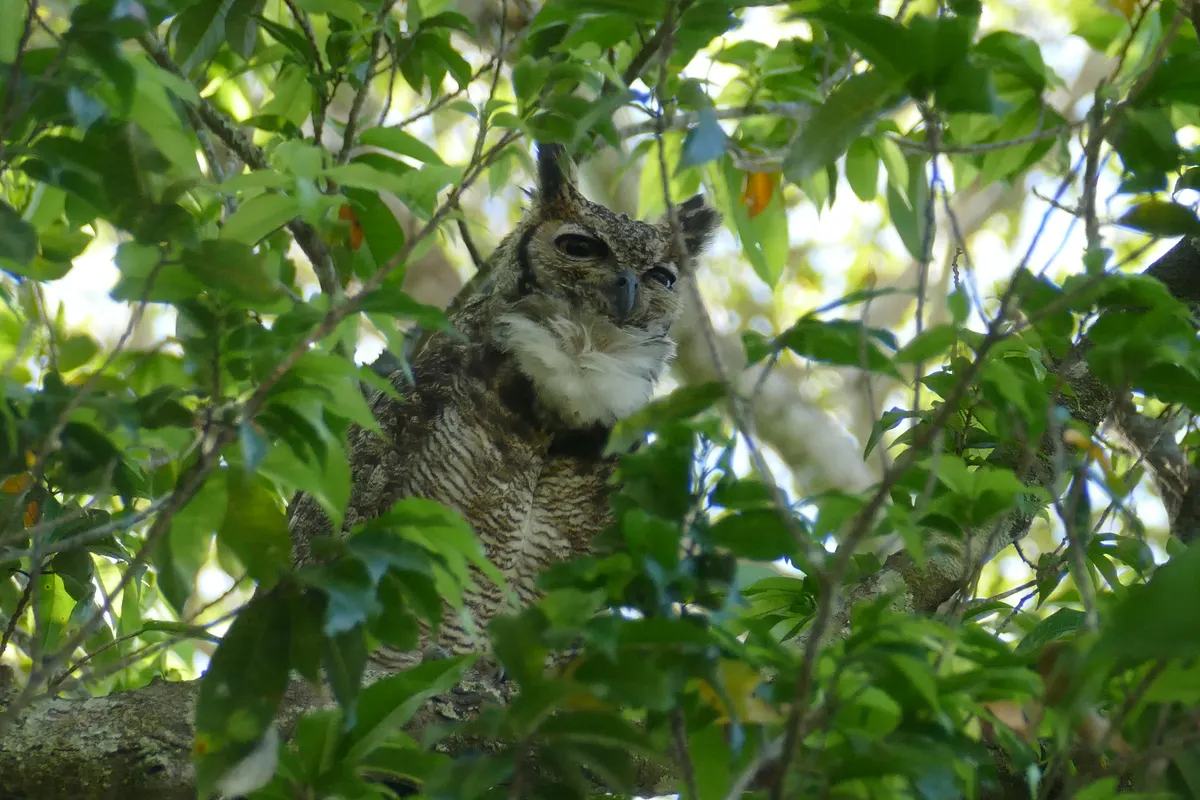
Great horned owl perched with ear tufts raised
Great horned owls are powerful night hunters with sharp talons and excellent hearing.
AvesLeast Concern

Great Horned Owl Facts

Great horned owls can rotate their heads far to the side, but not all the way around.

Great horned owls are powerful nocturnal raptors found from Arctic treelines to tropical American forests and cities. Ear tufts form part of their silhouette rather than their hearing system, while large talons let them take prey from rodents to rabbits and other birds.

By · Updated

Quick Facts

Great Horned Owl at a glance

Bubo virginianusStrigiformesStrigidae

About their home

Kind of animal

Aves

Where they live

What they eat

How safe?

Least Concern

Size and speed

How heavy

2.5 pounds – 5.5 pounds

How long

18 inches – 25 inches

How fast

Up to 40 mph in a dive

Lifespan

13 to 15 years

Core article

Great Horned Owl: ecology and life history

A closer look at habitat, diet, behavior, reproduction, and conservation.

Start here

Great Horned Owl

The great horned owl (Bubo virginianus) is a large nocturnal raptor found across the Americas. Its prominent feather tufts are not horns, and its yellow eyes, broad wings, and deep hoot make it easy to recognize. Soft-edged flight feathers reduce noise as it approaches prey. The species occupies habitats ranging from boreal forest and desert to farmland and city parks.

Taxonomy and Evolution

Classified within the kingdom Animalia, phylum Chordata, and class Aves, the great horned owl belongs to the order Strigiformes (owls). Within this order, it is placed in the family Strigidae, which encompasses the vast majority of "typical owls" globally, as opposed to the barn owls (Tytonidae). Its scientific name is Bubo virginianus.

The genus Bubo contains the eagle-owls, a group of large owls adapted to hunting in low light. The great horned owl is closely related to the Eurasian eagle-owl (Bubo bubo). Both share broad wings, feathered legs, strong feet, and plumage that helps reduce flight noise.

Anatomy and Physical Characteristics

The great horned owl is a heavily built raptor. Females are generally larger and heavier than males, a pattern known as reversed sexual dimorphism. Adults range from about 18 to 25 inches long, with a wingspan of roughly 3.3 to 4.8 feet and a weight of about 2.5 to 5.5 pounds.

Their tubular eyes are fixed in their sockets, so flexible neck vertebrae allow the head to rotate as much as 270 degrees. A high concentration of rod cells and a reflective layer called the tapetum lucidum support vision in low light.

Their hearing is equally unique. The flat, bowl-shaped arrangement of feathers on their face—known as the facial disk—acts like a parabolic acoustic reflector, channeling the faintest rustling sounds of rodents directly into their asymmetrical ear openings. This asymmetry allows the owl to precisely triangulate the exact vertical and horizontal location of hidden prey in absolute darkness.

The most lethal physical adaptation is their talons. A great horned owl possesses a crushing grip strength requiring up to 28 pounds of force to open, easily sufficient to instantly sever the spine of heavy prey. Furthermore, their flight feathers possess microscopic, comb-like serrations on the leading edges that break up aerodynamic turbulence, completely muffling the sound of air rushing over the wings, allowing for utterly silent, phantom-like flight.

Habitat and Distribution

Great horned owl perched on a branch in woodland
These adaptable owls nest in trees, cliffs, and old nests left by other birds.

The great horned owl is arguably the most widely distributed true owl in the Americas. Their geographic range is massive, extending continuously from the boreal treeline of Alaska and northern Canada, throughout the entirety of the United States and Mexico, and deep into South America, reaching as far south as Argentina and Brazil.

This immense distribution is a reflection of their profound ecological adaptability. They do not require a specific biome; they thrive in dense temperate and boreal forests, open grasslands, arid deserts, tropical rainforest edges, mangrove swamps, and even highly urbanized city parks and agricultural regions. Their only strict habitat requirement is the presence of elevated perches for hunting and suitable nesting sites.

Diet and Feeding Strategies

Great horned owl perched and ready to hunt
They hunt at night, using hearing and sight to locate prey in darkness.

The great horned owl is a fiercely opportunistic, hyper-carnivorous apex predator. Their diet is the most diverse of any North American raptor, heavily dictated by local prey abundance rather than strict specialization.

While they predominantly hunt small to medium-sized mammals such as rabbits, hares, rats, mice, and voles, they are entirely capable of killing massive prey. They are one of the few natural predators of the striped skunk, completely undeterred by the skunk's noxious defensive spray (owls possess a notoriously poor sense of smell). They also heavily predate upon other birds, including ducks, geese, crows, and even other raptors like ospreys, falcons, and smaller owl species.

Their primary hunting strategy is the "perch-and-pounce." An owl will sit completely motionless on an elevated branch, utilizing its facial disk to acoustically scan the forest floor. Once a target is pinpointed, the owl drops into a silent, plunging dive, extending its massive, razor-sharp talons at the last possible second to impale the victim. Because they lack teeth, they swallow small prey entirely whole. Hours later, the owl's highly acidic stomach digests the meat, and the indigestible bones, fur, and feathers are compacted into a dense pellet which the owl regurgitates (coughs up).

Social Structure and Behavior

Great horned owl chicks in a nest waiting for food
Both parents bring food to the nest while chicks grow flight feathers.

Great horned owls are fiercely solitary and fiercely territorial outside of the breeding season. They establish massive home ranges that they aggressively defend against conspecifics and other large raptors.

Their acoustic communication is highly territorial. The classic, deep, resonant "hoo-h'HOO-hoo-hoo" vocalization is primarily utilized by males to advertise their territory and attract a mate. These low-frequency calls can penetrate dense forest vegetation and carry for several miles on a quiet night. When defending a nest from predators or humans, they exhibit aggressive threat displays, aggressively snapping their beaks, hissing, and flaring their massive wings to appear larger.

Life Cycle and Reproduction

Downy great horned owl chick in a tree nest
Young owls practice flapping and hopping on branches before their first flight.

Great horned owls are among the earliest nesting birds in North America, frequently initiating courtship and breeding in the dead of winter (January or February), often while snow still covers the landscape.

Interestingly, they do not build their own nests. They are aggressive nest parasites, actively taking over the abandoned or forcefully stolen massive stick nests of red-tailed hawks, eagles, herons, or crows. They will also utilize large tree hollows or cliff ledges.

The female typically lays a clutch of 2 to 3 dull white eggs. Because they nest in freezing temperatures, the female must incubate the eggs almost continuously for 30 to 37 days to prevent them from freezing, relying entirely on the male to hunt and deliver food to the nest. The chicks hatch covered in dense, white down and are entirely blind and helpless. They grow rapidly on a high-protein diet of rodents and rabbits. At around 6 weeks of age, the chicks begin "branching"—climbing out of the nest onto nearby limbs before they can actually fly. True flight is achieved around 9 to 10 weeks, though the parents continue to aggressively defend and feed the fledglings for several more months. In the wild, they typically live 13 to 15 years, though some banded individuals have reached nearly 30 years of age.

Conservation Status and Threats

Great horned owl in a cold mountain forest setting
Great horned owls are widespread and not considered endangered across most of their range.

(Population and conservation trend data sourced from the IUCN Red List of Threatened Species)

The IUCN Red List officially categorizes the great horned owl (Bubo virginianus) as a species of "Least Concern." Their extreme dietary and habitat plasticity grants their populations incredible resilience, and they maintain a massive, stable global population numbering in the millions.

Because they are apex predators, adult great horned owls face virtually no natural predators, though unguarded chicks are occasionally taken by eagles or mammalian scavengers. However, they are highly susceptible to anthropogenic threats. The most significant localized threat is secondary poisoning from anticoagulant rodenticides; when an owl consumes a rat that has ingested rat poison, the owl rapidly bleeds to death internally. Furthermore, due to their low-level flight paths while hunting at night, they are frequently victims of fatal vehicle collisions on rural highways. Despite these localized mortalities, the great horned owl remains one of the most successful and widespread raptors in the Western Hemisphere.

References and Authoritative Sources

Great Horned Owl: classification and fun facts

Classification

Scientific Taxonomy
  1. Kingdom

    Animalia

  2. Phylum

    Chordata

  3. Class

    Aves

  4. Order

    Strigiformes

  5. Family

    Strigidae

  6. Genus

    Bubo

  7. Species

    B. virginianus

Did You Know?

Fun Facts

1

Great horned owls can rotate their heads far to the side, but not all the way around.

2

Special wing feathers help owls fly almost silently.

3

Their "horns" are really feather tufts, not ears.

4

A great horned owl's grip can be as strong as a large dog's bite.

5

Owls swallow small prey whole and later cough up pellets of fur and bone.

6

Their deep hoots can carry for miles on a quiet night.

Common Questions

FAQ about Great Horned Owl

Select a question to reveal the answer.

What is a great horned owl?

A great horned owl is a large bird of prey active mostly at night and found across the Americas.

Where do great horned owls live?

Great horned owls live in forests, deserts, grasslands, and even city parks from Canada and Alaska south through the Americas.

What do great horned owls eat?

Owls are carnivores that eat rabbits, rats, mice, birds, and other small animals they catch with their talons.

Why do owls hoot?

Owls hoot to defend territory and communicate with mates. A great horned owl's deep hoot is one of the most familiar owl sounds.

How do owls hunt in the dark?

Owls use excellent hearing and night vision. They perch quietly, listen for prey, then swoop down with silent wings.

Are owls endangered?

Great horned owls are listed as Least Concern and remain widespread. Local threats include car strikes and habitat loss.

Show 1 more questionsExpand
What is a baby owl called?

A baby owl is called a chick or owlet. Chicks hatch blind and helpless and depend on their parents for food.