Pufferfish Facts
"Pufferfish can swallow water or air to puff into a spiky ball."
Guinea fowl pufferfish are round reef fish with white spots that can puff up like a balloon and defend themselves with powerful toxins.
Loading page content

"Pufferfish can swallow water or air to puff into a spiky ball."
Guinea fowl pufferfish are round reef fish with white spots that can puff up like a balloon and defend themselves with powerful toxins.
Arothron meleagrisTetraodontiformesTetraodontidae
Explore arothron meleagris photos organized for learning and classroom observation.
Click any photo to view it larger. 8 images available.
Core article
Habitat, diet, behavior, and more — everything on one page.
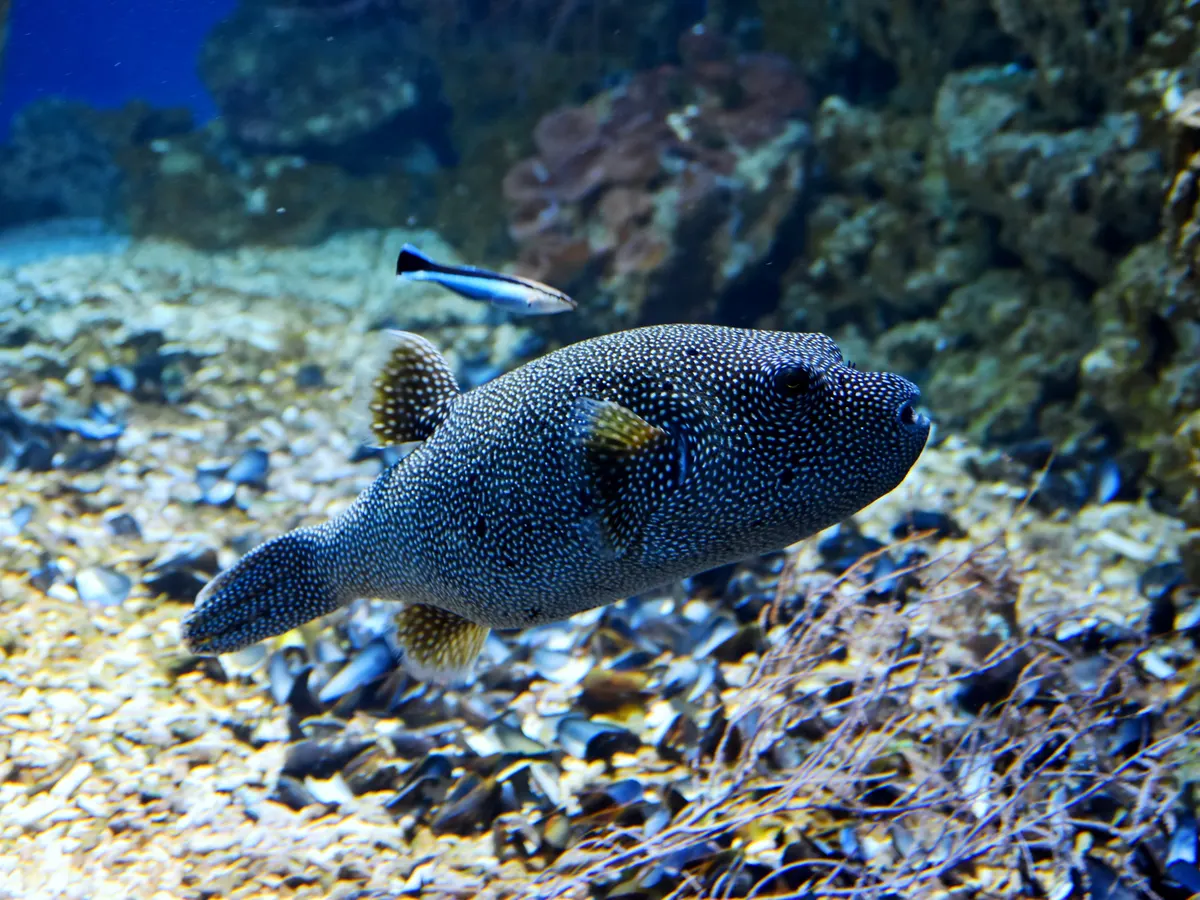
The pufferfish, with its comical, highly modified morphology and seemingly clumsy swimming style, is one of the most recognizable and chemically complex inhabitants of global reef systems. Known for their unique ability to dramatically inflate their bodies into rigid, spiky spheres when threatened, these fish utilize a highly specialized biomechanical defense mechanism that renders them nearly impossible to swallow. Among the diverse species, the Guinea fowl pufferfish (Arothron meleagris) stands out with its striking pattern of bright white spots scattered across a dark background, mimicking the plumage of the terrestrial bird it is named after. However, their true biological fascinating example lies unseen; pufferfish are notoriously armed with tetrodotoxin, a neurotoxin thousands of times more lethal than cyanide. Navigating a life heavily armored by physical inflation and lethal biochemistry, the pufferfish is a remarkable example of extreme evolutionary adaptation in the highly competitive environment of the coral reef.
The pufferfish belongs to the kingdom Animalia, phylum Chordata, and class Actinopterygii (ray-finned fishes). They are firmly situated within the order Tetraodontiformes, a highly derived group of fishes that includes boxfishes, filefishes, and triggerfishes. The pufferfish family itself is Tetraodontidae, which translates roughly to "four-toothed," referencing their specialized dental structure. The Guinea fowl pufferfish specifically falls under the genus Arothron.
Evolutionarily, the Tetraodontiformes represent a significant departure from the standard fusiform (torpedo-shaped) body plan of typical teleost fishes. Millions of years of selective pressure in complex, predator-rich reef environments drove a profound morphological shift. They sacrificed sustained, high-speed swimming capabilities for extreme maneuverability and impenetrable defense. Their bodies shortened and became rigid, losing typical scales in favor of tough, leathery skin often embedded with small, hidden spines. This evolutionary trajectory allowed them to exploit specific ecological niches, foraging deliberately among sharp corals where fast, open-water predators cannot easily navigate.
The anatomy of the pufferfish is distinctly bizarre and highly specialized for defense and specialized feeding. The Guinea fowl pufferfish is a medium-sized species, typically ranging from 8 to 12 inches in length and weighing between 2 to 4 pounds. They lack pelvic fins entirely, and their dorsal and anal fins are set far back near the tail, leaving them heavily reliant on their small pectoral fins for a slow, highly maneuverable, hovering style of swimming.
Their most famous anatomical feature is, unequivocally, their inflatable stomach. When a pufferfish is severely stressed or attacked, it rapidly unhinges a specialized valve at the base of its mouth, violently gulping massive quantities of surrounding water (or air, if removed from the water). This forces their highly elastic stomach to expand rapidly. Because their spine is highly flexible and they lack ribs, their tough, leathery skin stretches dramatically, transforming the fish into a rigid, spherical balloon, often erecting hidden spines in the process. This sudden massive increase in volume makes them physically impossible for most predators to fit inside their jaws.
Furthermore, the name Tetraodontidae ("four teeth") refers to their highly modified jaws. Their teeth are permanently fused together into a solid, incredibly powerful beak, with a distinct dividing suture down the middle of the upper and lower jaws. This heavy-duty oral hardware is driven by massive jaw muscles, allowing them to easily crush the hard calcium carbonate shells and exoskeletons of their heavily armored reef prey.
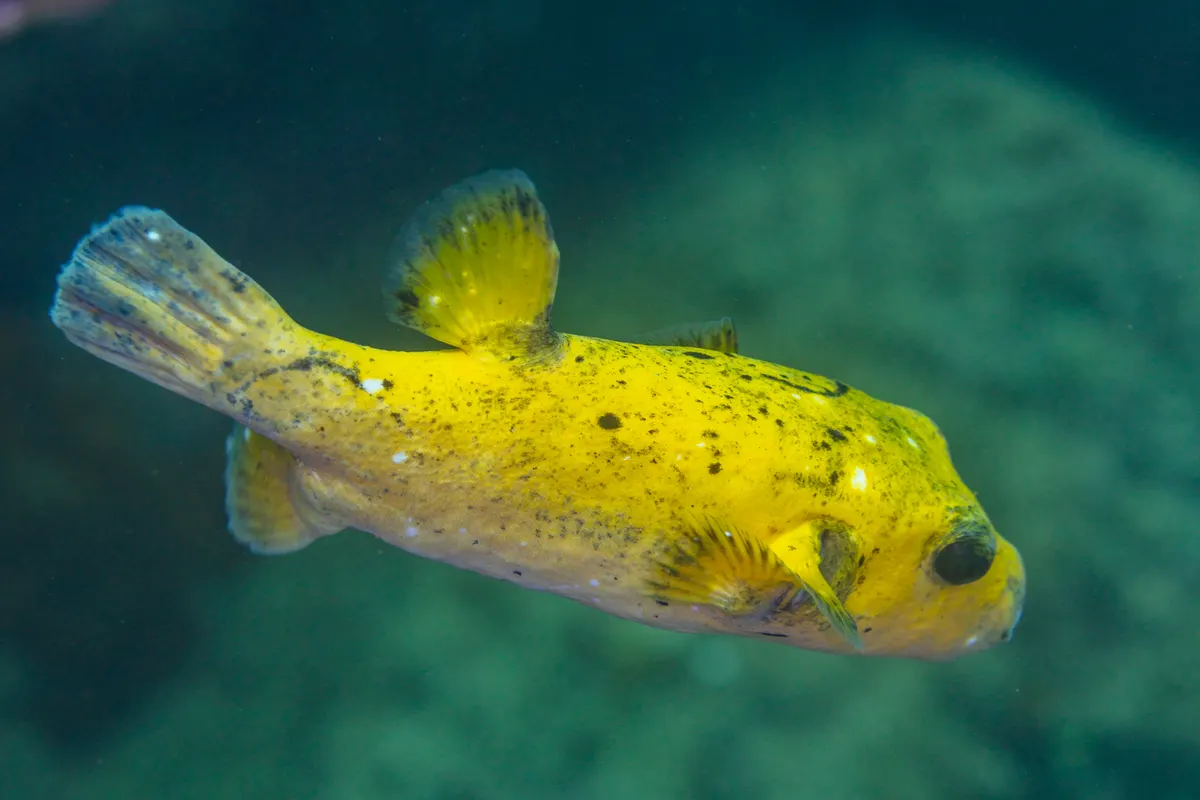
Finally, the Guinea fowl pufferfish has a fascinating capability for dramatic color morphing. While typically dark brown or black with bright white spots (the "guinea fowl" phase), they can transition completely into a bright, solid golden-yellow phase, a phenomenon that is not fully understood but is likely related to camouflage and social signaling within the complex visual environment of the reef.

Guinea fowl pufferfish and their relatives are primarily distributed across the vast, warm waters of the Indo-Pacific region, establishing a presence across the coasts of North America, South America, Africa, and Asia. Specific countries hosting robust populations include Mexico, Ecuador (particularly the Galápagos Islands), Indonesia, the Philippines, and Japan.
Their obligate habitat is the marine biome, specifically heavily structured, shallow-water coral reefs, rocky inshore reefs, and occasionally adjacent seagrass beds. They are highly dependent on the complex topography of these environments. The labyrinthine structure of coral reefs provides essential crevices and caves for the slow-moving pufferfish to hide from large, open-water predators like sharks, while simultaneously supplying a dense, constant source of the benthic invertebrates they rely upon for food. They generally prefer clear, sunlit waters where they can utilize their excellent vision to meticulously inspect the reef substrate.

Pufferfish are specialized, highly deliberate carnivores (and partial omnivores) that operate as benthic foragers. Their diet is heavily dictated by their powerful, beak-like dental structure, which allows them to exploit food sources that are inaccessible to many other reef fish.
They methodically patrol the reef structure, using their pectoral fins to hover in place while carefully scrutinizing the coral. Their primary diet consists of tough, often heavily armored organisms. They use their strong jaws to cleanly shear off chunks of living sponges, scrape calcified algae from rocks, and crush the shells of various marine mollusks, including snails, bivalves, and small crustaceans.
They are also known to consume tunicates, polychaete worms, and occasionally chunks of live branching coral, digesting the internal polyps and excreting the crushed calcium carbonate as fine sand. Because they move slowly, their hunting strategy relies entirely on careful visual detection and the mechanical superiority of their jaws, rather than speed or ambush tactics. Their consumption of toxic sponges and certain types of bacteria found on the reef is actually highly functional, as this is how many pufferfish bioaccumulate the deadly tetrodotoxin that permeates their own tissues.

Pufferfish are fundamentally solitary and often highly territorial animals. They do not form schools or cooperative social structures, navigating the complex reef environment alone. When interacting with conspecifics outside of the brief mating season, they are generally aggressive and will actively chase away rival pufferfish from their established foraging territories.
Despite their slow, ambling swimming style, pufferfish are deeply aware of their surroundings. Their large, independently mobile eyes allow them to constantly monitor the reef for threats. They spend their days meticulously patrolling the substrate and retreat to secure, tight crevices within the coral or rock formations at night to rest safely out of the reach of nocturnal predators.
Their primary defensive behavior—puffing up—is highly physiologically demanding and stressful. It is utilized strictly as a last resort when the fish is cornered or actively grasped by a predator, such as a reef shark or a large grouper. Once the threat passes, the pufferfish slowly expels the water from its stomach, deflating back to its normal shape.

The reproductive strategy of the Guinea fowl pufferfish is largely pelagic, meaning it involves open-water spawning. Unlike some highly specialized nest-building pufferfish species, Guinea fowl puffers generally engage in broadcast spawning.
During the breeding season, males and females congregate in the water column above the reef structure. Following a brief courtship display, the female releases massive quantities of tiny, buoyant eggs directly into the open ocean currents, which are simultaneously fertilized by the male's sperm.
This strategy provides no parental care. The fertilized eggs drift in the pelagic zone as part of the zooplankton, incubating in the open water. Upon hatching, the microscopic larvae are entirely at the mercy of ocean currents, feeding on minute plankton. As they grow and develop, they eventually undergo a metamorphosis, dropping out of the water column and settling onto the reef substrate as miniature, fully formed juvenile pufferfish. This pelagic larval stage ensures widespread genetic dispersal across different reef systems. In the wild, if they survive the highly dangerous larval and juvenile stages, Guinea fowl pufferfish can achieve lifespans of 10 years or more.
(Population and conservation trend data sourced from the IUCN Red List of Threatened Species)
The Guinea fowl pufferfish (Arothron meleagris) is currently evaluated as "Least Concern" by the IUCN, characterized by stable population trends globally. Their widespread distribution across the vast Indo-Pacific acts as a strong buffer against immediate extinction. Furthermore, their extreme toxicity acts as a significant deterrent against both natural predation and large-scale commercial fishing for human consumption, although they are heavily targeted by the specialty aquarium trade.
However, the long-term survival of the pufferfish is inexorably tied to the health of global coral reef ecosystems. Anthropogenic climate change is driving severe ocean warming and acidification, leading to catastrophic mass coral bleaching events worldwide. As the structural integrity of the coral reefs degrades, the pufferfish loses both its critical hiding spaces and its primary invertebrate food sources. Additionally, destructive fishing practices like dynamite and cyanide fishing, agricultural runoff, and coastal pollution pose significant localized threats, rapidly destroying the delicate benthic habitats these remarkable, toxic fish require to survive.
Pufferfish can swallow water or air to puff into a spiky ball.
Many pufferfish carry toxins that make them dangerous to eat.
Their teeth are fused into a beak for crunching hard foods.
Guinea fowl pufferfish can change between darker and lighter colors.
Pufferfish are also called blowfish or toadfish by some people.
They move slowly unless startled.
Select a question to reveal the answer.
A pufferfish is a reef fish with a rounded body that can inflate when threatened.
Pufferfish puff up to look too large for predators to swallow easily.
Many pufferfish contain strong toxins in their skin and organs. They should never be eaten unless prepared by trained experts.
Guinea fowl pufferfish live on coral reefs in the Pacific and Indian oceans, including Mexico and the Galápagos.
They eat algae, sponges, and small invertebrates found on reefs.
Yes. Pufferfish are fish with fins and gills, even though they can inflate like a balloon.
Guinea fowl pufferfish are listed as Least Concern, but reef damage threatens many reef animals.